
Curiousity has launched
Curiousity has successfully launched. More updates here.
Curiousity has successfully launched. More updates here.
A preview of the new Mars unmanned rover Curiousity, set for launch on Saturday. This is the part of its mission that scares me the most:
The final stages of the entry, descent and landing sequence will be especially tense as the rover, dubbed Curiosity in a student naming contest, is gently lowered to the surface on cables suspended from a rocket-powered “sky crane” making its debut flight. Too large to use airbags like those that cushioned NASA’s Pathfinder, Spirit and Opportunity rovers, Curiosity will rely instead on landing rockets positioned above the rover, avoiding the challenge of coming up with a reliable way to get a one-ton vehicle off of an elevated, possibly tilted lander. Instead, Curiosity will be set down on its six 20-inch-wide wheels, ready to roll.
If it works.
An ESA tracking station in Australia has made contact with Phobos-Grunt.
It appears that the chances of saving the spacecraft remain slim, though improved.
Russia is considering shifting its planetary research from Mars to the Moon, following the failure of the Phobos-Grunt mission to Mars.
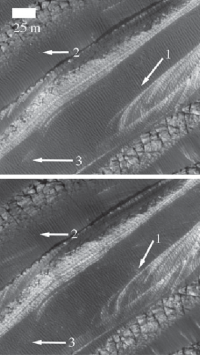
Images taken 1363 days apart.
In two different papers published in two different journals in the past month, scientists have concluded that — despite the thinness of the planet’s atmosphere — the dunes and sands of Mars are being continually shaped and changed by its winds. In both papers the data from which this conclusion was drawn came from high resolution images taken by the HiRISE camera on Mars Reconnaissance Orbiter.
What is especially interesting about this conclusion is that the climate models that had been developed for the Martian atmosphere, combined with wind measurements gathered by the various Martian landers, had all suggested that the kind of strong winds necessary to move sand were rare. To quote the abstract of the paper published on Monday in the journal Geology, Bridges, et al,
Prior to Mars Reconnaissance Orbiter data, images of Mars showed no direct evidence for dune and ripple motion. This was consistent with climate models and lander measurements indicating that winds of sufficient intensity to mobilize sand were rare in the low-density atmosphere.
Similarly, the second paper, Silvestro, et al, published on October 22 in Geophysical Research Letters, stated that
results from wind tunnel simulations and atmospheric models show that such strong wind events should be rare in the current Martian atmospheric setting.
Yet, both studies found significant evidence that such winds do occur on Mars, and are moving sand in many different places.
» Read more
New data says scientists must look underground for life on Mars.
More info on the engine failure of Phobos-Grunt, and what might still be done to save the mission.
Phobos-Grunt appears to be in trouble in Earth orbit.
In a posting to an online forum for the Phobos-Grunt mission, Anton Ledkov of the Russian Space Research Institute reported that there was “no telemetry” from the spacecraft.
Another report suggests that a variety of engine thrusters did not fire as planned.
Mars Express takes a close look at one of Mars’ giant volcanoes, Tharsis Tholus.
At least two large sections have collapsed around its eastern and western flanks during its four-billion-year history and these catastrophes are now visible as scarps up to several kilometers high. The main feature of Tharsis Tholus is, however, the caldera in its center. It has an almost circular outline, about 32 x 34 km, and is ringed by faults that have allowed the caldera floor to subside by as much as 2.7 km.
Russia heads for Mars: a detailed look at the Phobos/Grunt sample return mission, set to launch on November 8.
I really wish the Russians good luck with this project. Not only would it herald their return to planetary science since the fall of the Soviet Union, success here would break their long string of failures to the red planet. Though their unmanned planetary program had some remarkable achievements during the Soviet era, of the 19 missions they flew to Mars in the 1960s, 1970s, and 1980s, all were failures, producing almost no useful data.
The Mars rover Opportunity has spotted a geological formation not previously seen anywhere on Mars.