LRO spots Chinese lunar rover

Yutu-2 and Chang'e-4 on far side of Moon

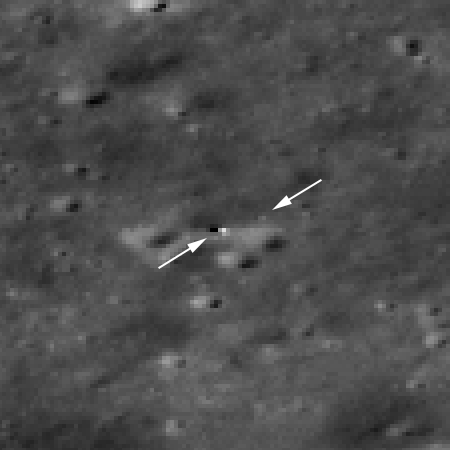
The Lunar Reconnaissance Orbiter (LRO) science team has now released a second and closer image of Chang’e-4’s location on the far side of the Moon, which now also shows the nearby rover Yutu-2.

The two arrows in the image to the right, cropped to post here, show both. The rover is the dot on the right, with the lander to the left, both just beyond the arrow tips. Both are very small, with Yutu-2 for example only two pixels across. Still, with both you can see their shadows, equally small, to the left of both bright dots. With sunlight coming from the right, all the craters, which are recessed, have their shadows on the right. The spacecraft, sticking up from the surface, have shadows going to the the left.

As Yutu-2 continues its travels, LRO will likely take more images, allowing us to track it even if the Chinese provide limited information.
1 comment

Chinese cubesat snaps picture of Earth and Moon from deep space

The Moon and Earth

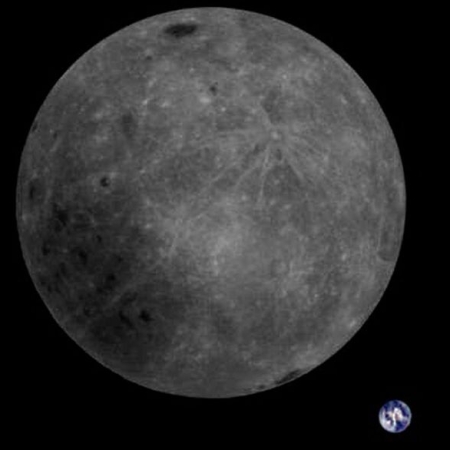
A interplanetary cubesat, Longjiang-2, launched with China’s communications relay satellite that they are using to communicate with Chang’e-4 and Yutu-2 on the far side of the Moon, has successfully taken a picture of both the Moon and Earth, as shown in the picture on the right.

Longjiang-2 is confirming what the MarCo cubesats proved from Mars, that cubesats can do interplanetary work.

And the picture is cool also. This was taken on February 3, when the entire face of the Moon’s far side is facing the Sun, illuminating it all. This timing also meant that the globe of the Earth would be entirely lit.

2 comments

LRO photographs Chang’e-4 on lunar surface

Chang'e-4 on the lunar surface

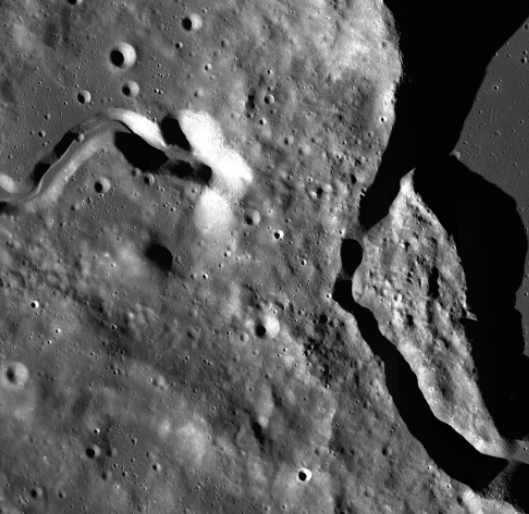
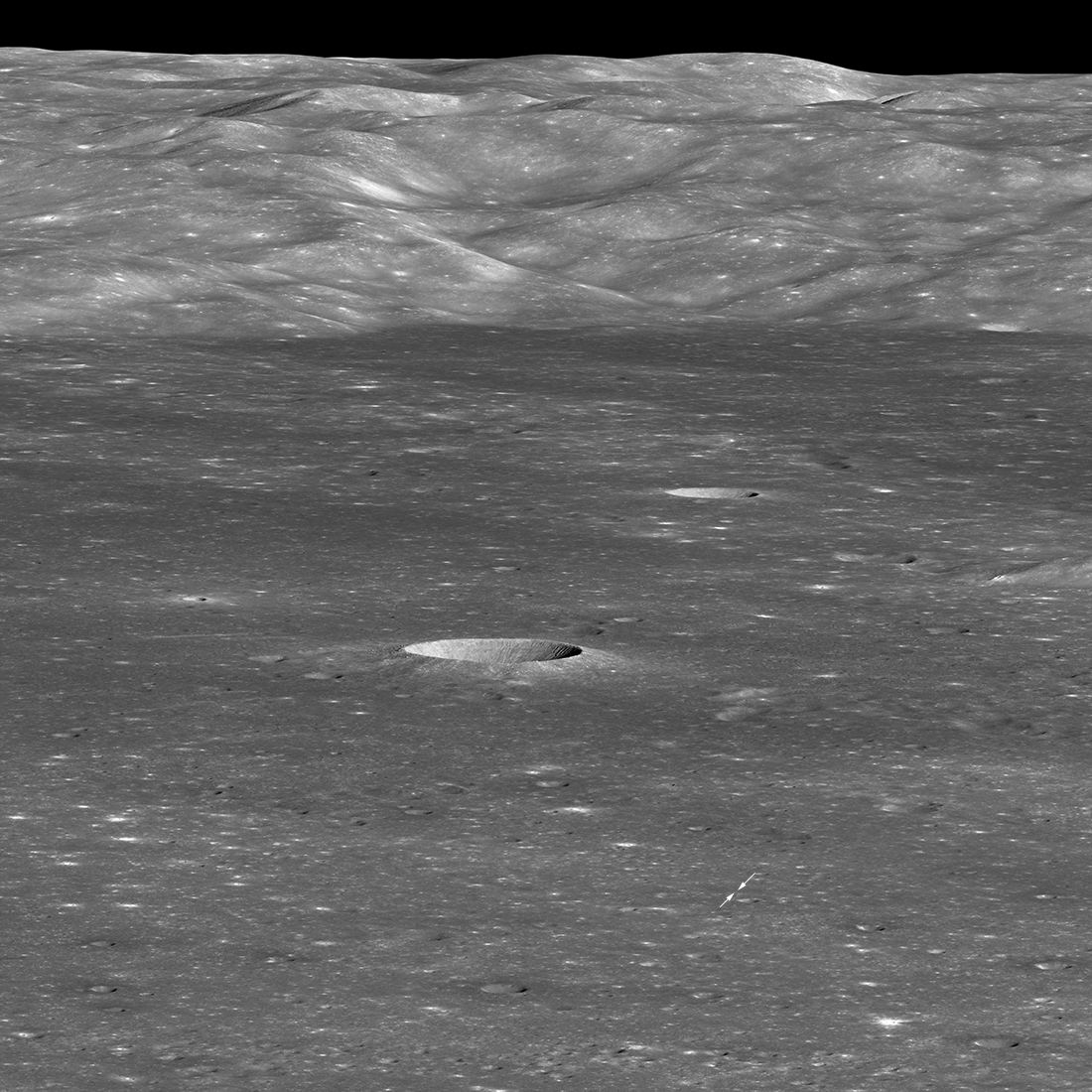
The Lunar Reconnaissance Orbiter (LRO) science team has released a spectacular oblique image that shows Chang’e-4 on the floor of Von Kármán crater.

Four weeks later (30 January 2019), as LRO approached the crater from the east, it rolled 70° to the west to snap this spectacular view looking across the floor towards the west wall. Because LRO was 330 kilometers (205 miles) to the east of the landing site, the Chang’e 4 lander is only about two pixels across (bright spot between the two arrows), and the small rover is not detectable. The massive mountain range in the background is the west wall of Von Kármán crater, rising more than 3000 meters (9850 feet) above the floor.

The image on the right has been reduced to post here. If you click on it you can see a larger version, but you need to download a very large file at the above link to see it at full resolution.

0 comments

Plato Crater on the Moon

Plato Crater's west rim

Cool image time! The Lunar Reconnaissance Orbiter (LRO) science team this week released a new high resolution image of the western rim of 63-mile-wide Plato Crater, located near the visible edge of the Moon’s near side. On the right is a slightly reduced version cropped to show the area of most interest.

Plato crater is prominent, yet from our vantage point on Earth we never truly see it as it is. That’s because it is located far enough north of the lunar equator (center latitude 51.62°N, center longitude 350.62°E) on the curving surface of the spherical Moon that it appears foreshortened. Plato is round like most other impact craters, but from Earth we see it as an oval aligned east to west.

A dark floor makes 101-kilometer-wide Plato crater stand out against a light-colored lunar highlands background. Plato crater is also prominent by association; the crater is located just north of 1145-kilometer-wide Mare Imbrium. A small part of this mare is visible at lower left in our Featured Image. Mare Imbrium is made up of many basalt layers laid down by violent volcanic episodes over a span of about 1.5 billion years. The basalts fill the Imbrium Basin, which a large asteroid or comet impact excavated about 3.85 billion years ago. When we look at a bright full Moon, round dark Mare Imbrium captures our gaze, then we see Plato crater, which is estimated to be about a hundred million years younger than the Imbrium Basin.

The western rim of Plato crater — visible on the east (right) side of our Featured Image — includes a 23.4-kilometer-wide slump block. The roughly triangular piece of rim broke free when an asteroid impact excavated Plato crater. Its eastern edge stands up to 1.4 kilometers above the crater’s dark floor. Part of the floor is visible in the image just above right center, east of the long shadow of the rim. [emphasis mine]

That block is thus 14.5 miles wide, and almost a mile high. I am trying to imagine what it was like when it broke off the rim and fell eastward into the crater floor. I am having trouble doing so.

Below is a image of the entire crater, with the area of the image above indicated by a white box. It shows clearly how this crater splashed into the basalt lava plain of Mare Imbrium.
» Read more

2 comments

Rock from Earth, found on Moon?

The uncertainty of science: Scientists studying rocks brought back by the Apollo 14 lunar mission have concluded that one sample originally came from the Earth, and if so would be the oldest known Earth rock.

It is possible that the sample is not of terrestrial origin, but instead crystallized on the Moon, however, that would require conditions never before inferred from lunar samples. It would require the sample to have formed at tremendous depths, in the lunar mantle, where very different rock compositions are anticipated. Therefore, the simplest interpretation is that the sample came from Earth.

The team’s analyses are providing additional details about the sample’s history. The rock crystallized about 20 kilometers beneath Earth’s surface 4.0-4.1 billion years ago. It was then excavated by one or more large impact events and launched into cis-lunar space. Previous work by the team showed that impacting asteroids at that time were producing craters thousands of kilometers in diameter on Earth, sufficiently large to bring material from those depths to the surface. Once the sample reached the lunar surface, it was affected by several other impact events, one of which partially melted it 3.9 billion years ago, and which probably buried it beneath the surface. The sample is therefore a relic of an intense period of bombardment that shaped the Solar System during the first billion years. After that period, the Moon was affected by smaller and less frequent impact events. The final impact event to affect this sample occurred about 26 million years ago, when an impacting asteroid hit the Moon, producing the small 340 meter-diameter Cone Crater, and excavating the sample back onto the lunar surface where astronauts collected it almost exactly 48 years ago (January 31–February 6, 1971).

The scientists also admit that their conclusion is controversial and will be disputed. If true, however, it suggests that there is significant material on the Moon from the early Earth that can provide a window into parts our planet’s history that are presently inaccessible.

2 comments

Moon hit by small meteorite during eclipse

During the lunar eclipse two days ago on January 20, 2018 amateur astronomers were able to record the impact of a small meteorite.

The MIDAS survey is a Moon-watching that scours video of its surface in the hopes of detecting the tiny flashes associated with meteorite impacts. In this case, MIDAS scored a home run, and it was the first time the system was able to spot an impact during a total lunar eclipse.

“In total I spent almost two days without sleeping, including the monitoring time during the eclipse,” [Jose] Madiedo explained to Gizmodo. “I was exhausted when the eclipse ended—but when the automatic detection software notified me of a bright flash, I jumped out of my chair. It was a very exciting moment because I knew such a thing had never been recorded before.”

The meteorite itself wasn’t terribly large, and is estimated to have only been around 22 pounds.

I have embedded the video of the impact below the fold. It is very short, and the flash is not very impressive, but it still is quite cool.
» Read more

3 comments

Planetary rover update: January 22, 2019

Summary: Curiosity begins journey off of Vera Rubin Ridge. Opportunity’s silence is now more than seven months long, with new dust storms arriving. Yutu-2 begins roving the Moon’s far side.

Before providing today’s update, I have decided to provide links to all the updates that have taken place since I provided a full list in my February 8, 2018 update. As I noted then, this allows my new readers to catch up and have a better understanding of where each rover is, where each is heading, and what fascinating things they have seen in the past few years.

These updates began when I decided to figure out the overall context of Curiosity’s travels, which resulted in my March 2016 post, Pinpointing Curiosity’s location in Gale Crater. Then, when Curiosity started to travel through the fascinating and rough Murray Buttes terrain in the summer of 2016, I stated to post regular updates. To understand the press releases from NASA on the rover’s discoveries it is really necessary to understand the larger picture, which is what these updates provide. Soon, I added Opportunity to the updates, with the larger context of its recent travels along the rim of Endeavour Crater explained in my May 15, 2017 rover update.

Now an update of what has happened since November!
» Read more

1 comment

Update on Chang’e-4 plant experiments

Link here. It appears the plant experiment has now run its course, designed as it was to end before the arrival of the first lunar night.

The experiment’s chief designer, Xie Gengxin of Chongqing University, told Xinhua that life inside the canister would not survive the lander’s first lunar night, which started on Sunday. The moon’s nighttime period lasts for about two Earth weeks.

It also appears that though the plant experiment included potato, cotton, and oilseed rape, only the cotton seeds spouted. China has only released a limited amount of information about this research, so to get further details we will likely have to wait for the published papers.

6 comments

Seeds sprout on Chang’e-4

The new colonial movement: The cotten seeds in a plant experiment on Chang’e-4 have now sprouted, becoming the first biological life to grow on the Moon.

On Tuesday, Chinese state media said the cotton seeds had now grown buds. The ruling Communist Party’s official mouthpiece the People’s Daily tweeted an image of the sprouted seed, saying it marked “the completion of humankind’s first biological experiment on the Moon”.

Fred Watson, Australian Astronomical Observatory’s astronomer-at-large, told the BBC the development was “good news”. “It suggests that there might not be insurmountable problems for astronauts in future trying to grow their own crops on the moon in a controlled environment. …I think there’s certainly a great deal of interest in using the Moon as staging post, particularly for flights to Mars, because it’s relatively near the Earth,” Mr Watson said.

Prof Xie Gengxin, the experiment’s chief designer, was quoted as saying in the South China Morning Post: “We have given consideration to future survival in space. Learning about these plants’ growth in a low-gravity environment would allow us to lay the foundation for our future establishment of space base.” He said cotton could eventually be used for clothing while the potatoes could be a food source for astronauts and the rapeseed for oil.

This experiment is actually a very big deal, as it is the first biological experiment, ever, to take place in a low gravity environment. All previous plant experiments in space have taken place in zero gravity, and thus failed to tell us anything about growth in a partial Earth gravity environment.

That the seeds have sprouted only tells us that they can. What we don’t know yet is if the low lunar gravity distorts their growth.

4 comments

LRO pinpoints Chang’e-4 landing site

LRO pinpointing Chang'e-4's location on Moon

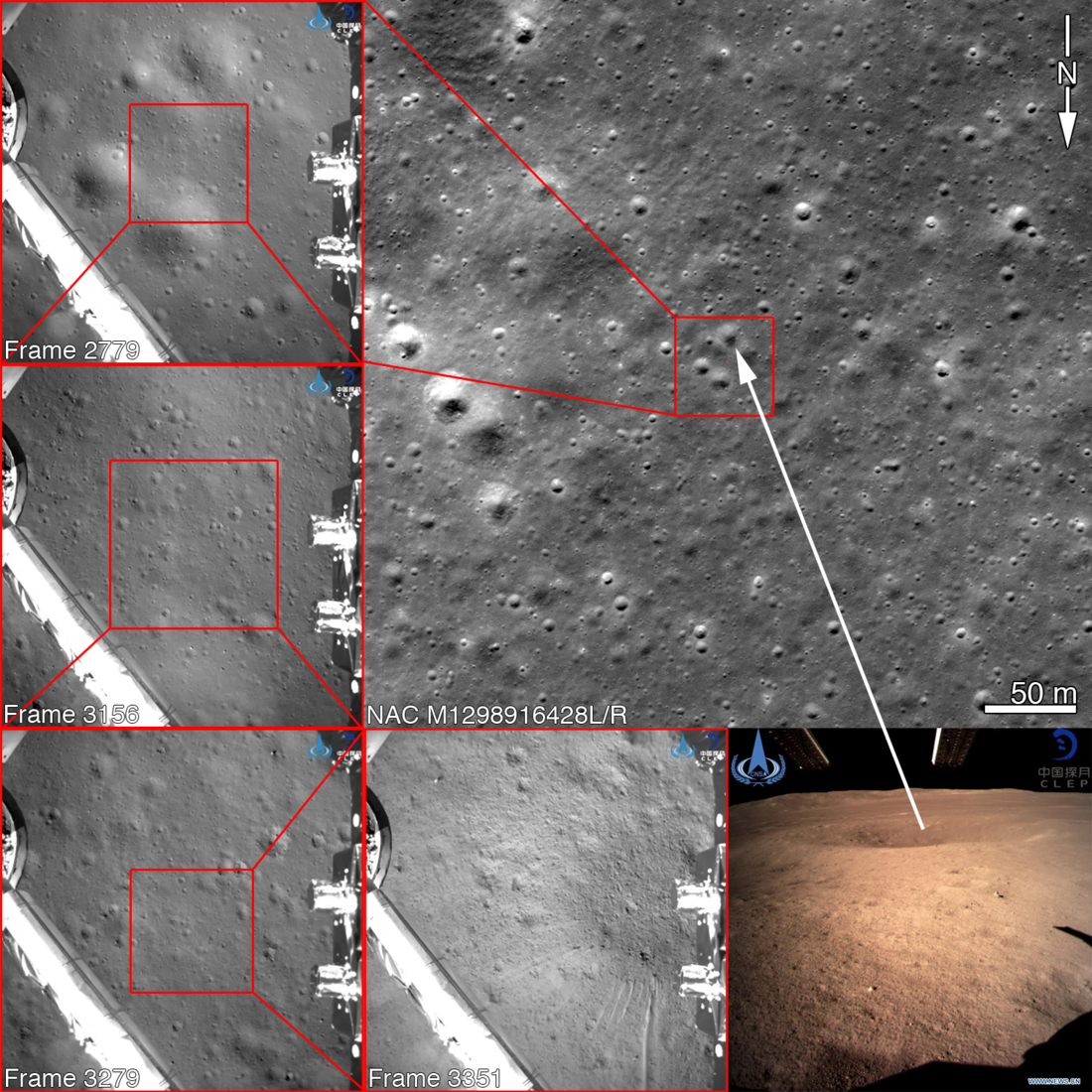
By referencing the footage released by China of Chang’e-4’s descent onto the Moon, the Lunar Reconnaissance Orbiter (LRO) team has been able to pinpoint exactly where the lander touched down. The image on the right has been reduced slightly. Click on it to see it in full resolution.

The largest nearby crater to the lander is estimated to be about 80 feet across.

Because the images were in December 2018 before the lander’s arrival, they do not show it. However, the LRO team now knows exactly where to look when they take new pictures in the next few weeks. Moreover, this will allow them to monitor Yutu-2’s travels as it roves the surface over the coming months.

10 comments

Chandrayaan-2 launch now scheduled for mid-April

The new colonial movement: India’s Chandrayaan-2 lander/rover mission to the south pole region of the Moon has now been re-scheduled for mid-April.

The launch date had to be pushed from the initially scheduled January-February window, as a few related tests could not be completed by the Indian Space Research Organisation (Isro). Isro chairman K Sivan told the media on Friday that the next available slot is during March-April, and the launch could take place by mid-April. However, if this window is passed, the prestigious mission will have to be pushed again to June.

The article also suggests that they have made some changes to the mission’s flight plan.

0 comments

Want to see a panorama of Chang’e-4 landing site? You can!

If you want a really good look at the Chang’e-4 landing site on the far side of the Moon — with Yutu-2 about thirty feet away — photographer Andrew Bodrov has produced a spectacular 360 degree panorama from images sent down by the lander.

This panorama reveals two things. First, the lander landed close to two small craters, which it thankfully missed. Second, there are some hills in the distance which I suspect are central peaks of Von Kármán crater. They are probably beyond Yutu-2’s range, but would make a worthwhile exploratory target.

Meanwhile, the rover and lander have come back to life after a brief hibernation to protect them from the heat of the lunar mid-day.

Finally, China has released a video showing Chang’e-4’s descent and landing, which I have embedded below the fold. In it, you can see the spacecraft computer maneuver to land between those two craters shown in the panorama.
» Read more

1 comment
1 62 63 64 65 66 94