SpaceX to name on Monday its first customer for BFR flight around Moon

Capitalism in space: In a tweet SpaceX announced that it will name on Monday its first customer for flight around Moon, using its Big Falcon Rocket rather than the Falcon Heavy as previously announced.

There will be a lot of speculation over the next few days, but we must remember that the BFR is years away from launch, so nothing here is either set in concrete, nor even likely to happen.

24 comments

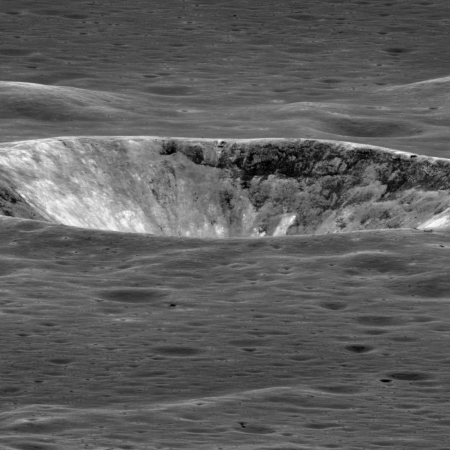
Oblique view of lunar crater

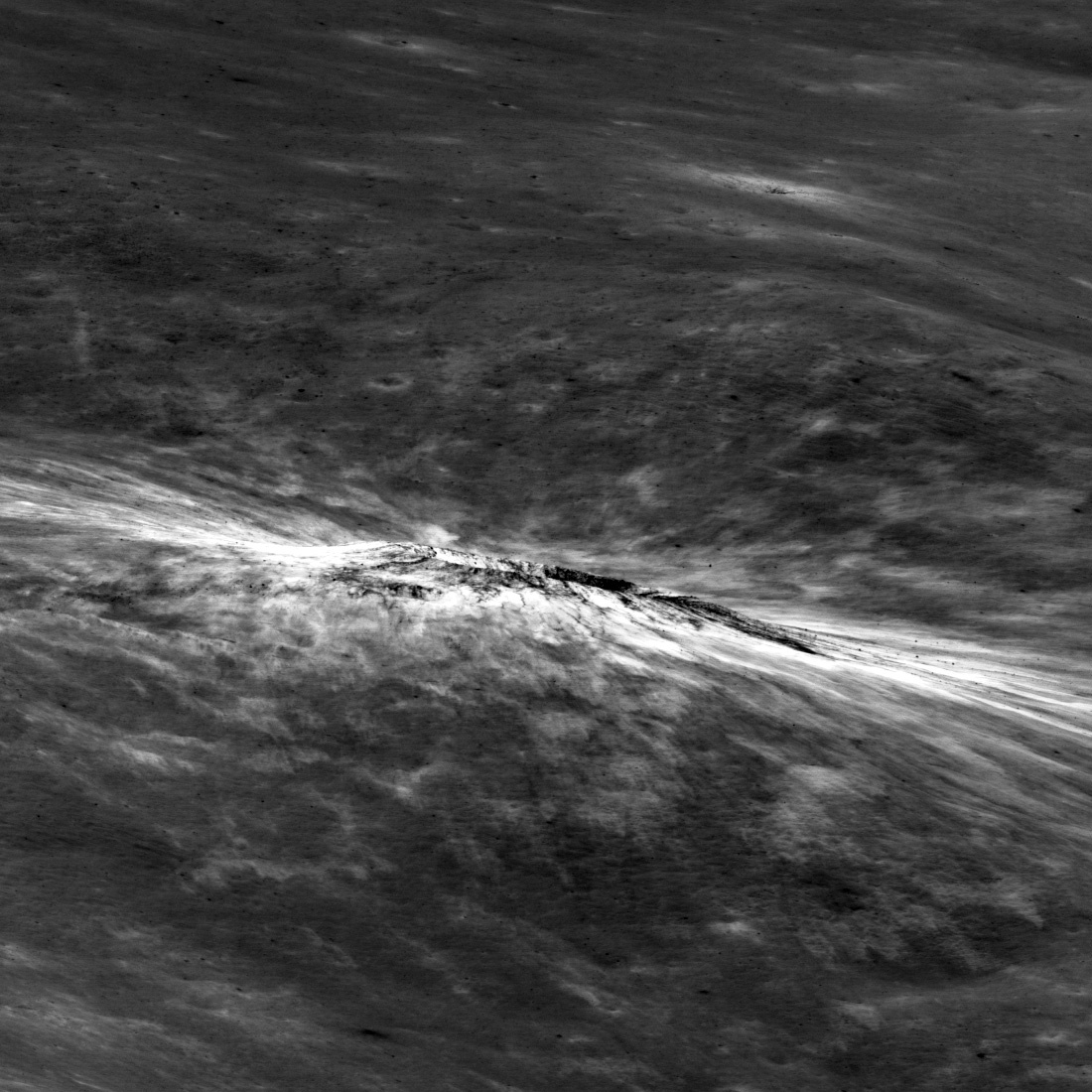
Wallach Crater

Cool image time! The Lunar Reconnaissance Orbiter (LRO) science team this week released an image showing Wallach Crater as seen from the side. The image on the right is a section of that image and has been reduced to show here. The full image of 3.5-mile-wide crater and its surrounding terrain can be explored at the link. From the link:

Wallach crater (4.89Β°N, 32.27Β°E) formed within a thin layer of black basaltic lava flows that overlie much brighter anorthositic material. Think of a white cake with chocolate icing. When the asteroid (or comet) impacted this “iced cake”, ejecta from deeper portions (white cake, or rather brighter anorthosite) was thrown out onto the icing (darker basalt) resulting in intermediate tones where the two materials mixed.

The dark streaks seen inside the crater are blocks of the icing (basalt) breaking off and creeping down slope. The fact that the deepest material lands on top of the shallowest material (known as inverted stratigraphy) was first described by Gene Shoemaker from his pioneering observations at Meteor Crater, Arizona. This effect simplifies sampling the local geology in three dimensions. As an astronaut traverses towards the rim of a crater, the rocks underfoot come from deeper and deeper within the crater. The rocks at the rim are from the deepest portions of the crater!

It is especially interesting to use the viewer at the link to see the surrounding terrain, which includes two other craters that are far less distinct.

2 comments

Lunar scientist Paul Spudis had passed away

R.I.P.: Paul Spudis, lunar scientist and strong advocate for the human exploration of space, passed away yesterday at the age of 66.

Spudis was one of the best lunar scientists we have had. He also saw past petty budget battles and his personal planetary research to recognize the need for human exploration and settlement on the Moon and elsewhere. This is a premature loss for us all.

Leonard David at Space News has written a fine obituary, which gives only a hint at how important Spudis was to the recent resurgence of the U.S. in the exploration of space.

5 comments

Swooping over a lunar cold spot

cold spot crater

Cool image time! The oblique image on the right, reduced and cropped to show here, was taken by Lunar Reconnaissance Orbiter (LRO) of an unnamed crater on the Moon’s far side. (Click on the image to see the full picture.) What makes the crater of particular interest is that it during the long 14-day-long lunar night the area around this young crater quickly cools to a temperature about 10 degrees Fahrenheit colder than the surrounding terrain.

Einthoven cold spot crater, the subject of today’s Featured Image, is 1143 m wide, or about the size of Meteor Crater in Arizona. So far, it has no official name β€” we call it Einthoven cold spot crater because it is just south of Einthoven crater, which is old, degraded, and, at 69 kilometers in diameter, the largest crater in the neighborhood.

Though craters associated with cold spot anomalies are small, the cold spots themselves are often large. The Einthoven cold spot crater anomaly takes in 2070 square kilometers of terrain and extends up to 50 kilometers from the crater. That’s much too large an area for ejecta from the crater to cover, which eliminates the most obvious cold spot formation hypothesis: that material blasted from the crater during its formation could create the cold spot.

So, how to explain the cold spot anomalies? Some researchers invoke a cascading series of tiny secondary impacts traveling outward from the crater-forming asteroid impact, while others believe that gas produced by the impact flows through the top layer of lunar surface material. Either process might “fluff up” the surface, changing the way heat affects it. Few researchers, however, find these explanations to be 100% convincing.

Though the abstract of one science paper proposes using these cold spots as an easy way to quickly identify young lunar craters, the actual cold area of this particular crater does not correspond perfectly to the crater itself. The temperature map at the link shows that the colder region is not even centered on the crater, and has a very irregular shape. Using these mysteriously cold regions on the Moon to identify young impacts I think will be difficult and will have a very large margin of error.

1 comment

New analysis strengthens evidence of water in lunar polar craters

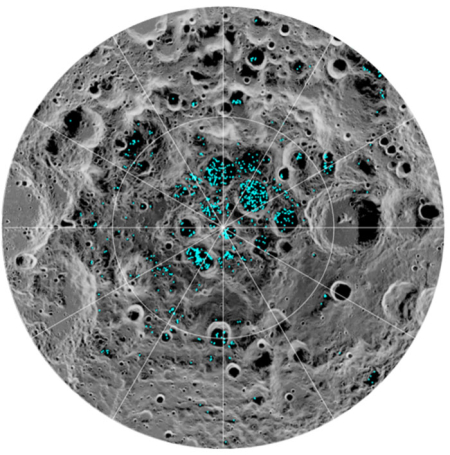
ice signatures in lunar south pole craters

The uncertainty of science: Scientists using data from India’s Chandrayaan-1lunar orbiter today claimed that they have confirmed water in the Moon’s polar craters.

A team of scientists, led by Shuai Li of the University of Hawaii and Brown University and including Richard Elphic from NASA’s Ames Research Center in California’s Silicon Valley, used data from NASA’s Moon Mineralogy Mapper (M3) instrument to identify three specific signatures that definitively prove there is water ice at the surface of the Moon.

M3, aboard the Chandrayaan-1 spacecraft, launched in 2008 by the Indian Space Research Organization, was uniquely equipped to confirm the presence of solid ice on the Moon. It collected data that not only picked up the reflective properties we’d expect from ice, but was able to directly measure the distinctive way its molecules absorb infrared light, so it can differentiate between liquid water or vapor and solid ice.

Most of the newfound water ice lies in the shadows of craters near the poles, where the warmest temperatures never reach above minus 250 degrees Fahrenheit. Because of the very small tilt of the Moon’s rotation axis, sunlight never reaches these regions.

The image on the right shows the craters surrounding the south pole with water ice signatures, according to this new analysis.

This press release has some puzzling aspects. First, it is almost a decade since this data was gathered. Why is this suddenly reported now, just prior to the launch of Chandrayaan-2? I suspect this release has come out now to garner some PR for that new mission.

Also, there is nothing in this release that explains why these results should be considered more certain than previous results. In fact, previous data from different lunar orbits has been somewhat contradictory, suggesting a lot of uncertainty about the presence of water-ice at the lunar poles that this story does not address or alleviate in any way.

Nonetheless, this new analysis and data adds more weight to the possibility of water near the lunar poles, making that real estate a prime target for future bases. Too bad it is China that is aiming to grab this territory, while NASA wants us to circle the Moon in LOP-G, going nowhere.

5 comments

China unveils next lunar rover

The new colonial movement: In unveiling its next lunar rover, China today also announced they will hold a contest to name it.

Images displayed at Wednesday’s press conference showed the rover was a rectangular box with two foldable solar panels and six wheels. It is 1.5 meters long, 1 meter wide and 1.1 meters high.

Wu Weiren, the chief designer of China’s lunar probe program, said the Chang’e-4 rover largely kept the shape and conditions of its predecessor, Yutu (Jade Rabbit), China’s first lunar rover for the Chang’e-3 lunar probe in 2013. However, it also has adaptable parts and an adjustable payload configuration to deal with the complex terrain on the far side of the moon, the demand of relay communication, and the actual needs of the scientific objectives, according to space scientists.

Like Yutu, the rover will be equipped with four scientific payloads, including a panoramic camera, infrared imaging spectrometer and radar measurement devices, to obtain images of moon’s surface and detect lunar soil and structure.

The Chang’e-4 lunar probe will land on the Aitken Basin of the lunar south pole region on the far side of the moon, which is a hot spot for scientific and space exploration. Direct communication with the far side of the moon, however, is not possible, which is one of the many challenges for the Chang’e-4 lunar probe mission. China launched a relay satellite, named Queqiao, in May, to set up a communication link between the Earth and Chang’e-4 lunar probe.

I am not sure what they mean by “adaptable parts and an adjustable payload configuration.” That sounds like they upgraded this rover’s design to allow them to use it to build many similar rovers for use elsewhere, not just on the Moon. This sounds good, but the conditions on other planets are so different I’m not sure a direct transfer of the rover will work very well.

Chang’e-4’s launch is presently scheduled for December.

4 comments

Aristarchus Crater on the Moon

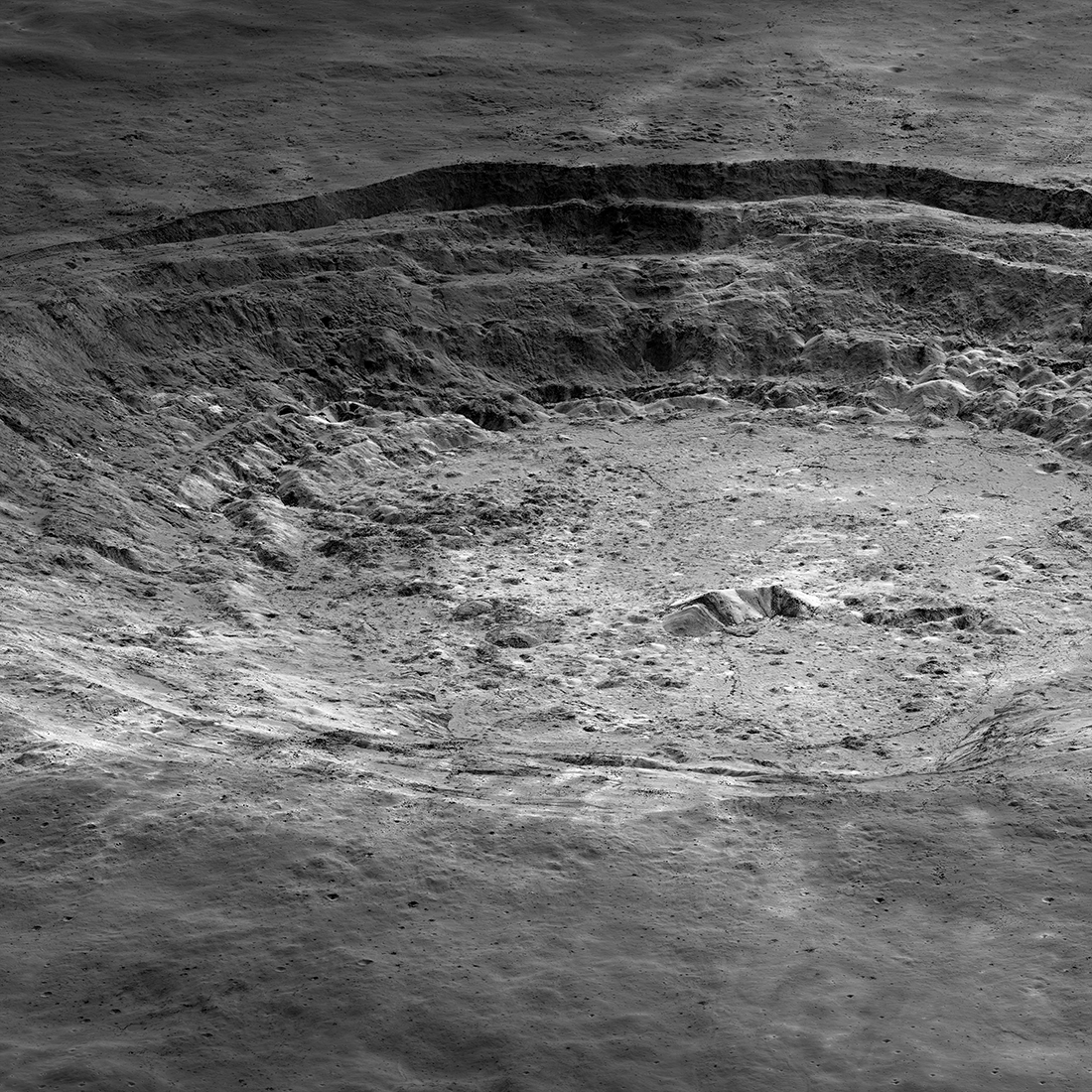
Aristarchus Crater

Cool image time! The image on the right, reduced in resolution to post here, shows Aristarchus Crater, one of the more geological intriguing locations on the Moon. This oblique image was taken by Lunar Reconnaissance Orbiter (LRO), still operating in lunar orbit. If you click on the image you can see the full resolution image.

Aristarchus crater is 40 kilometers (25 miles) in diameter and 2700 meters (1.7 miles) deep, with a central peak that rises 300 meters (almost a thousand feet) above the crater floor. When LRO pointed back towards the Sun, LROC was able to capture this magnificent view highlighting subtle differences in albedo (brightness). Some of the albedo contrast is due to maturity (young material is generally brighter than older material) and some reveal true differences in rock type. The central peak shows the complexity of what lies beneath the now hardened impact melt sea that filled the bottom of the crater.

The best part however is the close-up they provided of the crater’s central peaks, posted below.
» Read more

11 comments

Chandrayaan-2 delayed again, until January 2019

The new colonial movement: ISRO, India’s space agency, has revealed that the launch of its lunar rover/lander Chandrayaan-2 has been delayed from October to Janaury 2019.

Dr M Annadurai, Director of U R Rao Satellite Centre confirmed to NDTV that the launch date for Chandryaan-2 “is slipping to 2019” from the initially planned launch in October this year.

Dr Annadurai said that India’s moon mission now aims to land in February and the rocket launch will take place in January next year.

Moreover, since the weight of the Chandrayaan-2 satellite has increased, Dr Annadurai said that now instead of GSLV MK-II, GSLV MK-III will be used. Geo-synchronous Satellite Launch Vehicle MK-III (GSLV MK-III), also called the ‘The Bahubali’, is India’s heaviest rocket that weighs nearly 640 tons and will be used to hoist the Chandrayaan-2 satellite from India’s rocket port at Sriharikota.

It appears that in building the spacecraft they have not been able to keep its weight low enough, and have been forced to switch launch vehicles, with this switch causing the delay.

The article also provides a tidbit of information about the GLSV MK-III rocket, that they have an real name for it, Bahubali. If so, they should use it. It sells much better than GLSV MK-III.

4 comments

Chinese officials quite rightly dismiss LOP-G

At a science workshop in Europe this week Chinese space officials made it clear that they found the concept of NASA Lunar Orbiting Platform-Gateway (LOP-G) to be unimpressive and uninteresting.

Moreover, they said that while it appears we will be delaying our landings on the Moon for at least a decade because of LOP-G, they will be focused on getting and building a research station on the surface, right off the bat.

Overall, Pei does not appear to be a fan of NASA’s plan to build a deep space gateway, formally known as the Lunar Orbital Platform-Gateway, at a near-rectilinear halo orbit. Whereas NASA will focus its activities on this gateway away from the Moon, Pei said China will focus on a “lunar scientific research station.”

Another slide from Pei offered some thoughts on the gateway concept, which NASA intends to build out during the 2020s, delaying a human landing on the Moon until the end of the decade at the earliest. Pei does not appear to be certain about the scientific objectives of such a station, and the deputy director concludes that, from a cost-benefit standpoint, the gateway would have “lost cost-effectiveness.”

The Chinese are right of course. LOP-G is merely a fake project to justify SLS and Orion, designed not to explore space but to provide Congress a jobs program on Earth. It will hand the Moon to China, while we dither in lunar orbit.

27 comments

A weird lunar lava field

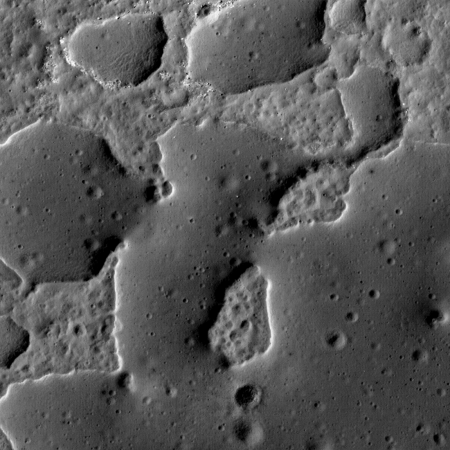
Weird terrain at Ina on the Moon

Cool image time! The image on the right, reduced and rotated 180 degrees to post here, comes from a recent release for Lunar Reconnaissance Orbiter (LRO). It shows a flow of lava that partly covers an older terrain.

Some scientists propose that Ina formed as very young (less than 100 million years) volcanic eruptions because only a few larger impact craters (>20 m) have formed on its surface. Others believe it is quite ancient (3.5 billion years), possessing highly unusual physical properties that stifle the formation of normal impact craters. At least everybody agrees it was formed as basalt was erupted to the surface! But how and when Ina formed remains open.

Ina’s morphology is so unusual that it is easy to see inverted topography – that is, craters appear as bubbles rather than bowls! Think of Ina as a cast iron frying pan with freshly poured pancake batter; the wiggly textured material is the frying pan and the bulbous smoother mounds are the batter.

The image to the right has been rotated 180 degrees so that my mind at least can see it with the craters as bowls and the uplifted smooth lava as uplifted. If this doesn’t work for you, click on the link and look at the original image.

While some scientists think the lava flows are recent, no one knows at present the origins of the rougher terrain that the lava has partly obscured.

6 comments

Israel’s former Google Lunar X-Prize contestant to launch in 2018

Capitalism in space: Despite a failure of all contestants to to win the Google Lunar X-Prize, Israel’s competitor announced today that they still plan to launch, and will do so in December of this year.

The SpaceIL spacecraft will be launched from the United States on a Falcon 9 orbital launch vehicle, built by Elon Musk’s Space Exploration Technologies Corporation, or SpaceX. At a press conference on Tuesday, SpaceIL representatives announced that the unmanned lunar landing craft will be transferred to the US in November, with a launch date in December.

According to SpaceIL, the unmanned space vessel will reach the moon and complete the lunar landing on February 13th next year.

They say the lander will plant an Israeli flag on the Moon, but the images at the link, as well as the announcement, suggests that the lander will no longer have the ability to rove, as required for the X-Prize. It appears to me that they have simplified the mission in order to fly it quickly and gain the public relations such a flight will give them.

4 comments

Chang’e-4 launch set for December

China has now scheduled the launch of its Chang’e-4 lunar rover/lander, aimed for the first landing on the Moon’s far side, for sometime this coming December.

They will use China’s Long March 3B rocket, not the bigger Long March 5. As is usual for China, many details about the mission remain secret. The exact landing area has not been announced, other than somewhere in the very large South Pole/Aitken Basin area. The exact date has not been announced, other than sometime in December.

Their planned sample return mission, Chang’e-5, is now set for launch in 2019, “should the Long March 5 rocket be proven ready for flight later this year.”

1 comment
1 65 66 67 68 69 94