India wants international instruments for its Venus mission

The new colonial movement: India has requested science instruments proposals from the international community for its planned Venus orbiter, set to launch in 2023.

ISRO has already selected 12 instruments, proposed by Indian scientists, including cameras and chemical analyzers to study the atmosphere. Now, it’s hoping other scientists will join. “Planetary exploration should be all about global partnerships,” says Kailasavadivoo Sivan, a rocket scientist and ISRO’s chair. (The deadline for submitting proposals is 20 December.)

For me, the big news with this article is that it is the very first I have seen that actually spells out Sivan’s first name. Since he became head of ISRO in January 2018, he has only been listed as “K. Sivan” in every single article, even those describing his background when he was appointed. Now that I have learned what a tongue-twister that first name is, I can understand why they abbreviate it.

On a more serious note, this article indicates the growing maturity of India’s space effort. They not only are planning a mission to Venus, they will fly missions to the Moon in January and Mars in 2022, and intend to launch their first manned mission in that same time period.
0 comments

A young lunar impact crater

Lunar crater

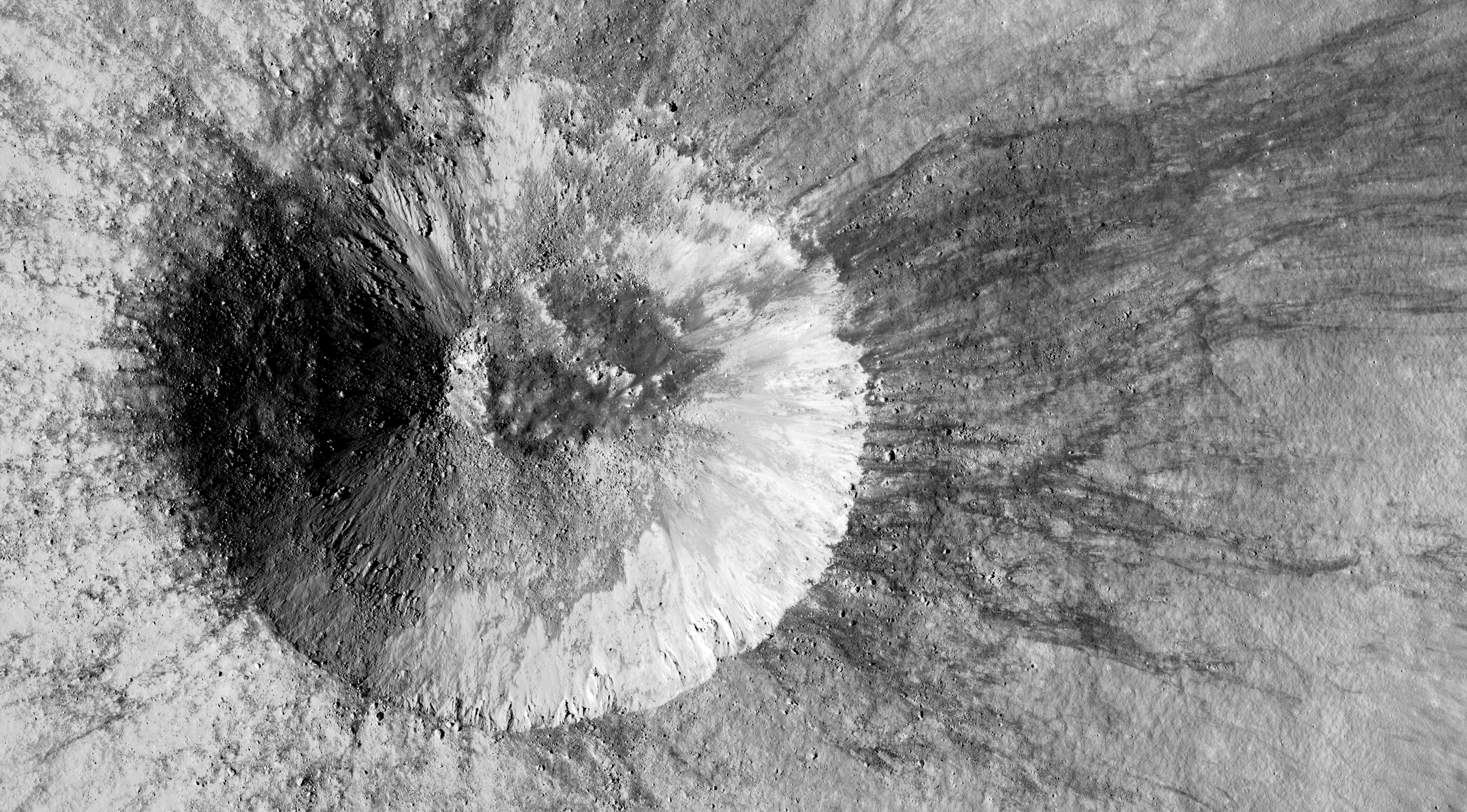
Cool image time! The science team from Lunar Reconnaissance Orbiter (LRO) today released a new image, taken on November 3, 2018, of a relatively young small crater not easily seen from Earth.

The unnamed crater, just 1.8 kilometers across, is too small to see from Earth with unaided eyes. It is in the Moon’s wild west, just past Oceanus Procellarum and close to the line dividing the nearside from the farside, so it would be hard to glimpse in any case. If you stood on the crater rim, you would see the Earth forever slowly bobbing up, down, and sideways close to the eastern horizon.

The image above is a cropped and reduced-in-resolution section of the released image. If you click on it you can see this section at full resolution.

What I find fascinating about this crater are the black streaks that appear to only run down the outside slopes of the eastern rim, but nowhere else. At first glance it looks like prevailing winds, blowing from the west, caused this, but of course that’s wrong because the Moon has no atmosphere. The website explains:
» Read more

1 comment

NASA to hire private lunar probes for future missions

Capitalism in space: Rather than build its own future lunar landers and rovers, NASA is now planning to hire these services from private companies, with missions flying as soon as 2021.

Under a program called Commercial Lunar Payload Services (CLPS), NASA would buy space aboard a couple of launches a year, starting in 2021. The effort is similar to an agency program that paid private space companies such as Elon Musk’s SpaceX to deliver cargo to the International Space Station (ISS). “This a new way of doing business,” says Sarah Noble, a planetary scientist at NASA headquarters in Washington, D.C., who is leading the science side of NASA’s lunar plans.

Scientists are lining up for a ride. “It really feels like the future of lunar exploration,” says Erica Jawin, a planetary scientist at the Smithsonian Institution’s National Museum of Natural History in Washington, D.C. She and other attendees at the annual meeting of the Lunar Exploration Analysis Group in Columbia, Maryland, last week were eager to show NASA why their small experiments would be worthy hitchhikers on the landers.

Several companies, including Astrobotic, Moon Express, and iSpace, are vying to establish a commercial moon market. Buying rides to the moon from launch providers like Rocket Lab, each firm hopes to become the go-to carrier for other companies seeking to prospect the moon for rocket fuel ingredients, or to gather rocks to sell for study. But a contract with NASA is the real prize. Moon Express, for example, has designed the MX-1, a lander roughly the size and shape of Star Wars’s R2-D2. But, “We won’t pull the trigger until we know we have a CLPS award,” says Moon Express CEO Robert Richards in Cape Canaveral, Florida.

The companies selected for CLPS must deliver at least 10 kilograms of payload by the end of 2021, NASA says. It is scrambling to find instruments that are ready to fly. “What do you have sitting on shelf now that you can throw onto the mission immediately?” Noble says. “We’re looking for flight spares, engineering models, student-built projects. It’s a little bit of a weird call for us.” The agency is planning to pay up to $36 million to adapt eight to 12 existing scientific instruments to the initial small landers; by the middle of next decade it aims to build a pipeline of instruments for bigger landers that might also carry rovers.

These are going to small missions with limited lifespans and limited abilities. They will however be cheap, fast, and many. In the end I am certain NASA (and the taxpayer) will get far more bang for the buck.

2 comments

The fractured floor of Komarov Crater

Fractured floor of Komarov Crater

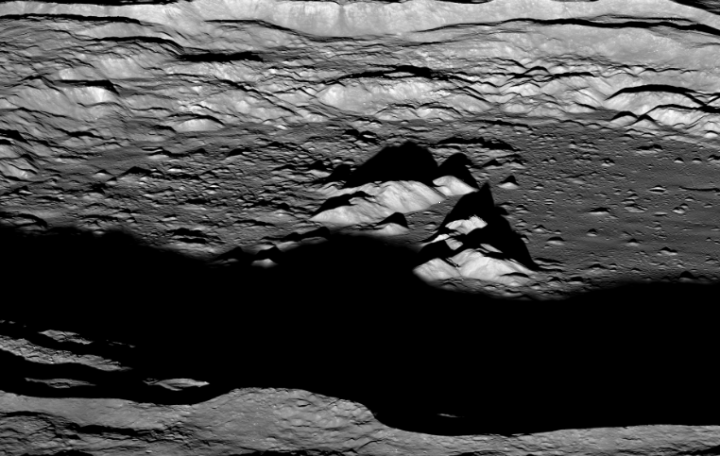
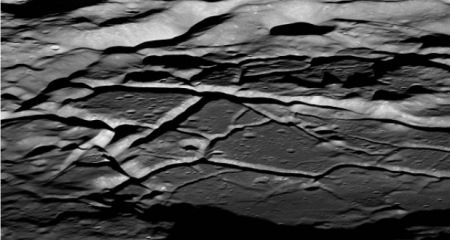
Cool image time! The Lunar Reconnaissance Orbiter (LRO) oblique image on the right, reduced significantly from the original to post here, shows the deeply fractured floor of Komarov Crater on the Moon’s far side. As noted at the image link,

The spectacular fractures that cut across the floor of Komarov crater [about 85 kilometers or 50 miles diameter] were formed when magma rose from the mantle, uplifting and fracturing the crater in the process. In this case the magma did not erupt to the surface, thus the fractures remain visible.

The Komarov fractures are quite large, the major left-to-right fracture that cuts across the center of the scene is over 500 meters deep [1,600 feet] and 2500 meters wide [1.5 miles]. When did they form? The large number of craters superimposed on the floor and fractures testifies to their ancient ages. Likely they are of the same vintage (>2.6 billion years) as the Mare Moscoviense lava plains just to the north

An overview of Komarov Crater as well as other LRO images of it can be found here.

The question that comes to my mind is the relative rarity of craters with such large fractures on their floors. I have noted this for Mars as well. It is expected that there is melt on the floor of all large impact craters. Why do a few produce such pronounced fractures, while most do not? This website posits one explanation, but its complexity leaves me unsatisfied. It also doesn’t explain why it happens only rarely.

1 comment

Another private lunar rover unveiled

Capitalism in space: The private start-up company Lunar Outpost today unveiled its tiny 10 kilogram (22 pound) rover, designed to map lunar resources.

The first Prospector was demonstrated driving and drilling in Lunar regolith simulant at the Colorado School of Mines’ new Lunar testbed facility in the Earth Mechanics Institute overseen by the Center for Space Resources. This event marks the first commercial Lunar Prospector publicly tested in the United States.

Evidence of valuable resources on the Lunar surface, such as water, precious metals, and helium-3 have been established by remote sensing on flyby missions around the Moon. This scientific data has been used to create general resource models of the Lunar surface, which now require ground-truthing to establish optimal landing sites and plan future resource extraction operations. Groups of Lunar Outpost Prospectors will map the surface and subsurface resources of the Moon, while autonomously navigating along waypoints and avoiding hazards such as large rocks and craters. These Prospectors can also be teleoperated if needed and can utilize NASA’s Lunar Orbital Platform-Gateway concept as a center of operations.

This is a tiny inexpensive rover, essentially an upgraded drone. Very smart, and efficent. Below the fold is the company’s video of this demo test. The drilling capability is especially impressive.

Their website does not say how much they will charge for this rover, but they also note that it has 5 kilograms of cargo capacity, meaning that they can also offer this to customers.
» Read more

12 comments

An update on China’s Chang’e-4 lunar lander

Link here. Chang’e-4 is set to land on the far side of the Moon, sometime in December. The article provides some additional details, including information about the likely landing site in Von Kármán crater. It also notes that there are three launches planned at the spaceport prior to the December launch, and that any issue on any of those launches could delay Chang’e-4’s lift-off. .

1 comment

The central peaks of Copernicus crater

Central peaks of Copernicus Crater

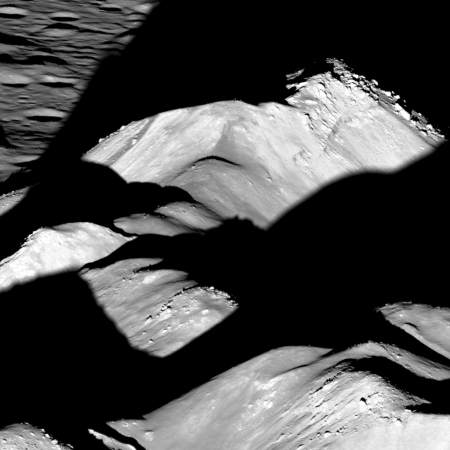
Cool image time! Lunar Reconnaissance Orbiter science team has released a new image of the central peaks of Copernicus Crater, shown on the right cropped and reduced in resolution.

Copernicus (9.62°N, 339.92°E), which is easily seen with a moderately powerful backyard telescope, is one of the best-known craters on the Moon. Despite its age (around 860 million years), it is well preserved with over 4000 meters of relief from floor to rim, and the tallest of its central peaks rises approximately 1300 meters above the crater floor. This image, centered on the central peaks, was captured just after dawn (86° incidence angle) as the Lunar Reconnaissance Orbiter slewed west to a 67°angle.

The image is similar to one taken back in 2012, but has a higher resolution because it was shot from 50 miles elevation instead of 75.

This crater was also the subject of one of the first breath-taking images ever taken of the Moon from lunar orbit, by Lunar Orbiter in November 1966.

The wider view taken by LRO gives some context for the image above. The peaks shown in closeup here are part of the lower right grouping. If you go to the first link above you can zoom in and explore all parts of the full image, and see some quite amazing details, including the large boulders scatter throughout the hollows between the peaks.

Copernicus Crater

2 comments

NASA signs agreement to work with SpaceIL’s privately built lunar rover

Capitalism in space: NASA, the Israeli space agency, and the private Israeli space company SpaceIL have signed a cooperative agreement to work together when SpaceIL’s privately built lunar rover is launched to the Moon in December.

NASA will contribute a laser retroreflector array to aid with ground tracking and Deep Space Network support to aid in mission communication. ISA and SpaceIL will share data with NASA from the SpaceIL lunar magnetometer installed aboard the spacecraft. The instrument, which was developed in collaboration with the Weizmann Institute of Science, will measure the magnetic field on and above the landing site. The data will be made publicly available through NASA’s Planetary Data System. In addition, NASA’s Lunar Reconnaissance Orbiter will attempt to take scientific measurements of the SpaceIL lander as it lands on the Moon.

This agreement is the first step in the transition from having the government build planetary probes to it becoming a customer, buying these probes from private companies that build them for profit.

0 comments

Celebrate Earthrise Day!

In only a little less than three months we will be celebrating the fiftieth anniversary of the December 1968 flight of Apollo 8 — first manned mission to another world. During that mission three humans spent 20 hours in orbit around the Moon, during which they read the first twelve verses of the Old Testament on Christmas Eve and became the first humans to witness an Earthrise and to photograph it.

To celebrate that achievement, a new website has been created, dubbed Celebrate Earthrise Day.

The website provides some great background material. You can listen to the astronaut’s Christmas telecast as well as see a recreation of the moment when the astronauts saw that Earthrise and Bill Anders took his famous color photo. The site also includes many photos from before, during, and after the mission, with many pictures coming from the personal family pictures of the astronauts. There is also audio of an 1988 Bill Anders’ interview, as well as a video of a fascinating presentation made by Bill and Valerie Anders, describing their life journey leading up to Apollo 8 and afterward.

Finally, and I think of most interest to my readers here, the site includes the audio of my introduction from the new audio edition of my book, Genesis: the Story of Apollo 8.

The site also includes the audio of one of the best radio interviews I have ever done, broadcast in 1998, on the subject of Apollo 8, our American culture, and the importance of each person choosing their path in life wisely. You can find that audio at the bottom of this webpage.

Check it all out. I think you will find it worth your while.

20 comments

Mountains on the Moon

Mountains on the Moon

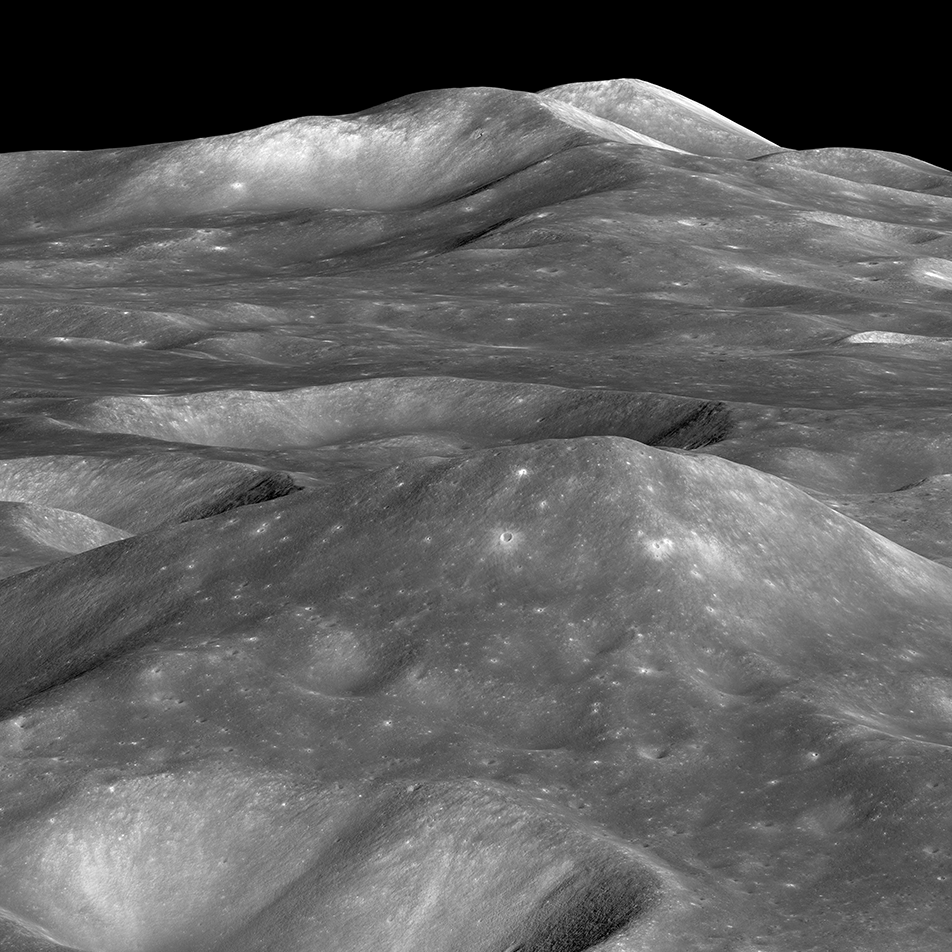
Cool image time! The image on the right, reduced slightly to post here, shows several high mountains on the far side of the Moon. If you click on the image you can see it at full resolution.

The summit of the unnamed peak in the foreground (50.2° S, 236.6° E) has an elevation of 6710 meters, about 7000 meters (about 23,000 feet) of relief relative to the low point at the bottom of the image. The two peaks on the horizon, 200 kilometers in the distance (about 125 miles), have summit elevations of 4320 meters (14,200 feet) and 4680 meters (15,350), respectively and both rise more than 6000 meters (almost 20,000 feet) above their surroundings.

In the Lunar Reconnaissance Orbiter (LRO) science team release in June, they noted that the high peak here is actually taller than Denali (Mount McKinley), the highest peak within the U.S. And it has no name. They also note that the peak is likely 4 billion years old, and has experienced extensive erosion in that time, meaning that it is also likely shorter than it once was.

I don’t have anything to add, other than this would be an amazing place to put up a resort, with trails taking you to the top of the mountains. In the lighter gravity, the hike would actually be somewhat easy, even wearing a spacesuit. And you wouldn’t have to worry about a thinning atmosphere as you climbed higher, as you do on Earth. You’d be carrying it with you.

5 comments
1 64 65 66 67 68 94