Analysis of Chang’e-6’s lunar samples suggest the giant impact that caused Aitken Basin occurred 2.83 billion years ago

Chang'e-6's landing site
Click for original image of Chang’e-6 on the Moon

In a paper published in mid-November, Chinese scientists have concluded that — based on their analysis of the lunar samples returned by their Chang’e-6 spacecraft — the giant impact that created the 1,600-mile-wide South Pole-Aitken Basin on the Moon occurred about 2.83 billion years ago.

This conclusion is based both on the dating of the samples as well an analysis of the cratering rate on the Moon. It also suggests the landing site as well as Aitken basin were volcanically active for longer than previous predictions. Overall, scientists believe most volcanic activity on the Moon ceased around three billion years ago.

As noted in the paper, the near and far sides of the Moon are very different.

The Moon has a global dichotomy, with its near and far sides having different geomorphology, topography, chemical composition, crustal thickness, and evidence of volcanism. Volcanic eruptions flooded parts of the surface with lava, producing rocks known as mare basalts, which are more common on the nearside (4), where they cover ~30% of the surface compared to 2% of the farside.

The farside’s crust is also thicker, though under Aitken Basin the difference largely disappears.

This first precise dating for the far side is the first step for understanding why the Moon’s hemispheres are so different. Though many theories exist, none can be considered definitive because we so far have only one data point for the far side.

0 comments

NASA: forcing it to fly VIPER would cause it to cancel funding to 1 to 4 other commercial lunar landers

VIPER's planned route on the Moon
VIPER’s now canceled planned route at the Moon’s south pole

According to a response by NASA to a House committee and obtained by Space News, if Congress forces the agency to fly its canceled VIPER moon rover NASA would have to cancel funding to one to four other commercial lunar landers being built by private companies as part of NASA’s CLPS program.

In one scenario, NASA assumed VIPER would launch on Astrobotic’s Griffin lander as previously planned in September 2025. The agency estimated it would need to spend $104 million to prepare VIPER itself, $20 million of which had already been allocated for activities in fiscal year 2024, along with $20 million in “additional risk mitigation activities” for Griffin. “NASA estimated that these additional funding requirements would lead to cancellation of one CLPS delivery and delay of another delivery by a year,” it stated.

A second scenario anticipated a one-year slip in VIPER’s launch to September 2026. NASA projected an additional $50 million in costs for VIPER and $40 million for Griffin. That would have resulted in two canceled CLPS task orders and a one-year delay to two others.

NASA also revealed it considered “alternative delivery means” for VIPER other than Griffin. NASA did not disclose details about those alternatives, calling them “highly proprietary” but which would have delayed the launch of VIPER beyond 2026 “and would still include significant uncertainty about the reliability of delivery success.” NASA projected total costs of $350 million to $550 million with this scenario, resulting in the cancellation of four CLPS task orders and delaying three to four more by two years.

NASA preferred option is for a private company to take over VIPER. At the moment the agency is reviewing eleven proposals put forth by such companies that has “enough spaceflight experience and technical abilities to conduct the VIPER mission.”

Congress has gotten involved because the science community has lobbied hard to save it. The project itself has been a problem for NASA since its first iteration as Resource Prospector, when NASA would have built both the rover and lander. It has consistently gone over budget and behind schedule, even after NASA gave the lander portion to a private company, Astrobotic. At present the rover is 3X over budget with more overages expected, which is why NASA cancelled it.

2 comments

Firefly’s Blue Ghost lunar lander now targeting mid-January launch window

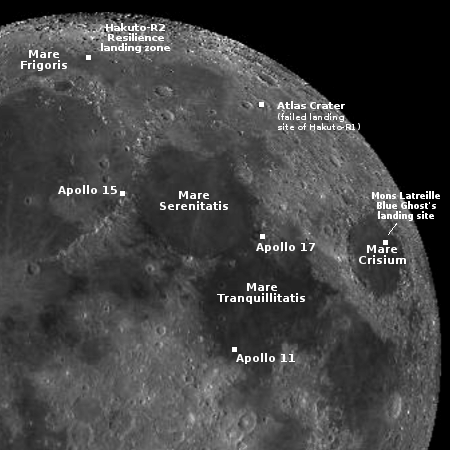
Landing sites on Moon

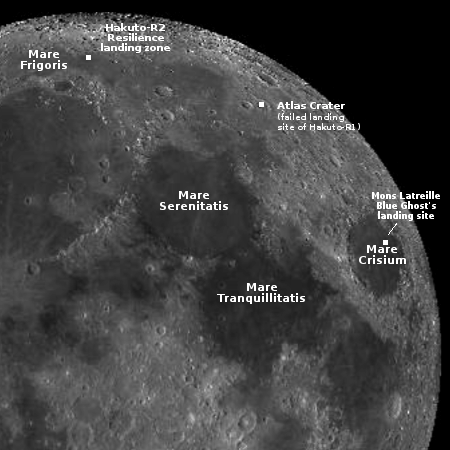
According to a media update from NASA yesterday, Firefly’s Blue Ghost lunar lander now targeting mid-January launch window for its unmanned mission to the Moon.

A six-day launch window opens no earlier than mid-January 2025 for the first Firefly Aerospace launch to the lunar surface.

The Blue Ghost flight, carrying 10 NASA science and technology instruments, will launch on a SpaceX Falcon 9 rocket from Launch Complex 39A at the agency’s Kennedy Space Center in Florida. Media prelaunch and launch activities will take place at NASA Kennedy.

The first quarter of 2025 will be a busy time for unmanned missions to the Moon. In addition to Firefly’s mission, the American startup Intuitive Machines also hopes to launch its Athena lander to the Moon’s south pole in February. Though it will launch after Blue Ghost, it will get to the Moon first, as it is taking a more direct week-long route compared to Blue Ghost’s 45-day journey. In addition, the Japanese company Ispace is targeting its own January launch for its Resilience lander.

If all three lift off as planned, there will be three landers heading for the Moon in early 2025.

0 comments

Starship gets contract to deliver Lunar Outpost’s rover to Moon

Capitalism in space: The lunar lander version of SpaceX’s Starship has won a contract from the startup Lunar Outpost to deliver its manned rover to the Moon.

The Colorado company announced Nov. 21 that it signed an agreement for SpaceX to use Starship to transport the company’s Lunar Outpost Eagle rover to the moon. The companies did not disclose a schedule for the launch or other terms of the deal.

This announcement is less a new deal for SpaceX and more an effort to convince NASA to award Lunar Outpost the full contract to build the rover. In April 2024 Lunar Outpost was one of three companies chosen by NASA to receive initial development grants to design their proposed manned lunar rovers. NASA expects to award the full contract, worth potentially up to $4.6 billion, to one of these three companies later this year, after seeing their preliminary designs. It wants to choose two, but at present says budget limitations make that impossible.

1 comment

NASA once again gambling on the lives of its astronauts for political reasons

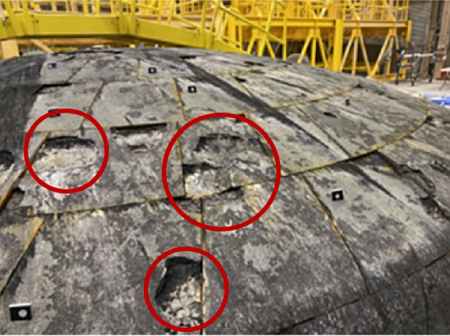
Orion's damage heat shield
Damage to Orion heat shield caused during re-entry in 2022,
including “cavities resulting from the loss of large chunks”

NASA this week began the stacking one of the two strap-on solid-fueled boosters that will help power SLS on the Artemis-3 mission, still officially scheduled for September 2025 and aiming to send four astronauts around the Moon.

A NASA spokesperson told Ars it should take around four months to fully stack the SLS rocket for Artemis II. First, teams will stack the two solid-fueled boosters piece by piece, then place the core stage in between the boosters. Then, technicians will install a cone-shaped adapter on top of the core stage and finally hoist the interim cryogenic propulsion stage, or upper stage, to complete the assembly.

At that point the rocket will be ready for the integration of the manned Orion capsule on top.

The article at the link sees this stacking as a good sign that NASA’s has solved the Orion capsule’s heat shield issue that occurred during the unmanned return from the Moon on the second Artemis mission. The image to the right shows that heat shield afterward, with large chunks missing. Though it landed safely, the damage was much much worse than expected. At the moment NASA officials have said it has found the root cause, but those officials also refuse to say what that root cause is, nor how the agency or Orion’s contractor Lockheed Martin has fixed it.
» Read more

19 comments

China’s plan to land astronauts on the Moon

Mengzhou as of 2023
Click for source.

The new colonial movement: China’s state-run press yesterday revealed the basic flight plan its space program will use to land astronauts on the Moon in 2030.

China’s first manned lunar mission will begin with the launch of the Lanyue lunar lander aboard the country’s new heavy carrier rocket [the Long March 10], and Lanyue will then await the subsequent arrival of the Mengzhou manned spacecraft in space. Mengzhou will be poised for its rendezvous with Lanyue in lunar orbit, at which time the astronauts will transfer into the lander.

The lander will then separate and descend to the moon’s surface. Upon the completion of their lunar exploration, the astronauts will return to lunar orbit in the lander’s ascent stage. This stage will involve re-docking with the spacecraft, and will mark the beginning of the astronauts’ journey back to Earth.

This plan is a variation of the Apollo approach, but rather than sending the ascent/descent capsule and lunar lander on the same rocket, China will launch them separately and have them rendezvous in lunar orbit.

Mengzhou is intended to be a larger and reusable replacement for the Shenzhou capsules China is presently using to transport its astronauts to and from its Tiangong-3 space station. Unlike Shenzhou, which appears to be an upgrade of Russia’s Soyuz capsules, Mengzhou instead appears more conelike, as shown by the mockup image to the right, first revealed in 2023.

1 comment

NASA to award SpaceX and Blue Origin contracts to deliver cargo to the Moon

Capitalism in space: NASA yesterday announced that is planning to award both SpaceX and Blue Origin contracts to use their manned lunar landers as cargo freighters to deliver supplies to its planned lunar base.

NASA expects to assign demonstration missions to current human landing system providers, SpaceX and Blue Origin, to mature designs of their large cargo landers following successful design certification reviews. The assignment of these missions builds on the 2023 request by NASA for the two companies to develop cargo versions of their crewed human landing systems, now in development for Artemis III, Artemis IV, and Artemis V.

…NASA plans for at least two delivery missions with large cargo. The agency intends for SpaceX’s Starship cargo lander to deliver a pressurized rover, currently in development by JAXA (Japan Aerospace Exploration Agency), to the lunar surface no earlier than fiscal year 2032 in support of Artemis VII and later missions. The agency expects Blue Origin to deliver a lunar surface habitat no earlier than fiscal year 2033.

The contracts however have not been issued. This is merely an announcement of NASA’s intent to do so, which suggests to me that NASA management has already recognized that the entire Artemis program is facing a major restructuring and wants to indicate it will support such a change. That does not mean these contracts won’t be issued — both rely on the privately owned rockets of both companies — but that NASA now realizes that its manned program — which now relies on SLS/Orion — will likely to be changed significantly, likely by the elimination of SLS/Orion and its replacement by private rockets and private manned spacecraft.

Because of this looming restructuring, NASA management probably intended this press announcement — which really announces little that is new — as a signal of its support for such a change, because the announcement focuses on these private companies rather than NASA’s government-built rocket.

0 comments

A new geologic map of one of the Moon’s largest impact basins

Orientale Basin on the Moon
Click for original image.

Using data from Lunar Reconnaissance Orbiter (LRO), scientists have now produced a high resolution geological map of Orientale Basin, one of the largest impact basins on the Moon — at about 600 miles across — and located just on the edge of the Moon’s visible near side.

That map is to the right, reduced and sharpened to post here. You can read the paper here [pdf]. From the press release:

Planetary Science Institute Research Scientist Kirby Runyon is a lead author on a paper published in the Planetary Science Journal containing a new high-resolution geologic map of Orientale basin that attempts to identify original basin impact melt. The hope is that future researchers use this map to target sample return missions and pin down impact dates for this and other impact basins.

“We chose to map Oriental basin because it’s simultaneously old and young,” Runyon said. “We think it’s about 3.8 billion years old, which is young enough to still have its impact melt freshly exposed at the surface, yet old enough to have accumulated large impact craters on top of it as well, complicating the picture. We chose to map Orientale to test melt-identification strategies for older, more degraded impact basins whose ages we’d like to know.”

The map’s prime purpose is to pin down locations where material from the actual impact exist and can be returned to Earth for precise dating, thus helping to create a more accurate timeline of the Moon’s formation as well as the entire solar system’s accretion rate.

0 comments

Pakistan to fly a small rover on China’s Chang’e-8 lunar lander

In an agreement signed yesterday, the Space and Upper Atmo­sphere Research Comm­ission (Suparco) in Pakistan announced it will collaborate with China to build a small rover that will to fly on China’s Chang’e-8 lunar lander.

The lander is present scheduled to land near the Moon’s south pole in 2030, will be China’s second lander to the south pole region, and will also act to officially establish China’s International Lunar Research Station (ILRS) on the lunar surface. It will also include a “hopper” to explore the nearby surface.

Pakistan had already signed on to China’s space alliance to build the ILRS. China’s present list of partners is as follows: Azerbaijan, Belarus, Egypt, Kazakhstan, Nicaragua, Pakistan, Russia, Serbia, South Africa, Thailand, Turkey, and Venezuela. That partnership also includes about eleven academic or governmental bureaucracies.

1 comment

A return to Phantom and the reminiscences of an Apollo astronaut

Charles Duke, Apollo 16 astronaut

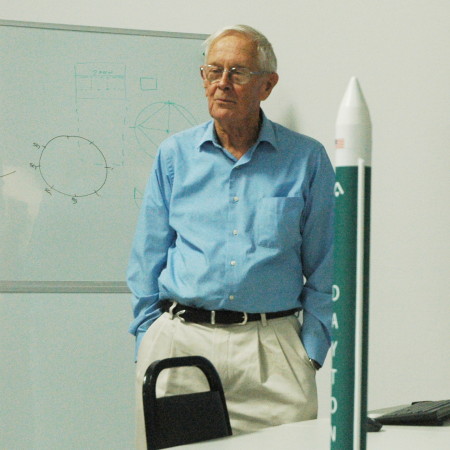
Yesterday I had to pleasure of getting my second tour of the Phantom Space facilities, located here in Tucson. Jim Cantrell, the founder of the Tucson-based rocket/satellite company Phantom Space, had last week graciously invited me to attend the event he was holding there, where astronaut Charles Duke, from the April 1972 Apollo 16 lunar landing, would be giving a talk to the company’s employees, investors, and customers. Duke had become an advisor for the company, and this would be his first visit to its operations.

First, the talk by Charles Duke, describing his life and Apollo 16 walk on the Moon, was as usual awe-inspiring, mostly because Duke spoke like every astronaut I’ve ever met so matter-of-factly about what he had done. During the second of three excusions on the surface with his commander John Young, they drove their rover up the slope of nearby Stone Mountain, climbing to an elevation of 500 feet, the highest any human has so far been on the lunar surface. From there he could look back and see for miles, including the entire valley where the lunar module was nestled as well as the mountains and craters that surrounded it.

When I asked him if he had had any sense of his remoteness from humanity, his response was a good-natured laugh. “We felt at home there!” They had done so much study of the terrain beforehand, including simulations, that from the moment they approached to land it all looked very familiar. This is where they were supposed to be!

Following Duke’s presentation we all were given a tour of the facility. My first visit there had been in 2022. At the time Cantrell’s effort was to aggressively succeed from his earlier failure at the rocket startup Vector, focusing this new company on building its Daytona rocket. After the tour I concluded as follows:
» Read more

2 comments

NASA picks nine lunar south pole candidate sites for Artemis-3 manned landing

The Moon's south pole, with candidate landing sites
Click for NASA’s original image.

NASA today revealed the nine candidate sites in the Moon’s south polar region for its Artemis-3 manned mission, presently targeting a 2026 launch date.

The map to the right shows the location of those nine sites, numbered in order of priority, as follows:

  • 1. Peak near Cabeus B
  • 2 . Haworth
  • 3. Malapert Massif
  • 4. Mons Mouton Plateau
  • 5. Mons Mouton
  • 6. Nobile Rim 1
  • 7. Nobile Rim 2
  • 8. de Gerlache Rim 2
  • 9. Slater Plain

The map also shows the planned landing sites for Intuitive Machine’s Athena lander in January 2025, and China’s Chang’e-7 lander in 2026, as well as where India’s Virkam lander touched down in 2023.

Cabeus B is likely the prime candidate site because its high elevation will make communciations easier, while placing it closer to the crater Cabeaus, which was impacted by the LCROSS mission in 2009 and found a significant signature of water in the ejecta plume of that impact.

To make a final decision NASA will be consulting all players, from the science community as well as the engineers. All of this however depends on other factors outside of science and engineering, mostly related to politics and practicality. The entire mission relies on the full version of the SLS rocket, the manned lunar version of SpaceX’s Starship, launched by Superheavy, and a working version of Lockheed Martin’s Orion capsule, none of which are presently flightworthy.

11 comments

ISRO head unveils new timeline for major missions

The head of India’s space agency ISRO, S. Somanath, yesterday unveiled a new timeline for several of that nation’s major missions, both manned and unmanned.

The new timeline is as follows:

  • 2025: NISAR: a joint Indian-American radar orbiter, long delayed
  • 2026: Gaganyaan-1, India’s first manned orbital mission
  • 2028: Chandrayaan-4, an unmanned sample return mission to the Moon
  • 2028: Chandrayaan-5, a joint lander-rover to the Moon

The last project will be done in partnership with Japan, with India building the lander and Japan the rover.

2028 will be a very busy year for India in space. The Indian government had previously announced that ISRO would launch in 2028 the first module of its space station as well as a Venus orbiter.

0 comments

Young lava on the Moon?

Young lava on the Moon?
Click for original image.

Cool image time! The photo to the right, cropped and reduced to post here, was taken on November 27, 2023 by Lunar Reconnaissance Orbiter (LRO) and was today featured by the science team. From their caption:

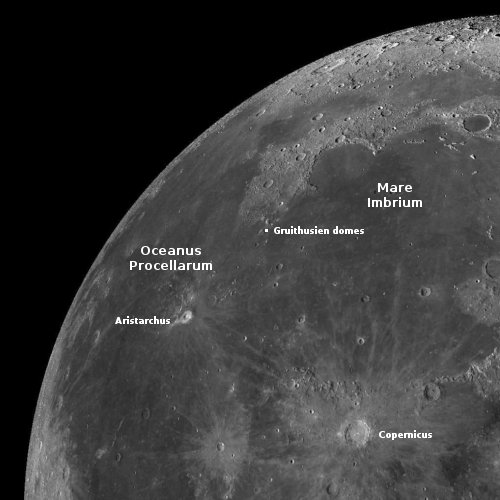
One of the early findings from the LRO mission was the discovery of volcanic features known as Irregular Mare Patches (IMPs) scattered across the nearside. These landforms are generally considered volcanic. However, their ages are hotly debated. They may be as young as 50 million years or as old as 3.5 billion years. The Aristarchus IMP (25.045°N, 313.233°E) is one of the smallest and most enigmatic IMP. The fact that this IMP is found within the Aristarchus crater ejecta suggests it formed after the crater, which is dated at 200 million years.

Alternatively, this IMP may have formed as part of ejecta emplacement from the Aristarchus crater forming impact. However, no other crater ejecta on the Moon exhibits a similar landform.

Astronomers for decades before and since Sputnick have reported what appears to be some activity in the Aristachus region, though none of those reports have ever been confirmed. In LRO’s long mission orbiting the Moon it has not yet detected any obvious changes there, suggesting that there is little or no present activity. These patches however appear to indicate activity in the relatively recent past.

The patches however also indicate activity that seems alien. Why would the lava form in this manner, as rough patch of knobs, sometimes aligned, sometimes not?

0 comments

GAO: Next SLS Artemis launches will almost certainly be delayed

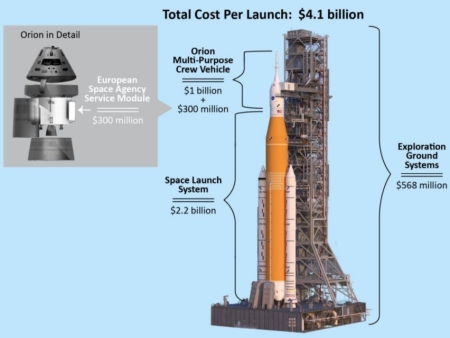
SLS's two mobile launchers, costing $1 billion
NASA’s bloated SLS mobile launchers

According to a new Government Accountability Office (GAO) report released yesterday, NASA’S continuing delays and technical problems building the various ground systems required for the next few Artemis launches will almost certainly cause those launches to be delayed.

The schedule at present is as follows:

  • September 2025: Artemis-2 will be the program’s first manned mission, taking four astranauts around the Moon.
  • September 2026: Artemis-3 will complete the first manned lunar landing.
  • September 2028: Artemis-4 will send four astronauts to the Lunar Gateway station in orbit around the Moon, and then complete the second manned lunar landing.

The GAO report notes at length that modifications to the mobile launch platform SLS will use on the first two missions is taking longer than planned. It also notes that the problems completing the second mobile launcher continue, with the budget growing from $383 million to $1.1 billion, and the work years behind schedule with no certainty it will be completed in time for the 2028 mission. These issues are the same ones noted by NASA’s inspector general in August 2024.

Orion's damage heat shield
Damage to Orion heat shield caused during re-entry,
including “cavities resulting from the loss of large chunks”

This report focused exclusively on the scheduling delays for the ground systems that will be used by SLS for each launch. It did not address the serious questions that remain concerning the serious heat shield damage experienced by the Orion capsule when it returned to Earth on its first unmanned mission in late 2022. NASA has been studying that problem now for two years, and as yet has not revealed a solution.

I continue to predict that the first manned landing, now scheduled for 2026, will not occur before 2030, six years behind the schedule first proposed by President Trump but actually fifteen years behind the schedule initially proposed by President George Bush Jr in 2004. All in all, it will take NASA almost a third of a century to put American astronauts back on the Moon, assuming the landing occurs in 2030 as I now predict. Compare that with the development time of SpaceX’s Starship/Superheavy. Proposed in 2017, it is already flying, and will almost certainly complete its first private manned lunar mission and its first test missions to Mars by 2027. The contrast is striking.

More and more the entire part of Artemis run by NASA is proving to be the failed disaster I predicted it would be in 2011. No wonder former New York mayor Michael Bloomberg wrote an op-ed yesterday calling for its cancellation. Like most politicians, reality is finally percolating into his thick skull, though several decades late.

22 comments

Axiom unveils its spacesuit design

Axiom's moonsuit
Click for original image.

Axiom today unveiled its proposed spacesuit for NASA’s Moon missions, designed in partnership with the fashion company Prada.

The graphic to the left, cropped and reduced to post here, shows the suit. The letters refer to detailed descriptions contained in the full image.

The suit accommodates a wide range of crewmembers, including males and females from the first to 99th percentile (anthropomorphic sizing). It will withstand extreme temperatures at the lunar south pole and endure the coldest temperatures in the permanently shadowed regions for at least two hours. Astronauts will be able to perform spacewalks for at least eight hours.

The AxEMU incorporates multiple redundant systems and an onboard diagnostic system to ensure safety for crewmembers. The suit also uses a regenerable carbon dioxide scrubbing system and a robust cooling technology to remove heat from the system. It includes advanced coatings on the helmet and visor to enhance the astronauts’ view of their surroundings, as well as custom gloves made in-house featuring several advancements over the gloves used today. The spacesuit architecture includes life support systems, pressure garments, avionics and other innovative systems to meet exploration needs and expand scientific opportunities.

It appears the suit follows the design concept of the Russian Orlan suit, with access in and out using the backpack as the access hatch.

Axiom had won the $228 million contract to build this suit in 2022. In two years it is now testing the suit as it nears what it calls “the final development stage.” Compare that with NASA’s failed effort over fourteen years and a billion dollars to create its own suit, never getting much past powerpoint presentations.

11 comments

Astrolab unveils small prototype unmanned rover

Astrolab, one of three companies with NASA design contracts to develop a manned lunar rover, yesterday unveiled a small prototype unmanned rover that the company has designed to test on the Moon and actually hopes to launch on Astrobotic’s Griffin lander.

In a presentation at the International Astronautical Congress here Oct. 15, Astrolab announced plans to build the FLEX Lunar Innovation Platform, or FLIP, rover for launch as soon as the end of 2025. The half-ton rover will have a payload capacity of 30 to 50 kilograms.

A key purpose of FLIP is to test key systems for its larger FLEX, or Flexible Logistics and Exploration, rover, maturing their technology readiness levels (TRLs). “We want to raise the TRL of our technologies ahead of our other missions,” said Jaret Matthews, founder and chief executive of Astrolab. FLIP will test the same battery modules that the larger FLEX will use and has the same tires as FLEX. Other technologies Astrolab plans to test on the smaller rover include actuators, power systems and communications.

Though no deal has been announced, FLIP was clearly designed to match the fit of NASA’s now canceled VIPER rover that was to be launched on Astrobotic’s Griffin lander. Griffin is still being prepped for its lunar mission to be launched in 2025, but no longer has that prime payload. It is very obvious that Astrolab is vying to make FLIP that prime payload.

If so, the company will have once again demonstrated the advantages of private enterprise. NASA spent almost a billion on VIPER, going so much over budget and behind schedule that the agency had to cancel it. Astrolab has now come up with a replacement in almost no time at all, for likely pennies on the dollar. It is for sure simpler, but it also is likely to fly and test engineering, while VIPER will not.

0 comments

NASA extends the mission of the lunar orbiter Capstone to the end of 2025

The Moon as seen by Capstone
The Moon as seen by Capstone during itsMay 2023 close fly-by.
Click for original image.

NASA has now funded the mission of the privately built and operated lunar orbiter Capstone to the end of 2025, allowing it to complete engineering testing by more than two years of the orbit around the Moon that NASA’s Lunar Gateway space station intends to use.

Extending CAPSTONE’s mission also allows further collaboration with the Lunar Reconnaissance Orbiter (LRO) team at NASA’s Goddard Space Flight Center in Maryland. That partnership comes via a recently extended Space Act Agreement to evaluate, and when appropriate, conduct opportunities for cross-link data collection between the two spacecraft.

The spacecraft is entirely commercial, with NASA merely acting as the customer. It was built by Terran Orbital, launched by Rocket Lab, and is owned and operated by the private company Advanced Space, making it I think the first interplanetary probe operated entirely by the private sector for NASA. Advanced Space’s achievement was further magnified in shortly after launch the spacecraft had some thruster issues causing it to tumble. The company’s engineers were able to regain control and get it to the Moon.

0 comments

Water on the Moon? New data analysis from two different lunar orbiters say yes

Two papers in the past month using data from two different lunar orbiters have claimed the presence of water on Moon, based on the detection of evidence of hydrogen on the surface.

First, on September 16, 2024 scientists published a paper [pdf] that analyzed data collected in 2009 by India’s Chandrayaan-1 lunar orbiter, and concluded, as stated enthusiastically in the press release:

Map of permanently shadowed regions at the Moon's south pole
From the second paper, a map of permanently shadowed
regions at the Moon’s south pole. Click for original.

“Future astronauts may be able to find water even near the equator by exploiting these water-rich areas. Previously, it was thought that only the polar region, and in particular, the deeply shadowed craters at the poles were where water could be found in abundance,” said Roger Clark, Senior Scientist at the Planetary Science Institute and lead author of “The Global Distribution of Water and Hydroxyl on the Moon as Seen by the Moon Mineralogy Mapper (M3)” that appears in the Planetary Science Journal. “Knowing where water is located not only helps to understand lunar geologic history, but also where astronauts may find water in the future.”

Then today NASA announced the publication of a new paper [pdf] that looked at the data collected over the last decade by Lunar Reconnaissance Orbiter (LRO), and have concluded that “hydrogen-bearing volatiles are observed to be concentrated, likely in the form of water ice, within most of the Moon’s permanently shadowed regions (PSRs), poleward of 77°.” The press release, which included the map to the right of permanently shadowed areas at the Moon’s south pole, was more enthusiastic:
» Read more

2 comments

ISRO reveals design of its Chandrayaan-4 lunar sample return mission

India’s space agency ISRO yesterday unveiled its design concept for its Chandrayaan-4 lunar sample return mission, requiring two launches and five modules that will dock in Earth orbit before traveling to the Moon.

“After two launches, the stacks will be docked together in elliptical Earth orbit to form an integrated stack. Subsequent to docking, the Integrated Stack will perform the first set of Earth-bound manoeuvres with the PM propulsion system. Once the PM is depleted, it gets jettisoned from the Integrated stack,” Isro said Tuesday.

The integrated stack then performs all the manoeuvres to achieve the lunar orbit, such that the orbit plane has the pre-determined landing site. In the final lunar orbit, the descender module and ascender module get separated from the transfer module and re-entry module. The descender and ascender modules then undergo powered descent to achieve a soft landing on the lunar surface.

Both a robot arm and a drill will then grab samples, deposit them separately in the ascender, which will then launch and redock with the stack. It will then take the re-entry module back toward Earth, where it will be released prior to its return.

This plan is essentially the same as the first proposal last year, but with many more added details.

A landing site has apparently not yet been chosen.

1 comment

China unveils proposed spacesuit for its planned manned lunar landings

China's proposed moonsuit
Click for original image.

China’s Manned Space Agency (CMSA) yesterday unveiled its proposed spacesuit for the planned manned lunar landings it hopes to achieve by 2030.

As shown on the left, the suit draws its design from the Russian Orlan suit. The large backpack-like unit is also a hatch. The astronaut opens it, drops into the suit, and then a partner closes the unit, locking it shut. The rest of the suit is a single piece, with the central body unit rigid and the arms and legs flexible.

The Russian’s Orlan suit has been upgraded a number of times over the years, but the basic design has proved to be practical, efficient, and reliable, generally the oppose of the unwieldy and complex American suits NASA has been using since the start of the shuttle era.

The announcement was made to initiate a contest for the public to pick a name for the suit. Like all such contests, the real goal is to provide bread-and-circuses to the public so that they can think they have some say in what is happening. In the end the government will pick the name, and find someone who made the same suggestion to “award” for the idea.

7 comments
1 6 7 8 9 10 57