The vast northern plains of Mars

The vast northern plains of Mars

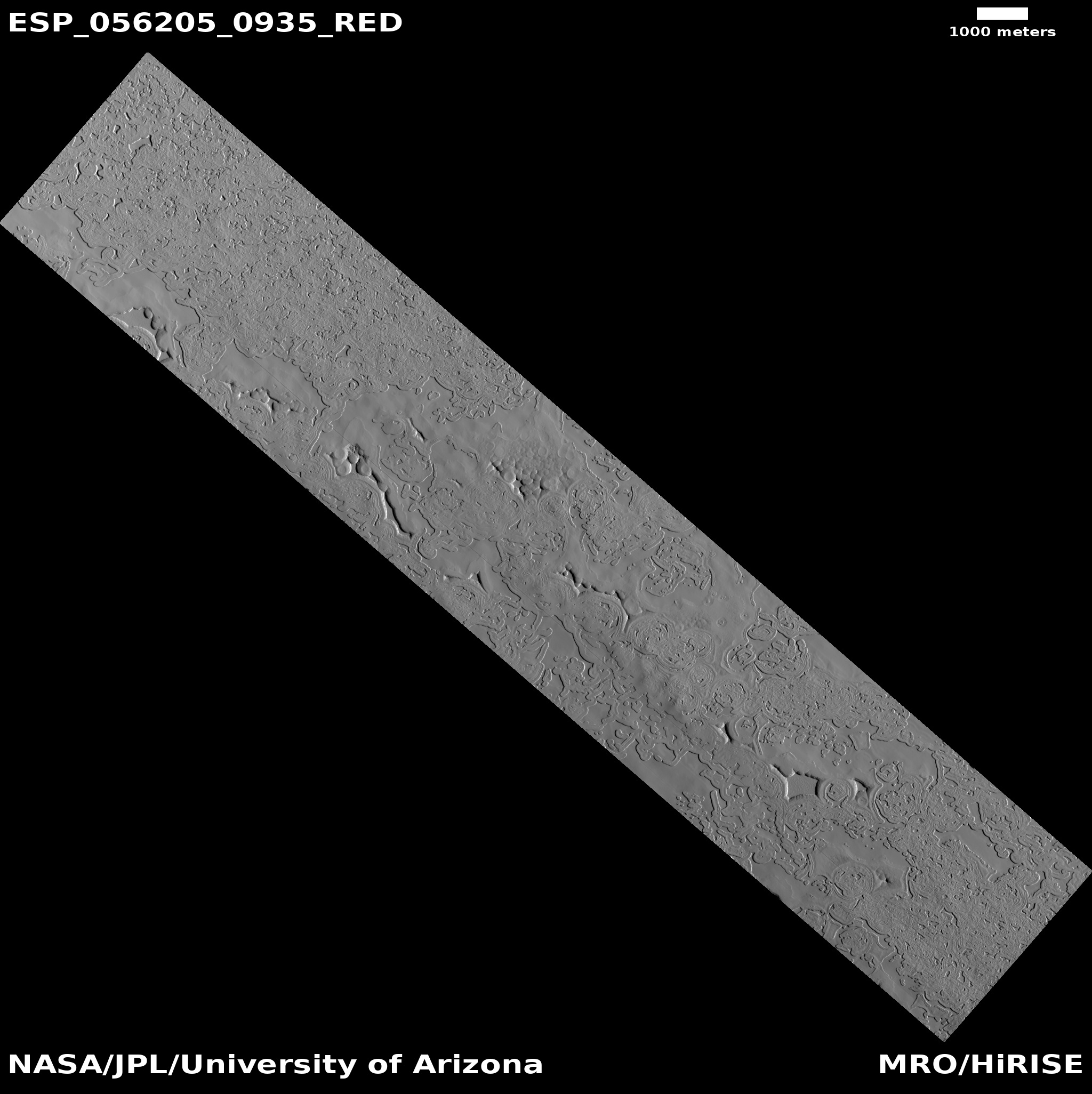
Cool image time! Actually, this image, found in the October image release from the high resolution camera of Mars Reconnaissance Orbiter (MRO), is not that interesting, in its own right. Context is all!

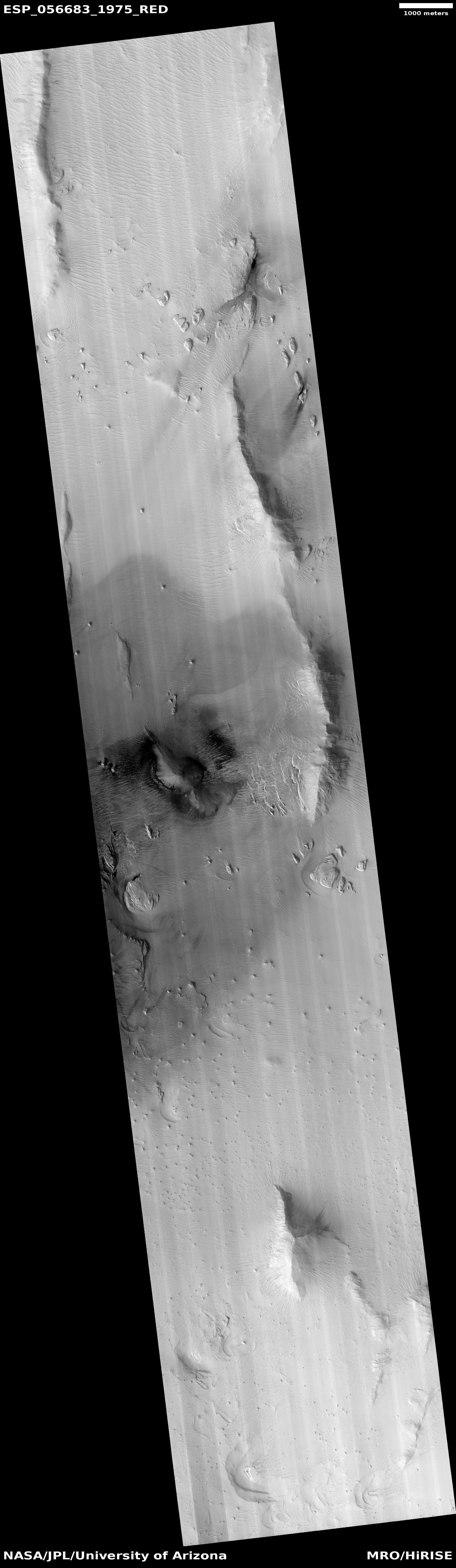
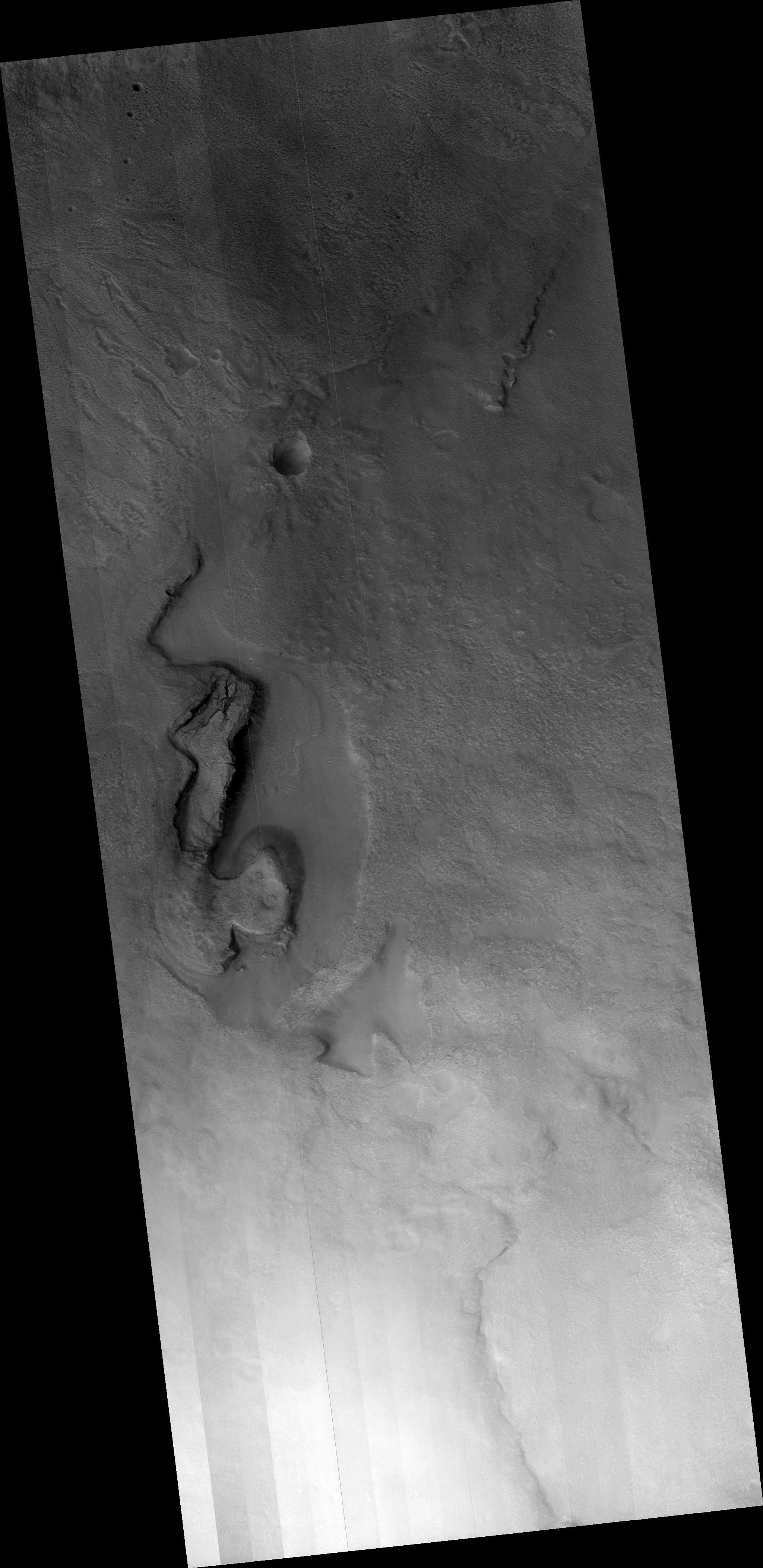
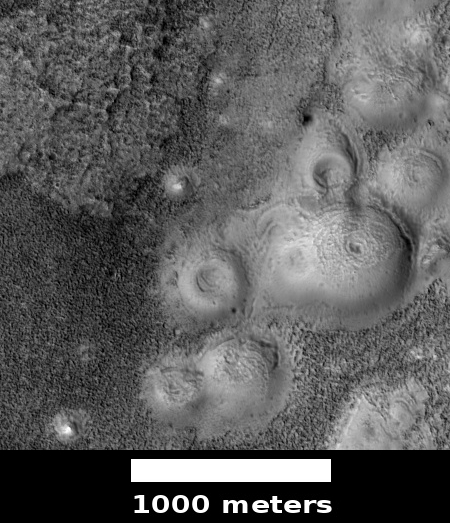
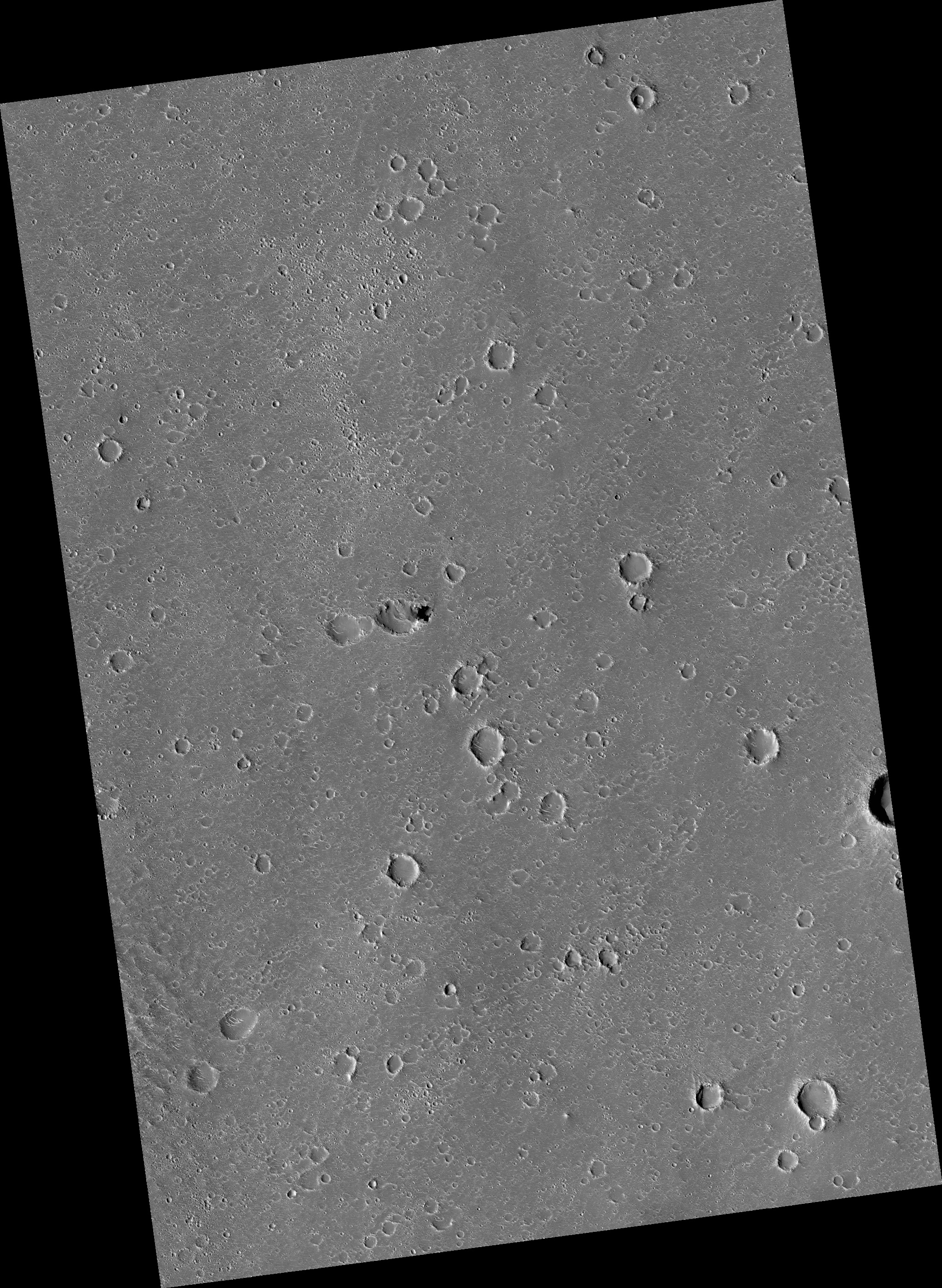
The image on the right is a small section cropped and reduced in resolution from the full image, which you can see by clicking on it. It shows one of the only interesting features in this long image strip, a small mesa sticking out all by itself in a flat featureless plain pockmarked by various small craters.

The release has no caption, though it is entitled “Northern Plains Survey.” The northern plains, while having a lot of interesting features that attract the attention of planetary scientists and thus get photographed at high resolution, is mostly featureless, at least at the resolution of the wide field survey cameras on many Mars orbiters. In order to know what is really there, they need to take high resolution images systematically, of which this image is obviously a part.

Overview image

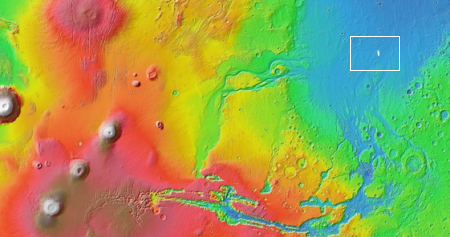
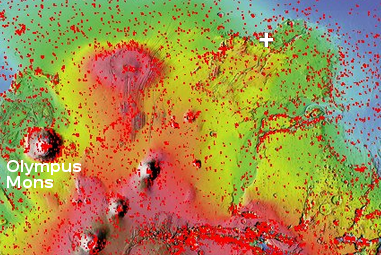
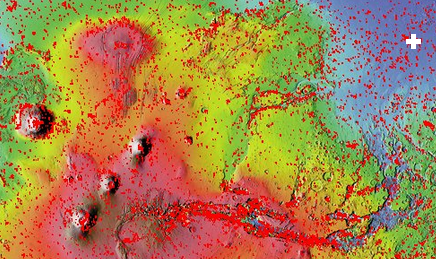
The problem is that there is so much ground to cover. This particular image was taken of a spot in the middle of the plains just to the north of the drainage outlets from Valles Marineris, as shown by the context map to the right. The tiny white spot to the right in the middle of the blue plains north of those drainage outlets is the location of this image.

Detail area of overview map

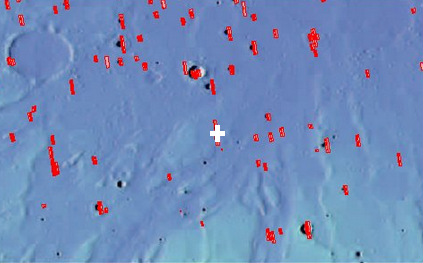
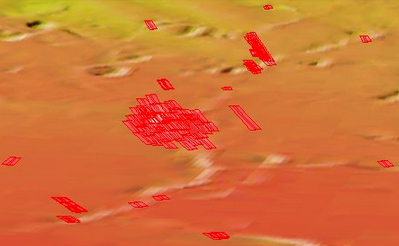
To understand how much ground needs to be covered, to the right is a close-up of the area shown by the white box in the first image above, with red rectangles indicating where MRO has already taken images. The white cross is the subject image. As you can see, most of this immense plain has not yet been imaged. It is almost as if they threw a dart to pick this one location. Most everything around it remains unseen at high resolution. Thus, to understand the geology of this one image is hampered because the surrounding terrain remains unknown, in close detail.

Mars is a big place. It is an entire planet, with the same land surface as the Earth’s continents. It still contains many mysteries and unexplored places. It will take generations to see it all.

1 comment

The steep slumping wall of a Martian volcano caldera

Caldera wall

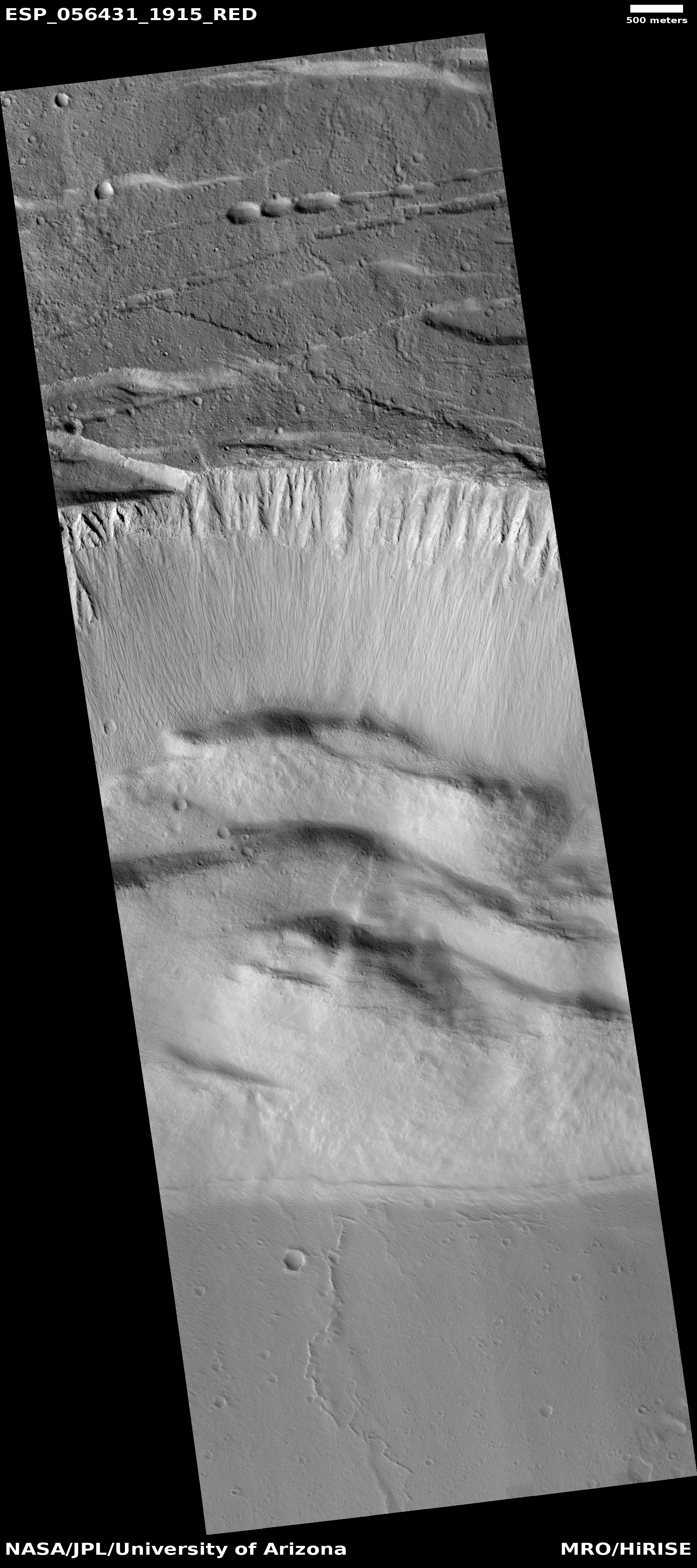
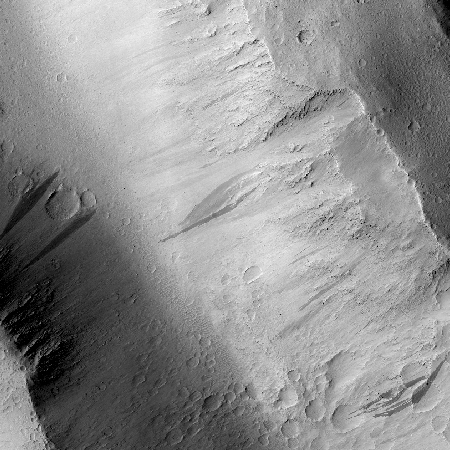
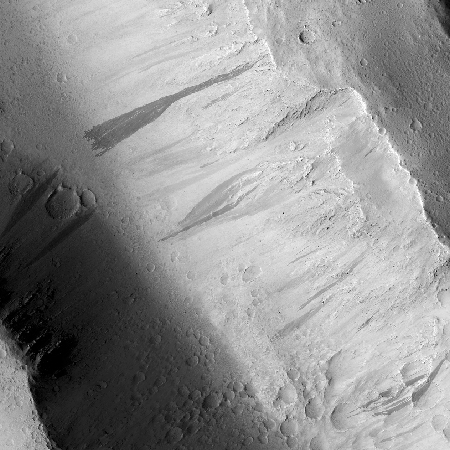
Cool image time. The Mars Reconnaissance Orbiter science team today released a nice captioned image of the steep wall of the caldera of Ascraeus Mons, the northernmost of the three giant volcanoes that lie to the east of Olympus Mons, the biggest volcano of all. The image on the right, reduced and cropped, shows that steep wall, with full image available by clicking on it. The caption from the release focuses on the fluted upper parts of the wall.

We can see chutes carved into the soft dust that has built up on the slope, with some similarities to gully landforms elsewhere on the planet.

More revealing to me is how this image reveals the slumping that is slowing eroding the caldera’s walls while also making that caldera larger. First, the plateau above the cliff shows multiple small cliffs and pit chains, all more or less parallel to the wall. This suggests that the plateau is over time breaking apart and falling into that caldera. Think of it as an avalanche in slow motion, with the upper plateau separating into chunks as sections slowly tilt down toward eventual collapse. As these chunks separate, they cause cracks to form in that plateau, and hence the parallel cliffs and strings of pits.

On the floor of the caldera we can see evidence of past chunks that did fall, piled up in a series terraces at the base of the wall. These are covered with the soft dust that dominates Martian geology. That soft dust also apparently comprises much of the wall’s materials, and almost acts like a liquid as it periodically flows down the wall, producing the chutes at the top of the wall.

The weak Martian gravity here is an important factor that we on Earth have difficulty understanding. It allows for a much steeper terrain, that also allows structurally weaker materials to hold together that would be impossible on Earth.This image gives a taste of this alien geology, on a large scale.

2 comments

Changes on the slopes of Olympus Mons?

Dark splotches on slopes of Olympus Mons

Cool image time! In reviewing the many images from the October image release from the high resolution camera on Mars Reconnaissance Orbiter (MRO), I came across two images, here and here, labeled “Change Detection in Olympus Maculae.” The image on the right is a cropped and reduced section of the first image, centered on the area of most interest. If you click on the image you can see the full photograph.

I did some research to see if I could find the changes indicated by this title. The location is an area on the outer western slopes of Olympus Mons, the largest volcano in the solar system. I found that MRO has taken images of this location twice before, in 2007, in 2009. I spent about fifteen minutes trying to find something that had changed, but was unable to locate anything, other than what look like a few wind-blown streaks probably caused by dust devils. I suspect I do not know what to look for.

Maybe my readers can spend some time and find these changes. If you do, please let us know in a comment.

Nonetheless, these two images revealed an area on the slopes of Olympus Mons that is most intriguing. It appears that there is a whole string of these dark splotches in this area, all of which have been carefully imaged by MRO several times. These splotches, along with the image titles, suggest that this might be area where there is activity from below that is causing the surface to darken. Could it be volcanic? Not likely. More likely is that there is underground frozen water located here, and like the spiders at the poles, this ice periodically pushes up as it sublimates to burst out as gas, and in the process darkens the surface.

If this guess on my part is correct, it suggests that this is an area in the mid-latitudes of Mars where water might be reasonably accessible. For future settlers this would be a significant discovery. And if my guess is wrong no matter. The features are puzzling, which explains why the scientists are aiming MRO at them repeatedly.

If I was to writing my science fiction novel Pioneer today, this is where I would have placed the discovery of the body of the Sanford Addiono, the astronaut who had disappeared on an asteroid near the orbit of Jupiter forty-six years previously. As the press release for the book’s release noted,

How Addiono had gotten to Mars from a distant lost asteroid–without a spaceship–was baffling.

That riddle was magnified by what Addiono had brought back with him. Among his effects was a six-fingered robot hand that had clearly been made by some alien civilization, along with a recorder and memo book describing what Addiono had seen.

What better place to put the start of this mystery but here, on a dark splotch on the slopes of Olympus Mons that also indicates its own geological mystery, a place some underground activity might be reshaping the surface of Mars.

1 comment

Land of swiss cheese and spiders

Swiss cheese on Martian south polar cap

Time for some cool images! In one of their periodic captioned releases of an interesting high resolution image, the Mars Reconnaissance Orbiter (MRO) science team this week released a picture of the strange “swiss cheese” terrain found throughout the Martian southern polar cap. (I have already highlighted in an early post the spiders that form in the south pole as the carbon dioxide evaporates.) The image to the right is a cropped section of that image, which you can see in its entirety if you click on it.

The South Polar residual cap is composed of carbon dioxide ice that persists through each Martian summer. However, it is constantly changing shape.

The slopes get more direct illumination at this polar location, so they warm up and sublimate, going directly from a solid state to a gaseous state. The gas then re-condenses as frost over flat areas, building new layers as the older layers are destroyed.

The captioned link above also included a link to a gif animation showing how this terrain has changed since 2009. The holes have become bigger, their cliffs retreating with time.

The section I highlight above not only shows the retreating swiss cheese dry ice, you can also see ghosts of several buried craters slowly becoming visible as the dry ice evaporates away.

This is only one of many images taken of the south pole by MRO. In the October archive release, I found almost two dozen, and that’s only the images taken during August of this summer. MRO takes images of the south pole regularly to track its changes, though I suspect it took more this summer because the global dust storm blocked imagery in the middle latitudes. Below and to the right is just one of these images, a particularly good illustration of the swiss cheese formation.
» Read more

3 comments

A vent on Mars?

A vent on Mars?

Cool image time! In their exploration of the surface of Mars using Mars Reconnaissance Orbiter (MRO), scientists often image geological features that strongly resemble Earth features. Sometimes, if real, the resemblances are significant, as they indicate important geological activity on Mars that can tell us a lot about the conditions and environment there.

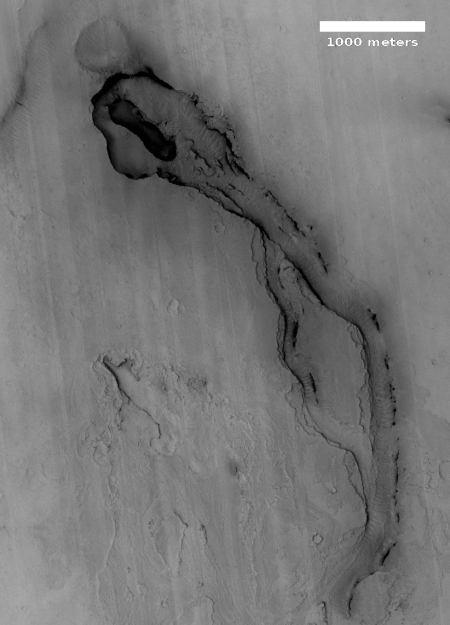
The image on the right, cropped and reduced in resolution to post here, is a good example of this. It was taken by MRO on June 14, 2018, just before the global dust storm obscured the planet’s middle latitudes for most of the summer, and was part of the monthly release of new images from the spacecraft. (If you click on the image you can see the full resolution picture.) The release website, which includes no caption, describes this feature as an “apparent vent,” a determination that certainly seems reasonable. The shadowed dark features suggest an abrupt oblong pit near the edge of a cliff, formed in the center of a collapsed sink. The tear-drop shape of the collapse sink and surrounding darkened areas also suggests that something is venting from it and then blowing away to the east and south, forming the darker stained ground. Some of the dark features to the southeast might also be smaller vents, releasing their own materials into the atmosphere.

The location also reinforces this suggestion, located on the southeast lava slopes of one of Mars’ larger volcanoes, Elysium Mons. This is also a region, dubbed Athabasca Valles, that some planetary scientists believe is one of the youngest lava flows on Mars.

Finally, it appears that the pit here has darkened considerably recently. MRO has taken images of this pit twice previously, in 2008 and 2010, and in both images the pit is much lighter in color, with its sandy dune-covered floor much easier to see. In the new image the floor is now very dark. This might be caused by shadows and the angle of the Sun, but I don’t believe so. It is also clear when comparing all three images that the surrounding area, including the flow to the southeast, has also darkened with time.

All this data suggests that the pit is venting something into the air, and it is settling on the ground to the southeast, blown there by the prevailing winds. Nor is this pit the only such feature in this region. Other images by MRO show a lot of similar dark splotches.

The problem is that this feature is not on Earth but on Mars. Determining what is being vented, and why, is therefore made more difficult. Based on Earth data you would assume this is some form of volcanic vent, releasing gases from below the surface. On Mars that assumption might not hold. We might instead be seeing the venting of any number of possible materials, such as underground water-ice, carrying with it other underground materials and thus darkening the surface.

We also can’t assume that the venting is occurring because of volcanic processes. On Mars the evidence so far gathered suggests that active volcanic activity ceased a very long time ago, even for this very young lava region. The venting is likely caused by something else, a fact that in itself is probably the most significant take-away from these images.

Something appears to be causing an active vent on the surface of Mars. Finding out the root cause of that venting is probably one of the more interesting questions facing researchers who study the Martian surface.

3 comments

Mars Reconnaissance Orbiter spots Opportunity through dust

Mars Reconnaissance Orbiter has taken a picture through the fading Martian dust storm that spots Opportunity about halfway down Perseverance Valley in the rim of Endeavour Crater.

Engineers have been increasing the number of times per day they are attempting to communicate with the rover, so far all to no avail. The picture thus only really tells us that the storm is lifting and that MRO’s high resolution camera is operating normally after three months of limited picture taking because of the dust storm.

0 comments

A Martian shoreline?

Collapsing cliff in Tempe Fossae

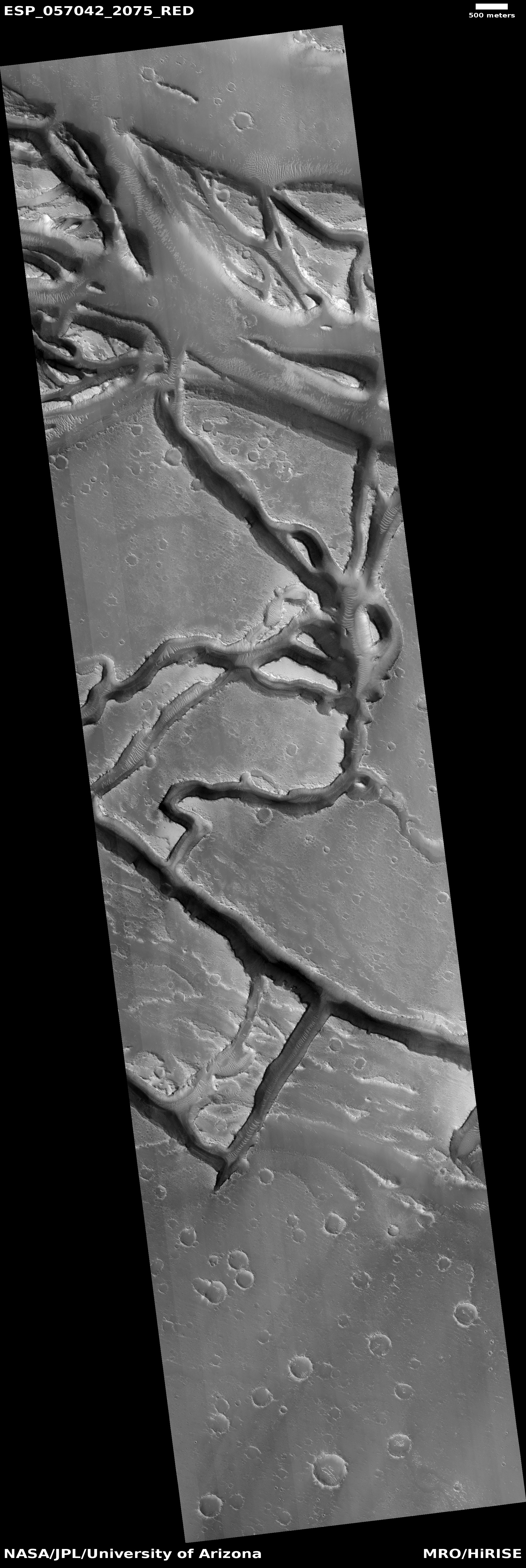
Cool image time! The image on the right, reduced and cropped to post here, was part of the August 31 image release from the high resolution camera of Mars Reconnaissance Orbiter (MRO). (Click on the image to see the full image.) It shows a slowly separating cliff feature in a region dubbed Tempe Fossae

As part of that monthly mass release, no caption was provided for this image. However, we can gain some understanding by looking at the larger context.

Tempe Fossae is located at the margins between the low flat northern plains and the high southern highlands. The location is also part of the vast drainage region to the east of Mars’ gigantic volcanoes. This is obvious from the overview image below and on the right. The location of this image is indicated by the white cross.

Mars overview

In this area of that drainage the canyons appear to follow southwest to northeast trending fault lines. Tempe Fossae is one of the smaller of these canyon complexes. All however appear to drain out into the northern plains.

Most of the MRO images of features in this area focus on the canyon cliffs. This image however focused on this one isolated small cliff in the middle of the canyon. To my eye it appears that these features document the slow drying of that vast intermittent ocean in Mars’s northern plains. The cliff is actually two steps, with the higher one appearing to mark an older shoreline. The lower cliff is abutted by a low flat area where it appears as if there had once been ponded water, now dried.

close-up of cracked area

The cracks in the cliff itself suggest it is slowly breaking apart and falling down towards that low flat area. In fact, the entire feature reminds me of the sand cliffs that are sometimes found along shorelines. The sand is not very strong structurally, and with time sections will separate and then fall down. The image to the right zooms in on this cracked region. The presence of sand dunes reinforces my impression.

I imagine that as the water drained down from the glaciers on the sides of the volcanoes and filled that intermittent sea, the shoreline regions would have had the most water. At Tempe Fossae the canyons might have been partly filled. As the water level drained out and lowered, first the upper cliff edge was exposed, then the lower. The draining water probably helped created these cracks as it flowed down through them.

Finally, the last remaining pits of water ponded at the base of the cliff, eventually drying out. With time, the weakly structured sand cliffs, already carved partly by the flowing water, began to slump apart and fall downward, producing the cracks we now see. I expect that some time in the near future, on geological time scales, there will be a landslide and the outer section will collapse downward.

1 comment

Baby volcanoes on Mars

Pitted cones on Mars

Most people are very aware of Mars’ giant volcanoes. This week the science team for Mars Reconnaissance Orbiter (MRO) decided to highlight instead a location on Mars filled with relatively tiny volcanoes. The image on the right is only one small section from the full image, and shows some of these pitted cones, as well the strange nearby badlands. From their caption:

The origins of these pitted mounds or cratered cones are uncertain. They could be the result of the interaction of lava and water, or perhaps formed from the eruption of hot mud originating from beneath the surface.

These features are very interesting to scientists who study Mars, especially to those involved in the ExoMars Trace Gas Orbiter mission. If these mounds are indeed mud–related, they may be one of the long sought after sources for transient methane on Mars.

The age of these pitted cones is not known. They might be still active, or have sat on Mars unchanged for eons.

Overview map

As always, context is crucial for gaining a better understanding of what we are looking at. The map on the right shows that these particular cones, indicated by the white cross, are located in an area of those plains dubbed Chryse Planitia, part of the vast northern plains of Mars, an area where some scientists think an intermittent ocean might have once existed. As you can see, this is also the region that took most of the apparent drainage running off the slopes of the planet’s giant volcanoes.

Nor are these cones unique in this region. MRO has taken a good scattering of images at this general location (41 degrees north, 332 degrees east), and throughout the surrounding terrain are many more of these pitted cones.

If these cones are a source of the transient methane on Mars, then the Trace Gas Orbiter should eventually see a concentration of methane above them. This would not prove them to be the source, but it would make them a much more intriguing target for a later rover mission.

0 comments

Looking for Marsquakes

After eight and a half years of study of one particular very young fault system on Mars using high resolution images from Mars Reconnaissance Orbiter, scientists have found no evidence that any quakes occurred there in that time.

The team studied images of Mars’s surface over nearly a decade to look for changes that might have been caused by marsquakes. The researchers used images of Mars’s surface from the High Resolution Imaging Science Experiment (HiRISE) and applied Co-registration of Optically Sensed Images and Correlation (COSI-Corr)—software that has been validated to track terrestrial glaciers, landslides, and quakes on Earth, as well as dune movement on Mars itself—to hunt for signs of displacement near fault zones.

The researchers focused on the Cerberus Fossae fault system, the youngest fault system on the Red Planet and thus the most likely to still be active. They used the average coregistration performance of each study image to determine that this method should be able to detect fault slip rates of 0.1–10 millimeters a year.

The team identified only one displacement signal that could have been interpreted as evidence of a marsquake—but dismissed it as the result of a topographic artifact. Their results suggest that no seismic movement occurred in the Cerberus Fossae area over the course of the study, which spanned 8.5 Earth years’ worth of images from the planet.

This suggests, but does not prove, that Mars has very few quakes. We shall know more when InSight lands on Mars on November 26.

0 comments

The search for Mars Polar Lander

A small section where Polar Lander might have crashed

In December 1999 the U.S. lander Mars Polar Lander was to set down near the southern polar cap of Mars. After an almost routine eleven month journey to Mars, all efforts to contact the spacecraft after its landing failed. A NASA review eventually concluded that the spacecraft had prematurely shut down its landing engines while the spacecraft was still far above the surface, and had therefore crashed to the ground.

Since then there have been extensive efforts to locate the lander’s remains on the surface, all to no avail. Though Mars Global Surveyor, in orbit at the time, tried to find it, its resolution was not sufficient. In recent years Mars Reconnaissance Orbiter (MRO) has taken several dozen high resolution images of the estimated landing area, two of the most recent were included in the August 2018 image release. The image on the right is a cropped section of one of those images, illustrating the difficulty of the search. (If you click on the image you can explore the full version.) The other image is quite similar.

As the southern polar cap shrinks and grows seasonally, it produces endless numbers of black spots from the release of underground dust as the carbon dioxide dry ice sublimates into gas. Moreover, the growth and retreat of the dry ice cap changes the landscape, periodically covering any remains of the rover as well as quickly removing many of the ground disturbances that the crash might have caused. In the almost two decades since the lander’s crash landing, about ten Martian years have passed, meaning that cap has melted and frozen ten times over this region in that time.

Images taken by MRO of Mars Polar Lander landing area

The image on the right shows the footprint of all the images that MRO has so far taken of the Mars Polar Lander landing area. If you are ambitious and want to get your name in the news, all you have to do is spend some time combing through those images and find the lander there. Every one of these images is available for public download at full resolution. Go to HiRise image archive, hover your mouse over latitude 77 degrees south, longitude 166 degrees east, and click several times to zoom in. You then change the selector icon at the top from “+” to “the arrow”. When next you click on any portion of that footprint it will show you a bunch of the images taken, all of which you can now download and inspect.

If you are successful and find the lander, please let me know. It would be nice to make that announcement here on Behind the Black.

0 comments

Inexplicable high latitude Martian terrain

Inexplicable high southern latitude Martian terrain

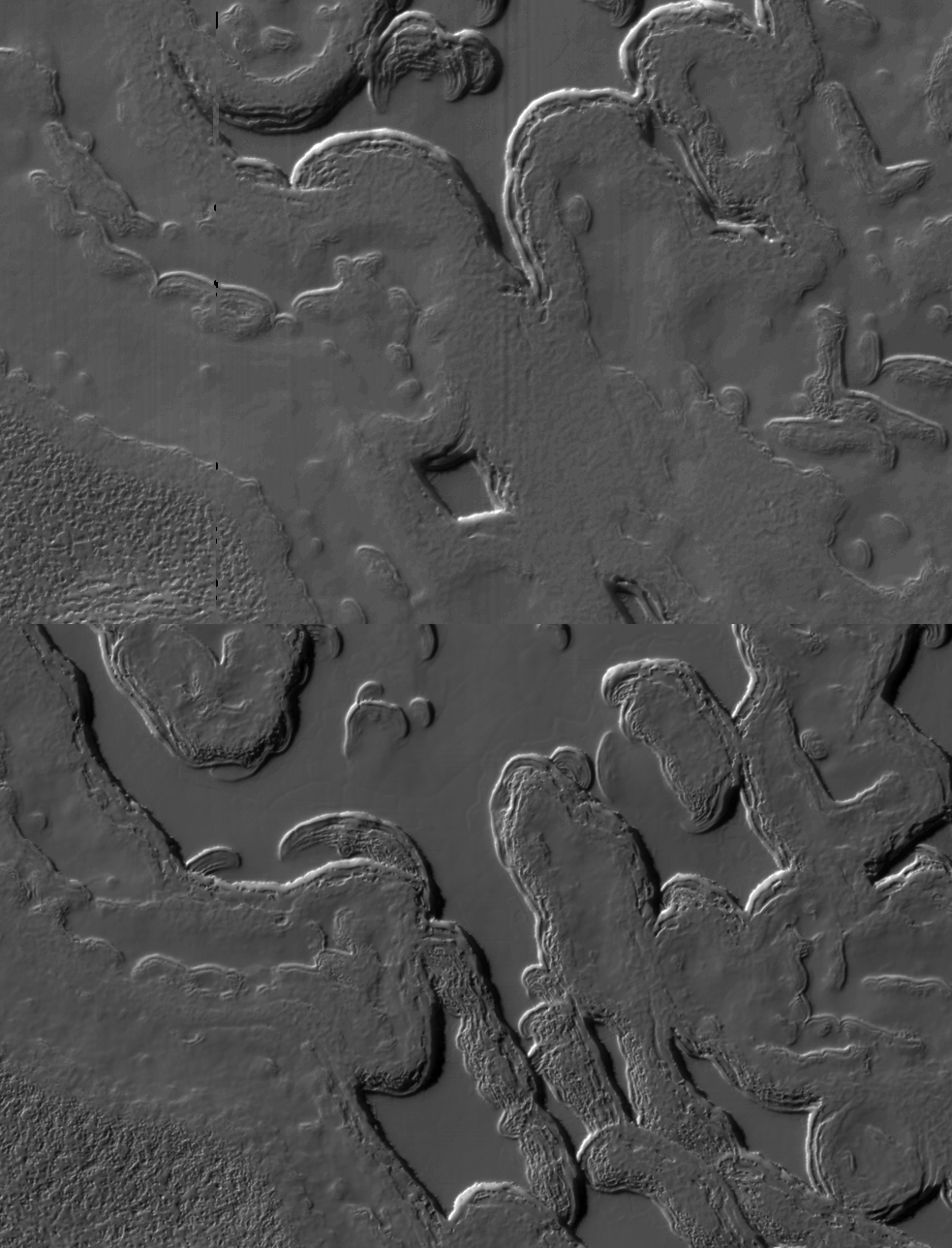
Strange image time! The image on the right, reduced in resolution to post here, comes from the August 1, 2018 image release from the high resolution camera on Mars Reconnaissance Orbiter (MRO). (If you click on the image you can see the full resolution version.) I have not cropped this image at all, so that you can see all of its swirling terrain.

This image did not come with a caption. The image site merely describes this terrain as having an “interesting morphology.” The location, in the very high southern latitudes (78 degrees south) just outside the southern rim of a very large crater, provides a slight explanation, as the growth and retreat of the Martian carbon dioxide polar caps is known to create very strange landforms. These swirling flows are obviously an example of one such landform.

The crater rim is just off of the top of the image and parallel with it. Therefore, the apparent erosional flows going around the hills and mesas are running parallel to the rim, not down from it. The black specks scattered about are probably points where dust was released as the carbon dioxide turned from ice to gas, a process that at the high latitudes on Mars often causes what planetary scientists call “spiders.”

I will not even try to make a guess at the process that formed what we see here. The image itself was taken on June 16, 2018 as part of a seasonal monitoring effort, which means scientists expect there to be changes occurring here from year to year as the polar cap shrinks and grown. An almost identical image had been taken two years ago, on December 18, 2016, and shows almost no black specks, probably because of the different time in the Martian year. A much closer comparison of both high resolution images would be necessary to tease out any more subtle changes.

4 comments

A strange bulge on Mars

Pollack Crater

Cool image time! The image on the right is not the cool image, but a context image of 59-mile-wide Pollack Crater, located slightly south of the Martian equator in the planet’s southern cratered highlands. What makes this crater intriguing to planetary scientists, and has prompted them to take many images over the decades, is the bulge in the southwest part of the crater’s floor. You don’t normally see a rise off-center like this inside craters. If there were any peaks, you’d expect them to be in the center, formed during the impact, when the crater floor melts and acts more like water in a pond when you drop a pebble into it, forming ripples with an uplifting drop in the dead center.

It therefore isn’t surprising that planetary scientists have taken a lot of pictures of this bulge, going back to the Mariner 9 orbiter in 1972, which first discovered it. Scientists then dubbed it “White Rock” because in the first black & white images it looked much brighter than the surrounding terrain. Later color images revealed that it is actually somewhat reddish in color, not white. As noted at this Mars Global Surveyor webpage,
» Read more

0 comments

Cryptic terrain in Martian high southern latitudes

Cryptic terrain in Reynolds Crater near Mars south pole

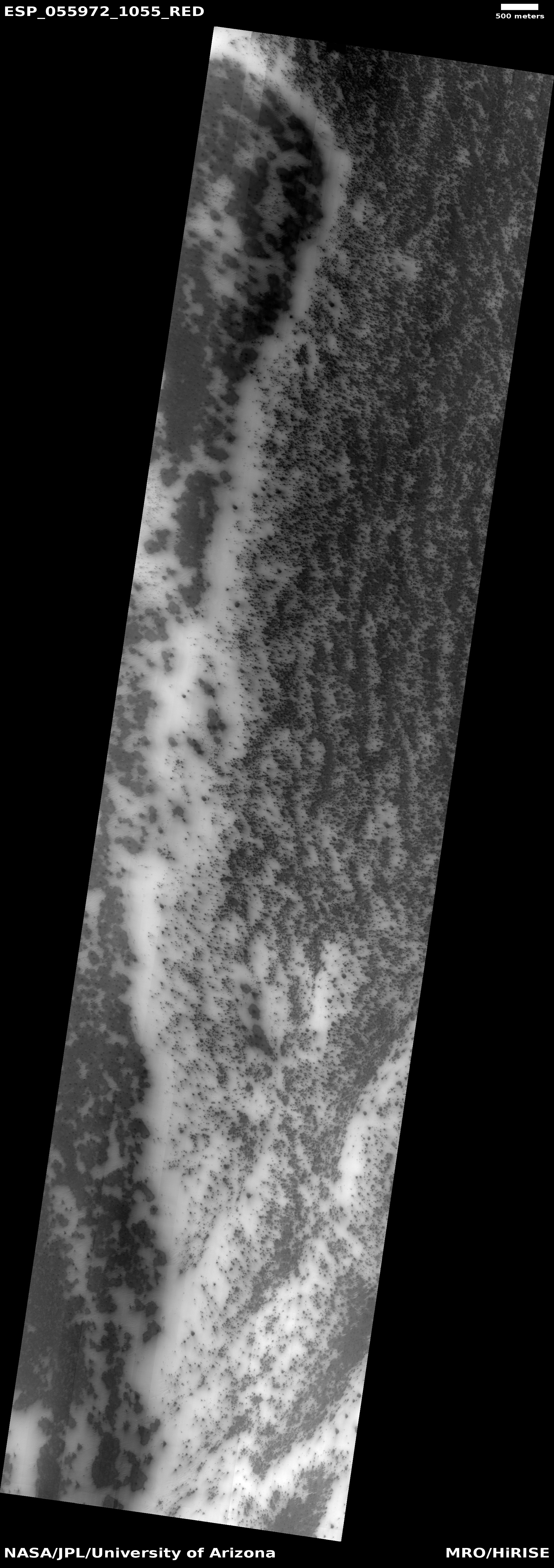
Cool image time! The image on the right is a small cropped section from a larger image taken of the floor of Reynolds Crater, near the margins of the Martian southern polar carbon dioxide icecap.

The image was part of the August 1, 2018 image release from the high resolution camera on Mars Reconnaissance Orbiter (MRO) and was taken on July 5, 2018. Because that was during the peak of now clearing global dust storm, a large majority of MRO’s images were obscured. Only images taken at high latitudes appeared clear and sharp.

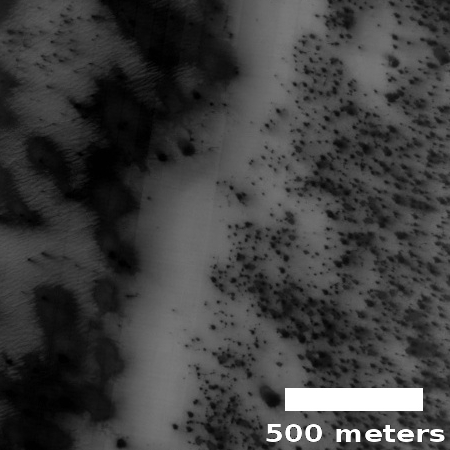
The image link, which has no caption, calls this “cryptic terrain.” Since this is at the margin of the polar cap, the white areas are almost certainly still-frozen dry ice. The white strip down the center of the image appears to be a low drainage gully, made even more evident on the full image.

What are the dark spots however? These are probably related to the dark spiders that appear wherever the carbon dioxide starts to melt and evaporate into gas, releasing the darker dust from below to coat the surface. The dark spots in this image are probably that same darker dust, but why it is scattered about as spots and splotches is a mystery. It does appear that the dark areas more completely cover the higher terrain, but why and if so is definitely unclear.

Back in 1999 I attended a press conference just prior to the failure of Mars Polar Lander. One of the mission’s investigators explained that, based on the orbiter images available at the time, they expected the lander to see some very weird land forms once it reached the surface, shaped in ways that are not seen on Earth. Unfortunately, contact with the spacecraft was lost just before it entered the Martian atmosphere, and was never recovered.

This image however remains me of that scientist’s lost expectation. The seasonal growth and retreat of the Martian icecaps will likely create some strange geology, which is only hinted at in this particular MRO image.

0 comments

Mars dust storm blocks Mars Reconnaissance Orbiter images

In my normal routine to check out the periodic posting of new high resolution images from Mars Reconnaissance Orbiter (MRO), the August 1 update brought what at first was a disturbing surprise. If you go to the link you will see that a large majority of the images show nothing by a series of vertical lines, as if the high resolution camera on MRO has failed.

Yet, scattered among the images were perfectly sharp images. I started to look at these images to try to figure out the differences, and quickly found that the sharp images were always of features in high latitudes, while the blurred images were closer to the equator.

The August 1 image release covered the June/July time period, when the on-going Martian dust storm was at its height. The images illustrate also where the storm was most opaque, closer to the equator.

The next few updates, which occur every three weeks or so, should show increasing clarity as the storm subsides. And the storm is subsiding, according to the latest Opportunity update. The scientists have still not re-established contact with the rover, and do not expect to for at least a month or more, but they are finding that the atmospheric opacity at Endeavour Crater seems to be dropping.

0 comments

Another skylight entrance pit found on Mars

Pit in Hephaestus Fossae

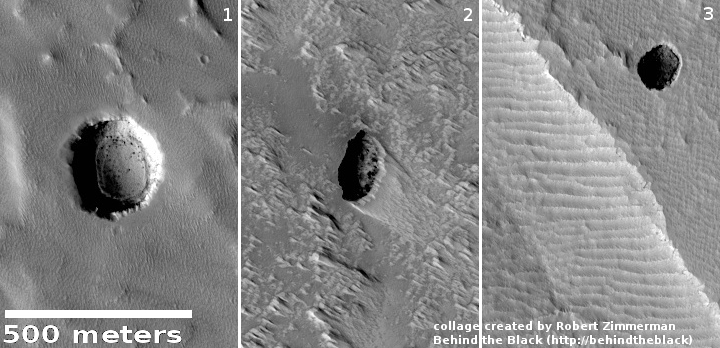
Cool image time! In my routine monthly review of the hundreds of new images released from the high resolution camera on Mars Reconnaissance Orbiter (MRO), I came across another most intriguing geological feature, the image of which is posted to the right, after cropping.

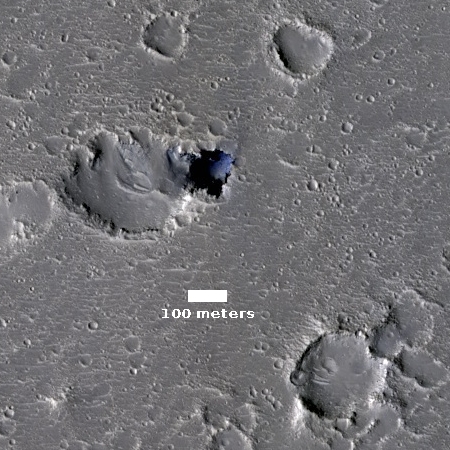
As the scale shows, the pit is about 300 feet across. Calculating the pit’s depth would require someone with better math skills than I. The website provides information about the sun angle, which can be used to extrapolate the shadows and then roughly calculate the depth.

The most fascinating aspect of this pit is the impression of incredible thinness for the pit’s overhung edges. All of the pit’s edges appear significantly overhung, and the thickness of the overhang seems incredibly paper-thin. This thinness is likely only an illusion, though in Mars’s light gravity it is perfectly possible for the overhang to be far thinner and more extended than anything you would find on Earth.

The image itself is in color, though the only color visible is within the pit itself. In that blueness at the base it seems to me that there is a pile of dust/debris, but once again, that conclusion should not be taken very seriously.

If you take a look at the full image, what is impressive is the bland flatness of the surrounding terrain. There is no hint that there might be underground passages hidden here. While most of the scattered craters are probably impact craters, many (especially those with unsymmetrical shapes) could be collapse features indicating the presence of underground voids. None however is very deep. Nor is there any other pits visible.

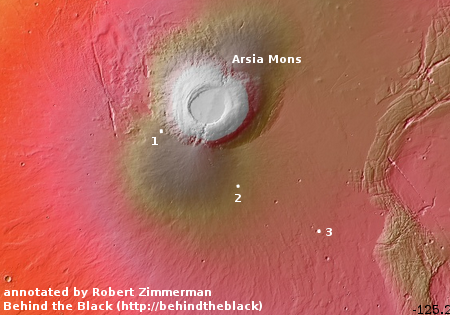
Below is a global map of Mars with the location of this pit indicated by a black cross. It is just on the edge of the transition zone between the lower northern plains and the southern highlands, where the shoreline of an intermittent sea is thought by some scientists to have once existed. This is also an area where not a lot of high resolution images have been taken, mostly because of its apparent blandness as seen in previous imagery.

This image demonstrates however that Mars is going to have interesting geology everywhere, and that we won’t really know it well until we have explored it all.
» Read more

11 comments

A dark dust avalanche on Mars

No dust avalanche

After dust avalanche

Cool image time! The two images to the right, both cropped to post here, were taken six years apart by Mars Reconnaissance Orbiter (MRO) of the western lava slopes of the giant volcano Olympus Mons. They show the appearance of a dark dust avalanche during the interim. As noted by members of the MRO science team.

Dust avalanches create slope streaks that expose darker materials usually hidden below a lighter-toned layer. Cascading fine-grained material easily diverts around boulders or alters direction when encountering a change in slope. The dark steak … is approximately 1 kilometer in length that we didn’t see in a previous image. Past avalanche sites are still visible and fading slowly as dust settles out of the atmosphere and is deposited on the dark streaks over time.

We also see boulders and their shadows that are a meter or greater in size. Movement of any of these boulders down the slope could trigger future avalanches.

The appearance of these Martian dark streaks on slopes is actually not uncommon. As more pictures are taken of Mars scientists are beginning to accumulate a large number all across the Martian surface.
What I find fascinating is the wet look of these dark streaks. Below is a close-up of the new avalanche, near its head.
» Read more

4 comments

Spiders on Mars!

spiders on Mars

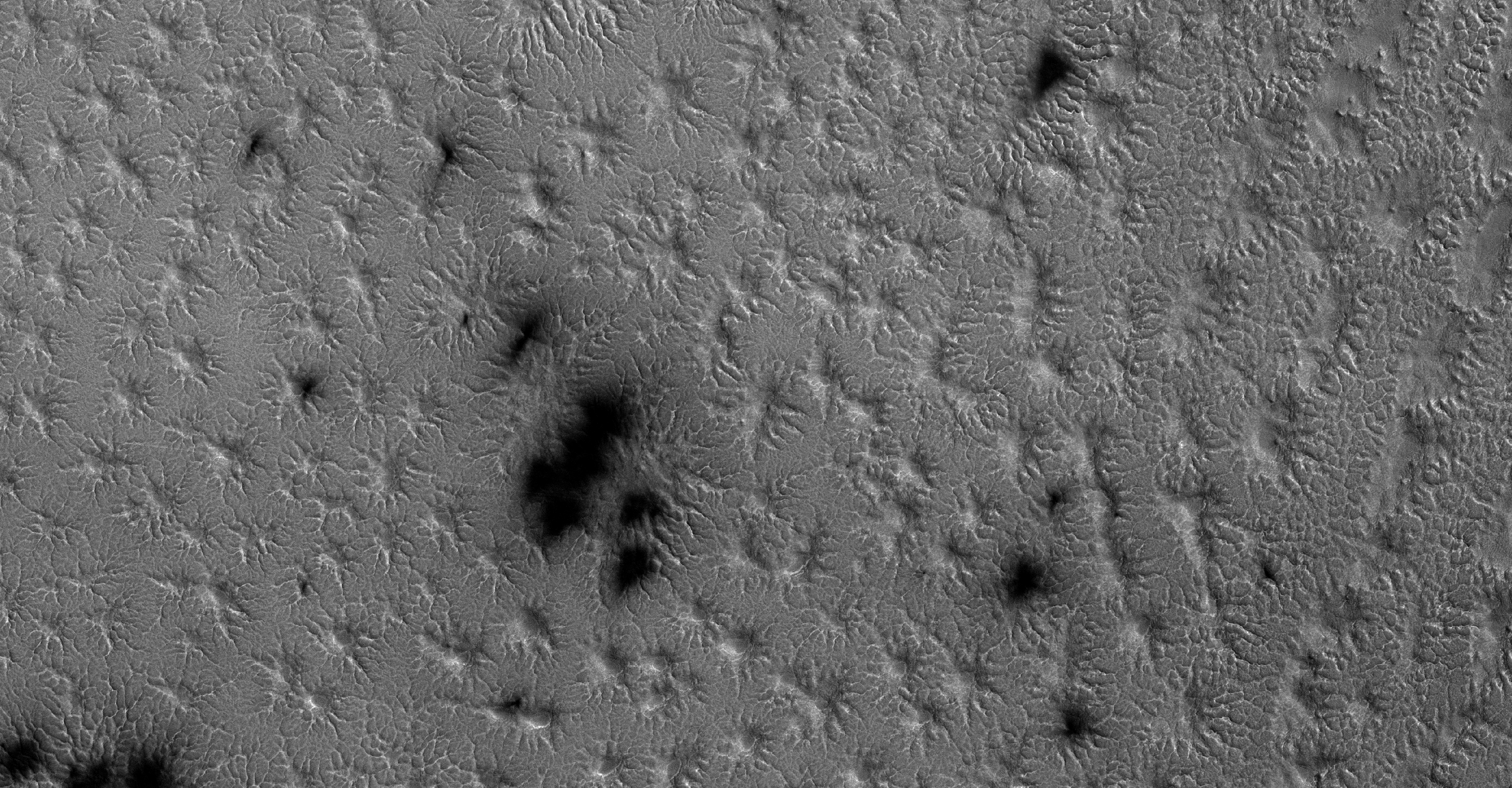
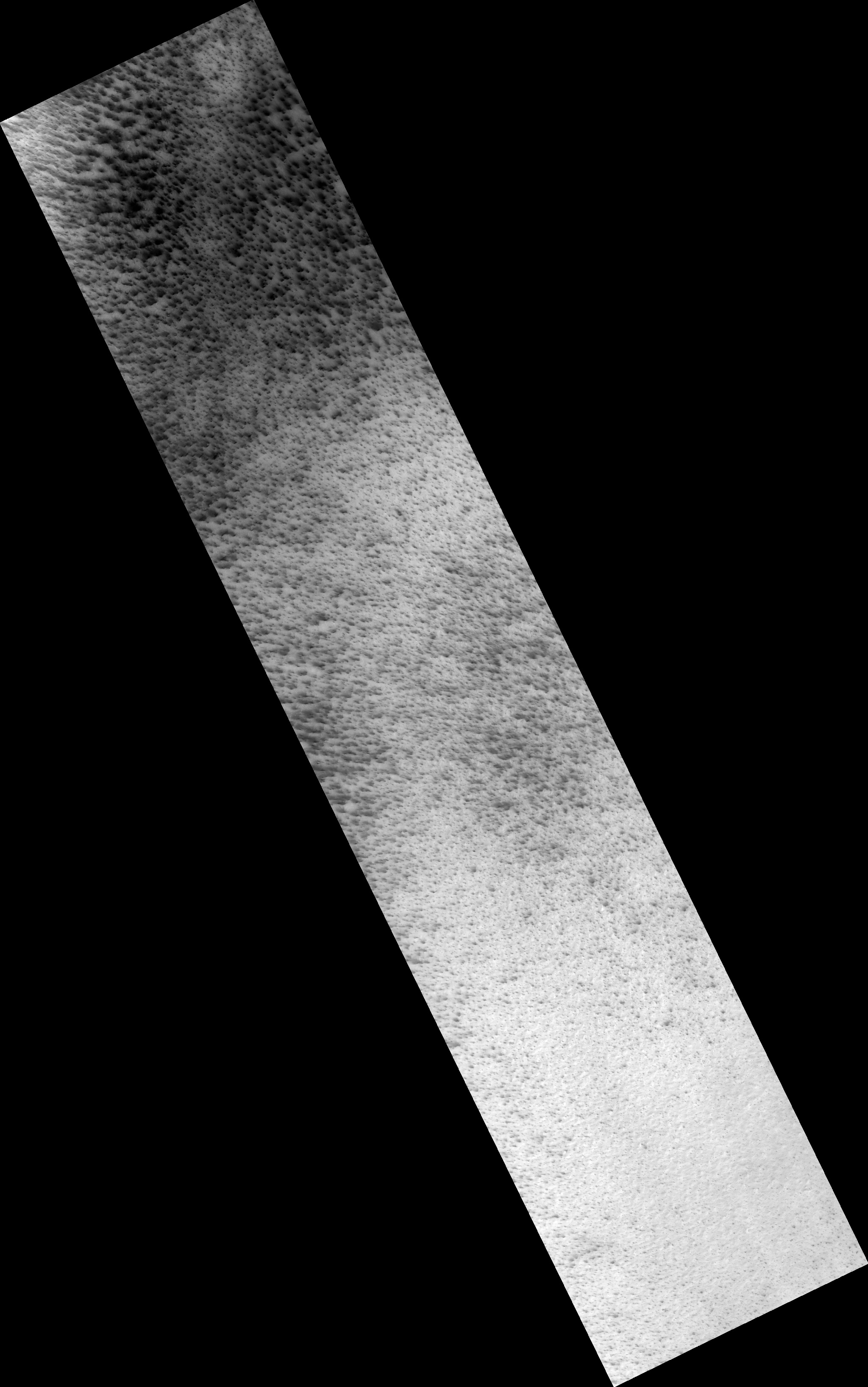
Cool image time! Today’s release of new captioned images from the high resolution camera on Mars Reconnaissance Orbiter (MRO) included a wonderful image of the melting carbon dioxide cap of Mars’s south pole. On the right is a cropped portion of the full image, showing what the MRO scientists nickname spiders, features that appear as the CO2 begins to turn into gas.

But these aren’t actual spiders. We call it “araneiform terrain,” to describe the spider-like radiating channels that form when carbon dioxide ice below the surface heats up and releases. This is an active seasonal process we don’t see on Earth. Like dry ice on Earth, the carbon dioxide ice on Mars sublimates as it warms (changes from solid to gas) and the gas becomes trapped below the surface.
Over time the trapped carbon dioxide gas builds in pressure and is eventually strong enough to break through the ice as a jet that erupts dust. The gas is released into the atmosphere and darker dust may be deposited around the vent or transported by winds to produce streaks. The loss of the sublimated carbon dioxide leaves behind these spider-like features etched into the surface.

The image above shows older spiders, formed during past seasonal events. If you click on the image you can see the full image, which shows darker spiders produced by this season’s cycle.

0 comments

The mysterious chaos terrain of Mars

In one of my weekly posts last month (dated May 14th) delving into the May image release from Mars Reconnaissance Orbiter’s (MRO) high resolution camera, I featured an image of what planetary geologists have labeled chaos terrain, a hummocky chaotic terrain that has no real parallel on Earth but is found in many places on Mars.

This month’s image MRO release included two more fascinating images of this type of terrain. In addition, the Mars Odyssey team today also released its own image of chaos terrain, showing a small part of a region dubbed Margaritifer Chaos. Below, the Mars Odyssey image is on the right, with one of the MRO images to the left. Both have been cropped, with the MRO image also reduced in resolution. The full MRO image shows what the MRO science team labels “possibly early stage chaos” on the rim of a canyon dubbed Shalbatana Vallis.

young chaos in Shalbatana Vallis

Margaritifer Chaos

» Read more

5 comments

The epic lava flows of Olympus Mons

Lava flows off of Olympus Mons

The eruption of Kilauea volcano in Hawaii has garnered a lot of deserved press coverage, having added at least a 200 acres of new land and destroyed at least 700 homes. Similarly, the recent violent eruption of a volcano in Guatemala, killing 100 people in its wake, has also gotten much deserved news coverage.

The magnitude of both however would pale in comparison to the stupendous eruption that occurred several hundred million years ago at the solar system’s largest volcano, Olympus Mons on Mars. While Kilauea is about 100 miles across, Olympus Mons is about 370 miles wide, and is so large that because of the curvature of Mar’s surface it is literally impossible for a viewer on the ground to actually see the volcano, in its entirety.

Both volcanoes are shield volcanoes, however, which means the lava flows don’t necessarily come from the caldera, but often from vents on the volcano’s slopes. Eruptions might be violent, but they generally do not involve the powerful explosive force of the sudden eruption, as seen in Guatemala and at Mount St. Helens in 1980 in the U.S. Instead, the lava seeps out steadily and continuously, an unstoppable flow that steadily overwhelms the surrounding terrain.

Olympus Mons

The flows that created Olympus Mons however were an epic event probably lasting millions of years, which brings us to this post. In the June release of Mars Reconnaissance Orbiter high resolution images, I found the image above, cropped and reduced in resolution to post here. It shows lava flowing down off one of the many escarpments on the slopes of Olympus Mons. This is not at the edge of the volcano’s shield, but just inside it. The map at the right, created using the archive of MRO’s high resolution camera, indicates the location of this flow, shown by the left light blue rectangle on the southeast slope of the volcano’s shield. The red rectangles show all the other images MRO has taken of Olympus Mons.

The scale of the MRO image above gives an indication of how big that eruption at Olympus Mons was.
» Read more

2 comments

Another intriguing pit on Mars

pit on Mars

Cool image time! In the June release of images from the high resolution camera on Mars Reconnaissance Orbiter, I came across the image on the right, cropped slightly to post here, of a pit in a region dubbed Hephaestus Fossae that is located just at the margin of Mars’s vast northern plains.

Below and to the right is an annotated second image showing the area around this pit. If you click on it you can see the full resolution image, uncropped, and unannotated.

wider view of pit

The scale bar is based on the 25 centimeter per pixel scale provided at the image link. Based on this, this pit is only about ten to fifteen meters across, or 30 to 50 feet wide. The image webpage says the sun was 39 degrees above the horizon, with what they call a sun angle of 51 degrees. Based on these angles, the shadow on the floor of the pit suggests it is about the same depth, 30 to 50 feet.

The shadows suggest overhung walls. This, plus the presence of nearby aligned sinks, strongly suggests that there are extensive underground passages leading away from this pit.

For a caver on Earth to drop into a pit 30 to 50 feet deep is nowadays a trivial thing. You rig a rope (properly), put on your vertical system, and rappel in. When you want to leave you use that same vertical system to climb the rope, using mechanical cams that slide up the rope but will not slide down.

On Mars such a climb would be both easier and harder. The gravity is only one third that of Earth, but the lack of atmosphere means you must wear some form of spacesuit. Moreover, this system is not great for getting large amounts of gear up and down. Usually, people only bring what they can carry in a pack. To use this Martian pit as a habitat will require easier access, preferable by a wheeled vehicle that can drive in.

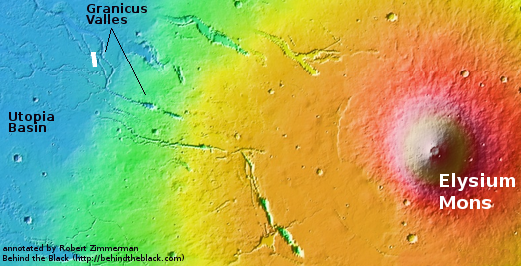
The pit’s location however is intriguing. The map below shows its location on a global map of Mars. This region is part of the Utopia Basin, the place with the second lowest elevation on Mars.
» Read more

7 comments
1 49 50 51 52 53 54