NASA reveals technical problem during solar sail deployment of test mission

NASA today revealed that a technical problem occurred during the deployment of a demonstration solar sail mission launched in April on Rocket Lab’s Electron rocket.

Upon an initial attempt to unfurl, the solar sail paused when an onboard power monitor detected higher than expected motor currents. Communications, power, and attitude control for the spacecraft all remain normal while mission managers work to understand and resolve the cause of the interruption by analyzing data from the spacecraft.

The goal had been test the boom deployment of a 860 square foot sail from a cubesat only about 4 feet in size.

The concept of the solar sail is simple: Use the pressure produced by sunlight to maneuver and fly controlled throughout the solar system. The idea has been tested successfully several times, with the Japanese IKAROS test solar sail and the Planetary Society’s Lightsail-2 the most successful. Sadly almost all other attempts to test this idea have had technical problems of one kind or another.

Ironically, one test solar sail proved that such a deployment from a cubesat could be done very cheaply, unlike NASA’s effort above. Brown University students in 2023 used cheap off-the-shelf parts to launch a smallsat sail that successfully deployed and was then used to lower the satellite’s orbit in order to de-orbit it more quickly. Total cost, $10,000. And it worked.

4 comments

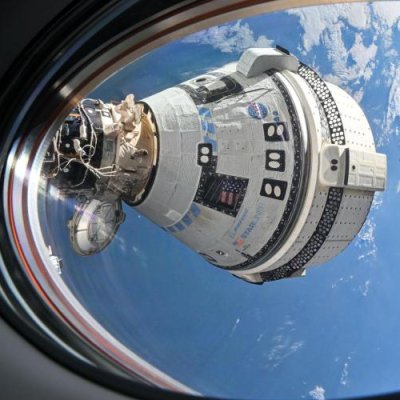
Starliner will return unmanned; crew will return in February 2025 on Dragon

Starliner docked to ISS
Starliner docked to ISS.

In a briefing today, NASA’s administrator Bill Nelson announced that Boeing’s Starliner capsule, launched in June on its first manned mission, will return unmanned and that the two astronauts it brought to ISS — Butch Wilmore and Suni Williams — will return in February 2025 as part of the crew of the next Dragon manned mission, scheduled to launch in late September.

Nelson made it a point to note that NASA’s past inactions to protect astronauts on two different shuttle missions, thus leading to their deaths, was a factor in this decision. The agency now decided safety must come first, and since Starliner’s return abilities still carry uncertainties that relate directly to safety, it decided to use a more reliable and tested Dragon capsule to return those astronauts back to Earth. During the entire briefing and Q&A session it became very clear that NASA is now paying very close attention to its engineers and their conclusions, rather than dismissing those conclusions because of other management concerns, as it did during those previous two shuttle failures.

Nelson also stated that NASA still wants to use Starliner as a second crew vehicle to ISS. He noted that he has spoken to Boeing’s new CEO, who apparently committed to getting Starliner fixed and operating. It remains undecided whether another test manned flight will be required of Boeing (at Boeing’s cost) before NASA certifies it as an operational vehicle. Whether any other customers will be willing to use the capsule remains unlikely until Boeing has flown a lot of Starliner NASA flights with no problems.

At this moment they are looking to bring Starliner back in early September, using a simplified undocking system to get the vehicle away from ISS quickly. The next Dragon mission will launch no earlier than September 24th carrying two astronauts and two empty flight suits that Wilmore and Williams use during their return.

34 comments

NASA adds three orbital tug startups to its contract bid list

NASA yesterday added three orbital tug startups to its contract bid list, allowing these companies to bid on projects that require the deployment of NASA smallsats to different orbits after launch.

NASA announced Aug. 22 that it selected Arrow Science and Technology, Impulse Space and Momentus Space for its Venture-Class Acquisition of Dedicated and Rideshare (VADR) contract. That selection allows them to compete for task orders for launching specific missions, typically small satellites willing to accept higher levels of risk in exchange for lower launch costs.

Arrow provides small satellite companies the deployment equipment used to release the satellite after launch. Impulse and Momentus have orbital tugs that not only deploy smallsats, but move them to their preferred orbit after the tug’s release from its launch rocket.

This NASA announcement allows its smallsats to be launched on either a dedicated small rocket that puts the satellite in its desired orbit or as part of a larger rideshare launch with many satellites that then uses the tug to get the satellite where it needs to be.

0 comments

Starliner decision expected tomorrow, August 24

According to a NASA update today, the agency will hold “an internal Agency Test Flight Readiness Review” to discuss whether to return Starliner manned or unmanned on Saturday morning, August 24, 2024 and then hold a press conference immediately afterward to discuss the results of that review.

What makes this review and press conference different from all previous Starliner reviews and conferences is that NASA administrator Bill Nelson will attend.

NASA Administrator Bill Nelson and leadership will hold an internal Agency Test Flight Readiness Review on Saturday, Aug. 24, for NASA’s Boeing Crew Flight Test. About an hour later, NASA will host a live news conference at 1 p.m. EDT from the agency’s Johnson Space Center in Houston.

The only reason a politico like Nelson would participate in such proceedings is because he has taken control of the decision-making process, and will make the decision himself. The review is likely to educate him as best as can be done in this short time, and he will then decide whether the two astronauts who launched on Starliner, Butch Wilmore and Suni Williams, will return on it in the next week or so, or will stay on board ISS until February 2025 and return on the next Dragon crew capsule scheduled to launch to ISS in late September.

Nelson might have decided to get involved on his own, but I am certain that if so it was strongly “encouraged” by officials above him in the White House. There is an election coming up, and the risks involved in using Starliner to return the astronauts must be weighed in connection not just with its engineering concerns but with its political ramifications also.

Nelson’s decision will also provide us a strong indication of a future Harris administration’s attitude toward space.

8 comments

NASA delays Starliner return decision to end of month

In a short FAQ posted by NASA today, the agency quietly revealed that the decision on whether to bring Starliner back with its astronauts on board has been delayed till the end of August.

NASA now plans to conduct two reviews – a Program Control Board and an Agency Flight Readiness Review – before deciding how it will safely return Wilmore and Williams from the station. NASA expects to decide on the path forward by the end of August.

It appears the agency has decided to bring more people into the decision-making process. In the briefing last week, it was then planning only one review, expected to be completed before the end of this week. It now sounds like a second review will occur after the first, pushing the decision back one more week.

All of NASA’s actions in the past three weeks have suggested an increasing involvement by upper management, possibly including White House officials. With an election coming up, the politicans who are supposed to be in charge have apparently inserted themselves into this process and are demanding greater review. I expect in the end the decision will fall to them, and might even be announced by NASA administrator Bill Nelson himself.

These actions have also suggested that upper management does not like the risks involved in returning the crew on Starliner. Politicians do not like to have bad things happen on their watch. We should therefore not be surprised if the decision is made to send Starliner home unmanned.

5 comments

NASA reconsiders cancellation of overbudget and behind schedule robotic refueling mission

Due to some pressure from Congress (which wants the 450 jobs the project employs), NASA is now reconsidering its cancellation of the On-Orbit Servicing, Assembly and Manufacturing (OSAM) 1 mission, designed in the late 2000s to demonstrate the robotic refueling of a dead satellite but is so overbudget and behind schedule that in the interim private enterprise accomplished the same goal now repeatedly for a fraction of the cost.

Language in the final fiscal year 2024 appropriations bill, released just days after NASA’s cancelation announcement, which fully funded OSAM-1 at $227 million, directed NASA to adjust the mission to launch in 2026 within the spending profile NASA included in its 2024 budget request. That could be done, the report accompanying the bill suggested, through “potential de-scoping of some non-essential capabilities,” adding that if it is not possible, NASA should conduct another continuation review in September.

In other words, Congress wants NASA to keep this project, even if it means cutting the budget of other more useful and valuable missions.

OSAM has cost a billion dollars so far, and after almost fifteen years has not yet flown. Meanwhile, Northrop Grumman’s MEV servicing robot has already provided fuel to several dead satellites, while orbital tug startups are flying missions and developing the same refueling capabilities for far less. The industry doesn’t need this demonstration mission anymore. It has already demonstrated it, and done so better.

Moreover, why the heck does OSAM require 450 people? That number is absurd, and likely exceeds the payrolls of all the orbital tug companies plus Northrop’s robotic servicing division combined.

There is hope for the American taxpayer. The legislative recommendations above come solely from the Senate. The House appears less interested in spending this money. And NASA has not yet decided what it will do.

1 comment

NASA leaning now to send Starliner astronauts home on Dragon, in February 2025

Though a decision will not be made until next week, during a press briefing today the nature of the briefing and the wording by NASA officials suggested that they are now leaning strongly to having the two Starliner astronauts, Butch Wilmore and Suni Williams, return on the next Dragon capsule to launch to the station on September 24, 2024 and return in February 2025.

My conclusion is based on several subtle things. First, no Boeing official participated, the second time in row that they were excluded. Second, this briefing included some new individuals who rank higher in the chain of command, and whose opening statements were clearly written carefully in advance and were read aloud.

Third, and most important, the wording of those statements repeatedly indicated they are looking at Dragon return more seriously. For example, NASA’s chief astronaut Joe Acaba suggested strongly that the two astronauts were now well prepared for an eight month mission, rather than coming home in August 2024. Other statements by officials suggested they themselves are less confident about returning on Starliner. Though the data suggests they can return safely, there remains enough uncertainty to make some people uncomfortable.

One factor not stated but is certainly controlling the situation now is the upcoming election in November. The Democrats who control Washington and the White House will allow nothing to happen that could hurt their election chances. We must therefore assume people in the White House are now in control and are the ones who now intend to make the decision about Starliner’s return.

Based on these factors, we should expect NASA to announce next week that the crew will return in a Dragon capsule. In order for the return to happen on Starliner NASA and Boeing engineers must somehow convince those politicos that the return would be entirely safe. Since these politicos are always risk adverse, it would shock me if they can be convinced. It could happen, but understanding the politically framework is important.

The officials stated that they have scheduled the final review next week, and it appears the decision will be announced then.

22 comments

Intuitive Machines wants to land VIPER rover on Moon

VIPER's planned route on the Moon
VIPER’s now canceled planned route at the Moon’s south pole

The lunar lander startup Intuitive Machines has now revealed it is putting together an industry partnership to bid on flying NASA’s VIPER lunar rover on its own largest lander, still under development.

In an Aug. 13 earnings call about its second quarter financial results, Intuitive Machines executives said they were planning to respond to a request for information (RFI) that NASA issued Aug. 9 seeking input from companies and organizations interested in taking over the Volatiles Investigating Polar Exploration Rover (VIPER) mission that the agency said in July it would cancel.

Steve Altemus, chief executive of Intuitive Machines, said on the call that his company, which also responded to an earlier call for “expressions of interest” from NASA regarding VIPER, is working with other companies, universities and international partners on responding to NASA’s RFI. He did not identify any of those prospective partners.

…NASA, in its RFI, said that prospective partners would be responsible for the costs of any final testing and other work on the rover itself, as well as delivering it to the lunar surface and operating it once there. NASA, in its July 17 announcement that it would cancel VIPER, said the agency would save at least $84 million by halting work now on the rover, now complete and undergoing environmental testing.

Whether this company can raise the capital to finish this mission, now that NASA has said it cannot, remains unclear. That it is trying, and NASA is not, illustrates however why NASA should get out of the business of building anything and just buy it from the private sector. NASA’s attempt to build VIPER went 3Xs over budget and is considerably behind schedule. Now the private sector see profits in finishing the job, which will in turn save the agency considerable money. Imagine if NASA had done this from the beginning. The savings would have been even greater, and VIPER might right now be even closer to launch.

1 comment

NASA inspector general blasts Boeing’s management relating to its work on SLS’s new more powerful upper stage

Boeing's schedule slips in building SLS's upper stage
Boeing’s schedule slips in building SLS’s upper stage

In a report issued today [pdf], NASA’s inspector general harshly criticized the Boeing managment and operations at its Michoud facility, where the company is developing SLS’s new more powerful upper stage. From the report’s executive summary:

Quality control issues at Michoud are largely due to the lack of a sufficient number of rained and experienced aerospace workers at Boeing. To mitigate these challenges, Boeing provides training and work orders to its employees. Considering the significant quality control deficiencies at Michoud, we found these efforts to be inadequate. For example, during our visit to Michoud in April 2023, we observed a liquid oxygen fuel tank dome—a critical component of the SLS Core Stage 3—segregated and pending disposition on whether and how it can safely be used going forward due to welds that did not meet NASA specifications. According to NASA officials, the welding issues arose due to Boeing’s inexperienced technicians and inadequate work order planning and supervision. The lack of a trained and qualified workforce increases the risk that Boeing will continue to manufacture parts and components that do not adhere to NASA requirements and industry standards.

The report also notes that delivery of that upper stage has been delayed from 2021 to 2027 (as shown by the graph to the right, taken from the IG report), and its cost has risen from $962 million to almost $2.8 billion. It also notes quite bluntly that:

Boeing’s quality management system at Michoud does not effectively adhere to industry standards or NASA requirements, resulting in production delays to the SLS core and upper stages and increased risk to the integrated spacecraft. … Boeing’s process for addressing contractual noncompliance has been ineffective, and the company has generally been nonresponsive in taking corrective actions when the same quality control issues reoccur.

Sound familiar? It should. These issues appear to be the same kind of quality control problems that have plagued Starliner, and are also the same kind of problems that had NASA reject Boeing’s bid to provide cargo to its Lunar Gateway station, and state while doing so that it will no longer consider future Boeing bids until the company straightens itself out.

It appears from today’s inspector general report that Boeing has fixed nothing. The report recommends some additional supervision of Boeing from NASA, and more importantly suggests the agency “institute financial penalties for Boeing’s noncompliance with quality control standards.”

15 comments

WISE/NEOWISE space telescope mission ends after fourteen years

Comet NEOWISE, photographed by the Hubble Space Telescope
Click for full image.

Launched in 2009, the Wide-field Infrared Survey Explorer (WISE) was shut down today after almost fourteen years of successful observations, with its first years dedicated to creating an infrared survey of the sky. In 2013, after two years of hibernation, it was reactivated and renamed NEOWISE (for reasons that I have always found absurd), with the goal over the next thirteen years of mapping the sky for near Earth objects.

By repeatedly observing the sky from low Earth orbit, NEOWISE created all-sky maps featuring 1.45 million infrared measurements of more than 44,000 solar system objects. Of the 3,000-plus near-Earth objects it detected, 215 were first spotted by NEOWISE. The mission also discovered 25 new comets, including the famed comet C/2020 F3 NEOWISE that streaked across the night sky in the summer of 2020.

A Hubble image of that comet is to the right.

The mission was ended because the telescope’s orbit is now too low to provide good data. It is expected to re-enter the atmosphere and burn up before the end of the year.

2 comments

NASA has decided to consider bringing Starliner down unmanned

Starliner docked to ISS
Starliner docked to ISS.

It appears that upper management at NASA has decided to force the agency to consider bringing Starliner down unmanned and extending the ISS mission of the two Starliner astronauts to a nine month mission.

The situation is definitely complicated, and no change as yet as been made. The schedule of dockings to ISS has been reconfigured to make this option possible. It appears this is the present plan:

First, they need to upgrade the software on Starliner for an unmanned mission. Apparently the present software on board is not satisfactory for an unmanned docking, even though a different Starliner has already done an unmanned docking last year. For this mission, the software relied on the astronauts to take over manually should there be an issue during undocking. In the previous unmanned demo, the software would react and prevent a problem. For reasons that make no sense, the software on the manned mission did not have this capability. Reinstalling this software will give them the option to send the two astronauts down on Dragon and returning Starliner unmanned.

Second, the next Dragon manned mission has been delayed until late September to allow time for these software upgrades, as well as give NASA and Boeing more time to analyze the situation and decide if a manned return on Starliner is possible. If they decide to not use Starliner, the Dragon capsule would come up to ISS with only two astronauts, and the two Starliner astronauts would then join them on their six month mission, coming home in the spring. For the Starliner astronauts Butch Wilmore and Suni Williams this would mean their mission will now be 8-9 months long, far longer than the original one-two week mission.

As to why these options are now being considered, it appears to me that both Boeing and NASA engineers were willing to return the astronauts on Starliner, but have been ordered to consider these options by higher ups. It appears that the last hot-fire thruster tests on ISS left everyone with some uncertainties about the situation. Engineers are fairly certain that the reasons some thrusters did not fire as planned during docking was because teflon seals expanded because of heat to block fuel flow. The problem is that these seals showed no problem at all in the most recent test on ISS. That difference creates some uncertainty as to whether they have really identified the cause of the problem. Imagine having an intermittent problem your car mechanic cannot constently make happen.

Because the thrusters did work as intended, Boeing and NASA seemed ready to return Starliner manned. In the agency review last week it appears others at the top were less sanguine (including Bill Nelson, NASA’s administrator), and demanded these new options be considered. Based on this speculation, it is almost certain Starliner will come home empty.

Whether this will have significant consequences remains uncertain. During the press briefing today, NASA officials said the agency might still certify Starliner for operational manned missions even if the capsule comes home unmanned.

21 comments

NASA/Boeing push back final decision of Starliner return

Starliner docked to ISS
Starliner docked to ISS.

Someone at NASA getting cold feet? According to a NASA posting today, the review that was supposed to happen this week to determine a return date for Starliner and its two-astronaut crew has been postponed until next week as engineers continue analzying the results of the recent thruster hot fire tests, both on the ground and on ISS.

The wording of this posting is intriguing, to say the least:

Teams are taking their time to analyze the results of recent docked hot-fire testing, finalize flight rationale for the spacecraft’s integrated propulsion system, and confirm system reliability ahead of Starliner’s return to Earth from the International Space Station.

Forward work for the team also includes finalizing the spacecraft’s undocking procedures and operational mitigations that could be used in flight, if needed, to build further confidence in the system. Meanwhile, Starliner ground and mission support teams are continuing to prepare for undocking by participating in integrated simulations with space station operations teams.

Following the completion of Starliner’s return planning, which is expected to continue into next week, more information will be shared about the agency’s return readiness review preparations and subsequent media briefing. As always, astronaut safety remains the top priority for both NASA and Boeing. [emphasis mine]

Up until this posting, I have been confidently predicting the two astronauts would return on Starliner. Now I am not so sure. It seems the data from the hot fire tests, especially the most recent tests on the Starliner capsule docked to ISS, was not as encouraging or did not confirm the conclusions drawn from the previous ground-based tests, and have required further analysis. This might not in the end make a difference, but the wording of this NASA’s press release, including the highlighted emphasis on astronaut safety, suggests NASA is at least considering the idea of bringing the astronauts home on a Dragon capsule.

27 comments

Inspector General: Roman Space Telescope is meeting the budget overruns and schedule delays NASA predicted

According to the twisted language in a new NASA inspector general report [pdf] describing the present status of the Roman Space Telescope, the project is on schedule and on budget because NASA decided to predict ahead of time how much it would behind schedule and over budget at this moment. From its executive summary:

[A]s of March 2024, Roman was meeting its cost obligations and schedule to launch by May 2027. Roman was on track to launch despite encountering contractor performance issues and cost overruns related to hardware anomalies, under scoping of work, and inadequate oversight of subcontractors. Roman remains on schedule because Science Mission Directorate officials conducted a replan in May 2021 to mitigate the expected cost and schedule growth caused by COVID-19, increasing the life-cycle cost estimate from $3.9 billion to $4.3 billion. This replan also included delaying the launch readiness date from October 2026 to May 2027. As of March 2024, Roman was tracking its project reserves and potential delays with L3Harris as its top risks. Roman has been using its project reserves to mitigate cost growth related to L3Harris’s performance challenges. Despite these contract value increases, Roman is still within its life-cycle cost estimate because the project’s reserves cover these extra costs.

The insulting nature of this inspector general report is astonishing. The administrative state really does think the American public is too stupid to notice this. I wonder if they are right.

The report further notes issues with the telescope’s two subcontractors, BAE Systems and L3Harris, as well as warning of insufficient ground-based antenna capacity for downloading the data that Roman will produce.

[A]s of April 2024, the NSN [Near Space Network] did not have adequate capacity to support Roman’s mission requirements without planned upgrades to the White Sands antenna and lacked the funding to implement the necessary upgrades by the mission’s launch readiness date.

In other words, more money will be needed to build more ground antennas, something that NASA conveniently forgot to mention when it first proposed Roman to Congress. How interesting, but completely par for the course.

Hat tip stringer Jay.

3 comments

Perseverance finds intriguing geology, and the press goes crazy

Intriguing Martian rock
Click for original image.

A press release from JPL yesterday described an intriguing rock (image to the right) that the Mars rover Perseverance science team has recently been studying, and in doing so repeatedly hinted that its features suggest the possibility of past Martian life. From its first two paragraphs:

A vein-filled rock is catching the eye of the science team of NASA’s Perseverance rover. Nicknamed “Cheyava Falls” by the team, the arrowhead-shaped rock contains fascinating traits that may bear on the question of whether Mars was home to microscopic life in the distant past.

Analysis by instruments aboard the rover indicates the rock possesses qualities that fit the definition of a possible indicator of ancient life. The rock exhibits chemical signatures and structures that could possibly have been formed by life billions of years ago when the area being explored by the rover contained running water. Other explanations for the observed features are being considered by the science team, and future research steps will be required to determine whether ancient life is a valid explanation.

Not surprisingly the press immediately went crazy. Here are just a few headlines:
» Read more

4 comments

NASA/Boeing: Cause of Starliner thruster failure identified

According to NASA and Boeing officials, ground static fire engine tests have now identified the likely cause of the thruster failures on the Starliner capsule during its docking to ISS in early June, and puts them in a position next week to determine a return date for the capsule and its two astronauts.

It appears the problem is related to teflon seals in the thrusters, detected while engineers did a series of tests on the ground with another Starliner capsule. Based on this information, Boeing thinks it can fix the problem on future capsules, while also insuring there will be no problems returning the astronauts from ISS.

The thrusters in question are all attitude thrusters, where there is a lot of redundancy and the issue has been seen to be well controlled from the start. The larger thrusters used for the undocking and de-orbit burn have been tested as well, and have not shown any similar issues at all.

The ground tests have also identified the cause of the helium leaks within the capsule engine system. Boeing will use this data to fix later capsules as well. These leaks are not a concern for the return to Earth.

The plan now is to do in the next few days one more set of static fire tests with the capsule docked on ISS, doing short bursts with all the attitude thrusters to further confirm what has been learned on the ground. If that goes as expected, a final meeting next week will determine the return date for the capsule and crew.

11 comments

SpaceX’s contract to de-orbit ISS reveals the inability of the older space companies to compete

Link here. The article goes into detail about the bidding process that led to SpaceX winning the contract $843 million fixed-price contract to build a specialized Dragon capsule to dock with ISS and de-orbit it. While its focus is on the refusal of the older companies (Northrop Grumman, Lockheed Martin, and Boeing) to sign the fixed-price contracts that NASA now prefers and that SpaceX can handle with no problem, it was this section that struck me the most:

SpaceX’s bid price was $680 million. The source selection statement did not reveal a price for Northrop’s bid other than saying it was “significantly higher.” Based on NASA’s budget request, Northrop’s bid was likely approximately twice as high.

But SpaceX did not just win on price. Its “mission suitability” score, effectively its technical ability to design, develop, and fly a vehicle capable of deorbiting the space station, was 822, compared to Northrop’s score of 589. SpaceX’s approach had one weakness, compared to seven weaknesses in Northrop’s bid, according to NASA evaluators.

Finally, the selection was also based on past performance by the contractors. SpaceX’s performance was rated as “very high,” given how it has delivered with the Cargo and Crew Dragon spacecraft and its Falcon 9 rocket. Northrop’s performance on Cygnus and its various rockets was given a “moderate” rating. Overall, the NASA evaluators expressed a “very high level” of confidence in SpaceX being able to complete the mission, whereas a “moderate level” of confidence was expressed in Northrop.

In other words, Northrop not only couldn’t do the job as cheaply and wasn’t even willing to do it at a fixed price, its technical performance has not been that good either.

The article focuses rightly on the present lack of any viable competitors to SpaceX, and the problems this raises for the entire American aerospace industry. I want to point out how this situation reveals a much more fundamental problem with the industry itself. The established aerospace industry is not only doing poor work, it is overcharging for it.

Or to put it more bluntly, it is unwilling or unable to compete. Relying on businesses with such bankrupt attitudes is not a good way to get anything done.

The hope had been that the newer startups (Rocket Lab, Blue Origin, Relativity, Firefly, etc) would pick up this slack, but except for Blue Origin the rocket capabilities of these companies are just not big enough yet to do it. Blue Origin’s proposed New Glenn rocket and associated spacecraft could do the job, but the company has demonstrated for the past decade its desire to emulate the older and failing big space companies rather than a new fresh face.

The new companies, given time, could solve this problem, since they are all willing to innovate and compete, but the apparent increase in the regulations imposed by the FAA and other government agencies in the past two years suggests they will be squelched as well.

Unless something changes, the U.S. is not going to see the space renaissance that seemed so promising only two years ago.

9 comments

NASA suspends all U.S. spacewalks on ISS due to water leak

Because of a water leak that occurred in an umblical cord at the beginning of a spacewalk on June 24, 2024, NASA has now suspended all U.S. spacewalks on ISS as it investigates the cause.

Tracy Dyson, a NASA astronaut, had a brief spacesuit leak a month ago while still in the hatch of the International Space Station (ISS). She and Mike Barrett had just opened the door for a 6.5-hour spacewalk for maintenance activities, when showers of ice particles erupted from a spacesuit connection to the ISS. The spacewalk was suspended, but the astronauts were never in any danger, NASA has emphasized.

“That spacewalk ended early because of a water leak in the suit’s service and cooling umbilical; that’s the site that’s connected to ISS,” station program manager Dana Weigel, of NASA, told reporters in a teleconference Wednesday (July 17). (Astronaut spacesuits stay connected to ISS life support systems via that umbilical until just before they exit the hatch.) “We’re still taking a look at the cause of the water leak, and what we want to do to recover,” Weigel added. “We’ll go look for the next opportunity for where we want to do the spacewalk. It’s not time-critical or urgent, and so we’ll find the best, logical place to put it.”

At this moment NASA has still not identified the cause of the leak, though astronauts on ISS have been inspecting the umblical cord as well as the entire suit, disassembling components where possible.

What really needs to happen is the delivery of newly designed suits, something NASA has wanted done for about fifteen years. The agency spent most of that time making powerpoint presentations and spending a billion dollars, with no new suits produced. It is now hoping its spacesuit contract with Axiom will get it new spacesuits.

8 comments

NASA and Boeing complete ground static fire tests of Starliner

According to a press announcement tonight from NASA, the agency and Boeing have now completed the static fire tests using a Starliner ground capsule to duplicate the engine burns required to bring the in-space capsule back to Earth, carrying its two astronauts.

Teams completed ground hot fire testing at White Sands and are working to evaluate the test data and inspect the test engine. The ongoing ground analysis is expected to continue throughout the week. Working with a reaction control system thruster built for a future Starliner spacecraft, ground teams fired the engine through similar inflight conditions the spacecraft experienced on the way to the space station. The ground tests also included stress-case firings, and replicated conditions Starliner’s thrusters will experience from undocking to deorbit burn, where the thrusters will fire to slow Starliner’s speed to bring it out of orbit for landing in the southwestern United States.

Engineers now need to complete a review of those tests, followed by a full review leading to a decision as to when the astronauts will return on Starliner. No dates have yet been set, but expect these reviews to be completed within two weeks, and that Starliner will likely be scheduled for return in early August, prior to the scheduled launch of the next Dragon manned mission in mid-August.

All this assumes the FAA will clear SpaceX to resume launches before then. SpaceX is apparently ready to resume this week, but we have no indication the FAA will go along.

4 comments

Scientists: Biden has infused DEI and racial quotas throughout the entire federal science bureaucracy

Joe Biden, allied with Hamas
Joe Biden, like the KKK in love with racist quotas

A new research paper just completed by a international group of scientists details at length how the policies of critical race theory and its “diversity, equity, and inclusion (DEI)” philosophy has been infused deeply into all levels of the entire federal science bureaucracy, influencing grant awards and hiring at the National Science Foundation (NSF), the National Institute of Health (NIH), the Department of Energy (DOE), and the National Aeronautics and Space Administration (NASA) in ways that warp science and research and make good research impossible..

You can read the paper here [pdf]. From the press release:

The paper exposes how DEI has spread much further and more deeply into core scientific disciplines than most people, including many scientists, realize. This has happened, in large part, by presidential executive order (specifically, EO 13985 and EO 14091), implemented through the budget approval process.

The two executive orders listed were issued by President Biden in 2021 and 2023 respectively, with the first issued on his very first day in office. If you have the patience, it worth reading both, since they outline in great detail the goals of this administration to favor the hiring and promotion of “underserved communities,” which the first order lists as follows:
» Read more

13 comments

NASA cancels its VIPER payload on Astrobotic’s Griffin lunar lander

VIPER's planned route on the Moon
VIPER’s now canceled planned route at the Moon’s south pole

Late yesterday NASA announced it was canceling the VIPER rover that was the primary payload on Astrobotic’s Griffin lunar lander, scheduled for launch in the fall of 2025.

NASA stated cost increases, delays to the launch date, and the risks of future cost growth as the reasons to stand down on the mission. The rover was originally planned to launch in late 2023, but in 2022, NASA requested a launch delay to late 2024 to provide more time for preflight testing of the Astrobotic lander. Since that time, additional schedule and supply chain delays pushed VIPER’s readiness date to September 2025, and independently its CLPS (Commercial Lunar Payload Services) launch aboard Astrobotic’s Griffin lander also has been delayed to a similar time. Continuation of VIPER would result in an increased cost that threatens cancellation or disruption to other CLPS missions. NASA has notified Congress of the agency’s intent.

Knowing a bit of history is important to understand this decision. In the first half of the 2010s VIPER was called Resource Prospector, and was intended as an entirely NASA-built lunar lander and rover mission with a budget of about billion dollars. In 2018 however the Trump administration cancelled it as part of its decision to shift from missions designed, built, and owned by NASA to making NASA simply a customer buying products from private sector. Rather than spend a billion on one lunar lander/rover mission, NASA would use that money to buy multiple lunar landers from private companies, and put its instruments on those.

NASA then decided to repurpose the rover portion of Resource Prospector, turning it into VIPER to launch on Astrobotic’s Griffin lander. However, that project still carried with it all the problems that curse all government-designed, government-built, and government-owned projects. It had no fixed price contract but instead had the typical government unlimited checking account, and thus its costs kept rising with repeated delays in construction.

When then-NASA Administrator Jim Bridenstine revealed the project at the 2019 International Astronautical Congress, the estimated cost was $250 million. By the time NASA was ready to make a cost commitment to Congress, that grew to $433.5 million with landing in 2023. That landing date slipped to 2024 with a cost of $505.4 million. Now it has slipped again to 2025 and with a cost of $609.6 million, more than 30 percent above the commitment. That triggered an automatic cancellation review, Kearns said, which took place last month.

Some of the cause of the 2023 delay was because Astrobotic’s Griffin lander wasn’t ready either. Now however it appears VIPER still won’t be ready for the 2025 launch, even though the lander will be ready.

NASA has therefore decided to stop throwing good money after bad, and kill the rover. It however has not killed its funding for Astrobotic’s Griffin, and the mission will go forward, with the company offering its now open payload space to others. It also may use this space to fly a demonstration mission of its own proposed LunarGrid solar power system.

1 comment
1 17 18 19 20 21 116