Boeing to reduce staffing for SLS due to overall delays in Artemis

Boeing announced yesterday that it is going to reduce the staffing for its SLS rocket, caused by delays in other parts of the program that force it to stretch out operations.

When Boeing cites “external factors,” it is referring to the slipping timelines for NASA’s Artemis Program. In January officials with the space agency announced approximately one-year delays for both the Artemis II mission, a crewed lunar flyby, to September 2025; and Artemis III, a lunar landing, to September 2026. Neither of these schedules are set in stone, either. Further delays are possible for Artemis II, and likely for Artemis III if NASA sticks to the current mission plans.

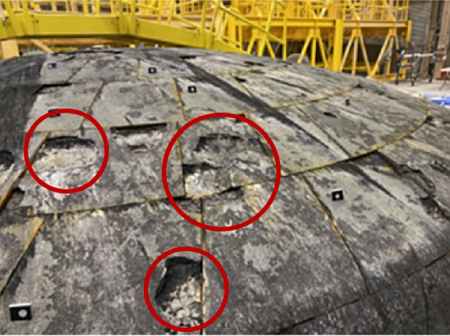
Although the SLS rocket will be ready for the current schedule, barring a catastrophe, the other elements are in doubt. For Artemis II, NASA still has not cleared a heat shield issue with the Orion spacecraft. That must be resolved before the mission gets a green light to proceed next year. The challenges are even greater for Artemis III. For that mission NASA needs to have a lunar lander—which is being provided by SpaceX with its Starship vehicle—in addition to spacesuits provided by Axiom Space for the lunar surface. Both of these elements remain solidly in the development phase.

What Boeing is telling us indirectly is that, though NASA has not yet announced any further delays in those launch dates for Artemis-2 and Artemis-3, those dates are going to be delayed, quite possibly by one or more years.

None of this is a surprise. I have long been predicting that the first manned lunar landing in the Artemis program will not take place before 2030. In fact, that date was obvious the moment NASA announced its plan to make the Lunar Gateway space station an integral part of the program, back in 2018, when it was called LOP-G.

Now that SLS development is complete and NASA considers it “operational”, Boeing is merely reducing the staffing to maintain its assembly line, reducing it accordingly because of expected delays when additional rockets will be needed.

3 comments

TESS has resumed science operations

Engineers have successfully returned TESS to full science operations, without providing as yet any explanaton as to why on April 8, 2024 it went into safe mode or what they did to fix the issue.

The Aprill 11 press release announcing the safe mode had only mentioned that the shut down had occurred “during scheduled engineering activities.” The lack of information continues to suggest that someone did an “Oops!” during those activities, and NASA is too embarassed to reveal that fact.

0 comments

NASA approves Dragonfly mission to the Saturn moon Titan

NASA yesterday announced that it has given final approval for the Dragonfly helicopter mission to the Saturn moon Titan.

With the release of the president’s fiscal year 2025 budget request, Dragonfly is confirmed with a total lifecycle cost of $3.35 billion and a launch date of July 2028. This reflects a cost increase of about two times the proposed cost and a delay of more than two years from when the mission was originally selected in 2019. Following that selection, NASA had to direct the project to replan multiple times due to funding constraints in fiscal years 2020 through 2022. The project incurred additional costs due to the COVID-19 pandemic, supply chain increases, and the results of an in-depth design iteration. To compensate for the delayed arrival at Titan, NASA also provided additional funding for a heavy-lift launch vehicle to shorten the mission’s cruise phase.

The rotorcraft, targeted to arrive at Titan in 2034, will fly to dozens of promising locations on the moon, looking for prebiotic chemical processes common on both Titan and the early Earth before life developed. Dragonfly marks the first time NASA will fly a vehicle for science on another planetary body. The rotorcraft has eight rotors and flies like a large drone.

Be prepared for the project to go overbudget, as NASA’s biggests projects almost always do.

1 comment

NASA admits that its Mars Sample Return project needs new ideas

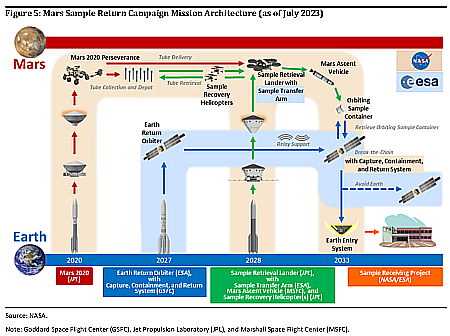
The present plan for Mars Sample Return

In issuing yesterday its reponse [pdf] to the February 28, 2024 audit [pdf] by NASA’s inspector general (IG) of its Mars Sample Return mission (MSR), NASA has admitted that its Mars Sample Return project needs new ideas and major changes. From the press release:

“The bottom line is, an $11 billion budget is too expensive, and a 2040 return date is too far away,” said [NASA administrator Bill] Nelson.

The agency will today issue a call for proposals from the private sector for alternative ideas for picking up the samples on Mars and getting them up into orbit.

This NASA response to the IG report however changes little else in overall project, and almost certainly will not succeed in either reducing cost or shortening the timeline in any way.
» Read more

12 comments

NASA: The piece of space junk that crashed through a Florida house came from ISS, and we released it

After completing a careful analysis of the 1.6 pound object that had crashed through two floors of a house in Florida on March 8, 2024, NASA engineers have confirmed that it came from the cargo pallet that was dumped from ISS in March 2021.

As part of the analysis, NASA completed an assessment of the object’s dimensions and features compared to the released hardware and performed a materials analysis. Based on the examination, the agency determined the debris to be a stanchion from the NASA flight support equipment used to mount the batteries on the cargo pallet. The object is made of the metal alloy Inconel, weighs 1.6 pounds, is 4 inches in height and 1.6 inches in diameter.

Though the NASA press release notes the agency will revise its computer models for determining what will burn up in the atmosphere and what will not, it says nothing about reinbursing the homeowner, Alejandro Otero, for the damage to his home. Based on the Outer Space Treaty, the U.S. is likely liable for this damage. I suspect the negotiations are on-going, and if Otero doesn’t have a lawyer yet, he should get one immediately.

4 comments

TESS in safe mode

NASA today revealed that on April 8, 2024 its TESS space telescope went into safe mode, for reasons that are not yet understood.

NASA’s TESS (Transiting Exoplanet Survey Satellite) entered into safe mode April 8, temporarily interrupting science observations. The team is investigating the root cause of the safe mode, which occurred during scheduled engineering activities. The satellite itself remains in good health.

The spacecraft itself remains healthy and they expect to resume science operations “in the coming days.”

That safe mode occurred while “scheduled engineering activities” were ongoing suggests that the two are linked. The lack of any details from NASA further suggests that someone did a “oops!” during those activities, and they are now scrambling to fix things.

1 comment

Japan and NASA ink lunar deal

After several years of discussion, Japan and NASA have finally signed an lunar exploration agreement whereby Japan will build a pressurized rover that astronauts can use to travel large distances in exchange for NASA launching two Japanese astronauts to the Moon.

An enclosed and pressurized rover will enable astronauts to travel farther and conduct science in geographically diverse areas by serving as a mobile habitat and laboratory for the astronauts to live and work for extended periods of time. It will be able to accommodate two astronauts for up to 30 days as they traverse the area near the lunar South Pole. NASA currently plans to use the pressurized rover on Artemis VII and subsequent missions over an approximate 10-year lifespan.

This rover is being built in a deal between Japan’s space agency JAXA and Toyota. It will be very heavy, which meanst NASA is now planning its lunar exploration with Starship as a fundamental part. No other planned lunar lander could bring this kind of mass to the surface.

The two Japanese astronauts will likely fly on two different Artemis missions over that time-span. When these missions will occur will largely depend on how long NASA stubbornly sticks with is SLS/Orion/Lunar Gateway framework for getting astronauts to the Moon. These assets are not yet ready. They are also very cumbersome and expensive and slow. Missions using SLS expecially cannot occur faster than every two years, if that. If NASA depends on them, serious lunar exploration will likely not occur before 2030, at the earliest.

If however SpaceX’s Starship/Superheavy becomes operational in the next two years, and NASA switches operations to it instead, the pace will pick up, exponentially. Launches could likely occur multiple times per year, and it will be possible to put large amounts of mass on the Moon quickly. That lunar base will be built fast.

The decision to switch however will require a political decision, one that it appears many in Washington are reluctant to make. First, the Democrats now see Elon Musk as an enemy. Why award his company? Secondly, SLS/Orion/Gateway are great jobs programs. Abandoning them will eliminate a lot of wasteful pork, a sin to the politicos who operate our government for their interests, not the interests of the country.

0 comments

Japan to sign deal with NASA to fly two Japanese astronauts to Moon

According to story in the Japanese press yesterday, a deal between Japan and NASA will be signed next week whereby Japan will have two astronauts go on Moon missions in exchange for providing cargo to the Lunar Gateway station as well as a manned lunar rover.

The report today is unclear whether those Japanese astronauts will land on the Moon, but I expect they will. The rover project is being led by Toyota. It will include a airtight cabin where spacesuits will not be necessary and passengers can also sleep, allowing for very long exploratory traverses from the landing site.

Reports of this deal have been appearing in the press since 2022, when NASA said it would involve flying one Japanese astronaut to the Moon. In December 2023 it was reported that the deal would be signed within a month. It is now April. It appears the extended negotiations have gotten Japan a second astronaut Moon walker.

NASA’s Artemis program is beginning to shape up as an international program for getting almost everyone to the Moon but Americans. I am exaggerating, but I think in the future Americans will find it easier to go on a private mission to the Moon than depend on NASA, especially because of all the international deals NASA will have to honor.

0 comments

Mitsubishi joins private consortium building the Starlab commercial space station

The Japanese big space company Mitsubishi has now joined the private consortium building the Starlab commercial space station for NASA, teaming up with Voyager Space and Airbus.

At this moment it appears that Voyager, the lead company in this station, is attempting to capture the international market that up to now has been part of ISS. Airbus gets it direct access to European companies and the Europeans Space Agency (ESA). Mitsubishi now gets it direct access to Japanese government financing.

The other stations being built with NASA financing, Axiom and Orbital Reef, so far seem more focused on getting American business, as is Vast’s Haven-1 station, being built entirely from private funds.

3 comments

Voyager-1 still out of commission

Though engineers have now confirmed the cause of the computer problem that has prevented Voyager-1 from sending back readable data, a fix has not yet been attempted and the spacecraft remains in safe mode.

In early March, the team issued a “poke” command to prompt the spacecraft to send back a readout of the FDS [Flight Data Subsystem] memory, which includes the computer’s software code as well as variables (values used in the code that can change based on commands or the spacecraft’s status). Using the readout, the team has confirmed that about 3% of the FDS memory has been corrupted, preventing the computer from carrying out normal operations.

The team suspects that a single chip responsible for storing part of the affected portion of the FDS memory isn’t working. Engineers can’t determine with certainty what caused the issue. Two possibilities are that the chip could have been hit by an energetic particle from space or that it simply may have worn out after 46 years.

Although it may take weeks or months, engineers are optimistic they can find a way for the FDS to operate normally without the unusable memory hardware, which would enable Voyager 1 to begin returning science and engineering data again.

Considering that Voyager-1’s power supply will run out sometime in 2026, after almost a half century of operation, the engineers really don’t have that much time to fix the problem and resume science operations.

7 comments

NASA picks three commercial companies to build manned lunar rovers

Capitalism in space: NASA yesterday announced that it has picked three commercial companies, Astrolab, Intuitive Machines, and Lunar Outpost, to begin feasibility design work on its new manned lunar rovers, dubbed a Lunar Terrain Vehicle (LTV), for its planned Artemis missions to the Moon.

NASA will acquire the LTV as a service from industry. The indefinite-delivery/indefinite-quantity, milestone-based Lunar Terrain Vehicle Services contract with firm-fixed-price task orders has a combined maximum potential value of $4.6 billion for all awards.

The three companies are actually each a partnership of several American companies, as follows:

  • Astrolab is building its FLEX rover in partnership with Axiom Space, Inc., and Odyssey Space. Its contract is worth up to $1.9 billion.
  • Intuitive Machines is building its RACER rover in partership with AVL, Boeing, Michelin, and Northrop Grumman. This initial award is worth $30 million, but future buys from NASA could exceed $1 billion.
  • Lunar Outpost is building its Lunar Dawn rover in partnership with Lockheed Martin, General Motors, Goodyear, and MDA Space.

All three lead companies are essentially startups that have partnered with older established players, a likely requirement imposed by NASA to give their effort some experienced help. Though this system of dividing up the work between all the players follows the old scheme used by NASA and the established big space companies for decades in order to guarantee every company gets steady work and a continuing cash flow from the government, the difference is that the product will be designed, built, and owned by each partnership, not NASA, allowing each to sell that product to others outside the agency.

If this goes as planned, eventually the government money will become somewhat irrelevant, once a real commercial industry starts functioning in space and on the Moon. That’s what happened in the airplane industry in the 1920s to the 1950s.

8 comments

Engineers confirm IXPE is fixed and resuming science observations

Engineers have now confirmed the software fix they sent to the IXPE space telescope on March 26, 2024 has worked, and have taken the telescope out of safe mode so that it can resume science observations.

The IXPE mission is now observing a new transient X-ray source – Swift J1727.8–161 – a candidate accreting black hole. The source has recently begun producing jets of material moving at a fraction of the speed of light. The IXPE observations will help to understand accretion onto black holes, including potentially revealing how the relativistic jets are formed.

The telescope observes the universe in X-rays, but does so by observing its polarization. This approach provides information not seen in direct observations.

0 comments

Technical issues with Lockheed Martin’s Orion capsule to delay next Artemis mission

It appears that technical issues with Lockheed Martin’s Orion capsule are one of the main reasons NASA has had to delay next Artemis mission, the first to put humans inside that capsule and then take them around the Moon.

In January 2024 it was reported that the mission would be delayed from a launch before the end of 2024 until 2025. We now know why:

NASA is working with Orion spacecraft prime contractor Lockheed Martin to resolve a handful of issues that came up late last year during ground testing, forcing the space agency to delay the launch readiness target date for its Artemis II circumlunar mission to September 2025. The Lockheed Martin assembly, test, and launch operations (ATLO) team at Kennedy Space Center (KSC) is reinstalling some electronics and implementing workarounds for others affected by an electrical circuit flaw found in digital motor controllers on the spacecraft.

While a resolution to that issue appears to be getting closer, the Orion program and contractor teams are also working through the corrective actions process for a problem with how the Orion batteries handle the shock of an extreme abort case.

In other words, Lockheed Martin discovered these two electrical issues only last year, after spending almost two decades and more than $15 billion developing Orion.

As I predicted in January, “None of these dates will be met. I predict that further delays will be announced next year and the year after that, pushing all these missions back again, in small increments.” I also predicted that NASA will be lucky to land a human on the Moon by 2030, a mere fifteen years after its original target date of 2015, set by George Bush Jr. in 2004.

In the meantime, expect SpaceX’s Starship to begin regularly commercial and governmental flights to the Moon in the next five years. Long before SLS and Orion put humans on the Moon, Starship will be doing it privately for less cost.

11 comments

First manned Starliner mission now targeting a May 6, 2024 launch

In order to work around scheduling issues at ISS, NASA and Boeing have now scheduled the first manned Starliner mission to launch no earlier than May 6, 2024.

Following a review of the International Space Station operations, NASA’s Boeing Crew Flight Test now is targeting no earlier than Monday, May 6, for Starliner’s first launch with astronauts to the orbital complex. The date adjustment optimizes space station schedule of activities planned toward the end of April, including a cargo spacecraft undocking and a crew spacecraft port relocation required for Starliner docking. NASA and Boeing also are performing prelaunch closeout work and completing final certification for flight.

Two astronauts will fly the capsule to ISS for a two week stay, testing its systems in order to determine if it is ready for regular operations.

This launch is years behind schedule due to numerous technical problems that have cost Boeing billions in extra costs as well as lost income. In order to convince other customers besides NASA to buy seats on Starliner will likely require the capsule to fly many times without issues. Until then, I suspect anyone wishing to do a tourist flight in space will pick SpaceX instead, because of its now proven safety and reliability record.

0 comments

De-orbiting debris from ISS hits a house in Florida

It appears that a 2-pound piece of a de-orbiting “cargo pallet” from ISS bored through the roof of a house in Florida on March 8, 2024 and broke through two floors.

A Nest home security camera captured the sound of the crash at 2:34 pm local time (19:34 UTC) on March 8. That’s an important piece of information because it is a close match for the time—2:29 pm EST (19:29 UTC)—that US Space Command recorded the reentry of a piece of space debris from the space station. At that time, the object was on a path over the Gulf of Mexico, heading toward southwest Florida.

This space junk consisted of depleted batteries from the ISS, attached to a cargo pallet that was originally supposed to come back to Earth in a controlled manner. But a series of delays meant this cargo pallet missed its ride back to Earth, so NASA jettisoned the batteries from the space station in 2021 to head for an unguided reentry.

NASA had taken possession of the piece to determine for certain if it is from ISS. Who is liable for the damages could become a legal tangle. The depleted batteries were owned by NASA, but were brought to ISS on a Japanese HTV cargo freighter. According to the Outer Space Treaty, the nation that launches an item is liable for any damages it causes when it crashes back on Earth. The language however doesn’t really cover a case where one nation builds the item for launch, and another nation launches it.

The owner, Alejandro Otero, had to use Twitter to get a response from NASA. According to his tweet, he had called and emailed the agency and had been ignored. Only after other news sources picked up the story did NASA respond. Furthermore, when NASA jettisoned the pallet from ISS it had insisted that the discarded batteries would burn up entirely in the atmosphere, even though other experts said differently.

The Aerospace Corporation, a federally funded research and development center, says a “general rule of thumb” is that 20 to 40 percent of the mass of a large object will reach the ground. The exact percentage depends on the design of the object, but these nickel-hydrogen batteries were made of metals with relatively high density. Ahead of the reentry, the European Space Agency also acknowledged some fragments from the battery pallet may survive to the ground.

What this information tells us is that NASA knew this discarded pallet posed a risk, but made believe it didn’t.

12 comments

Antenna for joint NASA-ISRO radar satellite needs fix, delaying launch

The large deployable antenna for a joint NASA-ISRO radar satellite, dubbed NISAR, that was targeting a spring launch will require an extra coat of reflective material, thus delaying the satellite’s launch until the second half of this year.

In a March 22 statement, NASA said a new launch date for the NASA-ISRO Synthetic Aperture Radar (NISAR) mission will be set at the end of April because of work to protect the spacecraft’s reflector, an antenna that is 12 meters across when fully deployed, from temperatures when in its stowed configuration. “Testing and analysis identified a potential for the reflector to experience higher-than-previously-anticipated temperatures in its stowed configuration in flight,” NASA said in the statement. To prevent those increased temperatures, a “special coating” will be applied to the antenna so that it reflects more sunlight.

That work, NASA said, requires shipping the antenna, currently with the rest of the NISAR spacecraft in India, to a facility in California that can apply the coating. NASA did not state how long the process of applying the coating, as well as shipping the antenna to California and then back to India, will take.

It appears that the need for this additional coat was discovered during environmental testing by ISRO engineers in India as part of its preparation for launch on India’s GSLV rocket. Based on the JPL website for this mission, it appears this antenna system was built by JPL.

NASA is providing the mission’s L-band synthetic aperture radar, a high-rate communication subsystem for science data, GPS receivers, a solid-state recorder and payload data subsystem. ISRO is providing the spacecraft bus, the S-band radar, the launch vehicle and associated launch services.

Though the purpose of the final environmental testing prior to launch is specifically to find such issues and correct them, the question remains why this issue occurred. One can’t help wondering if the many management problems detailed at JPL in several reports (here, herej, here) might have contributed, including the organization’s total commitment since 2022 to Diversity, Equity, and Inclusion quotas, making skin color and sex the primary qualifications for hiring, rather than skill, education, or talent.

1 comment

SpaceX launches a cargo Dragon to ISS

SpaceX today successfully launched a Dragon freighter to ISS, its Falcon 9 rocket lifting off from Cape Canaveral in Florida.

The cargo Dragon was flying for the fourth time. It will dock with ISS on March 23, 2024. The first stage completed its sixth flight, landing back at one of SpaceX’s landing pads at Cape Canaveral.

This was also the first Dragon launch from this particular SpaceX launchpad in four years. The company only recently reconfigured it for Dragon flights, both manned and unmanned, so that it has two options for launching NASA manned missions. NASA had demanded this before it would give SpaceX permission to launch Superheavy/Starship from that rocket’s new launchpad in Florida. The agency thought it was too close to SpaceX’s first manned launchpad, and wanted an option in case a Superheavy launch failure damaged the Dragon launchsite. With this success SpaceX is one step closer to flying operational Superheavy/Starship flights out of Cape Canaveral.

The leaders in the 2024 launch race:

28 SpaceX
12 China
4 Rocket Lab
3 Russia

American private enterprise now leads the rest of the world combined in successful launches 33 to 21, while SpaceX now leads the entire world, including American companies, 28 to 26.

1 comment

Apollo astronaut Tom Stafford passes away at 93

Apollo 10 astronaut Tom Stafford, who also flew two Gemini missions as well as the Apollo-Soyuz mission, passed away yesterday at the age of 93.

Stafford’s first flight was on Gemini 6, which achieved the first rendezvous in space when it maneuvered close to Gemini 7 during its two week mission. He then flew on Gemini 9, which was to attempt the first docking but was stymied when the shroud on the Agena target vehicle failed to release, blocking the docking port. The crew could only rendezvous again.

Stafford then commanded Apollo 10, the dress rehearsal for the lunar landing, flying his lunar module to within about ten miles of the Moon’s surface. His final mission was Apollo-Soyuz, the first joint mission between the United States and the Soviet Union.

Of the 24 Apollo astronauts that flew to the Moon, only seven still live. A truly great generation of Americans, possibly the greatest generation of all, is slowly leaving us.

3 comments

What to expect on the next few Starship/Superheavy test launches

Superheavy/Starship lifting off on March 14, 2024

As noted last week by Eric Berger after the third orbital test launch of SpaceX’s Superheavy/Starship rocket on March 14, 2024, this rocket is presently only a few short steps to becoming an operational expendable rocket that can put 100 to 150 metric tons into orbit for about the cost of a Falcon Heavy launch.

To completely achieve this status SpaceX will still have to accomplish several additional engineering goals during the next few test flights, beyond what it has been done so far. This is what I predict therefore for the next test flight, number four:

Superheavy

SpaceX will once again attempt to softly bring Superheavy down over the ocean in the Gulf of Mexico, hovering the stage vertically over the surface for a few seconds to demonstrate it could do the same once it eventually comes down next to the launch tower so that the chopsticks can grab it. To do this the company will have to figure out what went wrong on last week’s flight, when the stage began to tumble as it dropped below 100 kilometers altitude. It also appeared to be unable to fire its engines as planned.

An even more important achievement on this third flight however will be a third straight successful hot fire stage separation, sending Starship on its way to orbit as planned. If Superheavy can do this for the third time, it will prove without doubt that the rocket stage is now capable of doing its number one job, launching payloads. Reusability can follow later.

Starship
» Read more

18 comments

Engineers report progress in restoring proper communications with Voyager-1

According to a NASA update yesterday, software engineers for the Voyager-1 spacecraft now beyond the edge of the solar system have managed to decipher the garbled data the spacecraft’s computers have been sending back to Earth since November 2023, and are in the process of analyzing that data with the hope of restoring full understandable communications.

The source of the issue appears to be with one of three onboard computers, the flight data subsystem (FDS), which is responsible for packaging the science and engineering data before it’s sent to Earth by the telemetry modulation unit.

On March 3, the Voyager mission team saw activity from one section of the FDS that differed from the rest of the computer’s unreadable data stream. The new signal was still not in the format used by Voyager 1 when the FDS is working properly, so the team wasn’t initially sure what to make of it. But an engineer with the agency’s Deep Space Network, which operates the radio antennas that communicate with both Voyagers and other spacecraft traveling to the Moon and beyond, was able to decode the new signal and found that it contains a readout of the entire FDS memory.

This new readable data was the result of a command sent two days before, suggesting that engineers are on the right track. Because Voyager-1 is so far away, 15 billion miles, it takes 22.5 hours for any command to be sent to the spacecraft, and another 22.5 hours for ground controllers to get a response. This long lag time has slowed the effort to fix the problem, but this new success suggests that a full recovery is possible.

That recovery is going to be relatively short-lived, no matter what. The nuclear-powered power sources for both Voyager spacecraft, flying since 1977, are expected to finally run out of power sometime in 2026, after almost a half century of operation. Moreover, the computers on both Voyagers are the longest continuously running computers in history.

The engineering achievement of both is astonishing.

5 comments
1 20 21 22 23 24 116