ULA’s Vulcan rocket successfully places payload in orbit on first launch

Vulcan at liftoff.
Vulcan at liftoff.

After four years of delay, mostly caused by delays at Blue Origin in delivering the two BE-4 engines used in the first stage, ULA’s Vulcan rocket finally completed its first launch early on January 8, 2024, lifting off from Cape Canaveral and successfully placing Astrobotic’s Peregrine lunar lander into orbit.

As of posting the upper stage had just deployed Peregrine, which will leave Earth orbit in about four days using its own engines. The upper stage has one more burn to send it into solar orbit, carrying the ashes of numerous people for the company Celestis.

The 2024 launch race:

3 SpaceX
1 India
1 China
1 ULA

For ULA, this launch is a very big deal. It is the first of two required in order for the Space Force to certify the rocket for future military launches. It also positions the company to begin the many launches that Amazon has awarded it to place into orbit a large percentage of that company’s Kuiper internet satellite constellation, assuming of course Blue Origin can deliver on schedule the many BE-4 engines that ULA will require.

This launch will also likely lead to the sale of ULA. » Read more

10 comments

NASA: UAE to build airlock module for lunar station plus have astronaut fly there

According to a press release from NASA today, the United Arab Emirates (UAE) will build the airlock module for the Lunar Gateway space station plus have one astronaut fly a mission to the station after it is built.

Under a new implementing arrangement expanding their human spaceflight collaboration with NASA through Gateway, MBRSC will provide Gateway’s Crew and Science Airlock module, as well as a UAE astronaut to fly to the lunar space station on a future Artemis mission.

I strongly suspect that the UAE will mostly pay for this module to be built, hiring outside contractors from either the U.S. or Europe to do the work.

4 comments

Russia and NASA agree to extend ISS astronaut exchanges on each other’s spacecraft through 2025

Russia and NASA have agreed to extend their barter deal through 2025, whereby each nation sends astronauts to ISS periodically on the other nation’s rockets and capsules.

This is a barter deal, with no exchange of money. The fundamental idea is to make sure astronauts on board ISS understand how the capsules from each nation operate in case of emergency. Russia had initially resisted signing such a deal after SpaceX began providing NASA its Dragon capsules and Falcon 9 rocket to get astronauts to ISS. It said this was because it did not trust SpaceX’s technology, but I suspect Roscosmos was also hoping to squeeze some cash from NASA as it was no longer being paid to fly U.S. astronauts on its Soyuz rocket and capsule. That attempt was futile. For numerous political reasons there was no way NASA was going to pay Russia anything in this barter deal.

Russia then signed on, and will keep extending this agreement until the day ISS is retired, or it finally launches its own station (something that is becoming increasingly unlikely).

1 comment

Navaho Indians attempt to claim ownership of the Moon, delay Vulcan launch

The president of the Navaho Nation has asked NASA to delay the first launch of ULA’s Vulcan rocket because it carries ashes from a number of people (none who were members of its tribe) that Astrobotic’s Peregrine lander will place on the Moon.

The remains are a payload purchased by the company Celestis, which offers this burial option to anyone who wishes it. On this flight that payload includes a wide range of ashes, including many actors and creators from the original Star Trek series.

Navaho President Buu Nygren claims that the “Moon is sacred to numerous Indigenous cultures and that depositing human remains on it is ‘tantamount to desecration.'”

Nygren highlighted this commitment in his letter, as well as a 2021 memo signed by the Biden administration that pledged to consult the tribe on matters that impact them. “This memorandum reinforced the commitment to Executive Order 13175 of November 6, 2000,” President Nygren wrote. “Additionally, the Memorandum of Understanding Regarding Interagency Coordination and Collaboration for the Protection of Indigenous Sacred Sites, which you and several other members of the Administration signed in November 2021, further underscores the requirement for such consultation.”

In other words, though the Navaho have no plans to ever go there, have done nothing to try to explore it, and have no remains of any tribal members on the flight, he wants to claim the Moon as controlled entirely and forever by the Indian tribes of North America because of a law designed solely to protect specific archeological sites on Earth, where Indian remains are discovered.
» Read more

19 comments

Japan & NASA negotiating plan to put Japanese astronaut on later Moon landing mission

According to the Japanese press, Japanese and American government officials are negotiating a plan to include a Japanese astronaut on one of the later Artemis Moon landing missions, presently hoping to fly in the late 2020s.

Japan has been negotiating with the United States, aiming for its first landing on the moon in the late 2020s. Tokyo and Washington will establish and sign an agreement on the activities of Japanese astronauts on the moon as early as next month, according to several government sources.

These stories are likely linked to the blather from Vice President Harris last week saying the U.S. will fly an international astronaut to the Moon before the end of the decade. At the time NASA officials would not confirm her statement, other than to say that NASA had agreed to fly European, Canadian, and Japanese astronauts to its Lunar Gateway station as part of its Artemis lunar program.

Several important details must be noted. First, the schedule for Artemis, as designed by NASA using SLS, Orion, Lunar Gateway, and Starship, is incredibly optimistic. The first manned mission is presently scheduled for 2025, but no one believes that date, including many at NASA. It will likely slip to 2026 or even 2027.

Second, the program is very fluid, and could undergo major changes with a new administration, especially because of the high cost of SLS. Once Starship/Superheavy is flying, at a cost expected to less than 1% of SLS, with an ability to fly frequently instead of once every two or three years, a new government might scrap the entire Artemis program as designed. A shift from SLS to Starship entirely might actually increase the number of astronauts going to the Moon, both from the U.S. and the entire Artemis Accords alliance.

2 comments

Curiosity takes a close-up of distant cliffs

Panorama on December 20, 2023
Panorama on December 20, 2023. Click for full image.

Close-up of a distant cliff
Click for original image.

Cool image time! The picture to the right, reduced and sharpened to post here, was taken on December 21, 2023 by the chemistry camera (ChemCam) on the rover Curiosity. Originally designed to take close-ups of rocks very nearby the rover, the science team over time discovered that they could also use this camera to get close-ups of very distant objects, providing them another way to study the geology in Gale Crater and on Mount Sharp.

The picture to the right I think shows the horizon area indicated by the arrow on the panorama above, taken the day before. Note the many many layers, a geological feature that Curiosity has discovered is ubiquitous on Mars. Over eons the entire surface of the red planet has been layered repeatedly by cyclical geological events, producing layers within layers within layers. I guarantee that when Curiosity gets closer to this cliff it will see layers inside the smallest layers ChemCam can see now.

The red dotted line on the panorama above indicates the approximate planned route that Curiosity will eventually take, cutting across in front of that mountain and turning south somewhere near but to the west of where the cliff in this picture is located.
» Read more

8 comments

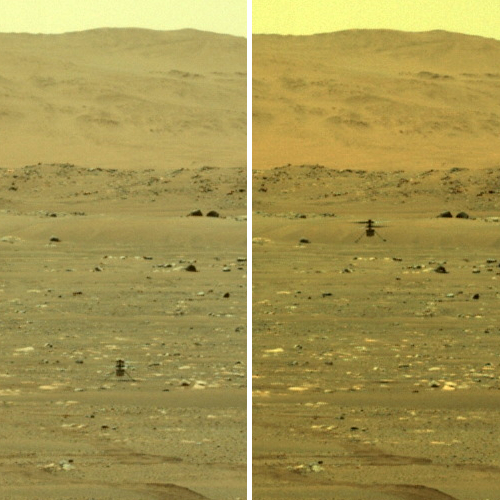
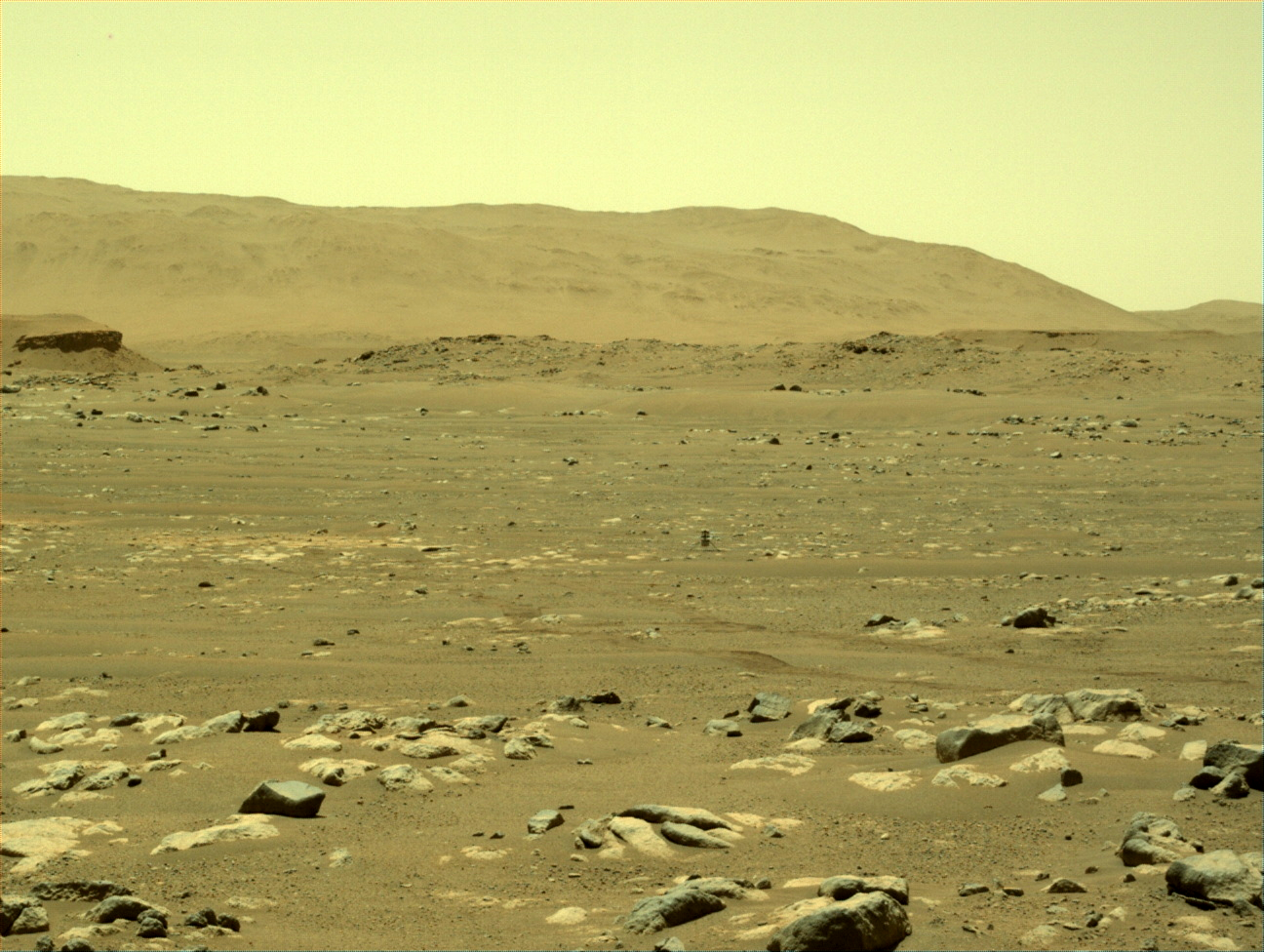
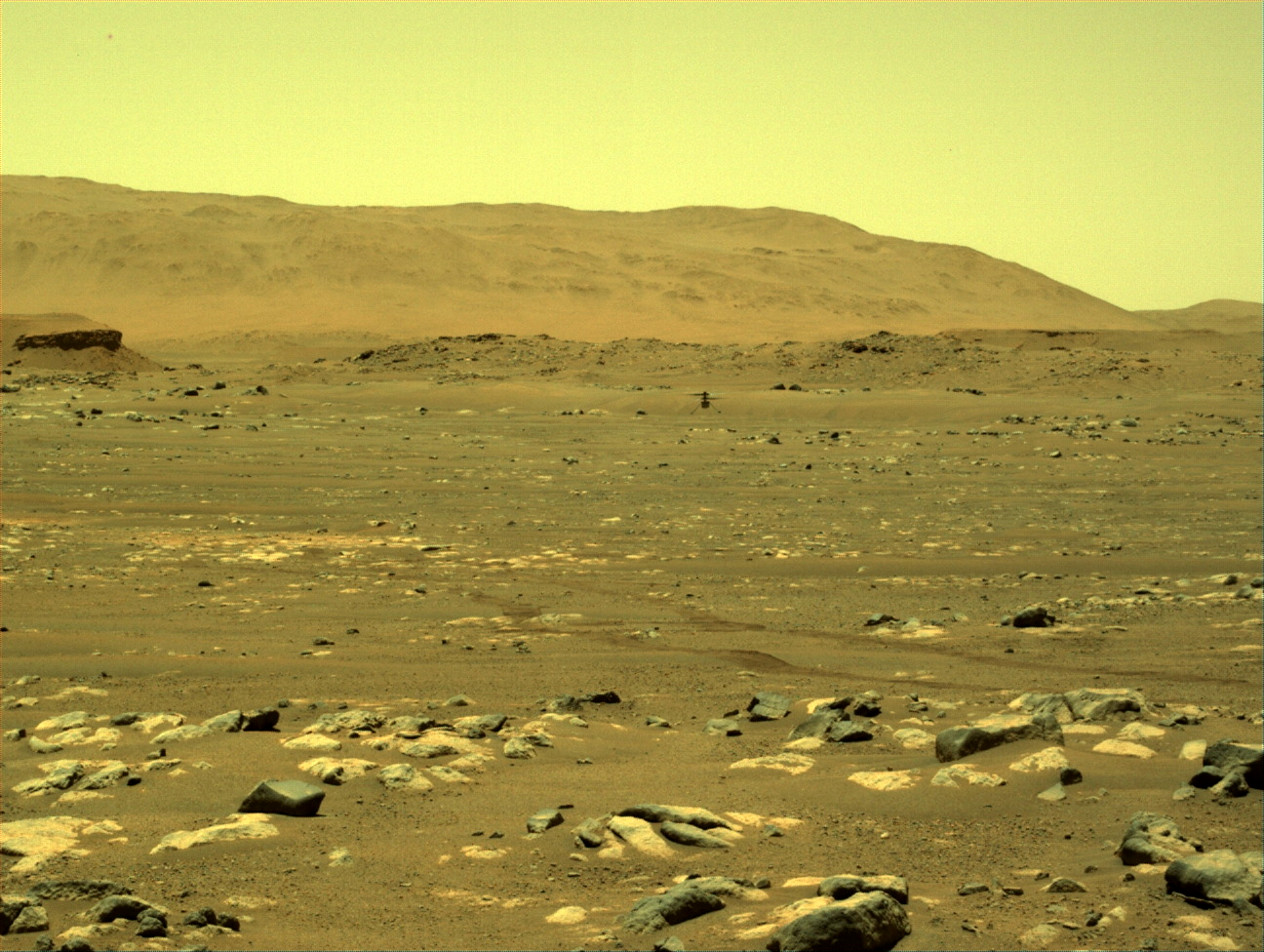
Ingenuity’s engineers explain what they have learned flying the helicopter on Mars

Link here. The essay details carefully the problems they have faced, and how they have not only overcome them but used them to refine operations to squeeze far more capabilities out of the helicopter, beyond its initial design.

Saving flight time saves energy, reduces heating, and provides more freedom to use slower speeds to tiptoe around disruptive terrain that might otherwise endanger or significantly degrade the landing accuracy of the helicopter. Higher speeds and higher accelerations reduce the time needed to execute a given flight path. Higher altitudes permit higher speeds, as the wider field of view helps to keep ground features in view of Ingenuity’s navigation camera longer, counteracting the effect of increased speed. Expanding Ingenuity’s flight envelope had the potential to relax flight planning constraints and allow Ingenuity to operate more effectively alongside Perseverance.

As a result, beginning with flight 45 the team has made changes to increase flight speeds and acceleration at every point of every flight, thus allowing the helicopter to fly higher and farther with less strain.

This report however does not provide any information on Ingenuity’s last two flights, especially its 68th, which did not go as planned. The helicopter appears to be in good shape (the team has already planned the 69th flight, which was supposed to happen two days ago), but a more detailed update would be appreciated.

0 comments

ULA’s Vulcan rocket fully stacked for the first time

Peregrine landing site
The landing site for Astrobotic’s Peregrine lunar lander

In preparation for its targeted January 8, 2024 launch, ULA’s Vulcan rocket has now been fully stacked for first time in its assembly building at Cape Canaveral.

ULA’s new rocket has rolled between its vertical hangar and the launch pad at Cape Canaveral Space Force Station several times for countdown rehearsals and fueling tests. But ULA only needed the Vulcan rocket’s first stage and upper stage to complete those tests. The addition of the payload shroud Wednesday marked the first time ULA has fully stacked a Vulcan rocket, standing some 202 feet (61.6 meters) tall, still surrounded by scaffolding and work platforms inside its assembly building.

It will next be rolled to the launchpad for some final checks prior to launch on January 8, 2023. Unlike most first launches, it carries a real payload, Astrobotic’s Peregrine lunar lander, which hopes to softly place several NASA and commercial payloads near the Gruithuisen Domes in the northwest quadrant of the Moon’s visible hemisphere, as shown on the map above.

1 comment

Laser communication tests with Psyche have now included a cat video

Following up on the first tests in mid-November, engineers on December 11, 2023 downloaded a 15-second cat video from the asteroid probe Psyche at a distance of 19 million miles, demonstrating fast download speeds 10 to 100 times faster than the best radio transmissions.

The demo transmitted the 15-second test video via a cutting-edge instrument called a flight laser transceiver. The video signal took 101 seconds to reach Earth, sent at the system’s maximum bit rate of 267 megabits per second (Mbps). Capable of sending and receiving near-infrared signals, the instrument beamed an encoded near-infrared laser to the Hale Telescope at Caltech’s Palomar Observatory in San Diego County, California, where it was downloaded. Each frame from the looping video was then sent “live” to NASA’s Jet Propulsion Laboratory in Southern California, where the video was played in real time.

I have embedded that video below. More details about the information in that video can be found here.
» Read more

18 comments

NASA: The flight plan for Dream Chaser Tenacity’s first demo mission to ISS

NASA today provided a detailed description of the flight plan for the first demo ISS mission of Sierra Space’s first Dream Chaser reuseable mini-shuttle, dubbed Tenacity, now targeting some unspecified date in 2024.

It will carefully approach ISS, testing its maneuvering and rendezvous capibilities, and then be grabbed by the station’s robot arm to be berthed to the station.

On its first flight to the International Space Station, Dream Chaser is scheduled to deliver over 7,800 pounds of cargo. On future missions, Dream Chaser is being designed to stay attached to the station for up to 75 days and deliver as much as 11,500 pounds of cargo. Cargo can be loaded onto the spacecraft as late as 24 hours prior to launch. Dream Chaser can return over 3,500 pounds of cargo and experiment samples to Earth, while over 8,700 pounds of trash can be disposed of during reentry using its cargo module.

On this first demo flight it will remain docked for 45 days, and then land on the shuttle runway at Cape Canaveral.

4 comments

NASA celebrates the 120th anniversary of the Wright Brothers first flight

Link here. The NASA article does a thorough job of not only describing that first powered flight from Kitty Hawk, it shows how that success is linked to the establishment first of the National Advisory Committee on Aeronautics (NACA), which after Sputnik became NASA.

NASA in turn has repeatedly honored the Wright Brothers and their work on subsequent space missions.

Pieces of the Wright Flyer, sometimes called Kitty Hawk, have flown in space, carried there by astronauts with a geographic connection and a sense of history. In 1969, under a special arrangement with the U.S. Air Force Museum in Dayton, Ohio, Apollo 11 astronaut Neil A. Armstrong, like the Wright brothers a native of Ohio, took with him a piece of wood from the Wright Flyer’s left propeller and a piece of muslin fabric (8 by 13 inches) from its upper left wing. The items, stowed in his Lunar Module Eagle personal preference kit, landed with him and fellow astronaut Edwin E. “Buzz” Aldrin at Tranquility Base, and returned to Earth with third crew member Michael Collins in the Command Module Columbia. Visitors can view these items near the Wright Flyer at the NASM.

In 1986, North Carolina native NASA astronaut Michael J. Smith arranged with the North Carolina Museum of History in Raleigh to take a piece of wood and a swatch of fabric salvaged, and authenticated by Orville Wright, from the damaged Wright Flyer aboard space shuttle Challenger’s STS-51L mission. Although Challenger and its crew perished in the tragic accident, divers recovered the artifacts from the wreckage and visitors can view them at the North Carolina Museum of History.

…A piece of the Wright Flyer has even traveled beyond the Earth-Moon system. When the Mars 2020 Perseverance rover landed in Mars’ Jezero Crater on Feb. 18, 2021, it carried underneath it a four-pound autonomous helicopter named Ingenuity. Engineers attached a small piece of cloth the size of a postage stamp from the Wright Flyer’s wing to a cable underneath the helicopter’s solar panel. On April 19, 2021, when Ingenuity lifted off to a height of 10 feet, it marked the first powered aircraft flight on a world other than Earth. Ingenuity’s first flight lasted 39 seconds in an area NASA named Wright Brothers Field. The United Nations International Civil Aviation Organization gave the field the airport code of JZRO – for Jezero Crater – and the helicopter type designator IGY, with the call-sign INGENUITY.

There is one major difference between NASA and the Wright Brothers. The latter worked independently with private funds given voluntarily. The former has always been a governent operation, funded by coerced taxes. The consequences of this difference are so profound many have written books describing them.

6 comments

NASA updates status of three private space stations

NASA today posted a short update of the development status for the three private space stations for which it has signed contracts.

Not surprisingly, Axiom’s station appears to be the most advanced.

Axiom Space, which holds a firm-fixed price, indefinite-delivery, indefinite-quantity contract with NASA, is on schedule to launch and attach its first module, named Axiom Hab One, to the International Space Station in 2026. A total of four modules are planned for the Axiom Commercial Segment attached to the station. After the space station’s retirement, the Axiom Commercial Segment will separate and become a free-flying commercial destination named Axiom Station.

With the remaining two stations, Starlab and Orbital Reef, the update provided no schedule information. While both Starlab, being built by a consortium led by Voyager Space, and Orbital Reef, being built by a consortium led by Blue Origin, appear to be making progess, the former appears to be accomplishing more than the latter, though that impression could simply be what NASA decided to report. For example, in describing the work being done on Orbital Reef, NASA chose for some reason to say nothing about the testing Sierra Space has been doing to test the inflatible module planned for the station. By leaving that out it makes it appear as if less has been done in developing that station.

These are not the only private space stations being proposed, only the ones that have contracts with NASA. A fourth station, Vast, is being built using funding from private sources, and is partnering with SpaceX.

0 comments

NASA to allow bidders on de-orbiting ISS to work under cost-plus contracts

In a major change of recent policy trends, NASA has decided to allow any bidders on the project to deorbit ISS to have the choice of working under either a fixed-price or a cost-plus contract.

In a procurement notice posted Dec. 5, NASA announced it would allow companies the choice of using either firm fixed price or cost plus incentive fee contract structures for both the design and the production of the U.S. Deorbit Vehicle (USDV).

When NASA issued the original request for proposals (RFP) for the vehicle in September, the agency gave bidders a choice. They could propose to develop the vehicle using a cost-plus contract and then produce it under a fixed-price contract, a so-called “hybrid” approach. Alternatively, they could propose doing both development and production under fixed-price contracts.

The revised approach now adds an option to perform both the development and the production under cost-plus contracts. NASA, in both the procurement notice and a blog post, did not disclose the reason for the change.

In recent years NASA had been shifting more and more to fixed-price contracts, because it works. It either forces discipline on companies, making them get the job done at cost and on time, or it reveals that the company is incompetent (as in the case of Boeing and its Starliner capsule), valuable information for future bidding.

I suspect that Boeing’s recent decision to refuse to sign any fixed-price contracts played a hand in this decision. For the last decade or so there have been many government officials who like to treat Boeing as their best friend, despite its recent failures. By doing so they increase the chances the company will hire them as consultants when they retire from their government job. Also, politicians tend to bow to this big company due to its large footprint in many congressional districts.

The result is this shift back to cost-plus. This will also mean that this project will likely go overbudget and behind schedule, as such contracts routinely do. The winning bidder will have no incentive to rein in costs. In fact, the nature of the contract will encourage just the opposite, as any cost overruns will be picked up by the government.

9 comments

Hubble to resume science operations using three gyros

Engineers have apparently figured out the issues with one of the Hubble Space Telescope’s three gyroscopes, and plan to resume science operations today using all three gyros.

After analyzing the data, the team has determined science operations can resume under three-gyro control. Based on the performance observed during the tests, the team has decided to operate the gyros in a higher-precision mode during science observations. Hubble’s instruments and the observatory itself remain stable and in good health.

This is excellent news. If it had been determined that the funky gyro was no longer functional, the telescope would have shifted into what the engineers call “one-gyro mode.” By using only one of the two remaining gyros, Hubble’s life could be extended. However, while it would allow the telescope to point and continue observations, the images would no longer be as sharp.

9 comments

NASA to fly Indian astronaut to ISS next year

During meetings in India between NASA and ISRO officials, instigated by administrator Bill Nelson’s visit this week, the mission details for the flight of an Indian astronaut to ISS in 2024 are now being worked out.

A Nasa delegation led by Nelson held a meeting with minister of state for science & technology Jitendra Singh on Tuesday. “I had a discussion with the minister on what the Indian astronaut would do on the space station. And the two of us talked about the fact that things that are important to India in scientific research, the Indian astronaut ought to have that as a choice to do. If there is a particular part of research that he or she would be interested in, then I want to encourage that,” Nelson later said at a media interaction. “Nasa will help train the Indian astronaut to fly to ISS by end of 2024. Those details are being worked out. Indian Space Research Organisation (Isro) will announce that,” Nelson said.

Though this plan for NASA to fly Indian astronaut to ISS next year was first announced in June, it was overshadowed by India’s decision at that time to sign the Artemis Accords.

It is also important to recognize that the real arrangements are all being done by others, that Nelson and the India government officials are merely there to get their faces on television.

If this flight happens as planned, next year could be very exciting for India’s manned space program, since it also hopes to fly its own manned mission at that time.

1 comment

Dragonfly mission to Titan delayed by a year because of budget shortfalls

Even as NASA gave engineers approval to move forward on building the helicopter set to fly on the Dragonfly mission to the Saturn moon Titan, it also revealed that the mission’s launch has been delayed by at least one year because of budget shortfalls.

In a presentation at a Nov. 28 meeting of NASA’s Outer Planets Assessment Group (OPAG), Lori Glaze, director of NASA’s planetary science division, said agency leadership decided to postpone formal confirmation of the mission earlier this month, a milestone where the agency sets an official cost and schedule for the mission.

The delay in confirmation by NASA’s Agency Program Management Council (APMC), she said, is based on uncertainty about how much money will be available for the mission and other parts of NASA’s planetary science portfolio given broader budget pressures on the agency. “Because of these incredibly large uncertainties in FY ’24 and FY ’25 funding and budgets, the decision was made at that APMC to postpone the official confirmation,” she said.

The launch had been scheduled for 2027. When it will launch now is unclear.

Apparently (and not surprising since this is a NASA project) the mission is beginning to cost more than originally predicted. Furthermore, this shortfall is enhanced by the cost overruns from the Mars Sample Return mission. In fact, it appears that these cost overruns are impacting NASA’s entire planetary program, causing delays on many smaller missions in order to fund Mars Sample Return and the Europa Clipper mission (set to launch next year). Just as Webb wiped out most of NASA’s astrophysics missions in the 2000s and 2010s, this handful of big planetary missions is wiping out most of NASA’s planetary program.

The announced delay is also a typical NASA’s negotiating tactic with Congress, trying to pressure elected officials to cough up more money. For decades NASA would announce the need for crippling cuts to major and popular science projects unless Congress allocates it more cash for its most expensive projects, and for decades Congress has gladly done so. No one ever asks whether those expensive projects might be better off redesigned, or cancelled.

0 comments

NASA laser communication experiment succeeds in sending data from beyond Moon

A NASA laser communication experiment on the asteroid probe Psyche succeeded on November 14, 2023 in sending data to and from the spacecraft as it traveled away from Earth.

NASA’s Deep Space Optical Communications (DSOC) experiment has beamed a near-infrared laser encoded with test data fromnearly 10 million miles (16 million kilometers) away – about 40 times farther than the Moon is from Earth – to the Hale Telescope at Caltech’s Palomar Observatory in San Diego County, California. This is the farthest-ever demonstration of optical communications.

Riding aboard the recently launched Psyche spacecraft, DSOC is configured to send high-bandwidth test data to Earth during its two-year technology demonstration as Psyche travels to the main asteroid belt between Mars and Jupiter. NASA’s Jet Propulsion Laboratory in Southern California manages both DSOC and Psyche.

The experiment seeks to demonstrate the advantages of optical communications, which if successful could have data speeds ten to a hundred times faster than standard high band radio communications. While the technology has been demonstrated as far away as the Moon, this is the first successful test from deep space, a key advance that suggests the technology is becoming mature enough to use on planetary missions.

If so, it could largely replace or at least supplement the various radio-antenna networks on Earth, such as NASA’s Deep Space Network, with smaller and more efficient communication links.

10 comments

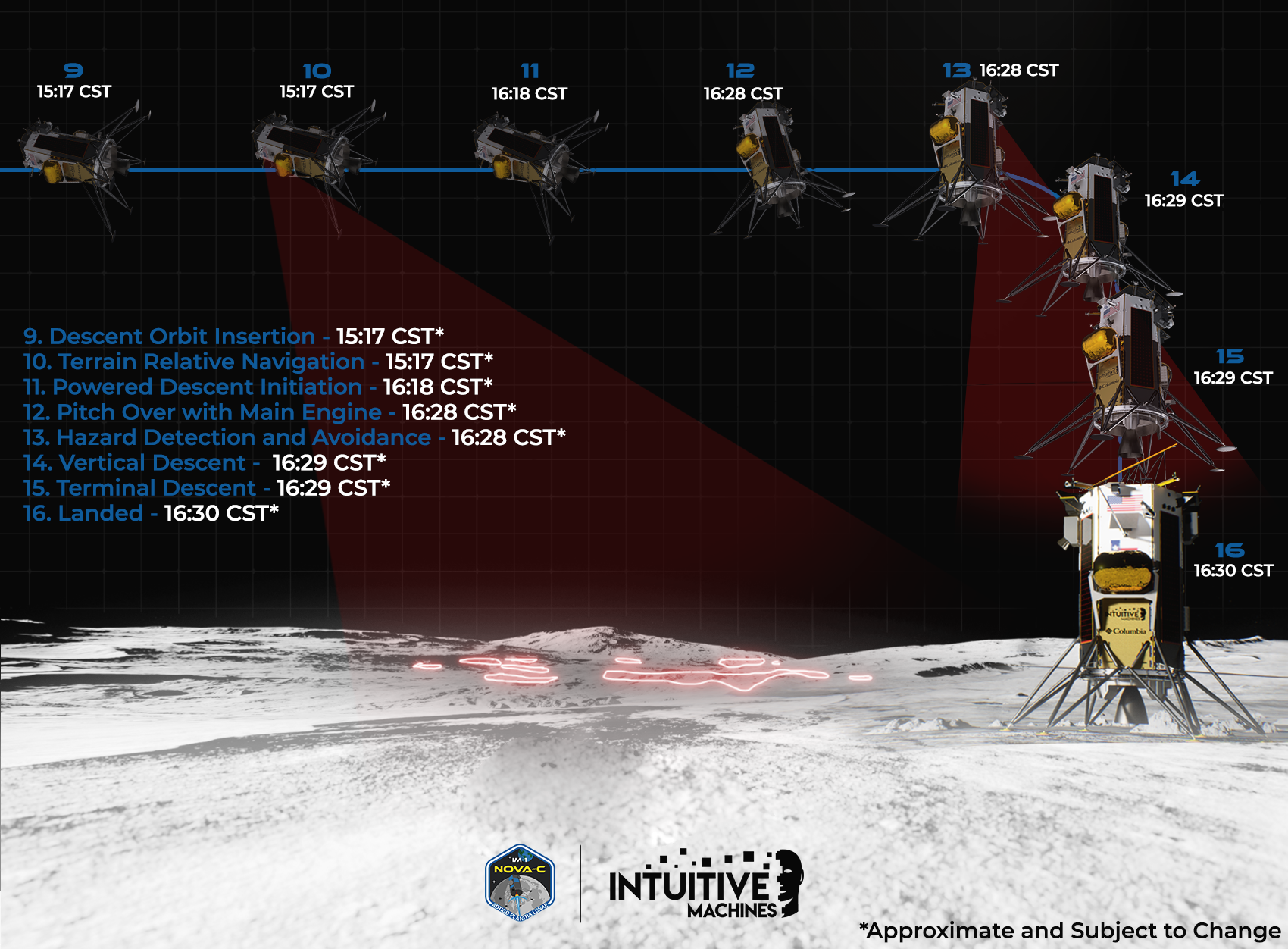
Intuitive Machines will attempt to launch 3 lunar landing missions in 2024

South Pole of Moon with landing sites

According to the company’s CEO, Intuitive Machines is pushing to fly two more Nova-C lunar landing missions next year after its first is launched by SpaceX on January 12th and hopefully lands successfully near the Moon’s south pole on January 19th.

Intuitive Machines is working on two more Nova-C landers for its IM-2 and IM-3 missions, also carrying NASA CLPS payloads. The company has not announced launch dates for those missions, but Altemus said he hoped both could take place by the end of 2024.

“We are planning three missions in 2024,” he said, which will depend in part on NASA’s requirements as well as orbital dynamics. Landings at the south polar region of the moon, the target for IM-2, are linked to “seasons” where lighting conditions are optimal for lander operations. IM-3, he said, would happen “a few months” after IM-2.

Though Nova-C will launch after Astrobotic’s Peregrine lander (launching on ULA’s Vulcan rocket), it will get to the Moon quickly, and will attempt its landing first. If successfully it will therefore be the first private payload to do so.

The company’s ambitions for 2024 are laudable, but depend so entirely on everything going perfectly it will not be surprising if they do not pan out. Nor will it reflect badly on the company if just one mission flies in 2024. Landing a robot on another world is hard. For private companies to do it is harder.

0 comments

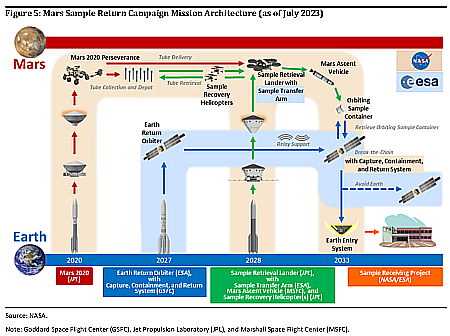
NASA “pauses” Mars Sample Return mission

Perseverance's first set of core samples, placed on the floor of Jezero Crater
Perseverance’s first set of core samples,
placed on the floor of Jezero Crater

Faced with a strong threat of major budget cuts from the Senate, NASA has decided to “pause” the Mars Sample Return mission (MSR) by ramping back some work to consider major changes to the project.

We brought Steve [Thibault] downtown to be the chief engineer in the Headquarters MSR program office … leading a team that consists of all the implementing centers and our European colleagues to stand back and take a look at the architecture with a fresh set of eyes and figure out not only just how to improve our technical margins and make the mission more robust, but also to see if there are ways to implement it in ways to potentially save costs. We’re also going off and listening to industry and seeing what ideas they have.

While the House had approved NASA’s budget request that exceeded $1 billion to complete the mission (more than double its original price tag), the Senate responded by only allocating one quarter of that, demanding NASA come up with a plan that would match its original budget number. This Senate pressure was enhanced by an independent review that harshly criticized the present design of the project, which involves three NASA centers, European participation, and multiple American companies, all building different components that must all interact perfectly.

7 comments
1 22 23 24 25 26 116