SpaceX wants revisions to federal rural grant program that has awarded it $733 million

SpaceX is presently asking for changes in the Broadband Equity Access and Deployment (BEAD) program that awards grants to companies that provide internet in rural areas and has already awarded the company $733 million in grants.

BEAD was part of the Biden administration’s bipartisan infrastructure act – originally a $42 billion program to bring broadband internet to areas of the country with little or no broadband access. The Trump administration eliminated other infrastructure act programs, and cut BEAD outlays to $21 billion, along with rule changes to allow satellite providers.

SpaceX applied for BEAD funds in 2025. The company won $733 million worth of BEAD projects nationwide, including $109 million in Texas.

Initially the Biden administration awarded SpaceX almost a billion dollar grant, because its Starlink constellation was the only broadband outlet actually doing the job. Then Musk began to campaign for Republicans, and suddenly the Biden administration pulled that grant, saying absurdly that SpaceX was failing to provide its service to rural areas, when that was exactly what it was doing.

Now SpaceX wants BEAD to ease some of its requirements, and wants these grant funds upfront.

I say, this whole BEAD program is a waste of taxpayer money and a perfect example of crony capitalism. I’m glad Trump cut it in half, but that wasn’t good enough. It should be shut down entirely. SpaceX doesn’t need this handout. It is making money hand-over-fist on its own.

14 comments

A nice summary of all space-based research of reproduction in space

Regulatory recommendations by these scientists
Click for original.

Link here to the press release. The paper itself can be read here.

The paper is an excellent summary of practically all the research that has been done in space and on the ground studying the impact of the harsh environment of space on reproduction. It notes above all that we really know very little despite this research, because the risks to the newborn have precluded direct study. From the paper’s abstract:

Despite over 65 years of human spaceflight activities, little is known of the impact of the space environment on the human reproductive systems during long-duration missions. Extended time in space poses potential hazards to the reproductive function of female and male astronauts, including exposure to cosmic radiation, altered gravity, psychological and physical stress, and disruption to circadian rhythm.

This review encapsulates current understanding of the effects of spaceflight on reproductive physiology, incorporating findings from animal studies, a recent experiment on sperm motility, and omics-based insights from astronaut physiology. Female reproductive systems appear to be especially vulnerable, with implications for oogenesis and embryonic development in microgravity. Male reproductive function reveals compromised DNA integrity, even when motility appears to be preserved. This review examines the limited embryogenesis studies in space, which show frequent abnormal cell division and impaired development in rodents.

In the paper’s conclusion, these academics sadly revert to type, and propose the establishment of an international regulatory framework for controlling this issue, as shown in the graphic to the right. This is empty foolishness, because such regulations will only do more harm than good, stifling research while failing to accomplish anything.

12 comments

Commercial changes at France’s French Guiana spaceport

French Guiana spaceport
The French Guiana spaceport. The Diamant launchsite is labeled “B.”
Click for full resolution image. (Note: The Ariane-5 pad is now the
Ariane-6 pad.)

Once France’s space agency CNES regained control of its spaceport in French Guiana several years ago from the European Space Agency’s (ESA) commercial pseudo-company Arianespace, it has moved aggressively to make that spaceport attractive to the new European rocket startups.

Beginning in 2022, it began to sign deals with every one of those rocket startups to allow them to establish launch facilities at the spaceport using several long abandoned pads, including the French Diamant rocket site not used for decades as well as the Soyuz launch site unused due to Russia’s invasion of the Ukraine.

CNES decided to standardize Diamant for multiple rocket companies, while leasing the Soyuz site to one.

In a news story today, it appears the startup MaiaSpace, a wholly owned subsidiary of the much larger aerospace company ArianeGroupk, has shifted its launch plans at French Guiana. Initially it was going to launch its rocket from the Diamant pad. In 2024 however it won the contract to use the Soyuz pad, and it has now withdrawn its plans to use Diamant entirely.

CNES has therefore put out a call to the European rocket industry to fill this slot at Diamant. At present Isar Aerospace, PLD Space, Rocket Factory Augsburg, and Latitude have agreements to use Diamant, though only Latitude and PLD had done any development work on their facilities there.

As far as I know, these companies comprise the entire cadre of new European rocket startups, so I don’t know what other users CNES hopes to find. Furthermore, CNES had wanted to standardize the launch site for everyone, and the companies had balked at that idea. PLD got a deal to use its own pad at Diamant. I suspect the reason Isar and Rocket Factory have done little there is because they want their own facilities as well.

Either way, French Guiana is moving the direction of supporting competitive commercial operations, and that is a very good thing.

4 comments

Midnight repost: Genocide is coming to America

Today I came across this tweet:

Brandon Straka Tweet
Click to see video in tweet.

The comparison between the tactics of the Nazi storm troopers and our modern Antifa thugs is apt. It illustrates the time we now live in. It also immediately made me want to repost my 2020 essay, Genocide is coming to America. That essay sadly remains pertinent, because the same unwillingness of decent Germans to believe the Nazis were a threat is the same unwillingness of too many modern Americans to believe the same thing about Antifa and the Democratic Party (which now enthusiastically uses Antifa as its storm troopers).

Worse, we now have a large minority of Americans who support this violent behavior. To them, violence is wholly justified against those who disagree with them. The proof of this horrible fact was demonstrated in the 2025 elections, where in Virginia a Democrat won his election despite openly wishing death not only on a Republican but on that Republican’s children, while in New York an anti-Semitic communist won election as mayor.

————————-
Genocide is coming to America

In my last visit to Israel in 2018, my brother and sister-in-law took me sight-seeing to the northern parts of Israel near the Sea of Galilee. On our first night, we stayed at the home of one of their older friends, a man in his seventies.

That night we sat around their kitchen table so that they could catch up on family matters. At one point in the conversation our host reminisced about an older woman, now gone, who he had known in his childhood in the 1950s who had lived in Germany before and during World War II and had survived a concentration camp.
» Read more

11 comments

Isaacman: SLS stands on very thin ice

Though NASA administration Jared Isaacman continues to support unequivocally NASA’s planned Artemis-2 ten-day manned mission around the Moon — presently targeting a March launch date — in a statement today on X he revealed that he also recognizes the serious limitations of the SLS rocket.

And it takes two-plus years between launches
And it also takes two-plus years between launches

The Artemis vision began with President Trump, but the SLS architecture and its components long predate his administration, with much of the heritage clearly traced back to the Shuttle era. As I stated during my hearings, and will say again, this is the fastest path to return humans to the Moon and achieve our near-term objectives through at least Artemis V, but it is not the most economic path and certainly not the forever path.

The flight rate is the lowest of any NASA-designed vehicle, and that should be a topic of discussion. It is why we undertake wet dress rehearsals, Pre-FRR, and FRR, and why we will not press to launch until we are absolutely ready.

These comments were also in connection with the first wet dress rehearsal countdown that NASA performed with SLS/Orion in the past few days, a rehearsal that had to be terminated early because of fuel leaks. NASA now plans to do another wet dress rehearsal, requiring it to push back the Artemis-2 launch until March.

I think there is more going on here than meets the eye.
» Read more

34 comments

India schedules next PSLV launch for June, claims it knows cause of January launch failure

India's space agency ISRO, as transparent as mud
India’s space agency ISRO,
as transparent as mud

According to a statement by a government minister yesterday, India’s space agency ISRO now knows what caused the January launch failure of its PSLV rocket, and has thus scheduled its next launch for June 2026.

This had been the second PSLV launch failure in a row, both of which occurred with the rocket’s third stage at almost the exact same time. With the first failure, ISRO never outlined publicly the cause, though it claimed it had solved the issue. According to the minister’s statement, the failure of the second launch was unrelated to the first.

The minister also said that the two PSLV missions that had failed—PSLV-C61 in May 2025 and PSLV-C62 in January this year—were unrelated. “It wasn’t the same problem. When the first mission failed, there was a detailed assessment, and the problem was fixed. Both the issues were different,” Singh said.

He also added that separate internal and external failure assessment committees have been set up to analyse what went wrong in each of the missions.

No word however as to the cause of the failure has yet been released. Though he also claimed the PSLV has not lost its customers due to these issues, ISRO’s lack of transparency says otherwise. If it claims the two failures came from different causes, it should provide the details in order to reassure potential customers.

0 comments

NASA makes right decision and delays Artemis-2 launch to do a 2nd dress rehearsal countdown

Artemis Program logo

NASA management announced today that it has decided to postpone the launch of the manned Artemis-2 mission around the Moon until March in order to give it time to do a second wet dress rehearsal countdown of the rocket and fix the hydrogen fuel leaks that occurred in yesterday’s rehearsal.

Engineers pushed through several challenges during the two-day test and met many of the planned objectives. To allow teams to review data and conduct a second wet dress rehearsal, NASA now will target March as the earliest possible launch opportunity for the flight test.

Moving off a February launch window also means the Artemis II astronauts will be released from quarantine, which they entered in Houston on Jan. 21. As a result, they will not travel to NASA’s Kennedy Space Center in Florida Tuesday as tentatively planned. Crew will enter quarantine again about two weeks out from the next targeted launch opportunity.

It should be understood that these hydrogen leaks have been systemic to SLS’s core stage rocket engines, which come from the shuttle era. Shuttle launches were routinely delayed due to similar leaks. This was partly because hydrogen is extremely difficult to control, as its atom is so small and light, and partly because of the engine design. This was the first rocket system ever to use hydrogen as fuel, and was thus cutting edge, in the 1970s. We should not be surprised by such issues.

Newer hydrogen-fueled designs have apparently overcome the problem. For example, Blue Origin uses hydrogen as a fuel in the upper stage of its New Glenn rocket, and though it has only launched twice, it has not had such issues on either launch.

In its announcement NASA also noted a bunch of other issues that occurred during this first rehearsal, all of which suggest that a delay is called for. There was a valve issue in the Orion capsule, some audio communication channels kept dropping out, and the cold weather affected some equipment. Waiting until warmer weather will help alleviate some of this.

10 comments

Fuel leaks cause Artemis-2 dress rehearsal countdown to terminate at T-5:15, several minutes early

Artemis Program logo

Two hydrogen fuel leaks during today’s Artemis-2 dress rehearsal countdown forced an early termination of the count as well as the cancellation of a second practice countdown.

The Artemis II wet dress rehearsal countdown was terminated at the T-5:15 minute mark due to a liquid hydrogen leak at the interface of the tail service mast umbilical, which had experienced high concentrations of liquid hydrogen earlier in the countdown, as well. The launch control team is working to ensure the SLS (Space Launch System) rocket is in a safe configuration and begin draining its tanks.

An earlier leak of hydrogen in the count forced a hold and a recycling of the count, though it did not stop the rehearsal.

The initial plan had been to do two terminal counts. First they would run the countdown down to T-33 seconds, hold for a few minutes, then recycle back to T-10 minutes and do it again. Because of that first leak delay the launch director canceled the second count. And because of the second leak they were unable to run that one count all the way to T-33 seconds.

The wise action would be for NASA to review their data, figure out what caused the leaks, correct it, and then do another dress rehearsal countdown. This being NASA, do not be surprised if they review the data, figure out what caused the leaks, and decide they can go ahead with the launch on February 8, 2026.

Why not? They are already launching this manned 10-day mission around the Moon with an untested life support system and a questionable heat shield. Might as well try a launch when you haven’t worked out all the fueling kinks.

23 comments

Axiom wins slot for next tourist mission to ISS

NASA yesterday announced that it awarded the space station startup Axiom the next slot for a tourist mission to ISS.

NASA and Axiom Space have signed an order for the fifth private astronaut mission to the International Space Station, targeted to launch no earlier than January 2027 from the agency’s Kennedy Space Center in Florida.

…Axiom Mission 5 is expected to spend up to 14 days aboard the space station. A specific launch date will depend on overall spacecraft traffic at the orbital outpost and other planning considerations.

Both Axiom and the space station startup Vast had been bidding for the fifth and sixth tourist slots. That Axiom had already done this four times previously was probably NASA’s reasons for choosing it. The agency has not yet decided on who will get the sixth slot, targeting a mission likely in 2028. My bet is that it will give to Vast, because by then Vast’s own demo station Haven-1 will have launched and been visited, thus giving that company some of the experience Axiom already has.

4 comments

Russia in discussions with Malaysian province about potential spaceport

Proposed spaceports in Malaysia

Officials from Glavcosmos, the commercial division of Russia’s Roscosmos space agency, have been holding meetings with officials from the Malaysian province of Sabah about building a spaceport there.

Glavkosmos said technical studies identify Sabah as the most suitable location in Southeast Asia for orbital launches, including low-earth and sun-synchronous orbits, due to its strategic geography and safe rocket stage drop zones. The proposed spaceport could create more than 2,000 high-income jobs and boost local supporting industries.

One year ago, in January 2025, the Sabah government announced it was holding similar discussions with the Ukraine. It seems either those talks fell through, or Russia decided to move in and block the Ukraine from making a deal.

A second Malaysian state, Pahang, is also planning a spaceport, working instead with China.

In all cases, it does appear for some reason Malaysia is not very interested in working with western nations.

8 comments

Amazon asks FCC for time extension for launching its Leo constellation

Amazon yesterday submitted a request to the Federal Communications Commission to extend the July deadline on its license for its Leo internet satellite constellation, which presently requires it to have 1,616 satellites in orbit by that date.

At present Amazon has 181 satellites in orbit, all launched in the last ten months. At that pace there is no chance the company can meet its FCC requirement. From its FCC submission:

While Amazon Leo will meet the deadline for full deployment of its constellation established by its license and the Commission’s rules, launch delays will cause it to fall short of the interim milestone requirement to deploy half of its originally authorized constellation by July 30, 2026. The Commission’s rules provide for extension of such milestones where, as here, delay arises from unforeseeable circumstances beyond an operator’s control or overriding public interest considerations favor an extension.

Because it meets both criteria, Amazon Leo respectfully requests a 24-month extension of its 50% milestone to July 30, 2028, or alternatively, a waiver of this interim requirement.

In its submission Amazon claims the delay is entirely the fault of the rocket companies it was relying on to launch the satellites, but that is a bogus claim. It initially choose to depend almost entirely on three new rockets (Blue Origin’s New Glenn, ULA’s Vulcan, and Arianespace’s Ariane-6), all of which had not launched and were still under development. To expect these to launch on time was absurd.

Furthermore, its ULA contract also called for launches using company’s already operational Atlas-5 rocket, which Amazon claims were delayed because of “unexpected anomalies and delays caused by issues with its vehicle fairings and solid rocket boosters.” I don’t buy it, and suspect the real cause was that Amazon was unable to produce the satellites on time.

Faced with these delays and a stockholder lawsuit, Amazon subsequently signed SpaceX to do three launches, which that company did quickly, in less than four months. If Amazon had truly wanted to get its Leo satellites in orbit on time, it would have given SpaceX more launches and gotten it done.

Nonetheless, it is likely the FCC will agree to Amazon’s extension request. The company has now shown it is committed to the process and intends to get its constellation in orbit. It is not sitting on its license doing nothing. I would not be surprised however if the FCC imposes some new requirements in an effort to force Amazon to launch more satellites more quickly.

8 comments

China launches Algerian satellite

China today successfully placed an Algerian “remote sensing” satellite into orbit, its Long March 2C rocket lifting off from its Jiuquan spaceport in northwest China.

No word on where the rocket’s lower stages, using very toxic hypergolic fuels, crashed inside China. China’s state-run press also said little about the satellite, other than claiming it would be used for “land planning and disaster prevention and mitigation.” This however doesn’t match what “remote sensing” satellites usually do, which is military surveillance.

The 2026 launch race:

13 SpaceX
6 China
2 Rocket Lab

2 comments

Russian defunct military satellite breaks up in graveyard orbit

A Russian defunct military geosynchronous satellite that was launched in 2014 and spent a decade spying on other geosynchronous satellites only to be moved to a graveyard orbit in 2025 when its fuel ran out apparently broke apart earlier today.

The Swiss company S2A systems, which specializes in tracking orbital objects, captured the moment the spacecraft began disintegrating. I have embedded that footage below, though it really is far less exciting than it sounds.

The debris poses a very small risk to other geosynchronous satellites, which orbit at about 22,000 miles elevation where there is too little atmosphere to decay orbits. The graveyard orbit is several hundred miles higher.
» Read more

11 comments

FAA moves forward on its environmental assessment of SpaceX’s proposal to launch Starship/Superheavy from Kennedy Space Center

Proposed Starship/Superheavy launchsites at Kennedy and Cape Canaveral
Proposed Starship/Superheavy launchsites at
Kennedy (LC-39A) and Cape Canaveral (SLC-37)

While NASA has already determined that Starship/Superheavy launches from the Kennedy Space Center in Florida will have no significant impact on the environment, the FAA has not yet completed its own environmental impact statement.

Last week it released a preliminary summary [pdf] of its impact statement, revealing that it has reduced its final options to either approving SpaceX’s request to do as many as 44 launches per year, or to reject any changes — the “no action alternative” — which would block all Starship/Superheavy launches at Kennedy.

The overall tone of this summary suggests strongly that the FAA is almost certainly going to approve SpaceX’s request, allowing as many as 44 launches per year from launchpad LC-39A, as shown on the map to the right. As it notes in describing the “no action alternative”:

SpaceX would not launch Starship-Super Heavy from LC-39A. NASA would not develop, implement, or approve agreements with SpaceX associated with Starship-Super Heavy operations at LC-39A. The No Action Alternative would not meet the purpose and need. [emphasis mine]

In other words, rejecting SpaceX’s request would not fulfill the FAA’s obligation to serve the public. It would also not fulfill the FAA’s obligation to serve a fellow government agency, NASA, which has already approved this SpaceX request in a 2019 environmental assessment.

It appears a final decision by the FAA is imminent. A nice summary of this FAA document can be found here, which notes that if approved, it will give SpaceX license approval to launch Starship/Superheavy as much as 146 times per year, from its launchpads at Boca Chica, Kennedy, and Cape Canaveral. Note too that this FAA assessment is independent of the Air Force’s environment assessment, which has already approved 76 launches per year at the SLC-37 launchpad.

6 comments

Orbex failure occurred partly because UK government withheld promised funding

Prime rocket prototype on launchpad
The prototype of Orbex’s never-launched Prime rocket,
on the launchpad in 2022

It appears the government of the United Kingdom contributed to the bankruptcy and sale of the British rocket startup Orbex in more than one way.

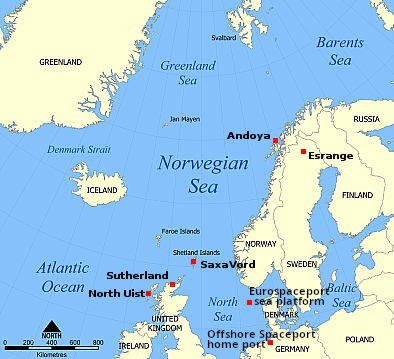
Orbex had hoped to do its first launch from the proposed Sutherland spaceport on the north coast of Scotland in 2022, but was blocked for four years because of red tape. First, the UK’s Civil Aviation Authority would not issue the spaceport and launch licenses. Second, local opposition delayed approvals as well. Those delays ate into the company’s resources, until it became entirely dependent on grants from the UK government (some through the European Space Agency) to keep it afloat.

Orbex’s problems were further compounded when it became clear in 2024 that the Sutherland spaceport would never get clearance. Orbex then switched to the Saxavord spaceport in the Shetland Islands, but this forced more delays because the company had no facilities there. It had already spent a fortune building everything for Sutherland.

A new report today says that it was finally forced to shut down and sell its assets to the French startup The Exploration Company because the UK government had withheld some of that promised funding.

News of the potential sale came just a month after a European Space Agency document confirmed that €112 million of €144 million UK government funding, earmarked for the European Launcher Challenge (ELC) scheme, was still “to be distributed”.

As a result, Orbex received just €34.9 million from the scheme – one-fifth of the €169 million awarded to each of its rivals by European governments.

That shortfall equates to about $160 million, a substantial amount of cash. While it is perfectly reasonable for the UK government to withheld these funds if it thinks the money would be badly spent, none of this government funding would not have been necessary at all if the UK government had simply issued the launch permits in a timely manner, allowing Orbex to launch and earn revenue.

As I noted early, congratulations to the United Kingdom, the place where rocket companies go to die! This is now the second such company killed by UK red tape and government incompetence, the first being Virgin Orbit.

8 comments

Russian official says Soyuz launchpad repair likely delayed

According to the Russian official in charge of ground infrastructure at Roscosmos, the repair of Russia’s only Soyuz launchpad for launching Progress and Soyuz capsules to ISS might not be completed by late March, as Roscosmos has previously promised.

It appears the winter weather at Baikonur is causing issues. In addition:

Barmin explained that the new service platform had to be assembled from components manufactured at different times and sometimes mismatching each other, requiring on-site modifications. For example, the core of the spare platform was manufactured in 1977 in accordance with a different set of blueprints for a planned-but-never-implemented refurbishment of another Soyuz pad, Barmin said. When it was shipped from an arsenal in the city of Tambov to Baikonur, the set of hardware was incomplete, requiring it to be complemented with parts from other sources and with newly manufactured elements.

It also appears the Russian government is going to make scapegoats of the workers who handled the launch platform during the November 2025 launch. It has placed them under criminal investigation. The managers, whom according to one report demanded the launch take place even though these workers could not get the platform properly fastened in place, appear to have been cleared of wrong-doing.

Until this pad is repaired, Russia has no way to launch any manned missions. Nor can it send cargo to ISS.

The decision to scapegoat the workers will further hinder work, as it will certainly damage morale. Such an approach also helps explain why there has been several cases of sabotage of Soyuz and Progress capsules while they are being prepped for launch.

5 comments

NASA delays Artemis-2 wet dress rehearsal countdown due to weather

NASA today announced it is delaying until February 2, 2026 the wet dress rehearsal countdown of its Artemis-2 mission due to weather concerns.

NASA is targeting Monday, Feb. 2, as the tanking day for the upcoming Artemis II wet dress rehearsal at the agency’s Kennedy Space Center in Florida, as a result of weather. With this change, the first potential opportunity to launch is no earlier than Sunday, Feb. 8.

Over the past several days, engineers have been closely monitoring conditions as cold weather and winds move through Florida. Managers have assessed hardware capabilities against the projected forecast given the rare arctic outbreak affecting the state and decided to change the timeline. Teams and preparations at the launch pad remain ready for the wet dress rehearsal. However, adjusting the timeline for the test will position NASA for success during the rehearsal, as the expected weather this weekend would violate launch conditions.

I had previously said this dress rehearsal countdown would include the astronauts inside Orion. This was incorrect. The astronauts are in quarantine in preparation for the actual mission. Orion will be unmanned during the rehearsal countdown.

6 comments

Artemis-2 proves NASA learned nothing from the Challenger and Columbia failures

NASA: an agency still avoiding reality
NASA: an agency that still avoids reality

Our bankrupt new media continues to fail us. NASA is about to send four astronauts on a ten-day mission around the Moon in a capsule with questionable engineering, and that media continues to ignore the problem. Mainstream news outlets continue to describe the mission in glowing terms, consistently ignoring that questionable engineering. In some cases the stories even make believe NASA has fixed the problem, when it has not.

The most ridiculous example is an article yesterday from an Orlando outlet, Spectrum New 13: “How the lessons learned from the Challenger disaster apply to Artemis rockets”. It focuses entirely on the O-ring problem that destroyed Challenger, noting repeatedly that NASA has fixed this issue in its SLS rocket.

Of course it has. That’s the last war, long over. Engineers fixed this issue almost four decades ago. The article however dismisses entirely the new engineering concern of today, Orion’s heat shield, which did not work as expected during its own test flight in space in 2022. It covers this issue with this single two-sentence paragraph:

However, during re-entry, it broke up into chunks instead of burning away. This issue pushed back the Artemis II and III missions, but NASA has stated it has resolved the problem.

NASA however has not resolved the problem. It is using the same heat shield now on this manned mission, and really has no reason to assume it will work any better, even if the agency has changed the re-entry flight path in an effort to mitigate the heat shield’s questionable design.

You see, NASA with Artemis-2 is doing the exact same thing it did prior to both the Challenger and Columbia accidents. » Read more

40 comments

German government hires German startup Polaris Spaceplanes to build reusable two-stage hypersonic plane

Mira-II prototype following first flight using aerospike engine
Mira-II prototype following first flight using
aerospike engine in October 2024.

The German government yesterday awarded a contract to the German startup Polaris Spaceplanes to build and fly a reusable two-stage hypersonic plane by 2027.

On 27 January, POLARIS Spaceplanes announced that it had been awarded a contract by the Federal Office of Bundeswehr Equipment, Information Technology and In-Service Support (BAAINBw) to build a fully reusable, horizontal take-off, two-stage hypersonic vehicle. The primary application of the Hypersonic Test and Experimentation Vehicle (HYTEV) will be as a hypersonic testbed for scientific and defence-related research. A variant of the vehicle with an expendable upper stage will also be capable of deploying small satellites into low Earth orbit.

According to the company, the HYTEV will be roughly the size and take-off mass of a fighter jet. The main stage will be powered by two turbofans and one of the company’s in-house developed aerospike rocket engines. The turbofans will be used for take-off and landing, and the rocket engine will accelerate the vehicle before upper-stage deployment. The upper stage will be entirely rocket-powered, with imagery accompanying the announcement appearing to show a more conventional rocket engine configuration compared with the aerospike engine equipped to the main stage. After completing its mission, it will likely be recovered under controlled glide conditions or potentially by a parachute or parafoil.

This deal appears to be an upgrade to a February 2025 German government deal with Polaris. It also follows Polaris’s successful use of an aerospike engine on a prototype test flight in 2024. While the company has shown some success, doing more than a dozen test flights with small scale prototypes (as shown in the image to the right), this program and schedule still seems quite ambitious.

3 comments

Ariane-6 gets a new government launch contract

The European Space Agency, one agency among many
The European Space Agency, one European
agency among many

The government rocket of the European Space Agency (ESA), the Ariane-6, yesterday won a new launch contract to place a pair of Galileo GPS-type satellites into orbit for the European Union (EU).

Arianespace announced today at the European Space Conference in Brussels the signature of the launch contract with the European Union Agency for the Space Programme (EUSPA), under the delegation of the European Commission, to orbit the second pair of second-generation satellites of the Galileo constellation (Galileo L18) on board an Ariane 6 launcher. With this signature, the European Commission and the EUSPA are formalizing the launch contract of Galileo L18, following the initial mission allocation to Arianespace made in April 2024.

All told this will be Ariane-6’s fifth launch of GPS-type satellites for the EU, which appears committed to Ariane-6, even though this expendable rocket costs much more than SpaceX’s Falcon 9, in order to promote European sovereignty. Eventually Europe will develop more cost effective private rockets (in about a decade), but until then its access to space will be limited by cost.

And the extra cost is not simply the expendable nature of Ariane-6. Note also the many layers of bureaucracy listed in the quote above. For the European Union there the European Union Agency for Space Programme, working under the supervision of the EU’s European Commission. It signed a deal with Arianespace, which represents the European Space Agency as its commercial rocket division.

That’s four different bureaucracies, two within the European Union and two more related to Europe’s space effort. Each adds cost to the launch, as well as the need for complex negotiations that delay any deal.

Not

6 comments
1 10 11 12 13 14 503