Toyota invests in rocket startup

In a positive sign that Japan’s rocket industry is beginning to join the private sector, Toyota yesterday announced that it is investing $44 million in the rocket startup Interstellar Technologies.

Interstellar had been more visible about five years ago, and then disappeared. I figured it had died having run out of cash. It appears it is coming back now in Japan.

2 comments

The members of Trump’s NASA transition team

We now have the names of the individuals that are reviewing NASA’s future under the Trump administration:

  • Charles Miller: A member of the first Trump administration’s transition team, Miller is a former NASA official who is now the chairman of Lynk, a direct-to-device satellite company that is struggling to go public through a merger with a SPAC backed by baseball star Alex Rodriguez.
  • Greg Autry: A longtime advocate for commercial space, Autry is a professor at the University of Central Florida who also worked on the 2016 Trump NASA transition and was nominated to serve as NASA’s CFO, though Congress failed to approve his nomination. He’s signing his emails “DOGE/NASA Transition.”
  • Ryan Whitley: A NASA engineer who was detailed to the National Space Council during Trump’s previous term, Whitley last worked on the Artemis HLS program before spending just over a year at ispace, the Japanese lunar company.
  • Lorna Finman: A Stanford PhD who worked on the Star Wars program at Raytheon back in the day, Finman’s LinkedIn says she has been advising the Heritage Foundation on space policy since 2023.
  • Jim Morhard: The NASA deputy administrator during Trump’s first term, Morhard was a longtime GOP senate staffer.

All appear to have deep roots in either Washington or academic, but all also appear to have deep roots in the conservative side of the political spectrum. Several have even moved from NASA positions to the private sector. That latter fact explains the radical changes at NASA that this team has been considering, including canceling SLS and Orion and re-orienting the entire Artemis program using the private sector. In addition they are considering consolidating several NASA centers as well shrink staffing at NASA headquarters.

5 comments

China completes its first launch in 2025

SpaceX is no longer the only entity that has launched a successful orbital launch this year. Early today China successfully placed an “experimental” satellite into orbit, its Long March 3B rocket lifting off from the Xichang spaceport in southwest China.

No word on where the rocket’s lower stages, using very toxic hypergolic fuels crashed within China. As for the satellite, China’s state run press merely said that it “was built by its subsidiary Shanghai Academy of Spaceflight Technology and is tasked with verifying orbital refueling and life-extension technologies.”

The 2025 launch race:

2 SpaceX
1 China

2 comments

Trump administration considering major positive changes at NASA

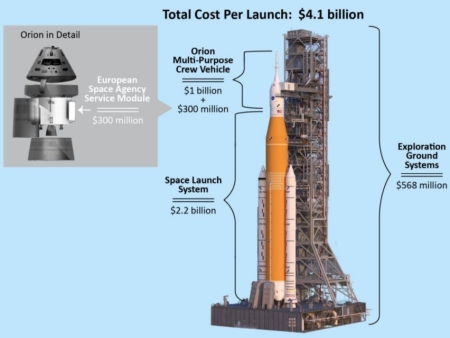
According to a report two weeks ago by Eric Berger at Ars Technica and reviewed today by Mark Whittington at The Hill, the transition team for the Trump administration is reviewing a number of very major positive changes at NASA. The transition team has set up a five-person committee to review the following:

  • canceling the costly Space Launch System rocket and possibly the Orion spacecraft
  • Redesigning the entire Artemis program to make it more cost effective
  • Set a new goal to put humans on the Moon by 2028
  • consolidating three NASA centers into one to reduce overhead
  • Reducing the size of NASA headquarters

The first two recommendations would be doing what I have been recommending since 2011. SLS is an over-priced boondoggle that is too cumbersome and expensive. It can never do the job of establishing a lunar base, NASA’s prime goal. The same applies to Orion, which NASA for years touted as an interplanetary spaceship, an utter lie. It is merely an overweight ascent/descent capsule, nothing more.

The third recommendation is mostly for photo op purposes, since it is unlikely a manned landing can occur that quick, especially if the entire Artemis program is redesigned, replacing NASA’s the SLS rocket with SpaceX’s Starship/Superheavy. At the same time, if Trump shuts down the FAA’s red tape, we might be seeing many test flights of this rocket in the next two years, accelerating its development considerably.

The last two recommendations match the only recommendation from my 2017 policy paper, Capitalism in Space [free pdf here] that NASA has not yet embraced. I had recommended NASA reduce its overhead and bureaucracy, since it widely known in the business that its many agencies do relatively little for their cost. The rumored proposal under consideration is to consolidate the Goddard center in Maryland, the Ames center in California with the Marshall center in Alabama, with the new combined center in Alabama.

Getting this done however remains difficult. The centers exist because elected officials want them in their states and congressional districts. Expect strong resistance in Congress.

That the Trump administration is considering it anyway suggests these big changes are coming, regardless. And if so, I say Hallelujah!

17 comments

Italy’s military negotiating with SpaceX to use its Starlink constellation for communications

In what would be a five year deal costing $1.56 billion, Italy’s military is presently negotiating with SpaceX to use its Starlink constellation for communications, rather than wait for the European Space Agency’s (ESA) IRIS2 constellation, which is years from launch and likely to experience delays, as do all of ESA’s projects.

By negotiating a five-year deal with SpaceX, Italy may be aiming to bridge the gap until Europe’s IRIS2 system becomes operational. With the ongoing war in Eastern Europe, the country’s Armed Forces likely view secure military communications as an urgent priority. However, critics may argue that the €1.5 billion price tag represents 14.15% of the total IRIS2 budget for just five years of service. For context, Italy is the third-largest contributor to the European Union, with its €18.6 billion contribution in 2023 accounting for roughly 10% of the EU’s total budget.

This story illustrates the good business sense of Elon Musk. He moved to get Starlink in orbit ahead of anyone else, and now is reaping the cash awards because he can provide services while others cannot.

0 comments

ISRO delays its unmanned docking in orbit two days

India’s space agency ISRO today announced that it has decided to delay the attempted unmanned autonomous docking of its two orbiting Spadex spacecraft two days, from January 7 to January 9.

“The docking process requires further validation through ground simulations based on an abort scenario identified today (Jan 6),” Isro said Monday. Multiple sources told TOI that “there was nothing concerning” with the Space Docking Experiment (SpaDeX) satellites and that the additional simulations are being carried out to validate the docking process.

This follows the pattern at ISRO since its present head, S. Somanath, took over in 2022. He pushes hard to get missions launched, but simultaneous demands caution and testing along the way to make sure the mission is a success. For example, when he took over he quickly added a number of unmanned test flights for India’s Gaganyaan manned capsule, to take place before the manned mission.

0 comments

FBI investigating reports of an effort to bomb SpaceX’s Boca Chica Starship facility

According to news stories from several sources tonight, the FBI is investigating a reported threat to bomb SpaceX’s Boca Chica Starship facility.

The source to the story comes from a local.

The report was made by Calvin Wehrle of Galveston, who frequently camps along Texas 4 near the Starship launch site.

In an interview Friday, he said he was there on the afternoon of Christmas Eve when an SUV pulled up with five male passengers who rolled down their windows to converse. They said they were from the Middle East. “I said something like, ‘What are y’all here for? ’ and the driver said, ‘Oh, we’re here to blow (Starship) up,’ ” Wehrle said. “I just went stone cold, and he said, ‘Oh, I got you. I was joking.’ ”

As the conversation went on, though, Wehrle’s visitors said at least three times they were in South Texas to attack Starship. He reported the incident to SpaceX and the sheriff’s office and said he was contacted later by an investigator.

This could be nothing, or it could be serious. The location of the Starship/Superheavy facilities is right along the road at Boca Chica, and it is very easy for anyone to get quite close. In fact there have been several incidences where people were caught trespassing.

Considering that SpaceX is gearing up for the seventh orbital test flight of Starship/Superheavy on January 10, 2025, the risks are now higher. The tank farm there, also not far from public access, is going to be filled with oxygen and methane, and will be an ideal target for attack.

And we can thank Joe Biden and his Democratic Party for allowing millions of illegals to enter the country un-vetted over the past four years, including tens of thousands who the evidence suggests could be potential terrorists. And we can also thank the Biden administration for sucking the quality out the FBI, making it incapable of doing its real job while it was used for political purposes harassing and persecuting Trump, many Republicans, and many ordinary conservatives.

Hat tip to BtB’s stringer Jay.

10 comments

Scientific American is looking for a new and “diverse” editor-in-chief!

Scientific American, where discrimination and bigotry thrive!
Scientific American, where discrimination and
bigotry thrive!

Scientific American needs a new editor-in-chief, but right off the bat I must warn qualified white men they needn’t bother to apply. They won’t get the job.

More on why later. First we must give the background. In November Scientific American’s editor-in-chief, Laura Helmuth, resigned, claiming it was time for her “to take some time to think about what comes next (and go birdwatching).”

In truth, it was time for her to go. She had disgraced herself repeatedly by posting some very ugly posts condemning Trump and insulting his supporters in a most emotional and irrational manner. But those posts weren’t the real reason she need to leave.
» Read more

23 comments

FAA cancels one of three public meetings on the Starship/Superheavy environmental reassessment

The FAA today announced that it has canceled one of three meetings that it plans to hold in the Brownsville region next week to obtain public feedback on SpaceX’s request to increase its Starship/Superheavy launch rate at Boca Chica to 25 launches per year.

The FAA was scheduled to hold in-person public meetings on January 7th and 9th, 2025. However, due to the designation of January 9, 2025 as a National Day of Mourning to honor the late former President Jimmy Carter, the January 9th meetings are now cancelled.

The meeting schedule is now as follows:

  • In-person meeting: Tuesday, January 7, 2025; 1:00 PM–3:00 PM & 5:30 PM–7:30 PM CDT at the Texas Southmost College, Jacob Brown Auditorium, 600 International Boulevard, Brownsville, TX 78520
  • Virtual on-line meeting: Monday, January 13, 2025; 5:30 PM–7:30 PM CDT Registration Link here. Dial-in phone number: 888-788-0099 (Toll Free), Webinar ID: 879 9253 6128, Passcode: 900729

As I noted in November when the new environmental reassessment and these meetings were announced, it is practically certain that the fringe anti-Musk activists groups SaveRGV, Sierra Club, the Friends of Wildlife Corridor, and the fake Indian Carrizo/Comecrudo Nation of Texas (which never existed in Texas) are organizing to be there in force, demanding SpaceX’s Boca Chica operations be shut down.

If the rest of the public, which is the vast majority of the Brownsville community, does not show up to counter these fringe activists, it will make it much easier for the bureaucrats who hate Musk at the FAA to take action against SpaceX. It is essential that the business community at least make an appearance, as the arrival of SpaceX has brought billions of dollars and tens of thousands of jobs to Brownsville.

0 comments

India and SpaceX announce their planned launch goals for 2025

We now have predictions from both India and SpaceX on the number of times each will attempt orbital launches in 2025.

In a tweet from India’s space agency ISRO today, the agency announced it plans ten launches in 2025. This count includes one launch of its man-rated Heavy Lift Vehicle-Mark 3 (HLVM3) rocket in March, testing its unmanned Gaganyaan manned capsule, one launch of its slightly smaller LVM3 rocket, four launches of its older GSLV rocket, three of its even smaller PSLV rocket, and one of its smallest new rocket, the SSLV. The last two the Indian government hopes to transfer to the private sector. (Note: The tweet says nine launches, but the graphic shows ten.)

This prediction does not include any additional orbital launches that India’s two private rocket startups, Agnikul and Skyroot, might attempt. Both have said they hope to do their first launches in 2025.

SpaceX meanwhile is hoping to smash its own record in 2024. According to comments made by the company’s CEO Gywnne Shotwell in mid-December (comments that I missed at the time), the company is planning 175 to 180 launches in 2025. This increase will likely come from two sources. First, it is my understanding that the company is adding another drone ship to its recovery fleet, allowing for more Falcon 9 launches. Second, it is probably going to be able to conduct Starship/Superheavy launches much more frequently, because the Trump administration is almost certainly going to eliminate much of the FAA regulatory red tape that has stymied the entire American rocket industry these last four years.

In the coming weeks I expect more nations and companies will announce their intended launch targets for 2025.

6 comments

Sunspot update: Is this sunspot maximum over, or will it become another doubled peaked maximum?

Well, after almost fifteen years it had to happen at last. In preparing to do my monthly sunspot update today, which I had done every month since I started Behind the Black in 2010, I discovered that I had completely forgotten to do the update in December. Sorry about that.

No matter, the changes from month-to-month are not often significant, and fortunately that turned out to be the case in November and December of 2024. Since my last update at the beginning of November 2024, sunspot activity on the Earth-facing hemisphere of the Sun has been relatively stable, based on NOAA’s monthly graph tracking that activity. In November the activity dropped slightly, only to recover a small amount in December.
» Read more

2 comments

The global launch industry in 2024: A year of amazing highs and depressing lows, with the best yet to come

For the past five years the entire global rocket industry has experienced a revolution that has resulted in a rise in global launch numbers unprecedented since the launch of Sputnik in 1957. 2024 was no different, with the total number of successful launches topping 256, two to four times the average number of launches that had occurred yearly prior to 2020.

This success has almost entirely been driven by the arrival of many private rocket companies competing for government and commercial business — led largely by SpaceX — aided by the decision by governments worldwide to get out of the way and let private enterprise do the job. The result has been spectacular, so much so that it now seem possible in the very near future to see humans finally revisiting the Moon and even getting to Mars and the asteroids.

At the same time, 2024 saw some significant signs that this success is not guaranteed, and could vanish in an instant if care is not taken.

The graph below, my annual count of launches world wide, provides the groundwork for these conclusions.
» Read more

15 comments

Seventh Starship/Superheavy test launch now targeting January 10, 2025

Based on a single word tweet by Elon Musk as well as the FAA’s license approval, it now appears that SpaceX is targeting January 10, 2025 for the seventh Starship/Superheavy test orbital launch.

According to the FAA license, the launch window that day opens at 4 pm (Central), with backup launch opportunities each day through January 15th.

Reading that license is very illuminating. The depth in which the FAA now demands compliance from SpaceX is beyond daunting, and illustrates the mission creep the agency has used to grow its power. Based on a recent Supreme Court ruling, the company likely has grounds to sue and win, correctly claiming that Congress never gave it such power over so many things, and that its regulatory oversight is unconstitutional.

4 comments

Space Force starts environmental impact study of SpaceX’s launches at Vandenberg

In mid-December the Space Force initiated a new environmental impact study (EIS), reviewing SpaceX’s request to significantly increasing the number of launches it would do out of Vandenberg, an increase that could climb to as much as a hundred launches per year.

The EIS will examine the environmental impacts from the redevelopment of Space Launch Complex (SLC) 6 for use by SpaceX for Falcon 9 and Falcon Heavy launches. The Space Force awarded SpaceX access to SLC-6, aka “Slick Six,” in 2023 after the final launch of United Launch Alliance’s Delta 4 from the site.

SLC-6 was built in the 1960s for the Air Force’s Manned Orbiting Laboratory program, which was canceled in 1969 before any launches took place. It was later converted to support Space Shuttle launches, but mothballed after the Challenger accident in 1986 before hosting a single launch. ULA took over the site in 2006.

The EIS would also allow SpaceX to conduct up to 100 launches annually between SLC-6 and its existing launch pad at Vandenberg, SLC-4. That includes booster landings at both launch sites as well as droneships downrange.

This is where we are are in the first quarter of the 21st century. Nothing new can be done anywhere without detailed environmental impact statements that take months, sometimes years, to complete, and almost always conclude that the proposed work can proceed without harm. Often however that conclusion can only come if the government and the private sector agree to funnel cash to environmental causes and organizations, if only to shut them up and prevent further lawsuits. (That’s exactly what happened in Boca Chica. Expect the same now in California.)

It must be noted again that we now have almost eight decades of empirical proof in both Florida and California that rocket launches do no significant harm to the environment, and that if anything they act to protect wildlife by creating large undeveloped refuges in the surrounding land. These new impact statements forced on SpaceX in California, in Florida, and in Boca Chica are therefore nothing more than a government power play, done in order to tell everyone who really is boss.

A new boss however takes over the executive branch of the federal government in only a few weeks. I suspect he will not look kindly at these games. Expect some quick changes almost immediately.

4 comments

Italian government awards former Ukrainian startup a $1.14 million development loan

A former Ukrainian startup, Kurs Orbital, has won a $1.14 million loan from Italy’s National Agency for Investment Attraction and Business Development (Invitalia) in order to build and sell its module providing rendezvous and docking capabilities for satellites.

Kurs Orbital was founded in 2021 by the former director of Ukraine’s space agency, Volodymyr Usov. After Russia invaded Ukraine in 2022, the company relocated to Turin, Italy. The company is currently developing its ARCap system, a rendezvous and proximity operations module that can be integrated with a wide range of vehicles, including satellites, orbital transfer vehicles, and even cargo or crew spacecraft. Possible applications for the technology include satellite life extension missions, in-orbit servicing, and space debris removal.

On 30 December, the company announced that it had secured a €1.1 million soft loan from Italy’s National Agency for Investment Attraction and Business Development (Invitalia). A soft loan provides the borrower with more favourable terms than traditional lenders typically offer. The loan was awarded through the agency’s Smart&Start programme, which focuses on supporting the growth of innovative startups by providing financing of between €100,000 and €1.5 million.

The Kurs rendezvous and docking system was first developed in the Ukraine for the Soviet-era space stations. When the Soviet Union broke up it continued to sell them to Roscosmos, but over time the Putin government increasingly worked to block these deals as it tried (and generally failed) to develop the capabilities within Russia. The Ukrainian companies then began marketing their products, with some success, in the west. Following Russia’s 2022 invasion of the Ukraine those companies have either died, or done what Kurs Orbital did, move to the west.

While this story might resemble the actions of the Chinese government as described in my previous post, there is one very fundamental difference. In Italy the law protects the property rights of this company. The Italian government might provide it loans and assistance, like the Chinese, but it does not have the power or right to take it over, at its whim, as the Chinese communists can.

The story also illustrates the foolishness of Russia’s power-hungry policies. It not only has wasted its youth and industry on a useless war, it has driven away companies and technology that formerly gave it capabilities it now lacks.

0 comments

Chinese pseudo-company gets major cash influx for its Starlink copycat constellation

The Chinese pseudo-company Genesat, which is making the satellites for the 14,000 Starlink-type satellite constellation being developed by the Chinese pseudo-company SpaceSail, has been awarded $137 million in cash from a variety of Chinese sources, most of which are government agencies focused on encouraging development by these pseudo-companies.

Superficially everything about these companies appears real. They compete for contracts and investment capital, and can only function if they make a profit. They also compete with other similar Chinese pseudo-companies. The reality however is that they only exist because the Chinese government wants them to. For example, Genesat was formed by a partnership of SpaceSail and the Chinese Academy of Sciences (which is entirely government-run). And SpaceSail was formed earlier with support of both the national and local Shanghai governments. For example, consider today’s story:

Shanghai Gesi Aerospace Technology, also known as Genesat, announced the more than 1 billion yuan (approximately $137 million) funding round Dec. 30. The main investors include China’s National Manufacturing Transformation and Upgrading Fund, China Development Bank Science and Technology Innovation, Guosheng Capital, SIMIC Capital and Shanghai FTZ Fund.

The first two backers are both government agencies created to funnel government cash to these pseudo-companies.

Overall this approach by the communist Chinese government has worked remarkably well. It has created an robust space industry within a competitive and innovative atmosphere. That industry only exists however as long as the present policies of the Chinese government exist. If there is a major change in leadership it all could vanish in a moment, as there are no property rights in China. A new government could do as Putin did in Russia, consolidate all these pseudo-companies into a central government-run agencies in order to more closely control them.

For the present however China’s pseudo-capitalist approach means it will be a major player in space in the coming years. That success might even lead to a positive change in government, throwing the communists out of power eventually. It is not only demonstrating the advantages of freedom and competition over a top-down command economy, it is developing a class of people doing it. They might eventually have enough wealth and power to take over the government and changes things for real.

3 comments

India gets nine bids involving 30 companies on proposal to build satellite constellation

Capitalism in space: India’s space agency in charge of promoting commercial space, In-Space, has received nine different bids involving 30 Indian companies on its proposal that an Earth observation satellite constellation be built by a private company, not by the country’s space agency ISRO.

The regulator had sought “expressions of interest” (EoI) in July to build home-grown satellite constellations as part of a broader strategy to monetize the sector and ensure data sovereignty.

India is doubling down on its small satellite and data services market to carve out a leading role in the global commercialization of space. The market for such services, increasingly key for industries ranging from telecoms to climate monitoring, is projected to reach $45 billion by 2030.

The applicants for IN-SPACe’s latest effort in this regard include startups such as Google-backed Pixxel and Baring Private Equity-backed SatSure, as well as larger entities like Tata Group’s Tata Advanced Systems. The companies did not immediately respond to requests for comment.

This is all part of the Modi government’s effort to shift from a government-run space program, controlled by ISRO, to the capitalist model where private companies compete for business and there is no “program” at all, at least not one that controls everything. The government becomes nothing more than one of many customers, buying services and products from the private sector to achieve its “program”. The companies in that sector then follow their own goals, and profit and innovation dictate who succeeds best. The result under this freedom model is always more development faster for less cost.

Hat tip to BtB’s stringer Jay.

0 comments

Beware the DEI shell game

Don't trust it to do the right thing
Don’t trust the leftists who run it to do the right thing

In the past few months the conservative has been repeatedly celebrating the retreat of the racist “Diversity, Equity, and Inclusion” (DEI) movement. From corporations to universities DEI departments are being shut down.

Today I report on one of the most recent examples, but I do so as a warning. Just because a university or company announces plans to shut down a DEI department does not mean this racist policy is no longer being taught or used in hiring. In many cases, the shut down is merely a shell game to fool the general public while the policies continue, under the radar.

On December 17, 2024, the University of Iowa announced that was shuttering a number of programs, including its department of Gender, Women’s, and Sexuality Studies, and combining them into a new department dubbed the School of Social and Cultural Analysis. From the university’s press release:

Under the proposed plan, the college would close the departments of American Studies and Gender, Women’s, and Sexuality Studies, as well as the current majors in American Studies and in Social Justice, which have fewer than 60 students combined, and create a new major in Social and Cultural Analysis. The existing programs have limited faculty and overlapping curricula, causing challenges for faculty in sustaining teaching capacity. The new curricula will not only streamline operations but offer clarity and flexibility in students’ educational pathways.

“Right now, these programs are administered by multiple department chairs and multiple directors,” said Roland Racevskis, CLAS associate dean for the arts and humanities. “Under this proposed plan, the school would have a single leadership team dedicated to overseeing the operations of the programs. This new structure would provide better coordination of curriculum across these related programs, easier pathways for degree completion, and support for interdisciplinary research opportunities.”

Existing minors and certificates in associated areas would move into the new school. No changes to graduate programs are currently being proposed. [emphasis mine]

One of the reasons for this action is that the state legislature had recently passed an education appropriations bill [pdf] that specifically banned spending any money on DEI-type programs. From page 8 of the bill:
» Read more

9 comments

ESA approves a slightly smaller preliminary budget for 2025

The council running the European Space Agency (ESA) has now approved a preliminary budget for 2025 of $8 billion, a very slight reduction from the 2024 budget.

According to [ESA’s director general Josef] Aschbacher, the budget includes €4.8 billion in contributions from ESA member states, approximately €1.7 billion from the European Union, and €1.2 billion from “some other sources.” A more detailed breakdown of the 2025 ESA budget will be released during the DG’s annual press briefing, which is expected to occur on 9 January 2025.

It is also expected that the final budget will be higher once the legislatures of ESA’s numerous member states approve their contributions to the agency. Right now German, France, and Italy are the largest contributors. All three governments have in the past two years clearly signaled their determination to support commercial space. This should translate into support for ESA, though the two are becoming increasingly separated. Those nations could also decide there is no reason to give cash to this bureaucracy, and instead use it to directly fund their new private rocket startups.

0 comments

China replaces head of its space agency

The man who has headed China’s space agency since 2018 during its most aggressive and successful period, Zhang Kejian, has been replaced by the Chinese government. Zhang has also been removed from another important political post.

Zhang, 63, who has been head of the China National Space Administration (CNSA) since May 2018, is to be removed as Party Secretary of the State Administration for National Defense Science, Technology, and Industry (SASTIND), the agency announced Dec. 26. Shan Zhongde, 54, has been appointed as his replacement. The leader of SASTIND typically also heads CNSA and the China Atomic Energy Authority, both of which are subordinate agencies to SASTIND. CNSA has yet to announce the expected change.

China’s state run press provided no explanation for this change, though it also follows the removal of two other high ranking managers this year from another space agency, CASC, that is supervised by CNSA. Those removals are thought related to reports of corruption.

In the past two decades CNSA administrators went on to become heads of Chinese provinces, the approximate equivalent of a state governor in the U.S. and a somewhat powerful position. It appeared the Xi government was using its space agency as a training ground for its future political leaders. This in turn gave its space operations a favorable political position within the government.

Zhang’s removal in this manner and the rumors of corruption suggest this policy failed in his case. Another possibility is ven more significant if true. It might imply Zhang was involved in some power struggle that threatened Xi and his leadership. If this last possibility is so, the present favored political position of China’s space operations might be seriously threatened. Xi might have decided he did not like the power its leaders have garnered, and is now moving to squash it.

This does not mean the government will now move to reduce its space effort. It could mean however that funding will be more closely watched, and new projects questioned and rejected more easily.

1 comment
1 50 51 52 53 54 503