Crash prediction for Venera failed lander now reduced to four hours

Venera reentry prediction
Click for original image.

UPDATE: According to several reports today such as this one, the spacecraft ended up burning up over the Indian Ocean west of Indonesia at 2:24 am (Eastern) on May 10, 2025. It remains unclear whether it can be salvaged in any way.
————————-

The Aerospace Corporation’s prediction for the final uncontrolled re-entry of the Soviet Union’s 1972 failed Venus lander Venera has now been reduced to four hours, centered above the Indian Ocean near Indonesia, as shown on the map to the right, at around 1:29 pm Eastern.

This prediction however has great uncertainty, and will change in the next few hours. However, based on the orbits depicted, there is a good chance the lander will come down over either Europe or Asia.

As it was designed to survive the very thick and very hot atmosphere of Venus, there is also a good chance it will survive its uncontrolled re-entry through Earth’s atmosphere. Since Russia inherited all the assets of the Soviet Union, it will be responsible for any damage the lander does, as per the Outer Space Treaty.

4 comments

Academics in space community scheme to continue their racist DEI policies

USRA logo

A letter sent out yesterday by the Universities Space Research Association (USRA) clearly illustrated the bigoted desire of our modern Marxist academic community to continue its racist Diversity, Equity, and Inclusion (DEI) policies in hiring by hiding or renaming them so that the Trump administration might not notice.

USRA is one of several university consortiums that manage a variety of space, science, and astronomical operations for the government. In USRA’s case, it manages the Lunar Planetary Institute (LPI) for NASA.

The letter purported to announce how the organization was complying with Trump’s executive orders banning such race-based programs, but instead revealed its desire to continue them, but to do so under the table where no one could monitor them.
» Read more

5 comments

China hints that it is moving forward with expansion of Tiangong-3 space station

According to a statement by one Chinese official, China will use its Long March 5B rocket to soon launch more modules to its Tiangong-3 space station, expanding the station’s size considerably.

“According to the plan, the Long March 5B rocket will also carry out the future launches of additional modules for the crewed space station,” Wang Jue from China Aerospace Science and Technology Corporation (CASC) told China Central Television (CCTV) April 30. No official timeline has been released for the missions, but the comments appear to confirm plans to add modules to Tiangong, a T-shaped, three-module orbital outpost constructed across 2021-2022.

In 2022 China had hinted on this same plan, but it is three years later and nothing has yet happened. It could be this statement was an attempt at lobbying by this official, trying to convince the government to finance the new modules. Or it could be the first new module, a hub with six docking ports that will allow the additional fullsize modules to be attached, is nearing completion and launch.

Who knows? One must take all such proclamations from China with a grain of salt.

The article also notes the revisions to the Long March 5B rocket so that its core stage no longer reaches orbit to subsequently crash uncontrolled somewhere on Earth. Instead, the upper stage has been upgraded so that it gets the payload into orbit and the core stage shuts down earlier and thus falls into the ocean immediately after launch.

Hat tip to BtB’s stringer Jay.

0 comments

Rocket Lab’s as-yet unlaunched new Neutron rocket gets military contract

Neutron landing platform
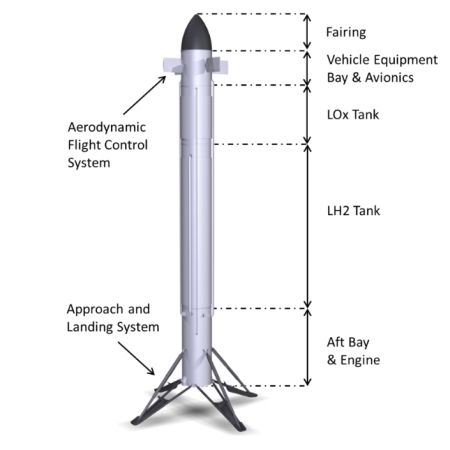
Graphic showing Neutron landing on Rocket Lab’s
barge

Capitalism in space: Rocket Lab has won a contract from the Air Force to test the use of its new Neutron rocket for tranporting cargo quickly across the globe, despite the fact that the rocket won’t make its first launch until later this year, at the earliest.

The mission, slated for no earlier than 2026, will fall under the Air Force Research Laboratory’s (AFRL) “rocket cargo” program, which explores how commercial launch vehicles might one day deliver materiel to any point on Earth within hours—a vision akin to airlift logistics via spaceflight.

…The cargo test would be a “survivability experiment.” Neutron is expected to carry a payload that will re-enter Earth’s atmosphere, demonstrating the rocket’s ability to safely transport and deploy cargo.

Neutron is designed to bring its first stage back to a vertical landing on Earth for re-use, similar to what SpaceX does with its Falcon 9. Unlike the Falcon 9, however, Neutron’s fairings remain attached to the rocket, opening and closing like alligator jaws to deploy its satellite payloads. Since it brings the fairing back attached to the rocket and closed after satellite deployment, the plan will be to see if it can carry within this enclosed fairing this Air Force test payload and bring it back unscathed.

This contract suggests the military is very confident that Neutron will fly as planned, and will succeed in its early launches.

5 comments

Update on Vast’s space station plans

Haven-2
Haven-2 station once completed

Link here. The article provides a very detailed look at Vast’s short and long range plans, including its overall strategy to win NASA’s full space station construction contract by first building, launching, and occupying its small scale Haven-1 station and thus demonstrating it is the right company for NASA to finance its full scale Haven-2 rotating space station (shown in the graphic to the right).

The article notes that Vast intends to complete Haven-1’s primary structure in July, and do environmental and vibration ground testing from January to March 2026, with its planned launch on a Falcon 9 rocket in May 2026. Once launched it plans to put crews on board for a total of 30-days (though it is unclear at this moment whether that will be a single mission or a series of shorter flights).

In addition, the article reveals that the company also hopes to do two spin tests of Haven-1, testing its ability to rotate and create an artificial gravity. That aligns with the goal of Vast’s full scale Haven-2 station, which it wants to rotate as well. Since the plan is to assembly Haven-2 from upgraded Haven-1 modules, these spin tests are essential for proving the larger station’s design.

Based on this new information, I think we can now map out the evolving but still subject-to-change manned operations at Haven-1, comprising several short 3-5 day manned missions. The first will the crew test the module’s operation. The next two will be to do these spin tests, with people on board.

Vast’s strategy is fundamentally different than the other proposed stations (all listed below). Instead of taking a small NASA development grant to create designs on paper, it is spending its own money to actually launch a demonstration station. If successful, this strategy will make it very easy for NASA to pick it when the time comes to award the larger station construction contracts.

My present rankings for the four proposed commercial stations:

  • Haven-1, being built by Vast, with no NASA funds. The company is moving fast, with Haven-1 to launch and be occupied in 2026 for an estimated 30 days total. It hopes this actual hardware and manned mission will put it in the lead to win NASA’s phase 2 contract, from which it will build its much larger mult-module Haven-2 station..
  • Axiom, being built by Axiom, has launched three tourist flights to ISS, with a fourth scheduled for early June, carrying passengers from India, Hungary, and Poland. Though there have been rumors it has cash flow issues, development of its first module has been proceeding more or less as planned.
  • Starlab, being built by a consortium led by Voyager Space, Airbus, and Northrop Grumman, with an extensive partnership agreement with the European Space Agency. It recently had its station design approved by NASA.
  • Orbital Reef, being built by a consortium led by Blue Origin and Sierra Space. Overall, Blue Origin has built almost nothing, while Sierra Space has successfully tested its inflatable modules, including a full scale version, and appears ready to start building its module for launch.
6 comments

The French startup, The Exploration Company, ships its next cargo capsule prototype for launch

The Exploration Company, a French startup aiming to provide cargo services to both ISS and the future space stations that will replace it, has completed construction and testing of its next cargo capsule prototype, dubbed “Mission Possible,” and has shipped it to Vandenberg in California for launch on a SpaceX Falcon 9 rocket in June 2025.

In a 6 May update, The Exploration Company announced that it had completed Mission Possible’s pre-shipment review on 2 May and subsequently shipped the capsule to its launch site in the United States. The spacecraft will launch aboard a SpaceX Falcon 9 as part of the Transporter-14 rideshare mission, which is expected to lift off no earlier than June 2025.

Once launched, the Mission Possible capsule will remain attached to the Falcon 9 upper stage until after the stage completes its deorbit burn. This approach is necessary because the capsule lacks sufficient propulsion to independently deorbit itself. After separation, it will carry out a series of reorientation manoeuvres as it begins atmospheric reentry.

This capsule is 2.5 meters in diameter, smaller that its proposed commercial Nyx capsule that is the company’s eventual commercial freighter. It is also larger than the company’s first prototype, which flew on the first launch of Ariane-6 in 2024 but was unable to test its re-entry designs because of a failure in that rocket’s upper stage engine that prevented its planned controlled de-orbit.

1 comment

Europe and India sign agreement to work together on manned space flight

The European Space Agency (ESA) yesterday announced that it has signed an agreement with the Indian government that will lay the groundwork for them to work together on manned space exploration, first in connection with their future space station plans and later on lunar exploration.

ESA and ISRO declared their intent to work together on the interoperability of rendezvous and docking systems to allow their respective spacecraft to work together in low Earth orbit. They will also examine further activities related to astronaut training, analogue space missions – where teams test aspects of space missions in ground-based simulations – and parabolic flight activities.

…Future cooperation possibilities include ESA astronaut flight opportunities to the planned Bharatiya Antariksh Station (BAS) and early scientific utilisation, as well as developing infrastructure in low Earth orbit. The two space agencies are also discussing alignment on payloads and robotic scientific missions to the Moon.

Faced with the decommissioning of ISS in 2030, as well as the likely end to several major Artemis components (Orion and Lunar Gateway) that ESA has had a major part, it appears Europe has quickly begun looking for other alternatives. It already has partnered with the American consortium building the Starlab space station, but this new agreement with India gives it more options.

India meanwhile gets aid and support from Europe. It could even be that both are negotiating transferring some of Europe’s Lunar Gateway modules to India’s space station.

4 comments

Russia signs space agreement with Venezuela

The losers unite! Russia’s state-run press today announced that its government have signed a bi-lateral agreement with Venezuela to work together in space.

Moscow and Caracas have agreed to enhance cooperation in the peaceful use of outer space, including by building a Glonass ground station in Venezuela, according to a bilateral cooperation treaty.

Because of the bankruptcy at both nations, this agreement really doesn’t involve much real space development. All it really does is allow Russia to build a ground station in Venezuela for operating its orbiting Glonass GPS-type constellation, which Russia in turn has been struggling for decades to bring back into full operation after the fall of the Soviet Union.

1 comment

India tightens its satellite regulations for foreign companies

In what is a likely response to the increased military conflict with Pakistan, India’s government has announced new satellite regulations for foreign companies that will likely impact the operations of both Starlink and OneWeb.

The country’s Department of Telecommunications (DoT) announced 29 additional regulations May 5, citing national security interests, which also apply to companies that already hold licenses for providing space-based communication services directly to users.

The rules include a requirement for call logs and other user data to be stored in India, and new obligations for interception and monitoring under national law. Satellite operators must also show how they plan to source at least 20% of their ground infrastructure equipment from India within five years of commercial launch.

The article at the link suggests that these new regulations will have a greater impact on OneWeb than Starlink. Yet, OneWeb already has approval to sell its services in India, while Starlink has not.

The article also included one interesting tidbit from a Starlink official, noting that the company expects to have 6.5 million subscribers by the end of this year. Based on the company’s subscriber fees, that translates into many billions in revenue. Very clearly SpaceX no longer needs NASA to develop Starship.

1 comment

FAA approves SpaceX request to increase Starship launch rate at Boca Chica

The FAA today by email announced that it has released the final environmental reassessment that approves SpaceX’s request to increase the number of yearly Starship/Superheavy launches at Boca Chica to as many as 25.

The assessment is now available for public comment, and could still be revised. However, the FAA’s conclusions are clear, as indicated by the highlighted phrase:

The FAA is announcing the availability of the Final Tiered Environmental Assessment and Mitigated Finding of No Significant Impact/Record of Decision (FONSI/ROD) for the SpaceX Starship/Super Heavy Vehicle Increased Cadence at the SpaceX Boca Chica Launch Site in Cameron County, Texas (Final Tiered EA and Mitigated FONSI/ROD).

Under the Proposed Action addressed in the Final Tiered EA, the FAA would modify SpaceX’s existing vehicle operator license to authorize:  Up to 25 annual Starship/Super Heavy orbital launches, including: Up to 25 annual landings of Starship (Second stage); Up to 25 annual landinqgs of Super Heavy (First stage). The Final Tiered EA also addressed vehicle upgrades.

You can read the executive summary of this announcement here [pdf]. The full reassessment can be read here [pdf]. Its conclusion is quite blunt:

The 2022 PEA [Preliminary Environmental Assessment] examined the potential for significant environmental impacts from Starship/Super Heavy launch operations at the Boca Chica Launch Site and defined the regulatory setting for impacts associated with Starship/Super Heavy. The areas evaluated for environmental impacts in this EA [environmental assesssment] included air quality; climate; noise and noise‐compatible land use; visual resources; cultural resources; Department of Transportation Section 4(f); water resources; biological resources (terrestrial and marine wildlife); land use; hazardous materials; natural resources and energy supply; and socioeconomics, and children’s health. In each of these areas, this EA concludes that no significant impacts would occur as a result of SpaceX’s proposed action. [emphasis mine]

As I’ve noted repeatedly, this has all been self-evident for years, as proved by the environmental circumstances at the American spaceports at Cape Canaveral and Kennedy in Florida and Vandenberg in California. Spaceports help the environment by creating large wildlife refuges where no development can occur. We have known this for decades. That the FAA and the federal bureaucracy has in the past five years suddenly begun demanded these long reassessments time after time that simply restate these obvious facts can only be because that bureaucracy wants to justify its useless existence with make-work.

4 comments

Update on launch schedule for India’s manned space program

According to the head of India’s space agency ISRO, V Narayanan, the first unmanned Gaganyaan orbital mission is now targeting a launch in the last quarter of this year, followed by two more unmanned test flights in 2026 and the manned mission of one to three days flying in the first quarter of 2027.

This schedule appears more firm than any previously announced. When first proposed back in 2018, ISRO’s goal was to launch the first manned mission in 2022. And like all government projects, the launch date kept getting pushed back again and again. ISRO officials will blame the COVID panic for these delays, but that’s hogwash. While ISRO shut down for almost two years out of fear of a only slightly more potent illness than the flu, others did not, and ended up stealing almost all of ISRO’s commercial business as a result.

The delays in Gaganyaan also stem from the unrealistic goals first put forth by ISRO. For example, initially the program did not include these unmanned test flights, a lack that was foolish and later corrected.

Based on all reports in the past year, however, it appears that this newest schedule probably reflects reality, and will take place more or less as described.

1 comment

Stratolaunch completes first hypersonic test flight for Pentagon

The military this week confirmed that Stratolaunch had successfully completed its first two hypersonic test flights for the Pentagon in December and March.

The hypersonic vehicle named Talon A2 exceeded Mach 5—the threshold for hypersonic speed—in two Pentagon-backed test flights conducted in December 2024 and March 2025, the Defense Department confirmed May 5.

The flights mark the first time since the X-15 program, which ended in 1968, that the U.S. has conducted reusable hypersonic testing.

At the moment the military’s hypersonic test program is really getting its money’s worth from private enterprise. Stratolaunch is doing tests using a reusable vehicle. Rocket Lab is doing suborbital flights using a revised version of its Electron rocket’s first stage. Varda will do hypersonic tests with its capsule when it returns from orbit. And startups Ursa Major and Radian have won contracts to do their own test flights.

For literally decades the military’s hypersonic test program had limped along, barely able to do tests more than once every few years. Then however it was run entirely by the government. Now that the military has stopped trying to be the designer and builder but simply a customer, it is getting what it needs fast and with a great deal of variety.

Ain’t freedom and competition and private enterprise wonderful?

2 comments
1 61 62 63 64 65 838