French official lauds Ariane 6 launch; demands Europe have its own launch capability

Philippe Baptiste, France’s Minister for Higher Education and Research, yesterday loudly touted the second successful launch of Ariane 6 rocket, even though it occurred years late and costs far more than any other rocket on the market today.

Baptiste did so even as he insisted the Europe must continue to have its own launch capability so that it need not depend on rockets from other countries.

Europe must have sovereignty in space and “not yield to the temptation of preferring SpaceX or another competitor that may seem trendier, more reliable, or cheaper,” Baptiste [said]. “This first commercial launch of Ariane 6 is not just a technical and one-off success. It marks a new milestone, essential in the choice of European space independence and sovereignty. In the labyrinth of the global space race, Ariane 6 is the guiding thread of our strategic autonomy for the years to come.

“We must also collectively advance, as Europeans, on the governance of Europe’s space ambitions. We must ask ourselves all the questions, without taboos. For Europe in space, I am convinced that the European Union must fully assume its role as the political leader in this matter. The challenges are immense, no one knows this better than we do.”

Note Baptiste’s focus on having the European Union (EU) run things, with a focus on Ariane-6, despite its high cost. He was previously head of France’s space agency CNES, which for years has used the EU and the European Space Agency’s (ESA) partners help pay for France’s space program by requiring that all rocket launches be run by ESA’s commercial division, Arianespace.

That situation is now changing, with other ESA nations (Germany, Italy, Spain, and the United Kingdom) all breaking free from Arianespace and instead encouraging the development of competing private rocket startups independent of ESA or Arianespace. Moreover, these ESA partners have aggressive reduced Arianespace’s areas of control. It no longer runs the French Guiana spaceport. Its management of the Vega-C rocket has been transferred back to the Italian company Avio, which builds it. All it now has is Ariane-6, which has limited value because it is so expensive.

So while Baptiste desire for European autonomy matches the efforts of these European countries, his apparent desire to keep all control within the continent’s centralized government authority has been rejected. Europe has a chance to compete, but only because it is freeing its rocket startups from government control.

6 comments

SpaceX’s eighth orbital test flight of Starship/Superheavy ends like the seventh flight

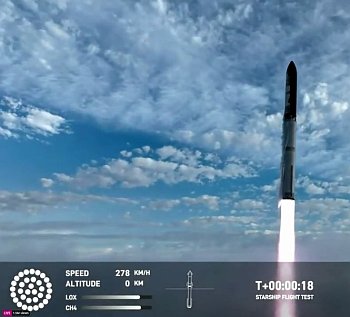
Starship just before loss of signal

Today’s eighth orbital test flight of SpaceX’s Starship/Superheavy giant rocket has turned out to be almost identical to the seventh flight, with Superheavy completing its mission with a perfect chopstick catch at the launch tower in Boca Chica and Starship failing just before engine shutdown that would have put it into its orbit.

The screen capture to the right shows that moment. Note that graphic on the far lower right. It indicates that only two of the outside engines are firing, in an asymmetrical configuration. As a result Starship began tumbling, as shown by the fact that the Earth is not visible in the background. Shortly thereafter contact was lost, and I expect the flight termination system took over to destroy the ship. Expect videos from the Caribbean of it burning up overhead in the next day or so.

Superheavy however completed the third ever capture by the launch tower chopsticks. Musk has indicated that the company is pushing to reuse a Superheavy booster as soon as possible. The lose of Starship and the fact that two Superheavy engines shut down prematurely during the boost-back burn after stage separation likely delays that reuse at least one or two test flights. First, this Superheavy had issues, that might be solvable but they nonetheless exist.

More important, the loss of Starship just before its orbital coast once again means SpaceX was unable to do any of its orbital and return test program. It will not make sense to risk the next Starship flight with a used Superheavy when testing Starship has now been delayed twice.

Nor does it matter much. It will take many more launches before this rocket is reliably reusable. The first priority now is to make it more reliable on its first launches. Expect SpaceX to target the next test flight for sometime in mid- to-late April.

29 comments

Athena sits at an unknown angle on the Moon, hampering operations

Athena's landing site 100 miles from the Moon's south pole
Yellow cross indicates Athena’s targeted landing site

According to the CEO of Intuitive Machines, Athena is sitting an an unknown angle on the Moon, impacting the possibility of all surface science operations.

The tilt is hampering their ability to use the high gain antenna which they need use to download most of their data. They do not know the angle, or the cause of this issue. It could simply be that the ground slope is too severe. It is also possible the spacecraft, which has a relatively high center of gravity, fell over on its side because of that slope. Moreover, they do not know at the moment exactly where the spacecraft landed, though they know it landed on Mons Mouton as planned. They need to download pictures from the spacecraft, as well as from Lunar Reconnaissance Orbiter (LRO) in orbit to determine precisely the location and the situation.

It is also unclear what payloads will be impacted by this situation. It could be that most if all could be utilized, but that question cannot be answered until they learn more. I suspect both the mini-rover and the Grace hopper will be affected the most, as the tilt might make it impossible to deploy either.

For Intuitive Machines this situation is very unfortunate. It has sent two unmanned lunar landers, and both have had issues at landing, though it must be emphasized that the issue on today’s second landing might have nothing to do with the company’s engineering at all.

3 comments

Ariane-6 successfully launches for the second time

The European Space Agency’s (ESA) commercial arm, Arianespace, today successfully launched from French Guiana its new Ariane-6 rocket for the second time, this time placing its first commercial payload, a military Earth imaging satellite, into orbit.

As of posting the satellite has not yet been deployed by the upper stage, as several additional engine burns are required over then hour or so to place it in the right orbit. As there were some issues with this upper stage on the rocket’s first launch, the successful completion of these burns is critical for the rocket’s future. So far the first major burn has been completed as planned. UPDATE: The payload has been successfully deployed in the proper orbit.

This was Europe’s first launch in 2025, so there is no change in leader board for the 2025 launch race:

26 SpaceX
9 China
3 Russia
2 Rocket Lab

0 comments

India’s space agency ISRO begins construction of second spaceport

India's spaceports
India’s spaceports

After several years getting the real estate as well as the necessary regulatory approvals, India’s space agency, Indian Space Research Organization (ISRO), has now begun construction of it second spaceport, dubbed Kulasekaranpattinam, near the southern tip of India.

The map to the right shows the location. The Sriharikota spaceport has been used by the agency for decades. The Agnikul site was used once by one of India’s rocket startups for a suborbital launch, but it is unclear if it will be upgraded to a full launch site in the future.

Kulasekarapattinam was one of the areas recommended for the launchpad even before the rocket launchpad was set up in Sriharikota due to its strategic geographical location near the equator. It is located on the east coast and there is no land to the south of it, allowing for direct southward launches over the Indian Ocean. This will minimize fuel consumption and maximize payload capacity for small satellite launch vehicles (SSLVs), particularly beneficial for cost-effective commercial satellite launches.

The site also avoids the need for complex “dogleg” manoeuvres around Sri Lanka. The manoeuvre involves a sharp turn or bend in a launch trajectory to avoid collisions or falling debris into populated areas, which would require additional fuel.

As part of the breaking ground ceremonies, ISRO scientists also completed a small suborbital rocket launch from this new site, reaching an altitude of 46 miles before falling back into the Indian Ocean.

0 comments

Engineers turn off one more instrument on each Voyager spacecraft

The Voyager missions
The routes the Voyager spacecraft have
taken since launch. Not to scale.

Due to continuing reductions in the power generated by their nuclear energy sources (after a half century of operation) engineers have now turned off one more science instrument on each Voyager spacecraft in order to extend the spacecrafts’ life as long as possible.

Mission engineers at NASA’s Jet Propulsion Laboratory in Southern California turned off the cosmic ray subsystem experiment aboard Voyager 1 on Feb. 25 and will shut off Voyager 2’s low-energy charged particle instrument on March 24. Three science instruments will continue to operate on each spacecraft. The moves are part of an ongoing effort to manage the gradually diminishing power supply of the twin probes.

Even with this action, the future lifespan of both spacecraft is very limited. It is expected the savings in power will allow both to last about a year longer, well into 2026. In order to keep the Voyagers operating as long as into the 2030s mission engineers are now working up a timeline for shutting down the remaining instruments in a step-by-step manner. In that long run the goal won’t be science gathering but engineering. Can humans keep a spacecraft operating for more than a half century at distances billions of miles away?

5 comments

Democrats: A party so filled with hate it can’t even cheer a child because Trump introduced him

In the next day or so you will hear a lot of analysis of Trump’s speech yesterday to Congress, both good and bad. The bulk of that commentary will focus on what Trump has or has not accomplished, for good and ill. Some will talk about the overall foolish behavior of many Democrats, who refused to applaud anything Trump said (something Trump predicted would happen near the start of the speech), with one Democrat getting ejected from the building for heckling the president and refusing to stop.

During such speeches presidents usually tout their past achievements and future goals. With each proclamation, the members of that president’s party will repeatedly give him a short standing ovation, with the opposition party usually sitting quietly. This fake theater is one reason I generally don’t watch such events, relying on reviewing them after the fact to save a LOT of time.

Another tradition during these speeches is for the president to invite several ordinary citizens to attend in order to honor them in some way. At these moments, when the president introduces the citizen, the entire room would routinely stand and cheer, because these individuals are generally not party partisans, and the ruling president and his party usually have nothing to do with that person’s particular achievement.

Last night however was starkly different, and the screen capture below captures the one moment that demonstrates so fully the utterly bankrupt nature of the Democratic Party. One of the private citizens Trump invited to honor was a 13-year-old boy, DJ Daniel, who five years ago was diagnosed with terminal brain cancer and given only six months to live. Five years later he is still alive and healthy, and proudly wears a police uniform frequently in public because of his dream to be a cop someday.
» Read more

31 comments

Lunar Reconnaissance Orbiter snaps picture of Blue Ghost on the Moon

Blue Ghost on the Moon
Click for full image. For original of inset go here.

Shortly after Firefly’s Blue Ghost lunar lander touched down within Mare Crisium on the Moon, the science team for Lunar Reconnaissance Orbiter (LRO) used it to capture a picture of lander on the surface of the Moon.

That image is to the right, reduced to post here. The inset was expanded and sharpened to bring out the details, with the arrow showing Blue Ghost, that tiny dot in the center with a shadow to the right.

The Firefly Blue Ghost lunar lander set down on 2nd March 2025. The landing site (arrow) is about 4000 meters from the center of Mons Latreille, a large volcanic cone [seen to the left].

…LRO was 175 kilometers east (19.294°N, 67.956°E) of the landing site when the NACs acquired this dramatic view of the landing site on 02 March 2025 at 17:49 UTC.

Blue Ghost landed shortly after lunar sunrise, and is designed to operate for one full lunar day (fourteen Earth days). Whether it can survive the 14-day-long lunar night won’t be known until the next sunrise.

4 comments

Watch the landing of Intuitive Machines’ Athena lander on the Moon tomorrow

Athena's landing site 100 miles from the Moon's south pole

NASA has now announced its live stream arrangement for the landing of Intuitive Machines’ Athena lander on the Moon tomorrow at 12:32 pm (Eastern).

The live stream will begin about sixty minutes before landing. The NASA live stream is available here. I have also embedded it below.

The map to the right shows the landing site by the yellow “X”, about 100 miles from the Moon’s south pole on a high relatively flat plateau dubbed Mons Mouton. This will be the closest any lander has come to the pole, and was the original site chosen for NASA’s now-canceled VIPER rover. If the landing is successful Athena will land close to a small crater that is believed to have permanently shadowed areas. The plan had been to have VIPER travel into it. Now the small Grace hopper that Athena carries will attempt this instead.

This will also be the second attempt by Intuitive Machines to soft land on the Moon. Its first attempt last year was able to land and communicate back to Earth, but the landing was not completely successful. The lander, named Nova-C as well as Odysseus, was moving too fast sideways when it touched down, thus breaking one leg so that the lander fell on its side.
» Read more

1 comment

France opens public comment period for adapting old French Guiana launchpad for commercial rockets

CNES, France’s space agency that now runs the French Guiana spaceport, is now running public meetings for the public to comment on its plans for adapting the old, long-abandoned Diamant rocket pad there for use by a number of commercial rocket startups.

On 17 February, the first of four public consultation sessions into the construction of the new Multi-Launcher Launch Complex (ELM1) at the Guiana Space Centre was held at Kourou Town Hall. This process allows local residents, stakeholders, and organizations to review the project and provide feedback before construction begins. A second session was completed on 23 February, with the remaining two sessions set for 10 and 18 March.

The construction of ELM1 will include common structures like the nodal building, guard post, offices, and storage areas, as well as more specific structures like assembly and preparation buildings, roads, and fences. The project is subject to a building permit, a unique environmental authorization under the regulations for Classified Installations for Environmental Protection, the Water Law, and a request for exemption from the prohibition on the destruction of protected species.

CNES in 2024 approved seven rocket startups to use the site. It later announced its plan to standardize the launchpad so that all users will have to arrive with identical engineering, something that these startups did not like. This comment period will allow them to voice those objections, and likely get the standardization minimized to only those places where it really matters. For example, the impression initially given was that the assembly and preparation buildings would require matching systems from all companies, something that makes no sense.

0 comments

The real underlying battle between Trump and Zelinsky

The kerfuffle last week between the United States and the Ukraine, instigated by the unprecedented ugly end to the press conference that concluded the visit of Ukrainian president Volodymyr Zelensky to the White House, is actually quite understandable if one is willing to consider the perspective of both sides. Unfortunately, I have seen little such analysis anywhere. Instead we get emotional attacks. On the left Trump is a vicious politician who wants to carve the Ukraine up for the benefit of Russia. On the right Zelensky is a corrupt barbarian who simply wants the war to continue forever so that he can steal as much U.S. foreign aid as possible for his own private benefit.

Neither of these conclusions are very helpful. Nor do they provide any insight to what is really going on.

So, what are the different perspectives that caused this confrontation?
» Read more

18 comments

Falcon 9 first stage lost after landing yesterday

According to an update on SpaceX’s website, the first stage of the Falcon 9 that launched 21 Starlink satellites (not 23 as initially reported) yesterday was lost shortly after landing.

The first stage booster returned to Earth and landed on the Just Read the Instructions droneship, which was stationed in the Atlantic Ocean ~250 nautical miles off the coast of Florida. Following the successful landing, an off-nominal fire in the aft end of the rocket damaged one of the booster’s landing legs which resulted in it tipping over.

This is only the second time in years that a first stage has been lost in this manner. After the previous occurrence last year during the Biden administration, the FAA grounded all SpaceX launches for several days, an action that indicated clearly an effort to harass the company for political reasons. I will be very surprised if this happens again, with Trump now in office.

1 comment
1 72 73 74 75 76 838