ESA to provide ground station communications support for India’s manned Gaganyaan missions

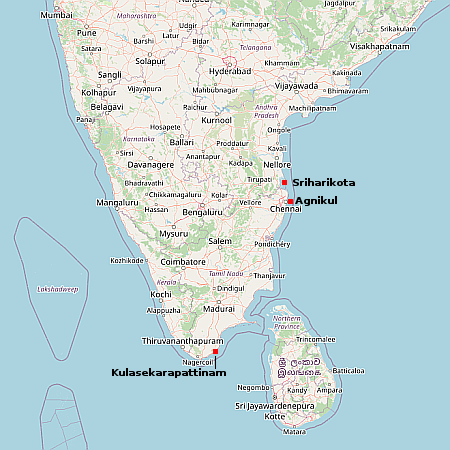
The new colonial movement: The European Space Agency (ESA) has now signed an agreement with India’s space agency ISRO whereby ESA will provide ground station communications support for India’s manned Gaganyaan missions.

The first unmanned test flights are planned for next year, with the first manned Gaganyaan mission targeting 2026.

3 comments

Japan’s space agency admits first launch of its new Epsilon-S rocket will be delayed

Japan’s space agency JAXA yesterday admitted that the first launch of its new Epsilon-S rocket — intended to be cheaper and competitive with the new rockets being developed worldwide — will be delayed because of the explosion that occurred during a static fire test on November 26, 2024.

The news reports in the Japanese press don’t provide much information. It appears the investigation into the explosion is still on-going, and that the cause of the failure has not yet been identified. Because of this, JAXA has been forced to cancel the planned March 2025 date for Epsilon-S’s inaugural flight.

JAXA should get out of the business of building rockets, as its track record is really horrible. The Japanese government has already told it to do so, but it is clearly dragging its feet, not wanting to give up the turf it has controlled for decades.

0 comments

Why Orion’s heat shield problems give Jared Isaacman the perfect justification to cancel all of SLS/Orion

Orion's damage heat shield
Damage to Orion heat shield caused during re-entry in 2022,
including “cavities resulting from the loss of large chunks”

In yesterday’s press conference announcing new delays in NASA’s next two SLS/Orion Artemis missions to the Moon, agency officials were remarkably terse in providing details on why large chunks of Orion’s heat shield material broke off during its return to Earth in 2022 during the first Artemis mission. That damage, shown to the right, is one of the main reasons for the newly announced launch delays.

All they really said was that the damage was caused during re-entry, the atmosphere causing more stress than expected on the heat shield.

Today NASA finally released a more detailed explanation.

Engineers determined as Orion was returning from its uncrewed mission around the Moon, gases generated inside the heat shield’s ablative outer material called Avcoat were not able to vent and dissipate as expected. This allowed pressure to build up and cracking to occur, causing some charred material to break off in several locations.

…During Artemis I, engineers used the skip guidance entry technique to return Orion to Earth. … Using this maneuver, Orion dipped into the upper part of Earth’s atmosphere and used atmospheric drag to slow down. Orion then used the aerodynamic lift of the capsule to skip back out of the atmosphere, then reenter for final descent under parachutes to splashdown.

[Ground testing during the investigation showed] that during the period between dips into the atmosphere, heating rates decreased, and thermal energy accumulated inside the heat shield’s Avcoat material. This led to the accumulation of gases that are part of the expected ablation process. Because the Avcoat did not have “permeability,” internal pressure built up, and led to cracking and uneven shedding of the outer layer.

In other words, instead of ablating off in small layers, the gas build-up caused the Avcoat to break off in large chunks, with the breakage tending to occur at the seams between sections of the heat shield.
» Read more

51 comments

Europe’s Vega-C rocket returns to flight after being grounded for more than two years

Europe’s Vega-C rocket, built by the Italian company Avio but presently still managed by the European Space Agency’s commercial arm Arianespace, today successfully completed its first launch in two years, lifting off from French Guiana carrying a European Earth observation satellite. As of posting the satellite had not yet been deployed.

The rocket was first grounded when its upper stage failed during a December 2022 launch. The investigation pinpointed the problem as the design of the stage’s engine nozzle. However, the first redesign also failed, requiring a second redesign.

This was the eighth launch worldwide in the past 48 hours, the most ever accomplished in such a short time. All told, five nations completed launches (United States 3, China 2, India 1, Russia 1, Europe 1) from eight different spaceports, with all three American launches completed by SpaceX.

Because this was only the third launch by Europe this year, the leader board for the 2024 launch race remains unchanged:

127 SpaceX
59 China
16 Russia
13 Rocket Lab

American private enterprise still leads the rest of the world combined in successful launches 146 to 90, while SpaceX by itself leads the entire world, including American companies, 127 to 109.

1 comment

Next two Artemis missions delayed again, with the future of SLS/Orion hanging by a thread

Orion's damage heat shield
Damage to Orion heat shield caused during re-entry in 2022,
including “cavities resulting from the loss of large chunks”

In a press conference today, NASA officials admitted that their present schedule for the next two Artemis missions will not be possible, and have delayed the next mission (sending four astronauts around the Moon) from the end of 2025 to April 2026, and the next mission (landing astronauts on the Moon) to a year later.

It must be noted that when first proposed by George Bush Jr in 2004, he targeted 2015 for this manned landing. Should the present schedule take place as planned, that landing will now occur more a dozen years late, and almost a quarter century after it was proposed. We could have fought World War II six times over during that time.

Several technical details revealed during the conference:

  • It appears a redesign of Orion’s heat shield will take place, but not until the lunar landing mission. For Artemis-2 (the next flight), engineers have determined they can make the shield work safely by changing the re-entry path. They have also determined that the design itself is still insufficient, and will require redesign before Artemis-3.
  • Though Orion’s life support system will still be flown for the first time on Artemis-2, the first to carry humans, they have been doing extensive ground testing and have resolved a number of issues. They are thus confident that it will be safe to fly with people on its first flight.
  • Though SLS’s two solid-fueled strap-on boosters will be stacked for more than one year when Artemis-2 launches in April 2026, they are confident based on data from Artemis-1 that both will still be safe to use.

The political ramifications that lurked behind everything however are more significant.
» Read more

16 comments

Yuma competing for up to $160 million in an NSF grant to establish its own spaceport

Yuma spaceport

Arizona wants its own spaceport! The city of Yuma, located in Arizona’s southwest corner, is now a finalist in a National Science Foundation (NSF) grant program that could award it up to $160 million to establish a spaceport there.

The city is one of two Arizona applicants, the other being the University of Arizona, which wants to use the grant money “to make the state a proving ground for transformative mining technologies.” There are in addition 69 other applicants to the NSF grant.

This announcement is mostly PR, since Yuma not only does not yet have a spaceport licence from the FAA, it does not yet have approval from Mexico to fly missions over that country. Yuma is not on the coast, so launches must cross land. And if not over Mexico, launches would have to cross other U.S. states, something that would need approval as well.

This proposal has been in the works for many years, as having a spaceport in Arizona would draw a lot of space business to the state. It could happen, but to do so will require a lot of approvals from a lot of government agencies.

1 comment

Republican California state legislator introduces bill to overturn California Coastal Commission’s effort to block SpaceX

Wants to be a dictator

Republican state assemblyman Bill Essayli has now introduced a bill that would overturn the decision by the California Coastal Commission to reject SpaceX’s request to increase its launch rate at Vandenberg spaceport, a decision the commissioners readily and publicly stated was made not to protect the state’s beaches (the commission’s prime function) but because they did not like Musk’s political positions.

“AB 10 will reverse the politically-motivated decision by the California Coastal Commission to restrict SpaceX launches for the Space Force due to their hatred of Elon Musk. This dangerous and illegal decision threatens our national security and erodes the public trust we place in our officials to act in the best interest of the people — not politics,” Essayli said in a statement this week.

SpaceX has already sued the commission and its commissioners for violating Musk’s first amendment rights as well as exceeding their statutory authority.

The bottom line however is that the commission’s decision carries no legal weight. Vandenberg is an federally operated military base, and thus this state commission has no authority to dictate what happens there. The Space Force has simply tried to work with it in the past.

Thus, if the commission’s fangs are not pulled by Essayli’s legislation as well as SpaceX’s lawsuit, the military will likely just ignore it.

4 comments

Airbus cuts almost 500 jobs in Great Britain

As part of a larger planned belt-tightening that is expected to reducing staffing by more than 2,000, Airbus has now begun eliminating 477 jobs in its British operations.

The cuts are expected to hit the workforce in Stevenage and Portsmouth, where Airbus’s UK space operations are concentrated, while Newport in south Wales may also be impacted. The Stevenage site is also building Europe’s first Mars rover for a mission designed to search for signs of past or present life on the planet that’s due for launch in 2028.

Airbus said that only “overhead positions” – such as management support – will be hit, with nobody assigned to individual programmes or projects affected.

The company claims these cuts are due to SpaceX grabbing a large part of market share in the satellite business. It is also because Airbus is likely overstaffed, its operations shaped by the European Space Agency past requirement that it spread those operations to as many member nations as possible. These cuts in Great Britain are likely an attempt to reduce that spread.

1 comment

Another record-setting launch day worldwide

In what might be a record for the global launch industry, yesterday saw a total of four launches at four different spaceports worldwide.

That record might very well be matched today. Already three launches have already taken place, with one more scheduled.

First, India’s space agency ISRO successfully launched European Space Agency’s PROBA-XL solar telescope, its PSLV rocket lifting off from its Sriharikota spaceport on India’s eastern coast. This was India’s fourth launch in 2024.

Next, China launched what its state-run press merely described as a “group of satellites,” its Long March 6 rocket taking off from its Taiyuan spaceport in northern China. That state-run press also said nothing about where the rocket’s lower stages and four strap-on boosters crashed inside China. (UPDATE: More information about the payload can be found here. It appears to have been the third set of 18 satellites launched as part of China’s attempt to compete with Starlink.)

Then, SpaceX launched SXM-9, a new satellite for the constellation of the radio company Siruis-XM, its Falcon 9 lifting off from Kennedy in Florida. The first stage completed its nineteenth flight, landing on a drone ship in the Atlantic. As of posting the satellite had not yet been deployed.

If all goes as planned, the fourth flight today will be the first launch in more than two years of Avio’s Vega-C rocket, which has been grounded while the company redesigned and then redesigned again the engine nozzle of its upper stage. The launch is also one of the last that will be managed by Arianespace, which is giving up control to Avio over the next year. The live stream is here.

If successful, it will be the eighth launch worldwide in only two days, something that I am fairly certain has never been done before. In the past there simply weren’t enough independent entities and spaceports available to allow this number of launches in such a short period of time. What makes this record even more striking is that three of the eight launches were launched by one private American company, SpaceX.

The leaders in the 2024 launch race:

127 SpaceX
59 China
16 Russia
13 Rocket Lab

American private enterprise still leads the rest of the world combined in successful launches 146 to 89, while SpaceX by itself leads the entire world, including American companies, 127 to 108.

1 comment

Two more launches completed today

Since the first two launches earlier today, we have seen two more launches successfully completed.

First Russia placed a classified military payload into orbit, its Soyuz-2 rocket lifting off from its Plesetsk spaceport in northeast Russia. The fairings and first three stages all crashed inside Russia. No word if they landed near habitable areas, though the regions are generally sparsely inhabited.

Then SpaceX completed its second launch today, placing another 20 Starlink satellites into orbit, its Falcon 9 rocket lifting off from Vandenberg in California. Of the satellites thirteen were configured for direct-to-cell service. For the second time in the last week the company broadcast did not begin until after liftoff. In both cases the reason might be to avoid revealing any visuals of the rocket’s fairing, suggesting that SpaceX was using something different that it wanted to keep secret.

The first stage completed its twelfth flight, landing on a drone ship in the Pacific.

Not surprisingly, two of the launches previously scheduled for today have been postponed. The PSLV launch of a European solar telescope was delayed one day due to an issue detected with the payload’s propulsion system, while the first launch in two years of Arianespace’s Vega-C rocket was delayed because of an unspecified “mechanical issue.” At present Arianespace is targeting a launch for tomorrow.

The leaders in the 2024 launch race:

126 SpaceX
58 China
16 Russia
13 Rocket Lab

American private enterprise still leads the rest of the world combined in successful launches 145 to 87, while SpaceX by itself leads the entire world, including American companies, 126 to 106.

2 comments

Trump picks billionaire and private astronaut Jared Isaacman to run NASA

Jared Isaacman
Jared Isaacman

Capitalism in space: In a decision that is certain to send shock waves throughout NASA and the established aerospace industry, President-elect Donald Trump today announced that he has chosen billionaire and private astronaut Jared Isaacman to be his nominee for NASA administrator.

Isaacman quickly accepted the nomination.

Besides being a jet pilot with extensive experience in the aerospace industry, Isaacman has also commanded two space missions, financed out of his own pocket. Both missions used SpaceX’s Falcon 9 rocket and Resilience capsule. Both also pointedly avoided any involvement with NASA, spending several days in free Earth orbit instead of docking with ISS. The second mission achieved several major engineering milestones, testing the first privately built spacesuit during a spacewalk while also flying farthest from Earth since the 1970s Apollo missions.

These flights were part of Isaacman’s own long term space program, dubbed Polaris, with two more missions already in planning stages. The first would be another Dragon orbital mission in which Isaacman had tried to get NASA to shape as a Hubble repair mission. NASA declined. The second is intended as a manned mission around the Moon using SpaceX’s Starship.

That program will now likely get folded into NASA’s Artemis program, which we can all expect Isaacman to force major changes. For one thing, this is another blow to the future of SLS and Orion. As a very successful businessman Isaacman will look with great skepticism at this boondoggle.

For another, Isaacman’s markedly different experiences working with SpaceX versus NASA will likely encourage major bureaucratic changes at the space agency. It is almost certain that Isaacman’s manned flights avoided ISS in order to avoid its Byzantine red tape, that would have likely also blocked use of SpaceX’s spacesuit on a private spacewalk. NASA’s decision to reject Isaacman’s proposal to do a simple but very necessary Hubble repair mission will also likely influence his management of the agency. Isaacman is going to force NASA to depend on the private sector more. He is also likely to reduce the agency’s risk adverse mentality that while often reasonable is many times very counter-productive.

Unlike many of Trump’s other radical nominees, I would be very surprised if Isaacman is not confirmed quickly and with little opposition.

Whether Isaacman will still fly his two remaining private Polaris manned missions is at this moment unknown. Practically it would make sense to cancel them, since he will have much bigger fish to fry at NASA. Emotionally and politically however it would be truly spectacular to have NASA’s administrator fly in space, on a mission using no taxpayer funds. That more than anything would demonstrate the ability of freedom and private enterprise to get things done.

32 comments

Japan awards $32.5 million contract for lunar GPS-type satellite constellation to startup

Capitalism in space: As part of the multi-billion dollar fund the Japanese government has allocated to encourage private enterprise by new Japanese startups, its space agency JAXA has now awarded a $32.5 million development contract to the startup ArkEdge Space to design and fly a GPS-type satellite in orbit around the Moon, thus demonstrating the technology.

Under the agreement, ArkEdge Space will plan and design the mass production and operation of micro-satellite constellations to lead the development of a next-generation Lunar Navigation Satellite System (LNSS), a vital component to the International “LunaNet” initiative driven by National Aeronautics and Space Administration (NASA), European Space Agency (ESA) and JAXA. LunaNet seeks to establish essential infrastructure to support sustainable lunar exploration and foster the growth of the lunar economy.

The real significance of this contract award is that it signals JAXA’s growing shift from designing, building, and owning everything to simply becoming the customer who gets what it needs from the private sector. The Japanese government had established that fund for this express purpose, but JAXA has shown a reluctance to proceed, as it directly threatens its turf. This award indicates that reluctance is finally being pushed aside.

3 comments
1 88 89 90 91 92 988