
New radar technology now available for radio astronomy

GreenBank radar image of Apollo 15 landing region

Astronomers have now demonstrated a spectacular new radar technology using radio telescopes and capable of producing high resolution images of all solar system bodies, as far away as Neptune.

[S]cientists built a miniature transmitter, powered at less than a kilowatt and about the size of a refrigerator, Beasley said, and in November hauled it up for a brief stint at the prime focus of Green Bank Telescope, suspended over the large dish.

Then, the team took advantage of the telescope’s superlative: It’s the largest fully steerable radio telescope in the world, able to study objects across 85% of the sky. So the team pointed the telescope and fired the radar system at the moon — more specifically, at the Apollo 15 mission’s landing site in the Hadley-Apennine region [the white dot in the image to the right]. The team used antennas of the NRAO’s Very Long Baseline Array (VLBA) to catch the signal that bounced back.

The image, with its sloping hills, stark crater and slinking rille, offers a hint of what could come. But the moon is our old companion. Scientists would much rather use a shiny new planetary radar system to study more mysterious objects, like the asteroids zipping through our neighborhood of the solar system, most of which are blurs and blobs, or the strange moons of the outer planets that have received few spacecraft visitors.

Without question this technology would be a major breakthrough for the observation of asteroids, especially those that are considered a threat of impacting the Earth for which we have little concrete information.

The article however notes that the technology had been developed with the assumption that the Arecibo radio telescope would be available. That telescope however is now dead, having been destroyed when its instrument platform fell in early December. With a limited number of radio telescopes available, all of which are oversubscribed for other work, it will be difficult to find time for the use of this technology on any of them.

But don’t worry. The Chinese will definitely want to steal it and put it on their giant FAST radio telescope, and I am sure the Biden administration will be agreeable to letting them.

1 comment

Roscosmos’ commercial division to market tourist seats on Soyuz

The new colonial movement: Glavkosmos, the commercial division of Russia’s space agency Roscosmos, has announced that it is now making available for sale to passengers up to four seats on the Soyuz capsule.

Roscosmos has previously sold such seats through a long-standing relationship with American company Space Adventures. In December, Glavkosmos tweeted its plans to start selling seats, which a company spokesperson has since confirmed. “We assume that each crewed Soyuz MS spacecraft intended solely for commercial spaceflight will have two seats for space tourists” with a professional astronaut occupying the third seat, Glavkosmos spokesman Evgenii Kolomeets told SpaceNews. “In 2022-2023, with a favorable combination of circumstances, we can count on four seats aboard the commercial spacecraft for space tourists.”

The first dedicated Glavkosmos flight should be Soyuz MS-23 in the fall of 2022 to the ISS, with a second flight expected some time in 2023. “Commercial spacecraft and launch vehicles for the 2022-2023 launch campaigns are being manufactured, and specific mission numbers are assigned to spacecraft only after they are included in the flight program,” Kolomeets said.

If this happens, it will mean that at least three different entities — Axiom, Space Adventures, and Roscosmos — will be selling tourists flights into space. And that doesn’t even count possible flights on Boeing’s Starliner, once it becomes operational.

This competition is certain to force a drop in price, which in turn should increase the customer base, making more such flights possible.

0 comments

Biden Justice Dept investigating SpaceX over hiring of non-citizens

They’re coming for you next: The Biden Justice Dept is now investigating SpaceX for discriminating against non-American citizens in its hiring practices.

The DOJ’s Immigrant and Employee Rights Section received a complaint of employment discrimination from a non-U.S. citizen claiming that the company discriminated against him based on his citizenship status.

“The charge alleges that on or about March 10, 2020, during the Charging Party’s interview for the position of Technology Strategy Associate, SpaceX made inquiries about his citizenship status and ultimately failed to hire him for the position because he is not a U.S. citizen or lawful permanent resident,” DOJ attorney Lisa Sandoval wrote in a court document filed Thursday. The document was a request for a judge to order SpaceX to comply with an administrative subpoena for documents related to how the company hires.

It also appears that SpaceX refused to comply with a subpoena from this Justice Dept section, claiming that it exceeded that section’s authority. The Biden administration is now asking the court to enforce that subpoena.

This is not just absurd, it smacks of government overreach designed to destroy the company. SpaceX is a rocket company that must follow very strict ITAR rules designed to prevent the release of military technology to foreign powers. By its very nature the company cannot hire foreign nationals for almost any position. If SpaceX were to hire a non-citizen the State Department would have grounds to shut them down.

Now the Biden administration is demanding that SpaceX do exactly that, essentially placing the company between a rock and a hard place.

This action, combined with the refusal yesterday by the FAA to issue a launch permit to SpaceX so it could do a test flight of its Starship prototype #9, gives us another clear picture of what to expect from Democratic Party rule for the next four years. They have always been out to squelch any independent operations in any way they can, and they now have the power to do it.

Musk better get ready to pay that bribe to the Democratic Party. Otherwise they will shut him down.

As for Starship, according to SpaceX’s website they will make their next launch attempt in February 1. This could be because the FAA has finally relented, or the company is scheduling it to apply more pressure to the agency to get that permit approved. We shall have to wait until then to see.

11 comments

FAA bureaucrats block SpaceX Starship test flight

Capitalism in space? It is now confirmed that the test flight of SpaceX’s ninth prototype of its Starship rocket was scrubbed because of the FAA’s refusal to approve the license. To quote the FAA:

We will continue working with SpaceX to resolve outstanding safety issues before we approve the next test flight.

Typically vague bureaucratic language. There is no word on why the government did this. The flight of Starship prototype #8 proved SpaceX has full control over its vehicle, to the point they could put it down right on target. Why the FAA should now suddenly get cold feet is inexplicable.

There is one difference between now and the December 9th flight of Starship prototype #8. Then the president was Republican Donald Trump, and the Senate was controlled by the Republicans. Now the president is Democrat Joe Biden, and both houses of Congress are in Democratic Party control. It would not surprise me in the least if some Biden officials called the FAA and demanded they impose stricter safety restrictions on SpaceX, and that they did so at the very last minute.

Or to put it another way, someone in the Biden administration essentially wanted to tell SpaceX, “Nice rocket company you got here. Sure would be a shame if something happened to it.”

29 comments

Watching Starship #9’s flight

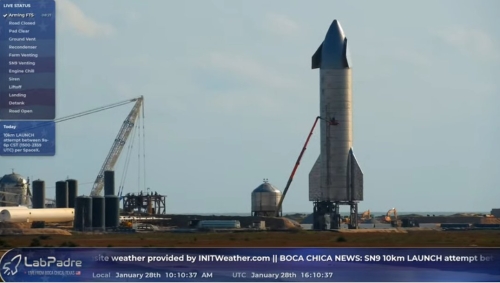
LabPadre's Starship 24/7 live feed, at 8:12 am (Central), January 28, 2021
LabPadre’s Starship 24/7 live feed, at 8:12 am (Central), January 28, 2021.
Click to go to it.

BUMPED AND UPDATED: It is now confirmed that the launch was scrubbed by the FAA’s refusal to approve the license. Though SpaceX seemed to go through a fueling and countdown procedure, they have since detanked the ship.

UPDATE: It appears from several live feeds that they have scrubbed today’s launch because of high winds, and will try again tomorrow. There are also rumors, not yet confirmed, that the launch was scrubbed because the FAA denied the launch license at the last minute.

Capitalism in space: SpaceX today will make an attempt to fly the ninth prototype of its Starship to a height of approximately 33,000 feet. As the company’s Starship website notes,

Similar to the high-altitude flight test of Starship serial number 8 (SN8), SN9 will be powered through ascent by three Raptor engines, each shutting down in sequence prior to the vehicle reaching apogee – approximately 10 km in altitude. SN9 will perform a propellant transition to the internal header tanks, which hold landing propellant, before reorienting itself for reentry and a controlled aerodynamic descent.

The Starship prototype will descend under active aerodynamic control, accomplished by independent movement of two forward and two aft flaps on the vehicle. All four flaps are actuated by an onboard flight computer to control Starship’s attitude during flight and enable precise landing at the intended location. SN9’s Raptor engines will then reignite as the vehicle attempts a landing flip maneuver immediately before touching down on the landing pad adjacent to the launch mount.

SpaceX will be providing a live stream, which I shall embed here at Behind the Black once it becomes available. In addition, there are these live streams available:

Without question the SpaceX live feed will provide the best visuals, but that will not go live until just before launch. Right now I think the Labpadre live feed is my preferred choice because it provides a quick checklist on the screen telling you the countdown status, which in turn gives you an idea how soon the launch might be. For example, when the sirens sound, it means they are approximately 10 minutes to launch.

Stay tuned. This flight, which will likely be as epic as the flight of prototype #8, could make today a fun day in the history of spaceflight.

6 comments

Scientists: Gale Crater never had flowing surface water and was always cold

The uncertainty of science: According to a new analysis of the data from Curiosity and Martian orbiters, scientists now propose that the climate in Gale Crater was never warm, but ranged from Icelandic conditions to far colder.

More importantly, the data suggests that none of chemistry there that required the presence of water was formed by fluvial processes, or flowing water. From the abstract:

We show that the geochemistry and mineralogy of most of the fine‐grained sedimentary rocks in Gale crater display first order similarities with sediments generated in climates that resemble those of present‐day Iceland, while other parts of the stratigraphy indicate even colder baseline climate conditions. None of the lithologies examined at Gale crater resemble fluvial sediments or weathering profiles from warm (temperate to tropical) terrestrial climates. [emphasis mine]

As must be repeated, the mineralogy found by Curiosity points to the presence of water once in Gale Crater, now gone. The initial assumption has always been that this water must have been liquid, as found on Earth. This new research is noting that the conditions show little evidence that liquid water ever existed, but was instead held in frozen lakes and glaciers.

In the coming years I think we are going to learn a lot about the glaciers and ice on Mars, both past and present, and how they reshaped Mars in ways that are alien to processes found on Earth.

1 comment

New analysis: It wasn’t even phosphine detected at Venus

The uncertainty of science: A new analysis of the data used by scientists who claimed in September that they had detected phosphine in the atmosphere of Venus has concluded that it wasn’t phosphine at all but sulfur dioxide, a chemical compound long known to be prevalent there.

The UW-led team shows that sulfur dioxide, at levels plausible for Venus, can not only explain the observations but is also more consistent with what astronomers know of the planet’s atmosphere and its punishing chemical environment, which includes clouds of sulfuric acid. In addition, the researchers show that the initial signal originated not in the planet’s cloud layer, but far above it, in an upper layer of Venus’ atmosphere where phosphine molecules would be destroyed within seconds. This lends more support to the hypothesis that sulfur dioxide produced the signal.

When the first announcement was made, it was also noted as an aside that phosphine on Earth is only found in connection with life processes, thus suggesting wildly that it might signal the existence of life on Venus.

That claim was always unjustified, especially because we know so little about Venus’s atmosphere and its alien composition. Even if there was phosphine there, to assume it came from life is a leap well beyond reasonable scientific theorizing.

It now appears that the phosphine detection itself was questionable, which is not surprising since the detection was about 20 molecules out of a billion. And while this new analysis might be correct, but what it really does is illustrate how tentative our knowledge of Venus remains. It might be right, but it also could be wrong and the original results correct. There is simply too much uncertainty and gaps in our knowledge to come to any firm and confident conclusions.

None of that mattered with our modern press corps, which ran like mad to tout the discovery of life on Venus. As I wrote quite correctly in September in my original post about the first results,

The worst part of this is that we can expect our brainless media to run with these claims, without the slightest effort of incredulity.

We live in a world of make believe and made-up science. Data is no longer important, only the leaps of fantasy we can jump to based on the slimmest of facts. It was this desire to push theories rather than knowledge that locked humanity into a dark age for centuries during the Middle Ages. It is doing it again, now, and the proof is all around you, people like zombies and sheep, wearing masks based not on any proven science but on pure emotions.

2 comments

Blue Origin reveals full throttle long duration test of its BE-4 engine

Capitalism in space: Jeff Bezos today revealed that Blue Origin has successfully completed a full throttle long duration test of its BE-4 engine to be used by both its New Glenn Rocket and ULA’s Vulcan rocket.

“Perfect night,” Amazon CEO Jeff Bezos, who created the Blue Origin space venture more than two decades ago, wrote in an Instagram post. “Sitting in the back of my pickup truck under the moon and stars, watching another long-duration, full-thrust hot-fire test of Blue Origin’s BE-4 engine.”

The post featured a shot of Bezos and other spectators looking on at the rising rocket plume from afar, as well as a video with closer perspectives of the firing.

The company has delivered two engines to ULA designed for ground testing, and says it will deliver soon the flight ready engines for Vulcan’s first launch later this year. Blue Origin also needs to get flight ready engines finished this year for New Glenn, which is also supposed to make it inaugural flight in ’21.

Personally, I think both Blue Origin and ULA are cutting it close. I will not be surprised if this tight schedule means that the first launches of both rockets get delayed into ’22.

Nonetheless, it is great news that the BE-4 appears to finally working as planned after what appeared to be problems for the past few years.

8 comments

The freaky floor of Mars’ Hellas Basin

The perplexing floor of Hellas Basin
Click for full image.

Today’s cool image takes us to the Death Valley of Mars, Hellas Basin, a place I like to call the basement of Mars. The photo to the right, cropped and reduced to post here, was taken by the high resolution camera on Mars Reconnaissance Orbiter (MRO) on September 28, 2020, and gives us another example of the very strange and inexplicable geological formations that are often found on the floor of Hellas.

The picture was taken not as part of any particular research project, but somewhat randomly for engineering reasons. In order to maintain the proper temperature of MRO’s high resolution camera, it must take images in a regular cadence. When large gaps in time occur between requested images, the camera team then picks locations to fill those gaps, sometimes randomly, sometimes based on a quick review of earlier wide angle images.

Sometimes these “terrain sample” images are quite uninteresting. More often they hold baffling surprises.

I think the photo to the right falls into the latter category. Though the terrain covered by the full image is largely flat and lacking in large features, the surface is strewn with perplexing small details.

The light streaks might be dust devil tracks, but why are they light here when such tracks are routinely dark everywhere else on Mars? What formed the many parallel small ridges? What caused the smooth solid patch near the photo’s center top? And why do the ridgelines at the western edge of that patch run in almost a perpendicular direction to the other ridges?

All a mystery, but then the floor of Hellas Basin is filled with such mysteries. Below is a list of some other cool images of the floor of Hellas, all weird and mystifying. Also below is an overview elevation map of Hellas Basin, with darker blue indicating the lowest elevations. The white cross marks the location of today’s photo.
» Read more

0 comments

SpaceX and Amazon in cat-fight over internet satellite constellations

Capitalism in space: Even as SpaceX is rolling out the internet service from its growing Starlink satellite constellation while Amazon’s own Kuiper constellation languishes in development, the two companies are in a battle over the orbits of their respective constellations.

SpaceX CEO Elon Musk took to Twitter on Tuesday, as his company works to persuade Federal Communications Commission officials that it should allow SpaceX to move some of its Starlink satellites to lower altitudes than originally planned.

Jeff Bezos’ Amazon has been among companies that have disputed SpaceX’s request, on the grounds that the modification would interfere with other satellites.

“It does not serve the public to hamstring Starlink today for an Amazon satellite system that is at best several years away from operation,” Musk said in a tweet.

Amazon responded to Musk’s comment in a statement to CNBC. “The facts are simple. We designed the Kuiper System to avoid interference with Starlink, and now SpaceX wants to change the design of its system. Those changes not only create a more dangerous environment for collisions in space, but they also increase radio interference for customers. Despite what SpaceX posts on Twitter, it is SpaceX’s proposed changes that would hamstring competition among satellite systems. It is clearly in SpaceX’s interest to smother competition in the cradle if they can, but it is certainly not in the public’s interest,” an Amazon spokesperson said.

SpaceX in its own response to the FCC has noted “that Amazon representatives have had ’30 meetings to oppose SpaceX’ but ‘no meetings to authorize its own system,’ arguing that the technology giant is attempting ‘to stifle competition.'”

Both companies appear to have a point. Amazon is planning its system under an agreed-to arrangement where its orbits would not conflict with SpaceX’s. To permit SpaceX to change the deal and expand its orbital territory into Amazon’s threatens their system.

At the same time, that Amazon has been so slow to launch its system is something the FCC will not take kindly to. Companies get FCC licensing approval on the condition that they deliver within a certain time frame. Amazon appears to be taking a bit too much time, and SpaceX is trying to take advantage of this fact.

I suspect the FCC will deny SpaceX’s request, but will also tell Amazon that it had better start launching its satellites soon, or else the FCC will change its mind and give SpaceX that orbital territory.

Overall, the slowness of Amazon to launch Kuiper seems to fit the operational pace of Jeff Bezos’ other space company, Blue Origin. Lots of talk, but relatively little action. At some point the talk has to stop and Bezos’ companies have got to start delivering.

20 comments

Antarctica data adds weight to hypothesis that glaciers shaped Mars

New data from an Antarctica ice core strengthens the hypothesis that the flow of glaciers, not liquid water, helped shape the meandering canyons on Mars.

The data was the discovery of the mineral jarosite deep within the south pole ice-cap. Jarosite needs water to form. Previously it was generally believed it formed in conjunction with liquid flowing water. On Mars, which appears to have lots of jarosite, scientists have struggled for decades to figure out how enough liquid water could have existed on the surface of Mars to produce it.

The discovery of jarosite deep inside the Antarctic ice cap now suggests that it can form buried in ice, not liquid water. According to the scientists,

the jarosite was born within massive ice deposits that might have blanketed [Mars] billions of years ago. As ice sheets grew over time, dust would have accumulated within the ice—and may have been transformed into jarosite within slushy pockets between ice crystals.

From the paper’s conclusions:

The occurrence of jarosite in TALDICE [in Antarctica] supports the ice-weathering model for the formation of Martian jarosite within large ice-dust deposits. The environment inside the Talos Dome ice [in Antarctica] is isolated from the Earth atmosphere and its conditions, including pressure, temperature, pH and chemistry, provides a suitable analogue for similar Martian settings. Dust deposited at Talos Dome is also similar to Martian atmospheric dust, being both mostly basaltic. Within thick ice deposits it is likely that the environment would be similar at Talos Dome and under Mars-like conditions since both settings would contain at cryogenic temperatures basaltic dust and volcanogenic and biogenic (for Antarctic only) sulfur-rich aerosols. … Considering this context, it is reasonable that the formation of jarosite on Mars involves the interaction between brines and mineral dust in deep ice, as observed in TALDICE. This mechanism for Martian jarosite precipitation is paradigm changing and strongly challenges assumptions that the mineral formed in playa settings.

Playa settings are places where there is standing liquid water, slowing drying away.

This result is another piece of evidence that ice and glaciers were the cause of the Martian terrain that to Earth eyes for decades was thought to have formed by flowing water. It also continues what appears to be a major shift on-going in the planetary science community, from the idea of liquid water on Mars to that of a planet dominated by glacial and ice processes.

3 comments

Space Force ends development contracts with Blue Origin and Northrop Grumman

The Space Force, having chosen SpaceX and ULA as its sole launch providers, officially ended on December 31, 2020, its rocket development contracts with Blue Origin and Northrop Grumman.

The Air Force awarded Launch Service Agreements to Blue Origin, Northrop Grumman and United Launch Alliance. These were six-year public-private partnerships where both the government and the contractors agreed to invest in rocket development and infrastructure required to compete in the National Security Space Launch program.

The plan from day one was to discontinue the LSAs with companies that did not win a National Security Space Launch procurement contract. Blue Origin and Northrop Grumman lost to ULA and SpaceX, which were selected in August 2020. The Space and Missile Systems Center confirmed in a statement to SpaceNews that the LSAs with Blue Origin and Northrop Grumman ended in Dec. 31, 2020.

From October 2018 through December 2020, Blue Origin was paid $255.5 million. The original six-year agreement was worth $500 million. Northrop Grumman got $531.7 million over that same period, nearly two-thirds of the total value of the LSA which was $792 million.

This whole deal stinks to high heaven. First, it never made any sense for the military to restrict bidding on future launches to just two companies. Such a restrictions smells of a cartel deal designed to play favorites, something the government should not do. It also ends up costing the government more, as it limits competition.

Second, the money handed out sure looks like nice pay-offs to all these big companies, designed to pay company salaries rather than real design work. SpaceX chose not to take it, because it did not want to be beholden to the military’s bureaucracy in how it developed Starship/Super Heavy. That choice has proven wise, as the deal slowed development of both Blue Origin’s New Glenn and ULA’s Vulcan rockets by at least a year, while SpaceX Starship development has moved forward far quicker.

Moreover, its seems very inappropriate for ULA to still be getting this government cash while SpaceX does not. In truth, neither should get a dime unless they actually sign a contract to launch something for the Space Force. Otherwise it is just a form of kickback and a misuse of the taxpayer’s money.

Not that my complaining here will change anything. The big aerospace industry has been addicted to these kind of government payoffs for decades, and apparently will continue to be so addicted for the foreseeable future.

2 comments
1 107 108 109 110 111 126