Axiom’s first passengers to ISS paying $55 million each

Capitalism in space: The three non-Axiom employees who will fly as part of the crew for the company’s first private manned mission to ISS are paying $55 million each for the privilege.

The first private space station crew was introduced Tuesday: Three men who are each paying $55 million to fly on a SpaceX rocket. They’ll be led by a former NASA astronaut now working for Axiom Space, the Houston company that arranged the trip for next January.

“This is the first private flight to the International Space Station. It’s never been done before,” said Axiom’s chief executive and president Mike Suffredini, a former space station program manager for NASA. While mission commander Michael Lopez-Alegria is well known in space circles, “the other three guys are just people who want to be able to go to space, and we’re providing that opportunity,” Suffredini told The Associated Press.

The first crew will spend eight days at the space station, and will take one or two days to get there aboard a SpaceX Dragon capsule following liftoff from Cape Canaveral.

The initial press release made it appear that all four men were crew members and not passengers. And though Axiom and these passengers are both continuing to de-emphasize the tourist nature of their flight, claiming they will each be tasked with science research and that it “is 100% not a vacation for these guys,” the simple fact remains that they are paying customers, flying in space for the fun of it.

Why Axiom and these passengers feel obliged to misconstrue the tourist nature of their flight puzzles me. There is no reason for them to be ashamed of their desire to fly in space. Nor should they feel any guilt about having the money that allows them to pay for the privilege. This is what freedom is all about. They earned their wealth, and it now allows them the chance to do something grand. All power to them.

The actual ticket-price is also intriguing. At $55 million it is far more than the $35 million paid by the last tourist flown on a Russian Soyuz to ISS, though less than the $75 to $90 million the Russians were charging NASA. Overall it appears the price per ticket for an orbital flight has gone up, though the emerging competition is likely stabilizing the price at a lower plateau.

The announcement is also interesting in that so little is mentioned of SpaceX. Though the flight has been sold as an Axiom one, this particular tourist flight will depend entirely on SpaceX hardware to get to and from ISS. Axiom has merely acted as the broker for the flight.

Eventually Axiom will have its own in-space habitable space, first attached to ISS as new modules and later flying free as its own space station after ISS is retired. Right now however the real achievement is coming from SpaceX. This detail must be recognized.

3 comments

Back to Mars’ glacier country

Tongue-shaped glacial flow on Mars
Click for full image.

The cool image to the right, rotated, cropped, and reduced to post here, was taken on November 3, 2020 by the high resolution camera on Mars Reconnaissance Orbiter (MRO). It shows what the science team labels a “Possible Tongue-Shaped Flow Feature in Protonilus Mensae.” There is no caption, so I will try to provide.

Protonilus Mensae is part of the long string of chaos terrain that runs about 2,000 miles along the transition zone between the southern cratered highlands and the northern lowland plains at about 30 to 40 degrees north latitude, and includes the other mensae regions dubbed Deuteronilus to the west and Nilosyrtis to the east. This region of Mars I like to call glacier country, because almost every high resolution photograph appears to show glacial features. To get an idea what I mean, take a gander at these past posts, their locations indicated by number in the overview map of Protonilus Mensae below:
» Read more

0 comments

Axiom names crew for its first private manned mission to ISS

Capitalism in space: The private company Axiom today revealed the names of the four-person crew that will fly a SpaceX Dragon capsule to ISS on the first wholly private manned spaceflight.

The four members of the Axiom Space Ax-1 crew: Michael Lopez-Alegria, former NASA astronaut, Axiom Space vice president and Ax-1 commander; Larry Connor, U.S. real estate entrepreneur and Ax-1 pilot; Mark Pathy, Canadian investor and philanthropist; and Eytan Stibbe, Israeli businessman and fighter pilot.

The crew of the first entirely-private orbital space mission will include the second oldest person to launch into space, the second Israeli in space, the 11th Canadian to fly into space and the first former NASA astronaut to return to the International Space Station, the company organizing the history-making flight has announced.

The launch date has also been delayed from the fall to early ’22.

It is unclear if these four men are the entire passenger list. Dragon can carry up to seven passagers, and earlier rumors had hinted that Tom Cruise and a movie director were buying two seats on this private mission in order to film scenes for a movie.

It is also unclear why the flight was delayed, other than a suggestion that it was due to scheduling conflicts with getting to ISS.

1 comment

OSIRIS-REx to make one last observation of Bennu before heading back to Earth

The OSIRIS-REx science team has figured out a way to make one last observation of Bennu and the Nightingale sample return site before heading back to Earth on May 10th.

This activity was not part of the original mission schedule, but the team is studying the feasibility of a final observation run of the asteroid to potentially learn how the spacecraft’s contact with Bennu’s surface altered the sample site. If feasible, the flyby will take place in early April and will observe the sample site, named Nightingale, from a distance of approximately 2 miles (3.2 kilometers). Bennu’s surface was considerably disturbed after the Touch-and-Go (TAG) sample collection event, with the collector head sinking 1.6 feet (48.8 centimeters) into the asteroid’s surface. The spacecraft’s thrusters also disturbed a substantial amount of surface material during the back-away burn.

The mission is planning a single flyby, mimicking one of the observation sequences conducted during the mission’s Detailed Survey phase in 2019. OSIRIS-REx would image Bennu for a full rotation to obtain high-resolution images of the asteroid’s northern and southern hemispheres and equatorial region. The team would then compare these new images with the previous high-resolution imagery of Bennu obtained during 2019.

Getting at look at Nightingale post-sample-grab is critical to better understanding the nature of the asteroid. Knowing how much changed from that contact will tell scientists a lot about the density, interior, and surface of this rubble-pile asteroid.

This last flyby will also give them the chance to assess the spacecraft’s equipment following the touch-and-go sample grab. They want to know if everything still works as designed in order to plan any post-Bennu missions, including the possibility that OSIRIS-REx will rendezvous with the asteroid Apophis in ’29, shortly after the asteroid makes its next close flyby of Earth.

0 comments

New Democrat head of House subcommittee covering NASA says he supports Artemis

The new Democrat head of the House appropriations subcommittee that covers NASA funding, Matt Cartwright (D-Pennsylvania), appears to support the Artemis program established during the Trump administration, though he has also indicated that he does not favor the timeline imposed by Trump to land a manned mission on the Moon by ’24.

Cartwright’s embrace of Artemis during [a] July 2020 webinar was a change from 2019 when he was one of several members reacting skeptically to a supplemental budget request from the Trump Administration after it unexpectedly accelerated the timeline for putting people back on the Moon from 2028 to 2024. He complained NASA did not even have a cost estimate for the entire effort, yet expected Congress to embrace it.

In 2018, he expressed concern about proposed cuts by the Trump Administration to NASA’s earth and space science activities especially climate programs and WFIRST (now the Roman Space Telescope). He urged NASA to follow the Decadal Surveys produced by the National Academies of Sciences, Engineering, and Medicine.

What his prior views presage now that he chairs the subcommittee remains to be seen. It is widely expected the 2024 deadline will be pushed back, perhaps to the 2028 date NASA originally planned, but Cartwright appears favorably disposed towards the agency overall.

Delaying the Moon landing by SLS forever is the real goal, so the jobs program can be extended without any risks. To actually fly might result in a failure, something that no politician wants.

In the end it will not be SLS anyway that gets Americans back to the Moon. It costs too much and is badly designed. It might fly once or twice, but after that Congress will drop it while keeping Artemis, albeit in a very different form. Instead of having NASA design and build things, the new Artemis will be built by the many companies who were awarded fixed priced contracts during the Trump administration to develop their own hardware as fast as possible and as inexpensively as possible.

The distinction is important, because the latter is more likely to succeed in a reasonable amount of time.

At the same time, with Congress on board and a Democrat in the White House, it is not surprising that the policy is immediately shifting to a slower timeline. Can’t get this done too fast! I must also add that 2028 was not NASA’s original date for its return to the Moon. Before the Trump administration took control of Artemis, NASA had wanted to complete Gateway first, which based on all of NASA’s previous schedules would have pushed a lunar landing into the 2030s. Do not be surprised if this sluggish schedule is reinstated.

In fact, with the present incompetents in charge in Washington, I fully expect China to own the Moon, while U.S. politicians brainlessly dither on how to spend pork.

12 comments

The strange moated mesas of the Kasei Valley on Mars

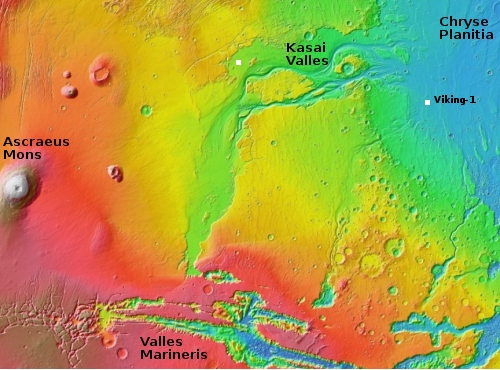
Overview map

In showing my readers today’s cool image, I want to present it as it is seen by scientists, first from a far distance that with time increasingly zooms in to reveal mysteries on a very human scale.

The overview map to the right essentially gives us the view of Mars as seen by scientists following the Mariner 9 orbiter mission that began mapping the Martian surface in late 1971 after the conclusion of a global dust storm that had hidden its surface initially. As the first high resolution map of Mars, the orbiter revealed numerous puzzling and surprising features, including the largest volcanoes and canyons in the solar system. The orbiter also found that the red planet’s surface was comprised of two very different regions, the northern lowland plains and the southern cratered highlands.

The overview map, covering from about 13 degrees south latitude to about 34 degrees north latitude, shows us all but the southern cratered highlands. The white box in Kasei Valles is where today’s cool image is located. Both Kasai and Valles Marineris represent those giant canyons, all invoking to Earth eyes the possibility of catastrophic floods of liquid water sometime in the past.

Ascraeus Mons is the northernmost of the three giant volcanoes east of the biggest volcano of all, Olympus Mons. All sit on what scientists now call the Tharsis Bulge.

Chryse Planitia, where Viking-1 landed in 1976, is part of those northern lowlands that some scientists believe might have been once had an intermittent ocean sometime in the past. Today’s image is about 600 miles from the outlet into Chryse Planitia.

The geological mystery of all these features demands a closer look, something that scientists have been pursuing now for more than a half century.
» Read more

3 comments

Falcon 9 successfully places 143 satellites into orbit

Capitalism in space: SpaceX this morning successfully launched its Falcon 9 rocket carrying a record 143 smallsats into orbit.

As I write this they are in the process of deploying the satellites, which will take time as the upper stage circles the Earth. This launch of 143 satellites beats the former record of the most satellites deployed on a single launch, 104, set by India in 2017.

The first stage landed successfully, completing its fifth flight. They also recovered both fairing halves.

The standings in the 2021 launch race:

3 SpaceX
1 Rocket Lab
1 Virgin Orbit
1 China

The U.S. now leads China 5 to 1 in the national rankings.

8 comments

SpaceX enters business of drilling for natural gas

Capitalism in space: SpaceX has decided to enter the natural gas energy business to help fuel its rockets, and is presently in a legal dispute with another natural gas drilling company over rights to drill on a piece of property near its Boca Chica Starship facility.

SpaceX intends to drill wells close to the company’s Boca Chica launchpad, it was revealed during a Friday hearing before the Railroad Commission of Texas, the state’s energy regulator.

Production has yet to start because of a legal dispute between the SpaceX subsidiary Lone Star Mineral Development and another energy company. Tim George, an attorney representing Lone Star, said at the hearing that SpaceX plans to use the methane it extracts from the ground “in connection with their rocket facility operations.”

While it’s unclear what exactly the gas would be used for, SpaceX plans to utilize super-chilled liquid methane and liquid oxygen as fuel for its Raptor engines.

Since methane is the main component of natural gas, I suspect SpaceX hopes to utilize the gas it pumps out to fuel its Starship & Super Heavy rockets. By obtaining the gas from its own wells, SpaceX cuts out any middle men, and has the opportunity to reduce its costs as well.

20 comments

New leak located in Zvezda on ISS

Russian astronauts have located the suspected new leak location in the Zvezda module on ISS, and also think there might be another, as yet unlocated.

The specialists have discovered one more crack at the International Space Station and suspect that yet another one exists, ISS Russian Segment head Vladimir Solovyov told Rossiya-24. “So far, we have found one place and suspect another, where as some kind of leak exists. We must bring a powerful microscope on a cargo spacecraft and use to examine this place. We are not totally certain so far,” Solovyov said.

These two leaks are in addition to the one inch crack that caused last year’s leak and has been sealed.

All are pointing strongly to stress fractures in this section of Zvezda, one of the station’s oldest modules at twenty-plus years. The leaks are apparently located in the aft section where ships dock to Zvezda, with over a 100 dockings there since launch.

If the cracks and leaks are caused by stress fractures, the life span of Zvezda is now quite limited. It might be possible to seal the cracks and protect the module from further breaks by ending dockings at its port, but I suspect that will not work. Moreover, if I remember correctly Zvezda has the engines that are used to periodically raise ISS’s orbits. If the stress of firing those engines is too risky than another way must be found to maintain the station’s orbit.

In a few years the private company Axiom will be launching its own modules to ISS, designed in the long run to separate from the station and function independently. If NASA and Axiom are smart, they will make sure this new module matches Zvezda’s capabilities, thus making the Russian module redundant and actually superfluous.

8 comments

“The solar system is open for business”

Link here. The article gives an independent look at the surging capitalism that appears to be driving the resurgent rocket and space industry in the U.S. and elsewhere.

As the author notes in his conclusion:

There was a time when space enthusiasts waited on taxpayer-funded space programs to realize their dreams of routine spaceflight and humanity’s expansion into the cosmos. It’s been a very long wait. Now, privatized launch services are opening up access to space. A new wave of exploration missions is widening human knowledge of the solar system. It’s only a matter of time before entrepreneurs, particularly those with deep pockets, figure out how to make money out there.

I plug this article not because he quotes me extensively, but because he came to these conclusions independent of me, and only called me for comments because he thought I might add depth to his conclusions. That the ideas I have been pushing since the late 1990s are now percolating into the larger culture is a very very good sign.

While in those early days the reporters I spoke to were routinely horrified by the idea of a privately financed space mission and wondered if the government should even allow it (they really would say this), today the idea is now considered the right way to go.

This is progress, even in this time of blacklists and a government focused on crushing its citizens.

5 comments

The pit caves of Mars: Can humans someday live in them?

Four more pits in the Tharsis Bulge on Mars

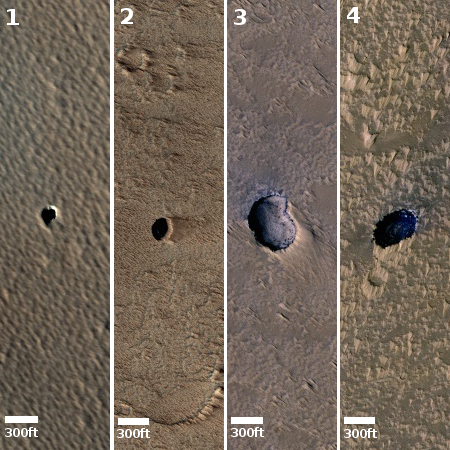
It has been more than four months since my last report on the pits of Mars. Time to do another.

The collage to the right shows the four different pits photographed by the high resolution camera of Mars Reconnaissance Orbiter (MRO) since October. The links to each image are:

Like almost all the cave pits so far found on Mars, all are in the Tharsis Bulge of giant volcanoes to west of Valles Marineris. The overview map below shows these pits in the context of every other pit in this region that I have featured on Behind the Black.
» Read more

11 comments

Chinese government gives wrist slap to powerful scientist on fraud and plagiarism charges

In a decision clearing a powerful scientist of charges of fraud and plagiarism in more than sixty papers, several of which have already been retracted, the Chinese government has also allowed that scientist to keep his post as head of one China’s universities.

The Chinese communists did punish him, but in a way that in the long run is mostly meaningless.

Cao [Xuetao, president of Nankai University and an academician at the Chinese Academy of Engineering] will be barred from applying for national science and technology projects, lose his qualification as a scientific expert, and be forbidden from recruiting graduate students, all for 1 year. The notification also ordered him to investigate and correct the papers. It appears he will keep his job as president of Nankai University, one of China’s most prestigious universities. (On Nankai’s English-language website, Cao is also listed as one of the university’s two chancellors.) Cao did not immediately respond to an email requesting comment.

In other words, he keeps his powerful post. To get off so lightly you would almost think he worked for the American FBI and had tried to overthrow a legal election. But then, no, it isn’t the same. The FBI officials who managed the Trump coup have actually seen less punishment. China, as corrupt as its communist government might be, in this case actually managed to administer a tiny bit of justice.

This is the future, as the world’s culture no longer honors law and the truth, but power and authority. And those in power will never be brought to justice, because they are above all those little people who serve them.

This also tells you how little you should trust any results coming from a government scientist. Those results might be real, but before you accept them you better go over them with a fine-tooth comb.

3 comments
1 108 109 110 111 112 126