Jeff Bezos to step down as Amazon CEO

Capitalism in space: Jeff Bezos announced today that he is stepping down as Amazon CEO to focus his efforts more on his other political and space-related activities.

From the email he sent to Amazon employees:

As Exec Chair I will stay engaged in important Amazon initiatives but also have the time and energy I need to focus on the Day 1 Fund, the Bezos Earth Fund, Blue Origin, The Washington Post, and my other passions,” Bezos wrote. “I’ve never had more energy, and this isn’t about retiring. I’m super passionate about the impact I think these organizations can have

I think this quote from the story above however explains a great deal about Blue Origin in the past three years:

Bezos is said to devote one day a week to Blue Origin (reportedly, Wednesdays), plus at least $1 billion worth of the annual proceeds from his sales of Amazon shares. He’s presided over high-profile publicity events including the unveiling of the Blue Moon lunar lander. But when it comes to the day-to-day business, he handed that responsibility over to veteran aerospace executive Bob Smith, who became Blue Origin’s CEO in 2017.

It was around 2017 that the pace of Blue Origin’s effort seemed to slow to a crawl. It was also about that time that the company became dedicated to becoming a government contractor, doing whatever the government required even if it meant that development of their New Glenn rocket would slow (which it did).

Whether this action will increase Bezos’ participation with Blue Origin however is unclear. In the last year he has seemed more interested in leftist environmental causes and leftist politics. We shall have to wait and see.
15 comments

Smallsat rocket company Astra to go public

Capitalism in space: A merger with a major investment capital company, bringing in $500 million, will result in the smallsat rocket company Astra going public.

Small launch vehicle developer Astra will go public by merging with a special-purpose acquisition company (SPAC), providing the company with nearly $500 million in cash and valuing it at more than $2 billion.

Astra announced Feb. 2 an agreement to merge with Holicity, a SPAC established last year by Craig McCaw. That merger, expected to close in the second quarter, will turn Astra into a publicly traded company on the Nasdaq exchange with the ticker symbol ASTR. McCaw, chairman and chief executive of Holicity, will join Astra’s board as part of the deal.

Astra expects to raise $489 million through the merger with Holicity, a total that includes a $200 million private investment in public equity (PIPE) led by BlackRock and $30 million from a concurrent Series C round, company executives said in an investor call. The deal will value Astra at $2.1 billion.

In the article Astra’s head claimed the company already has contracts for its first fifty flights, but did not provide any details. At this moment Astra has yet to complete a successful orbital launch, and has two attempted orbital tests which both failed.

4 comments

SpaceX live feed of Starship #9 flight

Just before landing
Just before landing.

Just after landing.
Just after landing.

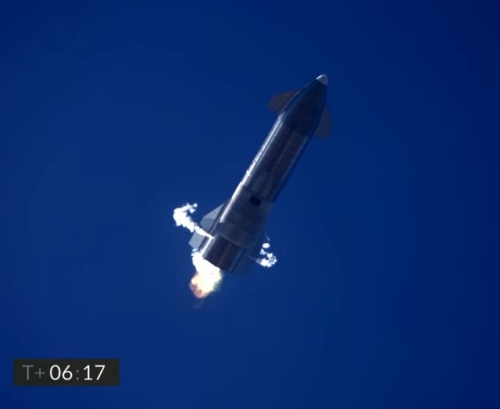
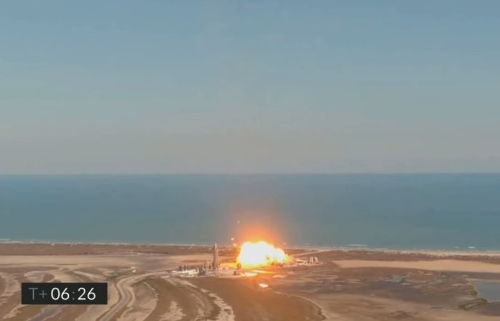
The test is over. All went perfectly until the landing, when the spacecraft once again crashed on the launchpad. They hit the target, but just too hard.

This time the problem occurred early in the landing maneuver. It appeared the spacecraft was unable to get completely vertical and hit the ground without firing its engines.

Right now we have no idea what the issue was, or what will be involved in fixing it. Starship #10 sits on its launchpad, ready to go. Assuming they do not have to make major changes or redesigns to correct the issue, I would expect it to launch within six weeks.

Of course, that assumes the Biden administration doesn’t ramp up its regulatory enforcement effort against SpaceX. And I have every expectation that will be the goal of the Democrats now in charge of the federal government.

Meanwhile, the FAA is now claiming the launch license approval delay last week was related to SpaceX violating it license approval during the December test flight of Starship prototype #8.

In a Feb. 2 statement, the FAA said that SpaceX had requested a waiver to its FAA license for suborbital test flights of its Starship vehicle before the Dec. 9 flight of the Starship SN8 vehicle. That waiver, the FAA said, would have allowed SpaceX to “exceed the maximum public risk allowed by federal safety regulations.”

The FAA denied the request, but SpaceX went ahead with the launch. SpaceX considered the flight successful, although the vehicle exploded upon landing. No injuries or third-party damage was reported during the flight, but the FAA determined that SpaceX violated the conditions of its license by proceeding without the waiver.

“As a result of this non-compliance, the FAA required SpaceX to conduct an investigation of the incident,” the agency stated. “All testing that could affect public safety at the Boca Chica, Texas, launch site was suspended until the investigation was completed and the FAA approved the company’s corrective actions to protect public safety.”

This could be true but personally, I don’t buy it. To me this sounds like government spin to justify their own incompetence in blocking last week’s flight. It also sounds like the kind of spin used by government bureaucrats when they want to enlarge their power. Today’s landing crash of prototype #9 now gives the FAA and Biden administration wonderful ammunition to clamp down hard on SpaceX.

20 comments

Watching Starship #9’s flight, take 2

LabPadre's Starship 24/7 live feed, at 9:12 am (Central), February 2,, 2021
LabPadre’s Starship 24/7 live feed, 9:12 am (Central), February 2,, 2021.
Click to go to it.

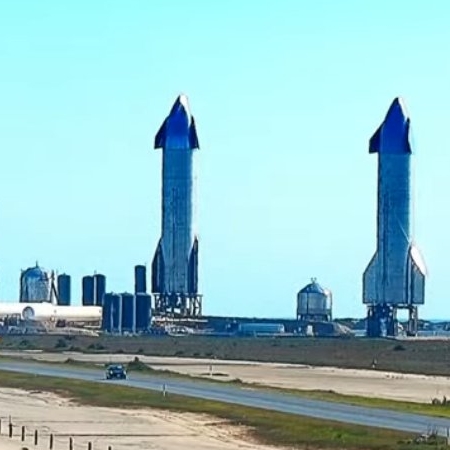
Capitalism in space: It appears that SpaceX has finally gotten approval from our benevolent government to attempt today a flight of the ninth prototype of its Starship. to a height of approximately 33,000 feet. The screen capture to the right from this morning shows Starship’s #9 and #10, both on their own launchpads. I think #9 is the one on the right.

As the company’s Starship website still notes,

Similar to the high-altitude flight test of Starship serial number 8 (SN8), SN9 will be powered through ascent by three Raptor engines, each shutting down in sequence prior to the vehicle reaching apogee – approximately 10 km in altitude. SN9 will perform a propellant transition to the internal header tanks, which hold landing propellant, before reorienting itself for reentry and a controlled aerodynamic descent.

The Starship prototype will descend under active aerodynamic control, accomplished by independent movement of two forward and two aft flaps on the vehicle. All four flaps are actuated by an onboard flight computer to control Starship’s attitude during flight and enable precise landing at the intended location. SN9’s Raptor engines will then reignite as the vehicle attempts a landing flip maneuver immediately before touching down on the landing pad adjacent to the launch mount.

SpaceX will be providing a live stream, which I shall embed here at Behind the Black once it becomes available about ten minutes before launch. In addition, there are these live streams available:

The SpaceX live feed will provide the best visuals, but that will not go live until just before launch. Right now I think the Labpadre live feed is my preferred choice because it provides a quick checklist on the screen telling you the countdown status, which in turn gives you an idea how soon the launch might be. For example, when the sirens sound, it means they are approximately 10 minutes to launch.

While this flight will likely be as epic as the flight of Starship #8, there is no guarantee it will occur today. Until they actually lights the candle, much of the action today will be like watching paint dry.

9 comments

Rocket of Chinese pseudo-private company fails on 2nd launch

The new colonial movement: Today’s second launch of the Chinese pseudo-private company iSpace’s Hyperbola-1 rocket ended in failure soon after launch.

No details yet on what went wrong.

The company had successfully completed its first orbital launch in July 2019. The smallsat rocket, using four solid-rocket stages, is almost certainly derived from China’s military technology, and thus the company could not exist without significant government supervision.

0 comments

Billionaire buys of entire SpaceX launch for tourist flight and charity

Capitalism in space: An American billionaire has purchased an entire SpaceX Dragon flight and Falcon 9 launch, set for sometime in October ’21, with the goal of using the publicity of the flight to raise money for St. Jude Children’s Research Hospital.

Besides fulfilling his dream of flying in space, Jared Isaacman announced Monday that he aims to use the private trip to raise $200 million for St. Jude Children’s Research Hospital, half coming from his own pockets.

A health care worker for St. Jude already has been selected for the mission. Anyone donating to St. Jude in February will be entered into a random drawing for seat No. 3. The fourth seat will go to a business owner who uses Shift4 Payments, Isaacman’s credit card processing company in Allentown, Pennsylvania

This flight means that SpaceX is likely going to have at about five commercial manned flights in the next year, three by NASA, one by Axiom to ISS, and Isaacman’s above. Moreover, none include the flights by various entertainers and reality show producers who have been rumored as being interesting in buying tickets. Nor does this include the tourism flights the Russians are planning in the next year.

All told, these flights strongly suggest that there is a very healthy market for commercial manned spaceflight, a market that can only grow once Boeing finally enters the market with its Starliner capsule.

I must also add that we have been waiting for commercial space tourism flights for almost sixteen years, since Richard Branson began promising them on his suborbital SpaceShipTwo back in 2004. Never happened, and now seems very second class in comparison to the pending orbital flights. As the article at the link says disparagingly about Virgin Galactic and Blue Origin’s suborbital craft, they “will just briefly skim the surface of space.”

Both Branson and Bezos had a window to make suborbital space tourism pay off. Neither stepped through it.

0 comments

More weird features and changes on Mars

Some strange stuff on Mars
Click for full 2020 photo.

Overview map

Cool image time! The photo to the right, rotated, cropped, reduced, and annotated to post here, was taken on September 28, 2020 by the high resolution camera on Mars Reconnaissance Orbiter (MRO). Uncaptioned and labeled “Reticulate Bedform Change Detection on Arsia Mons West Flank,” it shows a whole bunch of strange features in addition to a change that occurred sometime in the past two years.

I think it also well illustrates in one image how alien Mars is.

The main features in this photo are what scientists have dubbed reticulate bedforms. These features, found mostly in the high elevations on the flanks of the giant volcanoes in the Tharsis Bulge to the west of Valles Marineris, are thought to be ancient dunes made of volcanic dust and debris that has solidified into an aggregate. These dunes are found with a variety of patterns.

Aggregates on the flanks are transported downslope by katabatic winds and form linear and “accordion” morphologies. Materials within the calderas and other depressions remain trapped and are subjected to multidirectional winds, forming an interlinked “honeycomb” texture. In many places on and near the volcanoes, light-toned, low thermal inertia yardangs and indurated surfaces are present.

The photo to the right appears to show all three patterns, even though it is located on the northwestern slopes of of Arsia Mons, the southernmost of the string of three giant volcanoes in the Tharsis Bulge. On the overview map to the right, this photo’s location is indicated by the white box. The black boxes indicate the location of all the pits caves that surround Arsia Mons which I have previously posted about on Behind the Black.

It is intriguing that, at least at this point, these particular reticulate bedforms on the slopes of Arsia Mons happen to be in a region where few cave pits have so far been identified. It could be that the conditions that form each are mutually exclusive. If you get pits on the slopes of Martian volcano you can’t have reticulate bedforms. Or maybe not all the pits have yet been located, or the flanks of the volcano has many more reticulate bedforms that I simply have not documented.

Either way, this particular cool image has two areas of interest, as noted by the white boxes above.
» Read more

1 comment

Environmentalists cheer FAA blocking of Starship test flight

Two Starship prototypes now on launchpads
Two Starships are better than one!

They’re coming for you next: It appears the environmentalist movement is thrilled that the FAA and the Biden administration blocked last week’s test flight of SpaceX’s ninth prototype of Starship.

It also appears they are gunning to end Starship entirely, and might now have the right people in charge to get it done.

Jim Chapman, president of the nonprofit Friends of the Wildlife Corridor, says it is unusual for a federal regulatory agency to allow a company to conduct tests prior to completion of an environmental review and licenses issued.

He and other environmentalists have repeatedly expressed concerns to Border Report of what they say is a lack of oversight by the FAA on this site. But Friday’s actions gave Chapman some hope. “The fact that the FAA is going by the book for a change is a good development,” Chapman said. “They’re following the law by doing that and they’re supposed to do the environmental evaluation before they issue new licenses and up until now they kind of haven’t been doing that.”

The irony here is that these environmentalists are claiming that SpaceX’s rocket facility at Boca Chica will threaten the local beach wildlife, when we have more than a half century of evidence from Cape Canaveral that a rocket launch facility does the exact opposite. When the federal government established its Florida spaceport it reserved vast tracts around it for safety, but also reserved that land as a wildlife preserve. The result has been that the beach wildlife at Cape Canaveral has thrived, and been protected.

What these environmentalist really want to do is prevent SpaceX from flying, merely because they hate the development of new technology and the advancement of human capabilities. The environmental movement is routinely against anything new, and has been for decades.

With the Democrats controlling Congress and the White House, their allies are now in power. I would not at all be surprised if the FAA’s action last week is also tied to this environmental review. If so, expect future test flights at Boca Chica to be further delayed and stretched out.

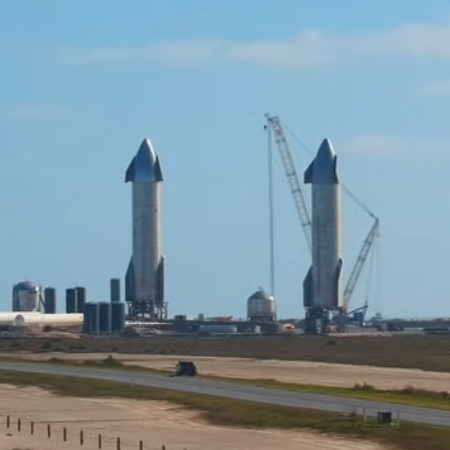
Meanwhile, this past weekend SpaceX rolled out its tenth Starship prototype, placing it on a second launchpad right next to prototype #9, as shown by the screen capture above from the LabPadre 24/7 live feed this morning. The company sure is making it clear that the only reason they have been stalled is the government.

24 comments

India is targeting ’21 for first unmanned test launch of manned system

The new colonial movement: According to Indian government officials, the first unmanned test flight of their Gaganyaan manned capsule will occur before the end of 2021.

The first unmanned launch is slated for December 2021. The Gaganyaan is a crewed orbital spacecraft expected to carry three astronauts into space for at least seven days. The spacecraft is likely to consist of an orbital module which will have a service and a crew module. The mission is estimated to cost around Rs 10,000 crore. The GSLV Mk-III, now called LVM-3 (Launch Vehicle Mark-3), will be deployed for the launch.

The new name for the rocket helps distinguish it from the GSLV Mk-II, a smaller version aimed mostly at commercial customers.

India also hopes to launch a new smallsat rocket in ’21, as well as its next lunar lander/rover, Chandrayaan-3. The country’s space effort will also be attempting to recover from its shutdown in 2020 due to the Wuhan virus panic.

2 comments

NASA delays lunar lander contract award

NASA, now under the control of the Biden administration, has quietly delayed by at least two months the contract award to two companies to build manned lunar landers for its Artemis program.

With short funding from Congress and a new administration focused on more pressing national issues, the move was expected.

Elon Musk’s SpaceX, a team of aerospace giants led by Jeff Bezos’ Blue Origin, and Leidos-owned Dynetics won a combined $967 million in seed funding from NASA last year to develop rivaling concepts for a human lunar landing system. It’s the space agency’s first effort to spend money on astronaut moon landers since the Apollo program in the 1970s.

Last Wednesday, NASA told the three contractors that an extension to their development contracts “will be required,” picking a new award date of April 30th. Under the Trump administration’s timeline, the agency had planned to pick two of the three bidders in late February, giving a stamp of approval for two systems that would inevitably carry humans to the moon.

This delay would likely have occurred under Trump as well, mainly because Congress only appropriated less than a third of the money needed for this Artemis program.

However, under Biden it was guaranteed. A major review is about to happen, designed not to kill Artemis but to slow it down appreciable. Congress likes the pork Artemis produces, but is wholly uninterested in it actually flying any dangerous missions. I suspect Biden will agree. The focus will once again shift back to Gateway, making any lunar landing require it so that it must be built first. Such a shift will guarantee that no American manned missions to the surface of the Moon will occur before ’30, but also allow the spending of gobs of money building a small lunar station that will only be occupied for short periods.

The big loser here, to my mind, is Jeff Bezos. His company, Blue Origin, was building the descent portion of the lunar lander, with all other portions built by his big space partners, Lockheed Martin, Northrop Grumman, and Draper. Not only is most of the other work by these partners more easily shifted to other uses related to Gateway, but those companies already have plenty of government contracts. As far as I can remember, Blue Origin has no other big government deals, with its New Glenn having been rejected by the military, and its lunar descent technology unneeded until there is a lunar landing, and I expect that to be significantly delayed.

For the past four years Bezos has clearly wanted to make Blue Origin a new big space contractor. Right now it appears that effort has failed wholly.

Dynetics will also lose out big, as they are a new company and can ill afford losing a contract here.

SpaceX will likely be hurt the least. Not getting any money for designing Starship to land on the Moon will do little to slow its development. Starship is almost completely privately funded, and does not need NASA money to get built.

4 comments

NASA to do another static fire test of SLS’s core stage

NASA has now scheduled a second static fire test of the core stage of its SLS rocket, tentatively scheduled for the fourth week in February.

The first test, planned to last eight minutes, shut down after only one minute when the stage’s computers decided the parameters on engine #2 were outside their conservative margins. That burn also had a sensor issue with its fourth engine.

Conducting a second hot fire test will allow the team to repeat operations from the first hot fire test and obtain data on how the core stage and the engines perform over a longer period that simulates more activities during the rocket’s launch and ascent. To prepare for the second hot fire test, the team is continuing to analyze data from the first test, drying and refurbishing the engines, and making minor thermal protection system repairs. They are also updating conservative control logic parameters that resulted in the flight computer ending the first hot fire test earlier than planned. The team has already repaired the faulty electrical harness which resulted in a notification of a Major Component Failure on Engine 4. This instrumentation issue did not affect the engine’s performance and did not contribute to ending the first test early.

Assuming this test is successful, they will then need a month to get the stage ready for shipment by barge to Cape Canaveral, where it will take several more months to get it assembled with its two strap-on solid rocket boosters, its upper stage, and the Orion capsule on top.

Right now the unmanned test flight into orbit of this entire rocket and Orion is set for November ’21. While NASA has not announced a delay, this additional static fire test puts significant pressure on that schedule.

11 comments

On the edge of Mars’ giant volcanic flood plain

Flows and pitted material on the edge of Mars' great volcanic flood plain
Click for full image.

Cool image time! The photo to the right, cropped and reduced to post here, was taken on September 30, 2020 by the high resolution camera on Mars Reconnaissance Orbiter (MRO). Uncaptioned, it shows what the science team labels “Flows and pitted material in Terra Sirenum.”

Downhill is to the southeast, which means the pitted material forms some sort of filled terrain, with the surface eroded similarly everywhere. At a latitude of 32 degrees south, these flows could conceivably be glacial features. Are they?

A wider look might help answer that question. Below is a photo taken by MRO’s context camera, cropped and reduced to post here.
» Read more

2 comments
1 106 107 108 109 110 126