Despite permanent repair of crack, air still leaking from Zvezda

According to a Russian news report yesterday, air is still leaking from the Zvezda module of ISS, despite the permanent repair of the crack earlier this week.

Earlier, the crew locked the hatches into the intermediate chamber. The Mission Control asked whether the crew had measured the pressure before the hatch into that chamber was opened. The crew reported that the pressure went down considerably in the smaller part of the compartment while it remained isolated from the rest of the station by an airtight hatch. “The pressure in the intermediate chamber went down from 723 mm of the mercury column to 685 millimeters,” Ryzhikov said.

The report is poorly written, and is unclear on the exact date this air test was done. It is therefore possible the test was done prior to the permanent repair.

If however the air is still leaking, this suggests there might be more than one leak point in that part of Zvezda. According to this same story, the two Russian astronauts during their spacewalk on November 18th took pictures of the exterior area of Zvezda where the leak is located, and noted no exterior damage.

All these facts point to a very serious problem. If there was no exterior damage, it means the leak was probably not caused by a micrometeorite hit (though closer more extensive observations as well as a review of the photos might still conclude otherwise). The fact that the leak is continuing after the permanent repair suggests there is another leak, in the same part of Zvezda. That section is also a docking port, and would have experienced the most stress during the several dozen dockings that have occurred since Zvezda was launched in 2000.

These facts therefore suggest stress damage and aging as the cause, which means the problem will only get worse no matter what method is used to seal any future leaks.

One quick solution that would work, at least for awhile, would be to close the hatch on this intermediate chamber, and do no more dockings to it. This at least would seal the station from atmosphere loss, and reduce the stress on this section of Zvezda. Whether Progress freighters, which use this port, can use another port, or will have a more limited ability to dock, is not clear, however.
7 comments

Successful Rocket Lab launch and descent of 1st stage

Capitalism in space: Rocket Lab today successfully used its Electron rocket to 30 smallsats into orbit from its launchpad in New Zealand.

They also did their first launch test of their planned method for recovering the first stage for reuse. In their case the first stage will use parachutes to slow its descent, and will then be grabbed by a helicopter to be brought back to land. On this launch they were only testing the parachute portion of this plan, and allowed the stage to land in the water, where they then recovered it.

The leaders in the 2020 launch race:

30 China
20 SpaceX
12 Russia
5 ULA
5 Rocket Lab

The U.S. now leads China 33 to 30 in the national rankings.

6 comments

The SpaceX fleet of Dragons

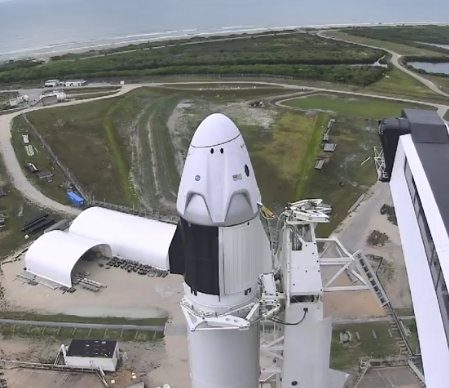
The first manned Dragon capsule on the launchpad
The first manned Dragon capsule, on the launchpad

Capitalism in space: During the post-launch press briefing after launch of its second manned Dragon mission on November 15, SpaceX CEO Gwynne Shotwell revealed the company’s plans to build and fly a fleet of Dragon cargo and crew capsules, and reuse them repeatedly over the coming years..

Specifically, Shotwell revealed that SpaceX intends to build three reusable Cargo Dragon 2 capsules, one of which is already completed and in Florida preparing for its December 2nd CRS-21 launch debut. On the crew side of things, SpaceX will build “three more” Crew Dragon capsules on top of the flight-proven Demo-2 and currently orbital Crew-1 capsules. It’s unclear if this means that the new Crew Dragon capsule flown on SpaceX’s January 2020 In-Flight Abort (IFA) test will be refurbished for additional flights.

Excluding IFA Crew Dragon capsule C205, SpaceX thus intends to operate a fleet of at least three Cargo Dragon 2 and five Crew Dragon capsules, representing eight reusable spacecraft each capable of at least five orbital missions.

She also hinted that the company has plans to fly its own missions, using these spacecraft, in addition to its contracted flights for NASA and the private company Axiom.

This private capability, which far exceeds anything ever built by NASA or any government worldwide, is entirely because Elon Musk had the freedom and the will to push for his particular vision. He had a bold idea, and with courage he pursued it.
» Read more

16 comments

Sierra Nevada delays first Dream Chaser launch to ’22

Sierra Nevada officials revealed yesterday that they are delaying the first test flight of their Dream Chaser reusable cargo mini-shuttle from late 2021 to some unspecified time in 2022.

‘’COVID has definitely played a role” in that delay, said Steve Lindsey, senior vice president for strategy at SNC Space Systems. One example he gave involved structural testing of the spacecraft’s cargo module at a contractor’s facility in San Diego. COVID-related restrictions prevented SNC engineers from being on site at that facility to oversee the tests. SNC developed a workaround by using a mission control center it developed for Dream Chaser in Colorado so those engineers could remotely oversee those tests. “That worked great. Unfortunately, it took probably three or four times as long as it should have,” he said.

A related problem, he said, involves suppliers who have had to suspend operations because of COVID-19 outbreaks at their facilities. There have also been technical challenges with Dream Chaser, although he did not go into details about specific issues. [emphasis mine]

I underline the unspecified technical issues, because I suspect they might be the real issue. SpaceX has not been slowed in any significant way due to the Wuhan panic, even though it deals with NASA also. I would therefore not be surprised if they are using COVID-19 as a cover for other issues.

It is a new craft, and problems are expected. I’d just rather they didn’t hide it. It contributes to doubts about the company, which by the way has been much slower in its development than one should expect. NASA awarded this contract in January of 2016, with the first launch then planned for as early as October 2019. It is now 2020, and the launch is still now two years away.

6 comments

New model suggests ringed nebula caused by star merger

The Blue Ring Nebula
Click for full image.

Based on a new theoretical model, astronomers now believe that the Blue Ring Nebula, a planetary nebula discovered in 2004 by the Galaxy Evolution Explorer (GALEX), was the result of the merger of two stars that only occurred a few thousand years earlier.

The image to the right, cropped, reduced, and annotated to post here, shows the original GALEX image on top, with a model to illustrate the geometry. The nebula is shaped like an hour-glass, with the rings the wide parts at the top and bottom. We just happen to be looking at it along its axis.

A new study published online on Nov. 18 in the journal Nature may have cracked the case. By applying cutting-edge theoretical models to the slew of data that has been collected on this object, the authors posit the nebula – a cloud of gas in space – is likely composed of debris from two stars that collided and merged into a single star.

While merged star systems are thought to be fairly common, they are nearly impossible to study immediately after they form because they’re obscured by debris the collision kicks up. Once the debris has cleared – at least hundreds of thousands of years later – they’re challenging to identify because they resemble non-merged stars. The Blue Ring Nebula appears to be the missing link: Astronomers are seeing the star system only a few thousand years after the merger, when evidence of the union is still plentiful. It appears to be the first known example of a merged star system at this stage.

When the merger happened it caused the bi-polar jets that formed the hourglass shape.

1 comment

Venus results suggesting life downgraded

Surprise! Surprise! Further research and review of the recent results that said phosphine existed in Venus’s atmosphere — which for some immediately suggested the presence of life — has found that the phosphine probably doesn’t exist.

[A]lmost immediately, other astronomers began to criticize the results, with four independent studies pointing out questionable methods or failing to reproduce the results.

Now, after reanalyzing their data, the original proponents are downgrading their claims. Even the most favorable interpretation of their data now suggests phosphine levels are at least seven times lower than first reported, making it a much more tentative finding, the authors reported in a preprint posted on 17 November to arXiv.

Also, observations in other wavelengths detected no phosphine, even though it should have been there if the first study was correct. Furthermore, other scientists have noted that the spectrum features detected might not be caused by phosphine. The sulphur dioxide in Venus’s atmosphere could instead be their source.

Even if phosphine is eventually confirmed, that is not the discovery of life on Venus, as so many in the mainstream press claimed. As I noted when this result was first announced, phosphine isn’t life, it is merely a specific inanimate molecule. That on Earth it only exists in connection with life-processes means nothing. Venus is a very alien place, and there could be any number of inanimate chemical processes that we have no experience with or knowledge of that could produce it there. To claim its discovery suggests the existence of life, or even the possibility of life, is simply junk science.

3 comments

Arianespace: Cause of Vega launch failure “human error”

According to Arianespace officials, today’s failure of their Vega rocket likely occurred because of “human error” in the installation of cables.

Engineers concluded that cables leading to thrust vector control actuators on the upper stage were inverted, apparently a mistake from the assembly of the upper stage engine, according to Roland Lagier, Arianespace’s chief technical officer. The thrust vector control system pivots the upper stage engine nozzle to direct thrust, allowing the rocket to control its orientation and steering.

The cabling problem caused the engine to move its nozzle in the wrong direction in response to commands from the rocket’s guidance system. That resulted in the rocket losing control and tumbling just after ignition of the upper stage engine around eight minutes after launch.

Lagier characterized the inverted cables as a “human error,” and not a design problem.

The next obvious question is the source of the error. The answer was not revealed, I think partly because of the number of contractors involved in building that upper stage:

The AVUM upper stage’s structure is produced by Airbus, and the Ukrainian rocket contractors Yuzhnoye and Yuzhmash supply the AVUM stage’s main engine, which consumes hydrazine and nitrogen tetroxide propellants. Avio, the Vega rocket’s Italian prime contractor, oversees final integration of the AVUM upper stage.

The goal of the investigation that will now follow will be to point that source among these contracts, and how their interaction might have contributed to it.

9 comments

Virgin Galactic cancels its announced November suborbital flight

Capitalism in space: Virgin Galactic announced yesterday that it has canceled its announced November suborbital flight, claiming the cause were new COVID-19 guidelines imposed by the New Mexico Department of Health.

The flight had been scheduled for the November 19-23 time period. It had been announced with the typical hype that comes from Richard Branson.

Personally, I don’t believe Branson or Virgin Galactic as to the cause of this flight cancellation. I think they either never intended to fly, or have known for some time that new technical problems would prevent its launch as scheduled. I think they hyped the launch despite this, which conveniently pumped up the stock price at a time Branson was selling stock. They now announce the cancellation, the stock drops, but Branson has already pocketed his profits.

The timing of this announcement is also most ironic, as it occurred on the same day SpaceX docked four astronauts on ISS. Branson’s company began building its suborbital spacecraft in 2004, promising that it would soon fly hundreds, even thousands of private passengers into space. Sixteen years later it has never flown one passenger, and very few manned test flights. In the interim SpaceX built its Falcon 9 rocket and Dragon capsule, and is now launching passengers to orbit, with its first entirely private launch scheduled less than a year from now.

The comparison is quite stark. Why anyone would invest real money in this fake company at this point baffles me.

6 comments

Israeli fighter pilot to fly on Axiom’s first private Dragon launch in ’21

Capitalism in space: Axiom has revealed that an Israeli fighter pilot, Eytan Stibbe, will be the second passenger on on its first private Dragon launch to ISS in the fall of 2021.

Stibbe will be the second Israeli to fly in space, following Ilan Ramon, who died when the space shuttle Columbia broke up in 2003 during its return to Earth.

The Axiom AX-1 mission is scheduled to launch in the second half of 2021, which the company unveiled in a deal with SpaceX earlier this year. Astronaut Michael Lopez-Alegria, who previously worked for NASA and flew to space four times, will be the AX-1 mission commander, with Stibbe set to serve as a mission specialist.

AX-1 would be the first fully private mission to the International Space Station, with Lopez-Alegria and Stibbe flying with two other yet-to-be-named people.

The consistent rumors are that actor Tom Cruise and a movie director will be those other two passengers, but this is not confirmed.

It is important to emphasize that this space mission will be entirely private, with almost no involvement of the U.S. government other than providing coordination, the training of the astronauts, and the use of ISS. The rocket and spacecraft are SpaceX’s, purchased by the customer Axiom. Moreover, Axiom has plans to add its own private modules to ISS where future private space passengers will be housed, which will then reduce the government’s role and contribution even more.

And since this will be a private mission, it means the funds to fly it will come from its passengers, not the government. This also means that as long as there are customers, there will be no slow-down in future flights.

2 comments

SpaceX successfully launches four astronauts to ISS

Falcon 9 launch on November 15, 2020 with four astronauts

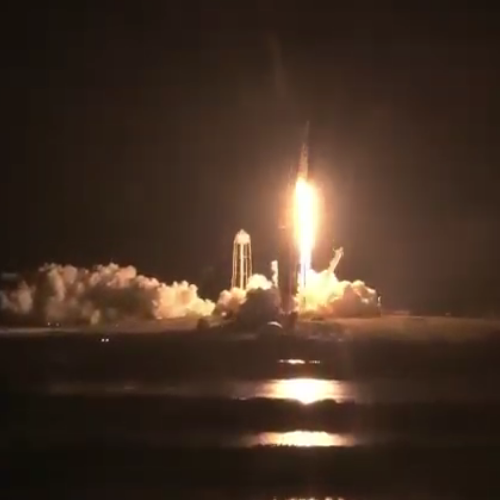
Capitalism in space: SpaceX tonight successfully launched four astronauts to ISS on its Dragon capsule Resilience, using its Falcon 9 rocket.

They also recovered the first stage, landing it on its drone ship in the Atlantic. The routine manner in which SpaceX ran this launch is truly admirable. They make landing and reuse of the first stage so expected it is hard to believe that for fifty years rocket managers and engineers insisted it wasn’t doable.

They had one issue today, a failure of the capsule hatch to hold air pressure after closure. They calmly reopened the hatch, cleared the issue, added some lubricant, and closed the hatch, all in less than ten minutes.

Resilience will dock with ISS tomorrow evening.

The leaders in the 2020 launch race:

30 China
20 SpaceX
5 ULA
4 Europe (Arianespace)
4 Rocket Lab

The U.S. now leads China 32 to 30 in the national rankings.

6 comments

Watch today’s launch of SpaceX’s Resilience manned capsule

According to a NASA report yesterday, the weather then stood at 50% for allowing a launch of four astronauts to ISS on SpaceX’s Resilience capsule tonight at 7:27 pm (Eastern).

That percentage was still reported this morning. Part of the issue is that SpaceX wants to recover the first stage, and the weather therefore not only has to be good in Florida, it has to be good in the Atlantic where the stage will come down.

NASA’s live coverage begins at 3:15 pm (Eastern). The link to that live stream is below the fold. As I write this at around noon (Eastern) it is simply NASA TV’s normal feed, which is essentially full time propaganda for NASA. After 3:15 pm it will switch to live coverage, which unfortunately will still be packed with pro-NASA propaganda, even though this launch is entirely being run by the private company SpaceX. NASA’s only part is that of a customer, with the ability to say “no” at any point. The rocket, the capsule, the launchpad, and the countdown, is operated completely by SpaceX and its employees.

I have also added the clean feed from NASA, which appears to carry little commentary or narration.

» Read more

4 comments
1 121 122 123 124 125 126