
November 6, 2020 Zimmerman/Batchelor podcast
Embedded the fold in two parts.
» Read more
Embedded the fold in two parts.
» Read more
Capitalism in space: Canada’s government yesterday announced that it has given final approval to SpaceX’s Starlink internet service to offer those services in that country.
More here.
This final approval came from the Innovation, Science and Economic Development Canada (ISED) agency, which appears designed to protect Canadian businesses from foreign competition. It had appeared initially that they had been stalling giving their approval (maybe for political reasons). The delay however could simply have been the slowness of operation which is typical of such government bureaucracies. As noted at the first link above, however “Clearly, the government heard the demand from consumers to get this service approved.” And since there are no Canadian companies that can offer this service, it was absurd not to okay SpaceX’s operation.
This approval means that Starlink is now posed to begin commercial operations, actually selling its internet service to the public, and doing it ahead of its primary competitor, OneWeb. Considering that OneWeb had started development and satellite launching first, this achievement illustrates again SpaceX’s nimble and fast approach to business. The company does not waste time in anything it does. It might not meet all of its scheduling goals, but not for want of trying.
SpaceX has already been offering the service in its test market in the northern U.S. for the price of $99 per month plus an initial fee of $499 for equipment, with the initial user reports very positive.
The new colonial movement: The pseudo-private Chinese company Galactic Energy today successfully completed its first orbital launch, placing a small satellite into orbit using its Ceres-1 rocket.
Galactic Energy is the fourth Chinese private launch company overall to make an orbital launch attempt, all with light-lift solid launchers. Landspace made the first attempt in October 2018, with OneSpace following in March 2019. In July last year iSpace became the first to successfully achieve orbit with its Hyperbola-1 launch.
The 19-meter-long, 1.4-meter-diameter Ceres-1 can loft 350 kilograms to low Earth orbit or 230 kilograms to a 700-kilometer SOO. It consists of three solid stages and an advanced liquid upper stage. [emphasis mine]
That all of these companies are using solid rockets explains why I call them “pseudo private.” They might be raising independent venture capital money to fund their operations, and they might be aimed at earning a profit, but solid rocket technology is always the primary technology used for military missiles, and none of these Chinese companies could do anything without the close and very firm permission and supervision of the Chinese communist government. In fact, their very existence is likely because that Chinese communist government wants them to exist.
Nonetheless, this launch raises China’s launch capabilities. The leaders in the 2020 launch race:
29 China
19 SpaceX
12 Russia
4 ULA
4 Europe (Arianespace)
4 Rocket Lab
The U.S. is still ahead of China, 30 to 29, in the national rankings.
For the first time in 2020 India has launched a rocket, successfully placing ten satellites into orbit using its PSLV rocket.
The primary payload was an Indian Earth resource satellite dubbed EOS-1.
When the year started ISRO, India’s space agency, had predicted it would complete twelve launches in 2020, which would have been a record for their nation. Then the panic over COVID-19 set in, and they canceled everything for months on end. This long stand down will likely cause delays in all their long term programs including their effort to launch their own astronauts on their own rocket in their own capsule.
The leaders in the 2020 launch race remain the same:
28 China
19 SpaceX
12 Russia
4 ULA
4 Europe (Arianespace)
4 Rocket Lab
The U.S. remains ahead of China 30 to 28 in the national rankings..
The podcast of my two-hour appearance on The Space Show yesterday is now available here.
As always it was a fun show, with David Livingston starting out by asking me to give my sense of the consequences of the election (no matter who wins) on the aerospace industry. Things went all over the place after that, from Mars exploration to China’s space program to Elon Musk.
China today used its Long March 6 rocket to successfully launch ten satellites for the Argentinian company Satellogic S.A.
The satellites form the beginning of a 25-satellite constellation designed to do Earth resource observations. The Chinese rocket in turn is designed to capture the emerging smallsat market.
The leaders in the 2020 launch race:
28 China
19 SpaceX
12 Russia
4 ULA
4 Europe (Arianespace)
4 Rocket Lab
The U.S. remains ahead of China 30 to 28 in the national rankings.
Capitalism in space: SpaceX tonight successfully launched the GPS satellite that on a previous launch had experienced a launch abort at T-2.
This was a completely new Falcon 9 rocket, with two of its original engines replaced after the company had traced the issue that caused the launch abort. The first stage successfully landed on the drone ship in the Atlantic Ocean, and will fly again on the next GPS launch by SpaceX for the Space Force.
The satellite has been deployed successfully, completing the launch.
The leaders in the 2020 launch race:
27 China
19 SpaceX
12 Russia
4 ULA
4 Europe (Arianespace)
4 Rocket Lab
The U.S. now leads China 30 to 27 in the national rankings.
Click for full image.
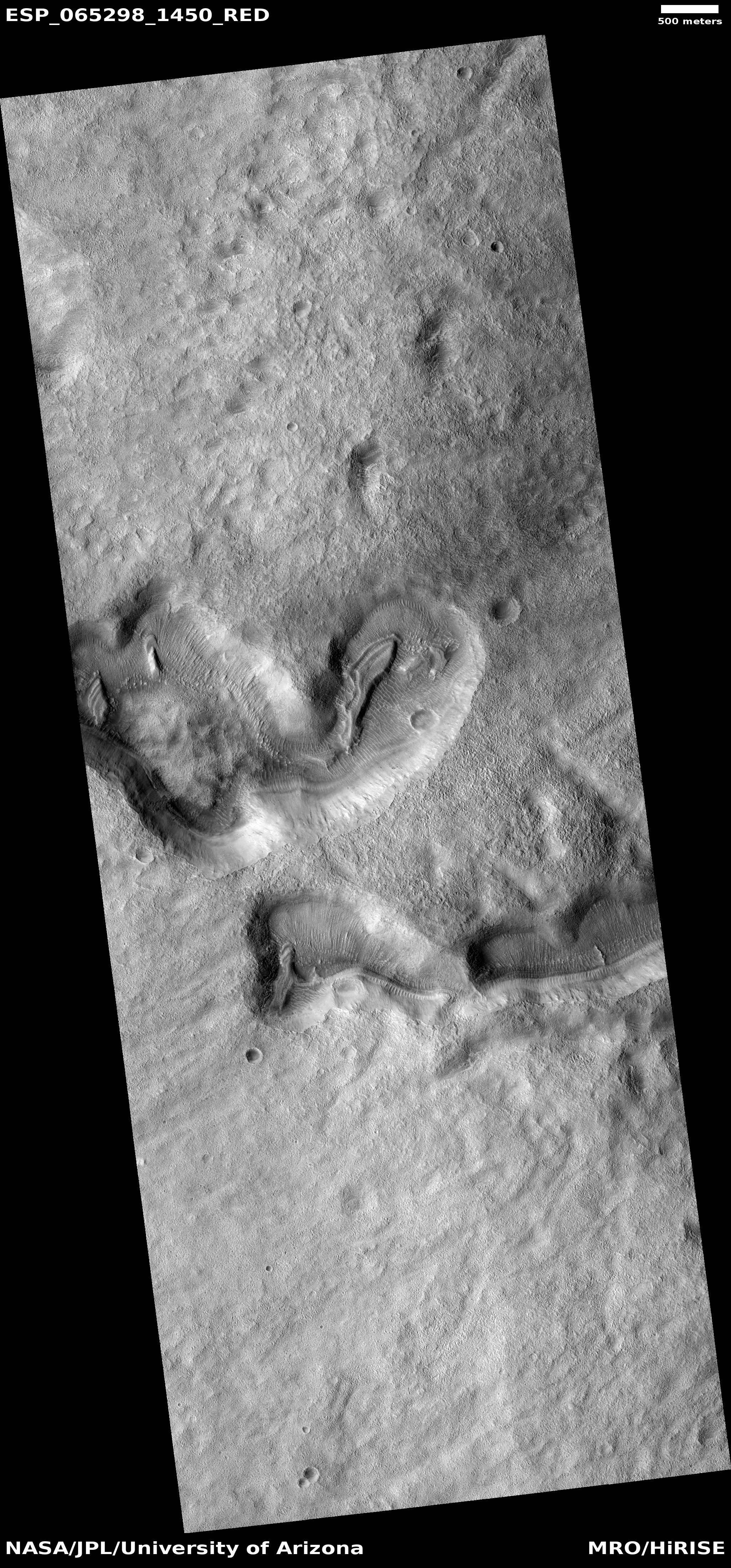
Cool image time! The photo to the right, cropped and reduced to post here, was taken on July 1, 2020 by the high resolution camera on Mars Reconnaissance Orbiter (MRO). It shows a very puzzling terraced mesa inside an enclosed depression or sinkhole (the western half of which can be seen in the full image).
What caused that mesa? A first scan of the image and the data suggests we are looking at sinkage related to the melting of an underground ice table. The latitude here is 34 degrees south, just far enough away from the equator for glacial activity to be possible. Moreover, the small circular depression in the upper right of the image strongly suggests an impact crater into slushy material. The implication is that this depression is the result of the melting or sublimation of underground ice, leaving behind a mesa that is made of solider stuff.
Another possibility is that the terraced mesa is actually the remains of glacial material. In the full image features inside other nearby depressions are terraced also, but are also much more reminiscent of glacial features found in many craters in the mid-latitudes. The depression is also close to the headwaters of Reull Valles, a meandering canyon where many images have shown glacial features (see for example here, here, and here).
These features however could also have nothing to do with water ice.
» Read more
Click for full image.
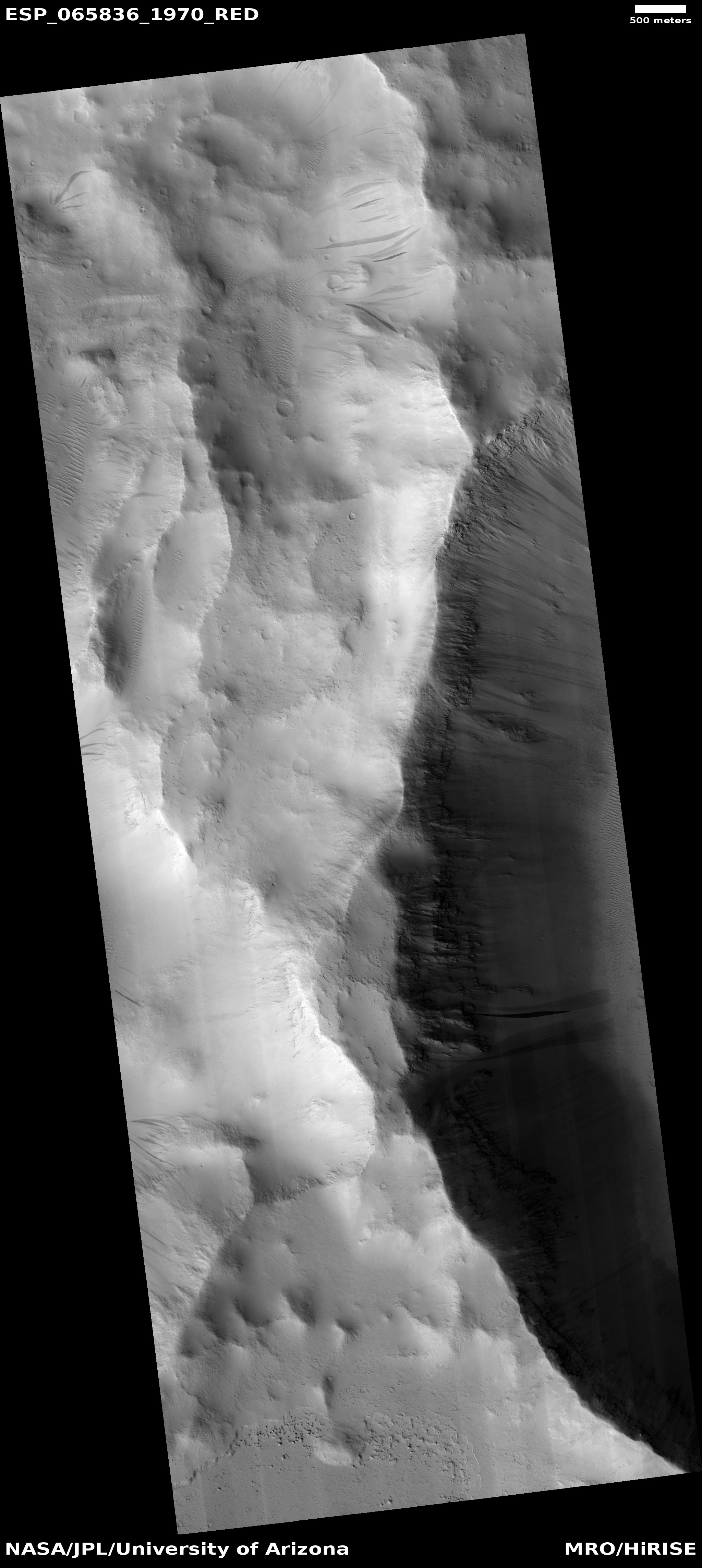
Cool image time! The photo to the right, rotated, cropped, and reduced to post here, was taken on August 12, 2020 by the high resolution camera on Mars Reconnaissance Orbiter (MRO). It shows what to any Earthling’s eye appears to be a somewhat ordinary flat-topped mountain peak with two major flanking ridgelines descending downward to the north and the south, and two minor ridgelines descending to the northwest and southwest.
This peak and its landscape would surely be quite a spectacularly place to visit, should humans ever settle Mars and begin doing sightseeing hikes across its more interesting terrain. I can definitely imagine hiking trails coming up the two minor ridges, with a crest trail traversing the main north-south ridge across the peak.
This is not however a mountain on Earth. It is on Mars, which makes its formation and evolution over time fundamentally different than anything we find on Earth, despite its familiar look.
First, what formed it? Unlike most of Earth’s major mountain chains, the mountains of Mars were not formed by the collision of tectonic plates, squeezing the crust upward. Mars does not have plate tectonics. Most of its mountains formed either from the rise of volcanoes at single hot spots, or from the wearing away of the surrounding terrain to leave behind a peak or mesa.
» Read more

Click for full image.
Cool image time! The photo to the right, rotated, cropped, and reduced to post here, was taken on June 24, 2020 by the high resolution camera on Mars Reconnaissance Orbiter (MRO). It shows a distinctive mesa in a mountainous region in the cratered highlands of Mars, just north of Hellas Basin, the deepest basin on the red planet.
The mesa’s most distinctive feature are its terraced layers, a feature that MRO has found in numerous other places surrounding and inside Hellas Basin (see for example the cool images here, here, here, here, here, and here.)
On Earth the assumption would be that these terraced layers imply different sedimentary layers that erode at different rates, as best illustrated by the Grand Canyon in Arizona. On Mars that assumption is not unreasonable, but unlike Earth, those layers could not have been formed in connection with large ocean bodies creating seafloor layers from the deposit of sealife over centuries. Some other geological process over time formed them, with volcanism, either from volcanoes or impact, being the most likely.
» Read more
With the start of a new month it is once again time to publish another sunspot update. NOAA yesterday updated its monthly graph for tracking the Sun’s monthly sunspot activity. As I have done now every month since this website started in 2011, it is posted below, with additional annotations by me to show the past solar cycle predictions.
Unlike September, which saw almost no sunspots, October was a very active month, with the amount of sunspots far exceeding prediction. Furthermore, every sunspot during the month had a polarity assigning it to the new solar cycle, not the last.
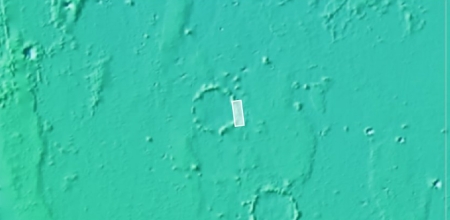
The overview map to the left indicates the general terrain surrounded today’s cool image. The white rectangle is the area covered by this image, taken on July 4, 2020 by the high resolution camera on Mars Reconnaissance Orbiter. If you look close you can see that this photograph covers the eastern rim of what looks like an ancient and mostly buried crater on Mars. This unnamed crater is about 17 miles across.
» Read more