ULA successfully launches reconnaissance satellite with Atlas 5

Capitalism in space: ULA today successfully launched a military reconnaissance satellite using its Atlas 5 rocket.

This launch was the first Atlas 5 using these particular Northrop Grumman solid rocket boosters.

Because this was a military launch, the live broadcast ended at the moment the fairings were released, exposing the satellite. Final announcement of the satellite’s successful deployment will come later, assuming all goes well.

The leaders in the 2020 launch race:

30 China
19 SpaceX
5 ULA
4 Russia
4 Europe (Arianespace)
4 Rocket Lab

The U.S. now leads China 31 to 30 in the national rankings, with two more launches scheduled for the next two day. SpaceX is first with its second manned Dragon mission tomorrow, followed by Rocket Lab’s next launch from New Zealand on November 15.

0 comments

A majestic terraced butte on Mars

Majestic butte on Mars
Click for full image.

Cool image time! The photo to the right, rotated, cropped, and reduced to post here, was taken on September 8, 2020 by the high resolution camera on Mars Reconnaissance Orbiter (MRO). It shows an outstanding terraced butte that would rival any of the similar buttes scattered throughout the Grand Canyon, and is reminiscent especially of Wotans Throne.

What makes this butte intriguing are its terraces, the obvious result of the repeated deposition of new layers across the surface over time, and now exposed by erosion. What caused them?

As always, location provides the clues. First, this butte is found at about 15 degrees north latitude in the vast Arabia Terra transition region between the Martian northern lowland plains and the southern cratered highlands. At that latitude, we are not looking at any recent glacial features. While there might have been ice here once, it hasn’t likely been present, either on the surface or underground, for a very long time.

This conclusion becomes important once we look at the wider photo below, taken by the high resolution camera on the European orbiter Mars Express. This image gives us the immediate context.
» Read more

0 comments

Ukraine signs Artemis Accords

Ukraine has becomed the ninth nation to sign the Artemis Accords, designed to encourage private enterprise in space.

The article at the link provides little information, other than claiming that ” Ukraine has all the scientific and technical capabilities and experience that allow it to become one of NASA’s important partners in the implementation of the Artemis program.”

Russia and the Ukraine are on opposite sides of a war, with Russia attempting to steal territory, with some success. Russia has also boycotted all Ukrainian space technology, ending a half century of business dealings.

It seems that the Ukrainian government looked at this political landscape, and decided to align itself with the United States. By signing the accords, it now has the opportunity to sell its space technology to NASA, as well as participate in any American effort to get to the Moon and elsewhere. That it chose to pick an ally halfway around the world instead of its big and powerful neighbor, tells us a great deal about the Ukrainian’s opinion of Russia.

I expect there will be a NASA press release in the next day or so that will provide us additional information.

1 comment

China today launched a new communications satellite

The new colonial movement: Using its Long March 3B rocket, China today launched another communications satellite for the Asian market.

No word on whether the rocket’s first stages landed near residential areas, as has happened in the past. Also no word on whether it used grid fins to control its crash somewhat, as China also did previously.

The leaders in the 2020 launch race:

30 China
19 SpaceX
12 Russia
4 ULA
4 Europe (Arianespace)
4 Rocket Lab

The U.S. and China are now tied at 30 in the national rankings. This tie won’t last long, as the U.S. has three launches scheduled for the next three days, a ULA Atlas 5 launch of a military reconnaissance satellite tomorrow, SpaceX’s second manned Dragon launch on November 14, and Rocket Lab’s next commercial launch on November 15.

3 comments

Hubble sees too much infrared energy from gamma ray burst

The uncertainty of science: During a short gamma ray burst (GRB) that was observed in a distant galaxy on May, astronomers were baffled when measurements from the Hubble Space Telescope detected ten times more near infrared energy that they predict from this type of GRB.

GRBs fall into two classes. First there are the long bursts, which are thought to form from the collapse of a massive star into a black hole, resulting in a powerful supernova and GRB. Second there are the short bursts, which scientists think occur when two neutron stars merge.

The problem with this GRB is that though it was short and somewhat similar to other short GRBs across most wavelengths, in the near infrared Hubble detected far too much energy.

“These observations do not fit traditional explanations for short gamma-ray bursts,” said study leader Wen-fai Fong of Northwestern University in Evanston, Illinois.

…Fong and her team have discussed several possibilities to explain the unusual brightness that Hubble saw. While most short gamma-ray bursts probably result in a black hole, the two neutron stars that merged in this case may have combined to form a magnetar, a supermassive neutron star with a very powerful magnetic field. “You basically have these magnetic field lines that are anchored to the star that are whipping around at about a thousand times a second, and this produces a magnetized wind,” explained Laskar. “These spinning field lines extract the rotational energy of the neutron star formed in the merger, and deposit that energy into the ejecta from the blast, causing the material to glow even brighter.”

What is intriguing about their theory is that this merger of two neutron stars simply resulted in a larger neutron star, not a black hole. This new neutron star was also a magnetar and pulsar, but unlike a black hole, it was a still-visible physical object. And yet its creation in this GRB produced more energy.

When GRBs were first discovered, I was always puzzled why so many astronomers seemed to insist there must be a single explanation for them. With time, when two classes of GRBs were discovered, this assumption was then replaced with the equally puzzling insistence that only two types of events explained them.

It seemed to me that that such explosions had too many potential variables, and could easily have a wide range of causes, though all related to the destruction or merger of massive stars. As the data continues to accumulate this now appears increasingly the case.

1 comment

A field of Martian knobs

Knob field on Mars
Click for full image.

Cool image time! The photo to the right, cropped and reduced to post here, was taken on August 9, 2020 by the high resolution camera on Mars Reconnaissance Orbiter (MRO). Uncaptioned, the image is merely dubbed a “knob field.”

I won’t spend much time trying to explain this geology. It might be related to pedestal craters, but these ridges and mesas don’t really look like those features, since they don’t really stand above the surrounding terrain.

Maybe they are a very ancient field of craters long buried, now partly exposed due to erosion, but also partly buried by wind-blown Martian sand and dust. Once again, that many of their shapes don’t resemble craters discounts this explanation.

The location of this photo is in the southern cratered highlands, as shown by the black cross in the overview map below.
» Read more

0 comments

NASA officially approves operational Dragon manned missions

Capitalism in space: NASA yesterday officially certified SpaceX’s Dragon capsule for future operational manned missions to ISS.

NASA officials gave approval Tuesday for SpaceX to begin regular crew rotation flights to the International Space Station with the launch of four astronauts set for Saturday from the Kennedy Space Center in Florida, signaling a transition from development to operations for the human-rated Dragon spacecraft.

Mission managers completed a two-day Flight Readiness Review Tuesday and issued a preliminary go-ahead for the launch of SpaceXโ€™s Crew Dragon โ€œResilienceโ€ spacecraft Saturday at 7:49 p.m. EST (0049 GMT Sunday) with NASA commander Mike Hopkins, pilot Victor Glover, and mission specialists Shannon Walker and Soichi Noguchi, a veteran Japanese space flier.

The decision means that SpaceX will now be rotating crews for NASA at ISS every six months. It will also be reusing both the first stages and the capsules. Endeavour, the capsule used on the demo flight earlier this year, will be reused in the spring. Resilience, the capsule scheduled for launch on November 14th, will be reused next fall.

Since SpaceX also has a commercial manned flight planned for next fall, that will probably require a third capsule. With those three capsules they will have at least for the next few years a fleet will cover all their initial needs. Don’t be surprised if however the introduce an upgraded capsule or two along the way, based on what they learn on these initial flights.

The article had one other piece of new news concerning Boeing’s Starliner capsule. The second unmanned demo flight has now officially been delayed into the first quarter of next year, rather than late this year.

0 comments

Rover update: Curiosity on the move again

After spending more than three months at a single site, drilling three different holes in the same rock, Curiosity is finally on the move again, heading east and uphill toward Mt. Sharp. Yutu-2 meanwhile continues its very slow journey on the far side of the Moon. And the new rovers are halfway to Mars.

Drill holes at Mary Anning site in Gale Crater
Click for full image.

Curiosity

The image to the right, cropped and annotated to post here, shows the three drill holes that scientists had Curiosity drill in this one pavement rock, dubbed Mary Anning and located in the clay unit within Gale Crater on Mars. As I noted in my last update on July 22, 2020, the rover’s science team had made a specific detour in their planned route up Mt. Sharp in order to find this one last place to drill in this geological unit.

Though they have been very quiet about their results, apparently what they found in this one pavement rock was important enough that it required three drill holes. In addition, samples from the second hole were subjected to two of Curiosity’s limited supply of wet chemistry experiments. From the science team’s August 28, 2020 update:
» Read more

1 comment

Gateway already behind schedule and mismanaged

Surprise, Surprise! According to a report by NASA’s inspector general released today [pdf], the agency’s Lunar Gateway space station project is already behind schedule, will likely not be available for any 2024 Artemis lunar mission, and apparently has been mismanaged in a manner that is raising costs.

Many of the problems appear to have been caused by NASA’s abrupt decision, ten months after awarding its contracts to Maxar and Northrop Grumman to build respectively the station’s service (PPE) and habitation (HALO) modules, to require that they both be launched on a single rocket, rather than separate launches as originally planned. From the report:

The decision to launch the PPE and HALO together, while avoiding the cost of a second commercial launch vehicle, has contributed to cost increases due to the redesign of several components, an elevated launch risk, and a longer duration flight to lunar orbit. In addition, due to the decision Maxar was forced to terminate its subcontract with Space Exploration Technologies Corp (SpaceX) for PPE launch services, even though Maxar had already paid SpaceX approximately $27.5 million for this service, a portion of which was paid by NASA prior to the termination. Further, a co-manifested launch increases risk because together the elements may be too heavy for commercially available rockets or too long for the rocketโ€™s fairing, potentially impacting intended spacecraft mass, length, and other requirements.

While the Trump administration had already made the decision to not rely on Gateway for its hoped-for 2024 manned lunar landing, it still hoped to have it available for use. This now appears unlikely. The report today is very clear: “Gateway likely will not be in a position to support a 2024 lunar landing.”

None of this is really a surprise. If anything, it is a feature of Gateway, not a bug. The program was always intended as a big jobs program, funneling money to NASA contractors who would in turn set up operations in various important congressional districts. Like SLS and Orion, it is more important that the program get delayed while costing more than actually accomplish anything.

Even if a Biden administration (still not confirmed) takes over and decides to support this project (which I think will happen), do not expect it to take place as scheduled. At best, Gateway will not be operational for years yet, and in fact it could take until the ’30s to get it built and launched. And that slow and expensive schedule will be exactly what our corrupt politicians and government bureaucrats want.

Meanwhile, China will be setting up its bases on the Moon. And maybe so will SpaceX using Starship.


4 comments

Giant iceberg heading to possible collision with South Georgia Island

Track of iceberg in the past three years

Close-up comparing iceberg with South Georgia Island.

The largest section of a huge iceberg that broke off from Antarctica’s Larson ice shelf in 2017 is now headed directly for a collision with remote South Georgia Island.

The first image to the right shows the iceberg’s movement since 2017. The second zooms in to show that the iceberg and island are almost the exact same size, 100 miles long.

South Georgia Island, 1,000 miles east of South America, has no permanent human inhabitants, though explorers, scientists, and mountain climbers do go there periodically. Instead, it is a wildlife preserve:

Around five million seals call the islands home, as well as 65 million birds of 30 different species. Migrating whales and various fish species populate the surrounding waters and there is a large penguin population.

The first link above, from the European Space Agency (ESA), typically shivers with the modern mindless fear that seems to permeate everything our culture considers:

About the same size as the South Atlantic island, it could ground in the shallow waters offshore and cause real problems for the island wildlife and seafloor-dwelling life. Penguins and seals need access to the sea to feed so the iceberg could easily block their foraging routes and life on the seafloor could be crushed if the berg grounds. The fear is that if the berg does anchor against the South Georgia coast, it could remain there for up to 10 years. When the A38 grounded here in 2004, many dead penguin chicks and seal pups were found along the shoreline.

All maybe true, but then, the arrival of icebergs this large to South Georgia Island while likely rare is also quite normal. The sea life there has had to adapt to these events, or else it would not have survived to today.

Also, note the blue lines. Those are the tracks of past icebergs as recorded from orbit. Not only is it common for icebergs to be aimed at South Georgia Island, the currents appear to guide them around the island once they get close. While this new berg is so huge it might plow into the island anyway, the data here suggests it will not.

Regardless, this somewhat rare event provides scientists a opportunity to learn something about the survival of species in hostile environments. We can’t prevent such things, but we can learn their consequences as well as how life adapts under such conditions.

6 comments

Apophis: the asteroid that may someday hit the Earth

Apophis' path past the Earth in 2029
From the conference’s logo.

Last week planetary scientists held a three-day virtual conference focused on the asteroid Apophis, whose orbit regularly places it close to the Earth with a real possibility that it might someday hit the Earth.

When Apophis was originally discovered early in 2004, it wasn’t at first seen as an out-of-the-ordinary asteroid. Not much was known about it other than its albedo and that it was not trivial in size, probably around 1,000 feet in diameter. All this changed in December 2004, when further observations suggested that it had a 2.7% chance of impacting the Earth in 2029, making it the most dangerous asteroid ever discovered.

Fortunately, all subsequent observations of the asteroid have since eliminated any possibility of an impact, at least through the year 2068. Depending on what happens during the 2029 and 2036 fly-bys of Earth, there is a very small chance that it could hit the Earth in 2068, though the data says the chances of that happening are quite small (1 in 150,000).

On April 13, 2029 however Apophis will still zip past the Earth less than 20,000 miles above its surface, well within the orbit of all geosynchronous satellites. For viewers in Europe and Africa it will be a naked eye object, with a magnitude of -3.

Because the date of that close fly-by is so well known, and because this asteroid still poses a threat to the Earth, the planetary science community is very much interested in taking advantage of that close approach. From the conference’s webpage:

Knowledge is the first line of planetary defense, and the 2029 Apophis encounter is a once-per-thousand-year opportunity for investigating an asteroid as large as 350 meters passing within 6 Earth-radii. Time is of the essence as we have less than a decade to plan Earth-based and possible in-situ missions whose measurements can deliver unprecedented detailed knowledge on the physical nature of Apophis as the prototype example (poster child) of potentially hazardous asteroids.

I attended that conference, and am here now to give a summary.
» Read more

15 comments

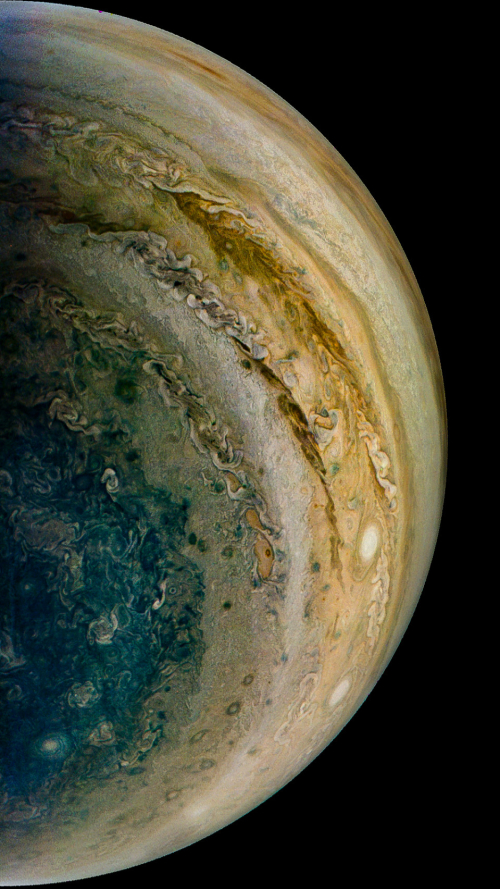
Jupiter’s stormy southern polar regions

Jupiter's polar regions
Click for full image.

Cool image time! The photo to the right shows the southern polar regions of Jupiter. The image, taken by Juno during its 29th close-fly of Jupiter, was enhanced by a citizen scientist who only goes by the nickname Flury-21. This in fact was this person’s first try at enhancing a Juno image. He or she did a nice job, but provided no additional information other than saying that he “used lightroom to enhance the image and mostly used the dehaze effect.”

Works nicely nonetheless to illustrate how the bands that dominate Jupiter’s equatorial and mid-latitude regions disappear at the pole. Instead, the pole is a region of chaotic independent hurricanes, many bigger than North America. Other images from Juno suggest that they change relatively quickly. For example, compare this image of the south pole with an earlier one taken during the 28th fly-by. While we might not be looking at the same hemisphere, it is hard to believe there is no overlap between both images. Yet I can find no corresponding features.

The two images of course were taken months apart, and thus it is not surprising the storms have changed completely. However, I also suspect, given their size, that even over this time span some storms have survived, but changed so much it is hard to link them together. The only way to do this would be to have an orbiter close enough all the time to make movies. Unfortunately, Juno cannot do this, and I don’t expect any orbiter like this to reach Jupiter for many decades.

0 comments
1 122 123 124 125 126