First images of Ingenuity’s second flight

Ingenuity's second flight, April 22, 2021
For full images go here, here, and here.

According to Mimi Aung, the project manager for Ingenuity, they attempted their second flight of the Mars helicopter early this morning, with the following flight plan:

[W]e plan to trying climbing to 16 feet (5 meters) in this flight test. Then, after the helicopter hovers briefly, it will go into a slight tilt and move sideways for 7 feet (2 meters). Then Ingenuity will come to a stop, hover in place, and make turns to point its color camera in different directions before heading back to the center of the airfield to land. Of course, all of this is done autonomously, based on commands we sent to Perseverance to relay to Ingenuity the night before.

No live stream was provided this time. However, the three images above from Perseverance, just downloaded today and taken about nine minutes apart, show Ingenuity before, during, and after that flight. If you compare the first and third images you can see that the helicopter was able to successfully return to the same landing spot.

I expect an announcement of this successful flight to be posted shortly.

UPDATE: JPL has now released an image taken by Ingenuity during its flight.

7 comments

Perseverance technology experiment produces oxygen from Mars’ atmosphere

An engineering test experiment dubbed MOXIE on the Perseverance rover has successfully produced oxygen from the carbon dioxide in the Martian atmosphere, a technology that will be essential for future human missions.

MOXIE (Mars Oxygen In-situ Resource Utilization Experiment), a small, gold box-shaped instrument on the rover, successfully demonstrated a solid oxide electrolysis technology for converting the Martian atmosphere to oxygen. The atmosphere on Mars is about 95% carbon dioxide.

MOXIE’s first oxygen run produced 5.4 grams of oxygen in an hour. The power supply limits potential production to 12 g/hr — about the same amount that a large tree would produce.

…The oxygen production process starts with carbon dioxide intake; inside MOXIE, the Martian CO2 is compressed and filtered to remove any contaminants. It is then heated, which causes separation into oxygen and carbon monoxide. The oxygen is further isolated by a hot, charged ceramic component; the oxygen ions merge into O2. Carbon monoxide is expelled harmlessly back into the atmosphere.

Human missions to Mars will not just need oxygen to breath. They will need it to provide the fuel for leaving the planet and returning to Earth, since it will be very impractical and expensive to bring everything they need with them. For colonization and planetary exploration to truly happen future space-farers must live off the land.

15 comments

Glacial layers in a northern crater on Mars

Crater filled with many layered glacial features
Click for full image.

Cool image time! The photo to the right, cropped to post here, was taken by the high resolution camera on Mars Reconnaissance Orbiter on March 6, 2021, and shows a mid-latitude crater in the northern lowland plains of Mars with what appear to be layered glacial features filling its interior.

The theory that scientists presently favor for explaining many of the features we see on Mars is based on many climate cycles caused by the wide swings the planet routinely experiences in its obliquity, or rotational tilt. When that tilt is high, more than 45 degrees, the mid-latitudes are colder than the poles, and water ice sublimates southward to those mid-latitudes to fall as snow and cause active glaciers to form. When that obliquity is low, less than 20 degrees, the mid-latitudes are warmer than the poles and that ice then migrates back north.

Such cycles, which are believed to have occurred many thousands of times in the last few million years, will place many layers on the ground in both the mid-latitudes and at the poles. The layers in this crater hint at this.

The overview map below gives some further context.
» Read more

0 comments

NASA to buy spacesuits from commercial market

Capitalism in space: NASA last week announced that it is looking for private companies to build spacesuits and other spacewalk equipment that the agency can buy.

In a request for information (RFI) published April 14, NASA revealed that it is looking for feedback from the space sector on its newly updated strategy to work with commercial partners in space. In this new strategy, NASA is looking to collaborate more with commercial partners in developing, building and maintaining technology for spacewalks, or extravehicular activities (EVAs), including spacesuits, the agency said in a statement.

Under this new strategy, the agency will be “shifting acquisition of the exploration extravehicular activity (xEVA) system to a model in which NASA will purchase spacesuit services from commercial partners rather than building them in-house with traditional government contracts,” the statement reads.

This request, issued only days prior to the award of the lunar lander contract to SpaceX, continues the shift at NASA from running things like the Soviet Union, where everything is designed, built, and owned by the government, to the traditional American model of capitalism and free enterprise, where the governement is merely the customer that gets what it needs from the private sector.

The timing also suggests that NASA’s management wants to firm up this shift prior to the arrival of big government guy, former senator and Democrat Bill Nelson, who is undergoing his confirmation hearing today as NASA administrator.

9 comments

The upcoming first launch of China’s space station

The Chinese Space Station

The new colonial movement: Later this month, on April 29th, China will use its Long March 5B rocket to launch the first module of its space station, dubbed Tianhe, thus beginning the assembly over the next year or so of their first space station, with ten more launches planned in that short time span.

The T-shape, 100-metric-ton CSS [Chinese Space Station] will comprise three major modules: the 18-meter-long core module, called Tianhe (“Harmony of the Heavens”), and two 14.4-meter-long experiment modules, called Wentian (“Quest for the Heavens”) and Mengtian (“Dreaming of the Heavens”), which will be permanently attached to either side of the core. As the station’s management and control center, Tianhe can accommodate three astronauts for stays of up to six months. Visiting astronauts and cargo spaceships will hook up to the core module from opposite ends. Both it and Wentian are equipped with robotic arms on the outside, and Mengtian has an airlock for the maintenance and repair of experiments mounted on the exterior of the station. Tianhe has a total of five docking ports, which means an extra module can be added for future expansion. The station is designed to operate for more than 10 years.

Much of the work on this station will be similar to the scientific research done on ISS. One additional science project linked to the station however is far more impressive:
» Read more

9 comments

Momentus losing contracts due to security concerns

Capitalism in space: The orbit tug company Momentus appears to be losing some of its contracts because of security concerns that have delayed FAA approvals of its launch licenses and forced the cancellation of flights.

The company delayed the launch of its first Vigoride vehicle, which was to fly on a SpaceX rideshare mission in January, because it could not complete a payload review by the Federal Aviation Administration’s Office of Commercial Space Transportation in time. Momentus said that the FAA could not approve the payload “due to national security and foreign ownership concerns regarding Momentus raised by the DoD during an interagency review.”

Momentus now hopes to launch that first Vigoride mission on another Falcon 9 rideshare mission in June. The company said the FAA is still working on that interagency review that is being held open by the Defense Department. The review needs to be completed by the end of May for the company to keep its slot on that June launch.

The company has also lost a contract with Lockheed Martin, which though the reasons have not been stated probably relates to the same issue.

That issue apparently is the company’s former chief executive Mikhail Kokorich and its co-founder Lev Khasis and his wife. To address these concerns, Kokorich has stepped down, and the Khasis have put their shares in the company in a voting trust and will divest them within three years.

All does not appear lost however. Momentus Vigoride tug is presently the only option available for cubesats that need an upper stage to move them to different orbits, and it appears that neither Lockheed Martin nor its other customers are entirely abandoning it. They are simply playing safe, standing back, and waiting until the security issues are resolved and the FAA gives its approval.

3 comments

Four more flights for Ingenuity in the next eleven days.

According to MiMi Aung, Ingenuity’s project manager, the test flight campaign for the Mars helicopter Ingenuity has only about eleven days left, during which they will try to complete full flight program of four more test flights.

The helicopter’s one-month test flight campaign officially began April 3, then the Perseverance rover deployed Ingenuity onto the surface of Mars. “We have a 30 day experiment window, so we have two weeks left,” said MiMi Aung, Ingenuity’s project manager at NASA’s Jet Propulsion Laboratory in California.

She said the helicopter will attempt “increasingly bolder flights” that could travel more than 2,000 feet (600 meters) from its takeoff location. “We do want to push it, and I believe we have enough time to squeeze the next four flights in the next two weeks left.”

The second flight, where the helicopter will go up about 16 feet and then move sideways about seven feet before landing at its take-off point, could happen tomorrow. The third flight, which will travel as much as 150 feet, will follow soon thereafter.

4 comments

Weather delays next manned flight on Endeavour capsule one day

NASA and SpaceX have chosen to delay tomorrow’s second manned flight on SpaceX’s Endeavour capsule one day because of “unfavorable weather conditions forecast along the flight path for Thursday.”

The launch is now scheduled for 5:49 am (Eastern) on April 23rd. NASA of course will live stream it, though you will have to listen to a lot of pro-NASA propaganda, even though this flight is almost entirely run by SpaceX using a SpaceX rocket, a SpaceX capsule, and SpaceX launch and landing crews. NASA’s real involvement is as a very interested and involved customer during launch and recovery, and then in charge while the crew is docking or is on board ISS.

This will be the first time astronauts will fly on a reused SpaceX capsule. Endeavour was used for the first manned test flight last spring. That earlier flight also creates an interesting human interest side story on this flight. Of the four person crew, pilot Megan McArthur also happens to be the wife of Bob Behnken, who flew on Endeavour last year.

0 comments

NASA’s choice of Starship proves government now fully embraces capitalism in space

Five years ago, before Donald Trump had even announced he was running for president, before Elon Musk had proposed his Starship/Superheavy rocket, and even before SpaceX had successfully begun to dominate the launch market, Jerry Hendricks at the Center for for New American Security (CNAS) asked me to write a policy paper on the state of the American launch industry, providing some background and more importantly, some recommendations that policy makers in Washington, dependent on that launch industry, could use as guidance in the coming years.

CNAS is a Washington, D.C., think tank that was founded in the middle-2000s by two political Washington insiders, one a Democrat and the other a Republican, with a focus on foreign policy and defense issues and the central goal of encouraging bi-partisan discussion. Hendricks’ area of focus was defense and aerospace matters, and at the time he thought the changes being wrought by SpaceX’s with its partly reusable Falcon 9 rocket required in-depth analysis. He had heard my many reports on this subject on the John Batchelor Show, and thought I could provide him that analysis.

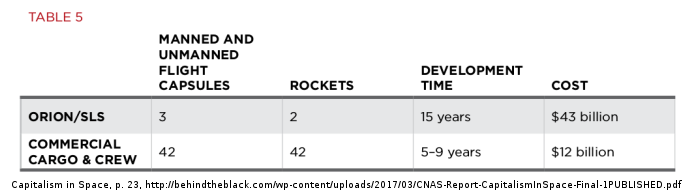
The result was my 2017 policy paper, Capitalism in Space: Private Enterprise and Competition Reshape the Global Aerospace Launch Industry. In it I reviewed and compared what NASA had been getting from its parallel rocket programs, the government-designed and owned Space Launch System (SLS) rocket versus the privately-designed commercial rockets of SpaceX and Orbital ATK (now part of Northrop Grumman). That review produced this very simple but starkly revealing table:

SLS vs Commercial space

From this data, combined with my extensive knowledge as a historian of American history and culture, resulted in the following fundamental recommendations:
» Read more

13 comments

Study: U.S. mortality rates suggest background radiation actually beneficial

The uncertainty of science: According to a new study by researchers at Ben-Gurion University in Israel of mortality rates across the entire United States, people that live in regions of higher background radiation have lifespans on average 2.5 years longer.

Background radiation is an ionizing radiation that exists in the environment because of natural sources. In their study, BGU researchers show that life expectancy is approximately 2.5 years longer among people living in areas with a relatively high vs. low background radiation. Background radiation includes radiation emanating from space, and radiation from terrestrial sources. Since the 1960s, there has been a linear no-threshold hypothesis guiding policy that any radiation level carries some risk. Hundreds of billions of dollars are spent around the world to reduce radiation levels as much as possible.

…According to BGU Professors Vadim Fraifeld and Marina Wolfson, along with Dr. Elroei David of the Nuclear Research Center Negev, lower levels of several types of cancers were found when the radiation levels were on the higher end of the spectrum rather than on the lower end. Among both men and women, there was a significant decrease in lung, pancreatic, colon and rectal cancers. Among men, there were additional decreases in brain and bladder cancers. There was no decrease in cervix, breast or prostate cancers or leukemia.

Their data “covered the entire US population of the 3139 US counties, encompassing over 320 million people,” according to their paper’s abstract.

Up until now the assumption has been that any radiation is bad, based not on research but on assumptions gained by the negative consequence of exposure to high radiation. There has been no good data on the consequences of low level background radiation, because it is so hard to gather. The time frames are long and the numbers small, all of which causes the impact of background radiation to be overwhelmed by other factors. This study’s statistical use of the entire U.S. population is an attempt to overcome these obstacles.

This study is statistical, which means it found a correlation between higher radiation and longer lifespans. Correlation however does not prove causation. The study found no direct evidence that humans health benefits from background radiation. We should therefore take these results with a large grain of salt.

At the same time, their extremely large database is quite telling, and adds some weight to their conclusion.

9 comments

Video of Ingenuity’s flight, taken by Perseverance

JPL yesterday released a short one minute long video created from images taken by the high resolution mast camera on Perseverance.

You can view the animation here.

Stitched together from multiple images, the mosaic is not white balanced; instead, it is displayed in a preliminary calibrated version of a natural-color composite, approximately simulating the colors of the scene as it would appear on Mars.

6 comments

Amazon signs ULA’s Atlas 5 for first 9 Kuiper satellite launches

Capitalism in space: Amazon today announced that it has signed a launch contract with ULA to use its Atlas 5 rocket for the first 9 Kuiper satellite launches.

The announcement did not say when these flights will take place, nor how many Kuiper satellites will be on each. Amazon’s license with the FAA requires that it launch half its 3,200 satellite constellation by ’26. Also ULA intends to retire the Atlas 5 in only a few years, replacing it with its Vulcan rocket. This suggests that the launches will occur in the next three years.

They better. Starlink is already going operational, and OneWeb is about to. Plus several other internet constellations are in the pipeline. If Amazon wishes to compete it needs to get those satellites in orbit as quickly as possible. Internet customers don’t generally change their servers easily, tending to stick with whom they’ve got. If Starlink and OneWeb scoop up all the best low-hanging internet fruit Amazon will find itself facing an uphill battle getting customers.

The article revealed one tidbit of interest. Rajeev Badyal, Amazon’s VP of technology for the Kuiper project, was one of the managers Elon Musk fired from his Starlink project in 2018 after realizing that that management team was moving far too slowly for his tastes. It appears Jeff Bezos then hired Badyal to run Kuiper.

1 comment
1 85 86 87 88 89 126