Spring arrives on the northern polar cap of Mars

Buzzell dunes and pedestal crater near the Martian north polar ice cap
Click for full image.

Cool image time! It is now spring in the northern hemisphere of Mars, and the first bits of sunlight are finally reaching its north polar ice cap. During the winter, as happens each Martian year, that polar cap of water ice gets covered by a thin mantle of dry ice no more than six feet thick. Moreover, this mantle doesn’t just cover the ice cap, it extends south as far as about 60 degrees latitude, covering the giant sea of dunes that surrounds the ice cap.

When spring comes that mantle begins sublimate away, with its base first turning to gas. When the pressure builds up enough, the gas breaks out through the frozen mantle’s weakest points, usually the crest or base of dunes or ridges, leaving behind a dark splotch caused by the material thrown up from below that contrasts with the bright translucent dry ice mantle.

Each year for the past decade scientists have been using the high resolution camera on Mars Reconnaissance Orbiter (MRO) to monitor this sublimation process. The photo above, taken on February 24, 2021 and cropped, enlarged, and brightened to post here, marks the start of this year’s monitoring program. Dubbed informally “Buzzell” by Candice Hansen of the Planetary Science Institute in Arizona, it shows dunes with a round pedestal crater just right of center. Though almost everything when this picture was taken is still covered by that dry ice mantle, in the lower left is a single splotch, the first breakout of CO2 gas that marks the beginning of the annual disappearance of this dry ice.

Last Martian year I repeatedly posted images of Buzzell to illustrate this annual process. The second image below was taken on April 4, 2019, at about the same comparable time in spring.
» Read more
0 comments

Boeing confirms next Starliner unmanned demo flight delayed until August

Capitalism in space: Boeing on April 17th confirmed what had already been rumored, that the second unmanned demo flight to ISS of Starliner, its manned capsule, has been delayed until August.

In a statement, Boeing said that the company and NASA are projecting the uncrewed Orbital Flight Test (OFT) 2 mission will take place in August or September. That date is “supported by a space station docking opportunity and the availability of the United Launch Alliance Atlas V rocket and Eastern Range.”

Boeing had been working toward a launch of OFT-2 in late March or early April. However, by early March, NASA officials acknowledged that was no longer likely because of delays from the replacement of avionics units on the spacecraft that were damaged by a power surge during ground tests, as well as power outages in the Houston area caused by a winter storm in February that interrupted software testing.

They still hope to make the first manned demo flight before the end of the year, assuming the summer unmanned flight goes as planned.

For Boeing, the sooner they get this capsule operational, the sooner it can start earning money by flying commercial flights. At the moment the delays have meant that SpaceX is getting all that business, with two private flights already scheduled and rumors that it will win a flight from the UAE as well. Furthermore, other commercial competitors are on the horizon, including both China and India.

15 comments

Starship prototype #15 readying for flight, possibly tomorrow

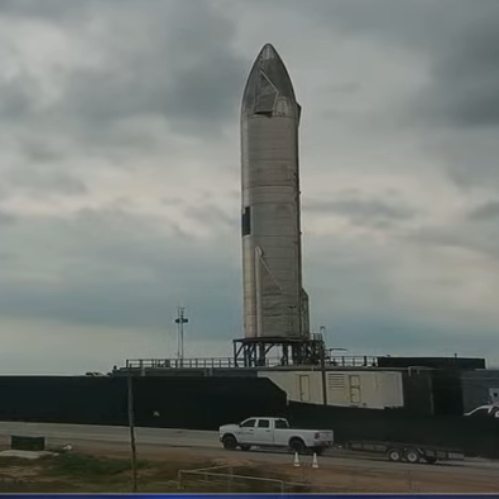
Starship #15 on launchpad
Screen capture from Labpadre launchpad live stream.

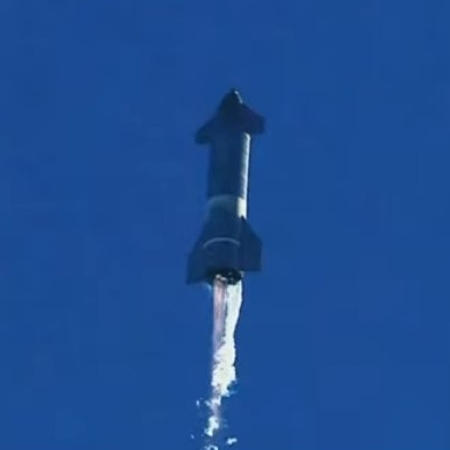
Capitalism in space: SpaceX’s 15th prototype of its Starship upper stage, is preparing to do a static fire test today, with its first test flight possibly as soon as tomorrow, though at present the FAA has not given its approval.

They have done tank tests already, and installed three upgraded Raptor engines yesterday. This spacecraft is a major upgrade from the previous prototypes, and SpaceX probably plans to eventually fly it higher and farther than the previous prototypes. Though no details about those flight plans has yet been released, the first flight will almost certainly repeat the previous flights, going up about ten miles, flipping sideways to simulate a controlled atmospheric descent, and then uprighting itself and landing vertical on the landing pad. Hopefully the upgrades will result in the first truly clean landing with this prototype.

Though the FAA under the Biden administration has seemed eager to flex its bureaucratic muscles and slow development, that NASA has chosen this vehicle as the one that will take astronauts to and from the Moon will put pressure on it to not slow things down too much.

4 comments

Ingenuity flies!

Ingenuity takes off!
For full images go here and here.

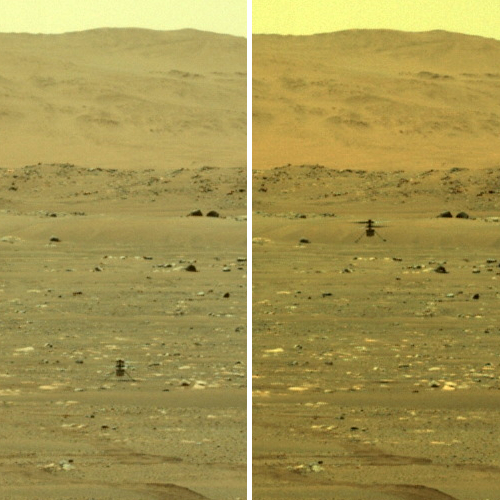
The first autonomous flight of the helicopter Ingenuity on Mars successfully took place early this morning, according to JPL engineers.

NASA has pulled off the first powered flight on another world. Ingenuity, the robot rotorcraft that is part of the agency’s Perseverance mission, lifted off from the surface of Mars on 19 April, in a 40-second flight that is a landmark in interplanetary aviation. “We can now say that human beings have flown a rotorcraft on another planet,” says MiMi Aung, the project’s lead engineer at the Jet Propulsion Laboratory (JPL) in Pasadena, California.

As shown by the two images taken by Perseverance above, the first flight was very simple. The helicopter simply rose about 10 feet, hovered for about 30 seconds as it swiveled 90 degrees, and then carefully descended back down. I have also embedded the video that JPL scientists have created compiling by high resolution Perseverance images below the fold.

Four more flights will next be attempted in the coming weeks.

Four further flights, each lasting up to 90 seconds, are planned in the coming weeks. In these, Ingenuity is likely to rise up to 5 metres [16 feet] above the surface and travel up to 300 metres [1000 feet] from the take-off point. Each successive flight will push Ingenuity’s capabilities to see how well the drone fares in Mars’s thin atmosphere, which is just 1% as dense as Earth’s.

» Read more

16 comments

The rovers’ view of Mars

The view from the top of Mont Mercou
Click for higher resolution. For original images, go here and here.

Some cool images to savor from Mars! Above is a panorama from Curiosity, created by me from two images taken by the rover’s left navigation camera today, April 18, 2021. The view is southwest towards the canyon regions where Curiosity will be heading in the coming months. Note the roughness of the ground. Travel is going to be tricky from here on out.

The photo was taken from the top of Mont Mercou, the 20-foot high outcrop that the rover spent several weeks studying at the cliff’s base. The Curiosity science team is presently preparing to drill into the bedrock at the top.

Ingenuity on the floor of Jezero Crater
Click for full image.

The photo to the right, reduced to post here, was taken by Perseverance on April 13, 2021, and looks west across the floor of Jezero crater. The high mountains in the distance are the crater’s rim. The low and much closer hill is the delta that is the rover’s primary geological target.

In the center of the picture is the helicopter Ingenuity. You can also see the tracks of Perseverance’s wheels just below it.

This will be the rover’s vantage point when Ingenuity attempts its first test flight in the early morning hours of April 19, 2021. The helicopter will head to the right once it lifts off.

2 comments

Ingenuity first test flight scheduled for 3:30 am (Eastern) tonight!

The engineering team for the Ingenuity helicopter on Mars have decided to attempt the first test flight tonight, scheduled for 3:30 am (Eastern) in the early morning hours tomorrow.

Data from the first flight will return to Earth a few hours [later] following the autonomous flight. A livestream will begin at 6:15 a.m. EDT (3:15 a.m. PDT) as the helicopter team prepares to receive the data downlink in the Space Flight Operations Facility at NASA’s Jet Propulsion Laboratory (JPL).

NASA propaganda will begin on NASA TV at 3:30 am (Eastern), but the actual live stream of the flight will not air until about 6:30 am (Eastern) on April 19th.

At the first link above the engineers explain their decision to proceed immediately.
» Read more

13 comments

Russia hands over last rocket engines to ULA

In a ceremony in Russia yesterday, Roscosmos’s Energomash division completed and handed over ownership to ULA six RD-180 engines, to be used in ULA’s Atlas 5 rocket.

These are the last such engines required as part of the contract. They will also likely be the last Russian engines ULA will ever buy. The company is retiring its Atlas 5 rocket, which requires them, and replacing it with its Vulcan rocket, which will instead use Blue Origin’s BE-4 engine.

Furthermore, as of September 1st, 2021 such commercial space contracts with Russia will be difficult to obtain because of new sanctions imposed on Russia by the Biden administration.

7 comments

Ingenuity successfully completes rapid spin test

Ingenuity’s engineers announced this morning that yesterday the helicopter on Mars was able to successfully complete a rapid spin test of its rotary blades.

Today, April 16, on the 154th anniversary of Wilbur Wright’s birth, the Ingenuity flight team received information that the helicopter was able to complete a rapid spin test. The completion of the full-speed spin is an important milestone on the path to flight as the team continues to work on the command sequence issue identified on Sol 49 (April 9).

…The approach that led to today’s successful spin test entailed adding a few commands to the flight sequence. This approach was tested extensively on both Earth and Mars, and was performed without jeopardizing the safety of the helicopter.

They have still not set a date for flight, because they might still decide, after they have analyzed fully the results from this test, to revise the helicopter’s software and upload that change. If not the flight will be relatively soon. If so there will be a longer delay to test that software fully before flight.

1 comment

SpaceX wins competition to build Artemis manned lunar lander, using Starship

Starship prototype #8 on first flight test
Starship prototype #8 on its first flight test,
December 2020

Capitalism in space: NASA has just announced that it has chosen SpaceX to build the Artemis manned lunar lander, using Starship.

The award, a $2.9 billion fixed price contract, also requires SpaceX to complete an unmanned demo lunar landing with Starship that also returns to Earth, before it lands NASA astronauts on the Moon. The contract also still retains the goal to get this to happen by 2024, though NASA official emphasized that they will only launch when ready.

After these flights the agency says it will open bidding again to the entire industry, which means that others are now being challenged to come up with something that can beat SpaceX in the future.

Nonetheless, the contract award was a surprise, as NASA originally intended to pick two teams to provide redundancy and encourage competition. Instead, the agency completely bypassed lunar landers proposed by Dynetics and a team led by Blue Origin that included Lockheed Martin and Draper.

Even more significantly, though NASA explained in the telecon that they still plan to use SLS and Orion to bring astronauts to Gateway, who will then be picked up by Starship for the landing, this decision is a major rejection of the Space Launch System (SLS), since Starship will not use it to get to the Moon, while the other two landers required it.

In fact, this decision practically makes SLS unnecessary in the Artemis program, as NASA has also awarded SpaceX the contract for supplying cargo to the Lunar Gateway station as well as launching its first two modules, using Dragon capsules and Falcon Heavy. SLS is still slated to launch Orion to Gateway, but Starship can replace Orion as well, since Starship is being designed to carry people from Earth to the Moon. This makes SLS and Orion essentially unneeded, easily abandoned once Starship starts flying.

NASA’s decision also means the Biden administration is willing to use its clout to push for Starship over SLS in Congress, which has favored SLS for years because of the pork it brings to their states and congressional districts. They apparently think that Congress is now ready to risk the end of SLS if it comes with a new program that actually accomplishes something. These developments firmly confirm my sense from February that the political winds are bending away from SLS.

This decision is also a major blow to Blue Origin and the older big space companies that Jeff Bezos’ company partnered with. Their dependence on the very costly and cumbersome SLS rocket meant that their ability to launch on a schedule and cost desired by NASA was severely limited. NASA looked at the numbers, and decided the time was right to go with a more radical system. As was noted by one NASA official during the press teleconference, “NASA is now more open to innovation.”

Based on the details announced during the announcement, NASA was especially drawn to Starship’s payload capability to bring a large payload to the Moon, at the same time it brings humans there as well. It also appears SpaceX’s recent track record of success also added weight to their bid.

53 comments

InSight pauses science operations to conserve power

The science team for the InSight lander on Mars have been forced to suspend science operations because dust on the solar panels is reducing the available power.

InSight’s solar panels were producing just 27% of their energy capacity in February, when winter was arriving in Elysium Planitia. So NASA decided to start incrementally turning off different instruments on the lander. Soon the robot will go into “hibernation mode,” shutting down all functions that aren’t necessary for its survival.

By pausing its scientific operations, the lander should be able to save enough power to keep its systems warm through the frigid Martian nights, when temperatures can drop to negative-130 degrees Fahrenheit. “The amount of power available over the next few months will really be driven by the weather,” Chuck Scott, InSight’s project manager, said in a statement.

InSight is still in good condition – it’s even using its robotic arm – but the risk of a potentially fatal power failure is ever-present. If the lander’s batteries die, it might never recover.

As with the rovers Spirit and Opportunity, InSight engineers have depended on periodic strong wind events to periodically clean off the solar panels. Unfortunately, these events are somewhat random, and for the past few months none have occurred.

Note: the article at the link says that winter was arriving at InSight’s location in February, but this is incorrect. InSight sits at about 4 degrees north latitude. In February the end of winter was approaching in the northern hemisphere. More to the point, sitting at the equator you wouldn’t really expect InSight to experience much seasonal changes regardless.

It therefore seems that these issues had less to do with the seasons and much more to do with the accumulating dust on the panels.

6 comments

New OSIRIS-REx photos of Bennu sample site after sample grab

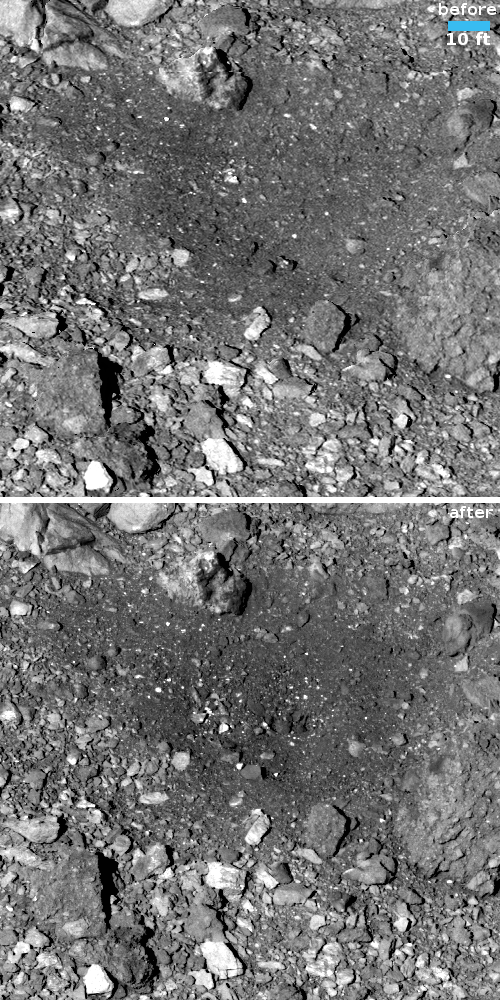
Nightingale before and after sample grab
Click here and here for original images.

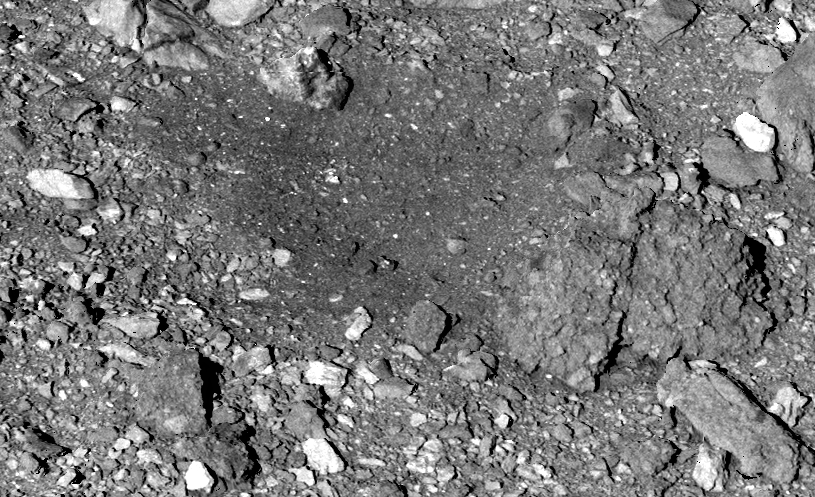
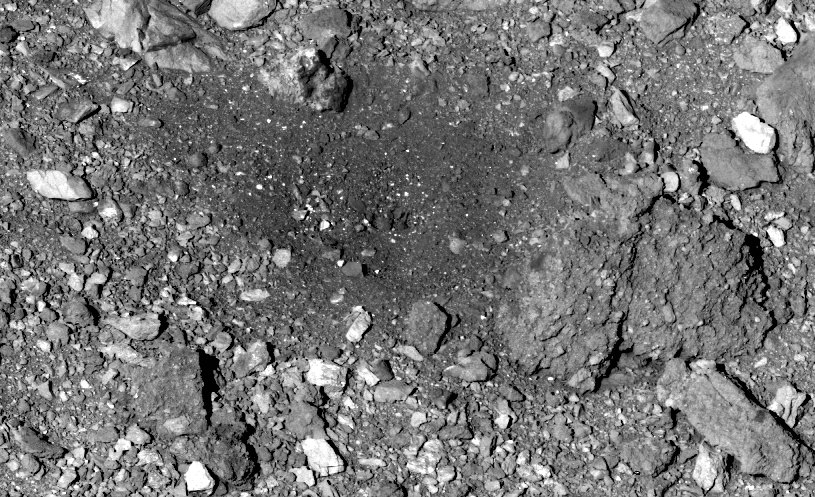
The OSIRIS-REx science team today released the photos the spacecraft obtained in its last fly-by of the asteroid Bennu on April 7th of the Nightngale sample site, showing how it changed after the sample grab in October 2020.

The two photos to the right compare that site, with the top image taken before the sample grab and the bottom image taken on April 7th.

Comparing the two images reveals obvious signs of surface disturbance. At the sample collection point, there appears to be a depression, with several large boulders evident at the bottom, suggesting that they were exposed by sampling. There is a noticeable increase in the amount of highly reflective material near the TAG [touch-and-go] point against the generally dark background of the surface, and many rocks were moved around.

Where thrusters fired against the surface, substantial mass movement is apparent. Multiple sub-meter boulders were mobilized by the plumes into a campfire ring–like shape — similar to rings of boulders seen around small craters pocking the surface.

Jason Dworkin, the mission’s project scientist at NASA’s Goddard Space Flight Center in Greenbelt, Maryland, noticed that one boulder measuring 4 feet (1.25 meters) across on the edge of the sampling site seemed to appear only in the post-TAG image. “The rock probably weighs around a ton, with a mass somewhere between a cow and a car.”

Dante Lauretta, of the University of Arizona and the mission’s principal investigator, later pointed out that this boulder is likely one of those present in the pre-TAG image, but much nearer the sampling location, and estimates it was thrown a distance of 40 feet (about 12 meters) by the sample collection event.

The sample grab arm penetrated the surface by more than a foot, and that event is marked by that dark depression at the center of the site.

OSIRIS-REX will now prepare for its May 10th engine firing that will send it on its route back to Earth to return that sample in September 24, 2023. After that the spacecraft could be sent on another mission, this time to the potentially dangerous asteroid Apophis.

2 comments
1 86 87 88 89 90 126