67P from less than 200 miles

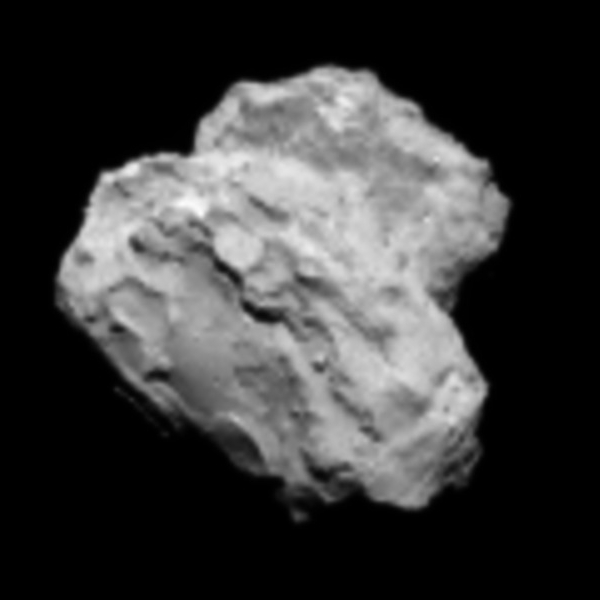
67P on August 3

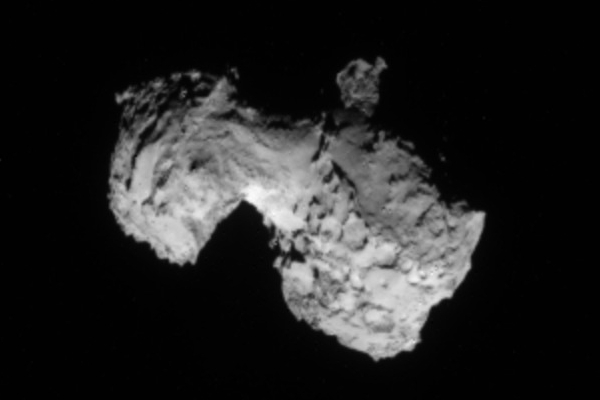
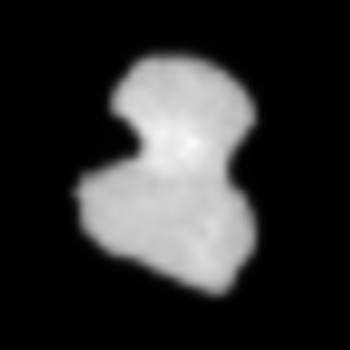
Today’s Rosetta image of Comet 67P, shown above, gives us a different angle of the comet. The spacecraft was only 186 miles (300 kilometers) away when it snapped the picture, and this side view emphasizes the nucleus’s jagged shape.

I am reminded of what happens to a block of ice when you spray warm water on it. It begins to melt away, but very randomly and unevenly, producing very weird shapes and the surface evaporates off. In the case of Comet 67P, the nucleus is a dirty ball of ice, and the Sun’s rays have been causing its surface to evaporate off every time it approaches the Sun. Thus, we get a very weird shape.
0 comments

Today’s Comet 67P image

Comet 67P on August 2

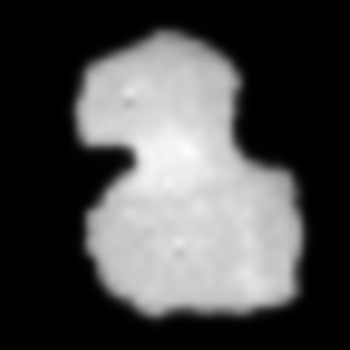
The image above was taken on August 2 using Rosetta’s navigation camera. It has been processed by the science team to bring out the details. I have also rotated it to match the August 1 image taken at a distance of 620 miles that was taken by Rosetta’s OSIRIS narrow angle camera, designed to do the actual science.

You can see that the navigation camera does a pretty good job on its own of capturing the comet’s nucleus. Both images show that the instruments are working perfectly, and thus tell us that the next few months will be quite spectacular after Rosetta goes into orbit in three days, followed in November by the landing of Philae somewhere on the comet’s surface.

If you download both images and then switch back and forth between them you can get a better feel for the geometry of the surface features.

0 comments

Comet 67P from 1000 k

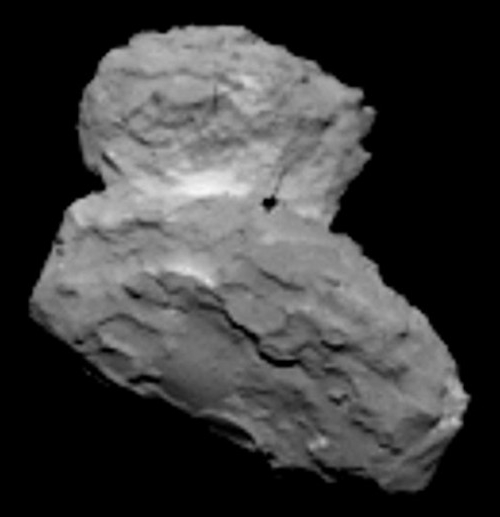
67P from 1000 kilometers

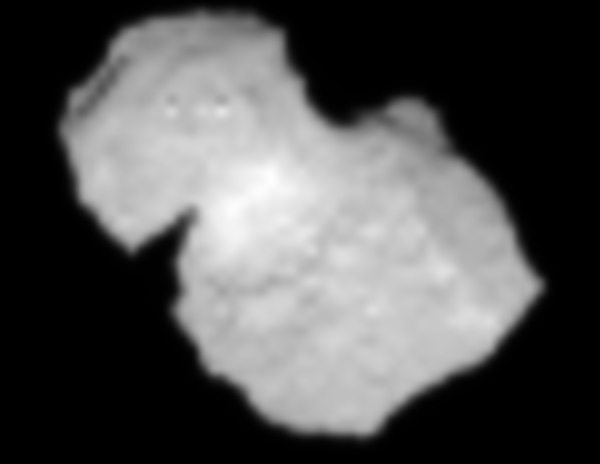
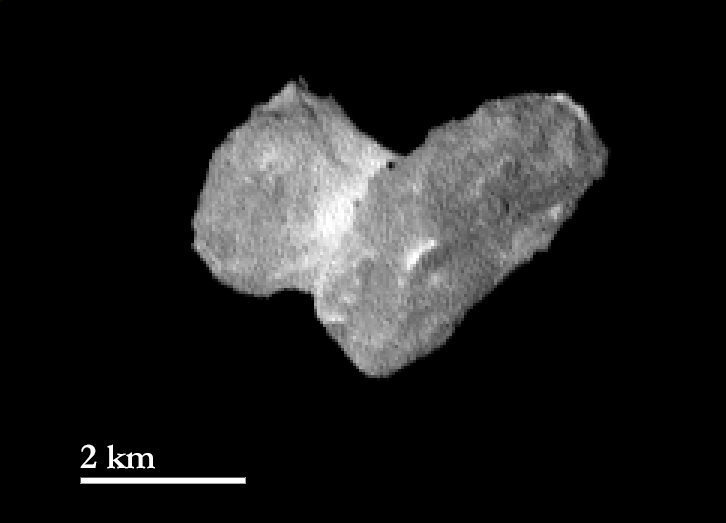
Above is a new image of Comet 67P as seen from about 1000 kilometers, or about 620 miles, released by the Rosetta science team today. The image was taken on August 1 and has been processed somewhat to bring out the details. The black spot near the junction between the nucleus’s two sections is not real but an artifact of the camera’s CCD.

This image is the first real clear and sharp look at the nucleus, and what it shows us is a surface quite different from the many other asteroids that science probes have imaged close-up in the past. From this angle there are far few craters visible then is normally seen on asteroids, and the surface has complex roughness and pitted look that I suspect the planetary geologists are right now scratching their heads about and waving their arms trying to explain. My first guess, which no one should take too seriously, is that as material vents off the comet when it gets close to the Sun it leaves behind these scars.

One more thing: If you go here you can see a number of additional image releases in the last 24 hours, all fascinating. This link explains that the features that looked like craters in earlier images were actually artifacts from the camera’s CCD.

0 comments

Getting closer

Comet 67P on July 31

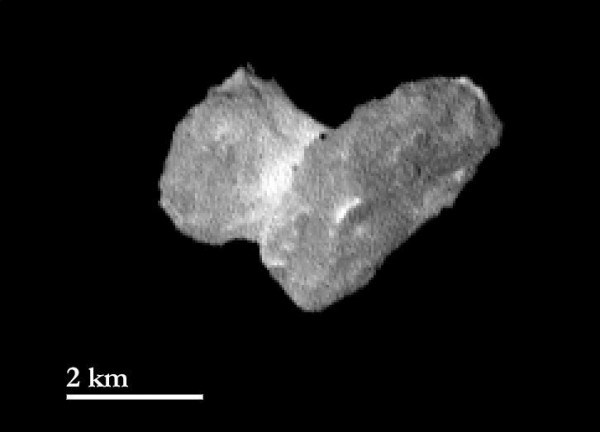
This image of Comet 67P from Rosetta was taken yesterday. Though it has not been processed like the image I posted yesterday, more details continue to come out as the spacecraft each day gets closer to the comet. This image was taken from a distance of 825 miles, 375 miles closer than the previous day.

Very soon these close-up images will become too large to show the entire nucleus in one image. Rosetta will instead begin to snap images of specific features.

Meanwhile, the Rosetta science team released its first temperature readings of the comet.
» Read more

0 comments

New Rosetta comet images

New images from Rosetta have a resolution of 100 meters per pixel and are finding that the neck connecting the comet’s two sections is apparently much brighter than the rest of the nucleus.

As earlier images had already shown, 67P may consist of two parts: a smaller head connected to a larger body. The connecting region, the neck, is proving to be especially intriguing. β€œThe only thing we know for sure at this point is that this neck region appears brighter compared to the head and body of the nucleus”, says OSIRIS Principal Investigator Holger Sierks from the Max-Planck-Institute for Solar System Research (MPS) in Germany. This collar-like appearance could be caused by differences in material or grain size or could be a topographical effect.

It looks like this comet is going to turn out to be one of the most fascinating objects any space probe has visited in a long time.

0 comments

More images from Rosetta

67P

The comet that Rosetta will orbit is getting stranger and stranger, with new images suggesting that it is really two objects stuck together.

The pictures show that 67P/Churyumov-Gerasimenko appears to be not one but two objects joined together. It is what scientists call a “contact binary”. How the comet came to take this form is unknown. It is possible that 67P suffered a major fracture at some point in its past; it is also possible the two parts have totally different origins.

What is clear is that the European Space Agency (Esa) mission team now has additional and unexpected considerations as it plans how to land on the comet later this year – not least, which part of the comet should be chosen for contact?

1 comment

Rosetta snaps more comet pictures

rotating comet nucleus

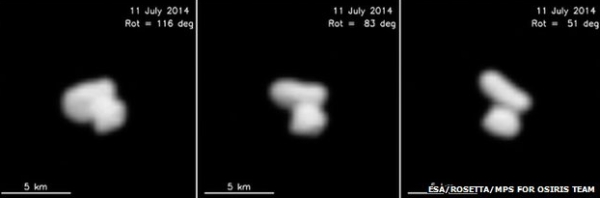
Rosetta’s new images of Comet 67P/Churyumov-Gerasimenko show the very irregular shape and rotation of its nucleus.

These images were taken on July 4 from a distance of only 23,000 miles. The rendezvous is expected in early August, with the touchdown of Rosetta’s landing probe Philae sometime in November after they have done a reconnaissance of the nucleus to pick a landing spot.

0 comments

Rosetta measures its comet

As Rosetta approaches Comet 67P/Churyumov-Gerisimenko, it has measured the amount of water evaporating of the comet as it slowly comes to life as it approaches the Sun.

ESA’s Rosetta spacecraft has found that comet 67P/Churyumov–Gerasimenko is releasing the equivalent of two small glasses of water into space every second, even at a cold 583 million kilometres from the Sun. The first observations of water vapour streaming from the comet were made by the Microwave Instrument for Rosetta Orbiter, or MIRO, on 6 June, when the spacecraft was about 350 000 kilometres from the comet. Since the initial detection, water vapour has been found every time MIRO has been pointed towards the comet.

That rate of evaporation will increase with time.

0 comments

Rosetta’s comet has unexpectedly gone to sleep.

Rosetta’s comet has unexpectedly gone to sleep.

An image snapped earlier this month by ESA’s Rosetta spacecraft shows its target comet has quietened, demonstrating the unpredictable nature of these enigmatic objects. The picture was captured on 4 June by Rosetta’s scientific camera, and is the most recent full-resolution image from the narrow-angle sensor. It has been used to help fine-tune Rosetta’s navigation towards comet 67P/Churyumov–Gerasimenko, which was 430 000 km away at the time.

Strikingly, there is no longer any sign of the extended dust cloud that was seen developing around nucleus at the end of April and into May, as shown in our last image release. Indeed, monitoring of the comet has shown a significant drop in its brightness since then.

Rosetta’s approach for the next few months and arrival at the comet in August should be quite exciting.

0 comments

Rosetta photographs its target comet as it comes to life.

Rosetta photographs its target comet as it comes to life.

The comet 67P/Churyumov-Gerasimenko, target of ESA’s Rosetta mission, has begun to develop a dust coma. This can be seen in a series of images taken by OSIRIS, the spacecraft’s scientific imaging system, between March 27th and May 4th. In the images from the end of April, the dust that the comet is already emitting is clearly visible as an evolving coma and reaches approximately 1300 kilometers into space.

0 comments

The German-built comet lander Philae has been successfully reactivated on Rosetta.

The German-built comet lander Philae has been successfully reactivated on Rosetta.

Philae will be ejected from the Rosetta mothership in November to latch itself onto the comet’s icy surface with harpoons and screws. The lander has its own suite of science instrumentation to take the first-ever photos and measurements from a comet’s surface. Engineers plan a four-week commissioning phase for Philae to check on its health and activate the lander’s 10 instruments.

0 comments

The comet that the European probe Rosetta will visit in August has awakened.

The comet that the European probe Rosetta will visit in August has awakened.

Already 67P/Churyumov-Gerasimenko is approximately 50 percent brighter than in the last images from October 2013. While the comet has moved another 50 million kilometers closer to Earth in this time (and 80 million kilometers closer to the Sun), the increase in brightness cannot be explained by the smaller distance alone. β€œThe new image suggests that 67P is beginning to emit gas and dust at a relatively large distance from the Sun”, says Colin Snodgrass from the MPS. This confirms a study presented by Snodgrass and his colleagues last year in which they had compared the comet’s brightness as recorded during its previous orbits around the Sun. The calculations showed that already in March 2014 its activity would be measurable from Earth.

Update: A preprint paper published today on the astro-ph website predicts that Rosetta will see an unusual topographical feature on the comet’s surface when it arrives in August:

Comet 67P/Churyumov-Gerasimenko. The Secular Light Curve (SLC) of this comet exhibits a photometric anomaly in magnitude that is present in 1982, 1996, 2002 and 2009. Thus it must be real. We interpret this anomaly as a topographic feature on the surface of the nucleus that may be a field of debris, a region made only of dust or an area of solid stones but in any case it is depleted in volatiles. We predict that images taken by spacecraft Rosseta will show a region morphologically different to the rest of the nucleus, at the pole pointing to the Sun near perihelion.

4 comments

Because of a computer reboot, Rosetta’s revival from hibernation came 18 minutes late.

Because of a computer reboot, Rosetta’s revival from hibernation came 18 minutes late.

[Rosetta] woke yesterday as planned, to the relief of ESA scientists – but the signal it sent home to confirm it was awake reached Earth late, fraying the nerves of some mission controllers in the meantime. Due to call at 1745 GMT, Rosetta did not announce its revival until 1818. Fifteen minutes could be explained because the spacecraft’s computer checked the on-board clock only every quarter of an hour. The additional 18 minutes, however, was a mystery.

Now, the telemetry has shown that soon after Rosetta’s first revival sequence had started, the on-board computer automatically rebooted and the sequence started again, causing 18 minutes of delay.

It seems all is well now, though the engineers plan to spend some time pinpointing the cause of the reboot.

1 comment
1 7 8 9 10