Playing with today’s Rosetta image of Comet 67P/C-G
Adjusted comet image

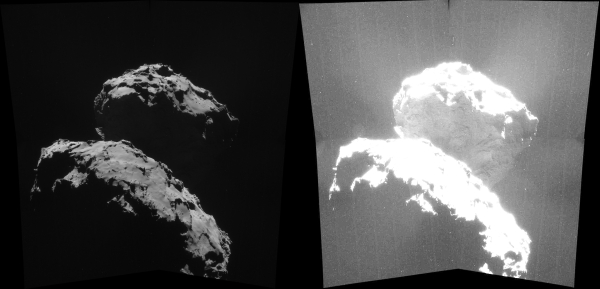
In releasing Wednesday’s image of Comet 67P/C-G, the Rosetta science team suggested that readers download it and play with the brightness and contrast settings to bring out some interesting details.

[I]f you adjust the contrast of the image you will see that there is a lot of ‘noise’ in the background. Some of this is simply detector noise and cosmic rays, but there seem to be a few bright objects that may be dust/ice particles between Rosetta and the comet.

In previous NAVCAM and OSIRIS images, we’ve already seen jets of gas laced with dust streaming away from the comet, and the instruments COSIMA and GIADA have started detecting dust, so it would be no surprise if these objects were also found to originate from the comet. In any case, it is a phenomenon that will clearly be studied in great detail at 67P/C-G over the coming weeks and months.

Another nice observation you might like to make while playing around with the contrast settings is that faint details can be brought out in the ‘neck’ region of 67P/C-G, which on first look is seemingly obscured by shadows. It appears as though the neck is being illuminated by the reflection of sunlight off the main body of the comet below.

The image on the left above is the image as released. The image on the right I have brightened considerably to bring out additional details. As they noted, you can see topographical details in the shadowed neck area. Also, the entire nucleus seems to be surrounded by faint dust streaming away in all directions.

It is going to be a great deal of fun to watch this comet change over the next year as it makes its journey around the Sun.
1 comment

The first chemical analysis of Comet 67P/C-G’s coma

The Rosetta science team today released their first analysis of the chemical make-up of Comet 67P/C-G’s coma, finding that not surprisingly it is made up mostly of water, carbon monoxide, and carbon dioxide.

However, ROSINA [the instrument on Rosetta for doing this analysis] has made the surprising observation that the ratio between these species varies quite significantly, depending on where in the coma Rosetta is. Sometimes carbon monoxide is almost as abundant as water; sometimes it’s only around 10%. In addition, ROSINA has not only detected these main species already, but many of the expected minor ones, such as ammonia, methane, and methanol.

1 comment

Rosetta gets closer

If all goes well with maneuvers today, Rosetta will creep inward to an orbit only 16 miles from Comet 67P/C-G.

From this position the probe will begin gathering a global map of the comet nucleus. Nor is this the closest they will get. Over the next month they will move in again and again in weekly increments.

0 comments

Rosetta’s camera zooms in

67P/C-G on August 23, 2014
Comet 67P/C-G as seen on August 23, 2014 from 38 miles.
Click on image for uncropped version.

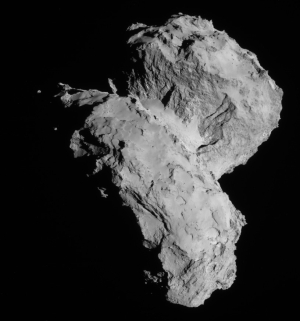
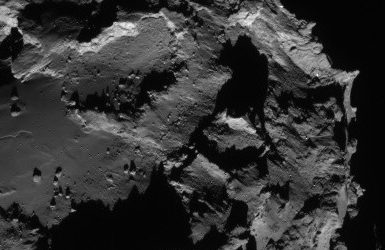
The Rosetta team has begun releasing more close-up images of Comet 67P/C-G taken by the spacecraft. The image to the right was taken by the navigation camera, but rather than capture the entire nucleus in a single image the camera is now zoomed in and taking a mosaic of four images. This picture is one quarter of that mosaic.

Note the boulders and the sharp peaks in the image. The boulders are important to map for planning Philae’s landing site. The sharp peaks suggest recent outgassing.

0 comments

Rosetta’s comet landing sites

67P/C-G landing sites

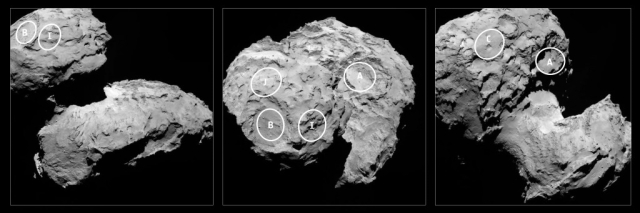
The Rosetta science team has narrowed the choices for Philae landing sites on Comet 67P/C-G to five, three on the smaller lobe and two on the larger lobe.

The smaller lobe sites, being on the outside surface of the lobe, don’t provide as good a view of the rest of the comet, while the larger lobe sites are on its inside surface, looking down at the neck and the smaller lobe. In addition, the terrain for the larger lobe sites looks to me more interesting.

Being on the inside surface, however, the larger lobe sites are going to be more difficult to land on.

0 comments

Picking a comet landing site

67P/C-G on August 22, 2014
Comet 67P/C-G as seen on August 22, 2014
from 40 miles. Click on image for full resolution.

Engineers have begun the landing site selection for Rosetta’s Philae lander.

This week, up to ten possible sites are being laid on the table for a first round of dedicated discussions and for the LCC and the SONC to carry out a technical analysis on each site, ready to be presented at the weekend meeting. Participants of the LSSG will then review the results from the technical analysis and discuss the scientific merits of the candidate sites. By the end of the weekend meeting, as many as five sites could be selected for further detailed investigation.

They will announce the five finalist sites on Monday.

1 comment

The weight of Comet 67P/C-G

Scientists, using radio and orbital data from Rosetta, have made their first estimate of the mass of Comet 67P/C-G.

For the Rosetta mission, this task comes under the umbrella of the Radio Science Investigation (RSI). Using 80 hours worth of tracking data between 6 August, since arriving at the comet, and up to 9 August, the RSI team made a first estimate of the comet’s mass as approximately 1×10^13 kg +/-10%, or about 10 trillion kilograms.

This is very much a preliminary number which will be refined significantly as the spacecraft continues its travels with the comet.

More here. This mass, when considered in conjunction with the nucleus’s size, suggests a very low density. If you could find an ocean large enough it would float.

0 comments

Rosetta detects its first dust grains

67P/C-G on August 12, 2014

The Rosetta science team announced today that the spacecraft’s Grain Impact Analyser and Dust Accumulator (GIADA) has captured its first dust grains from Comet 67P/C-G.

Earlier this month, GIADA detected the first four dust grains in its Impact Sensor. The first detection was made on 1 August, when Rosetta was 814 km from 67P/C-G, and about 543 million kilometres from the Sun. Further impacts from three more dust grains were detected on 2, 4, and 5 August, at distances of 603, 286, and 179 km from the comet, respectively.

There is still too little data to come to any firm conclusions about the density and make-up of the coma, but this announcement confirms that the instrument is working as designed. When the comet zips past the Sun at its closest point on August 13, 2015, this instrument will then be able to give us a very good assessment of this particular comet’s behavior as it slowly evaporates.

Meanwhile, the images keep coming. The picture at the top of the post was taken on August 12 from about 64 miles.

0 comments

Another Rosetta closeup of 67P/C-G

67P on August 8

The above image is not the most recent daily image from Rosetta, but it is the most interesting of the last three.

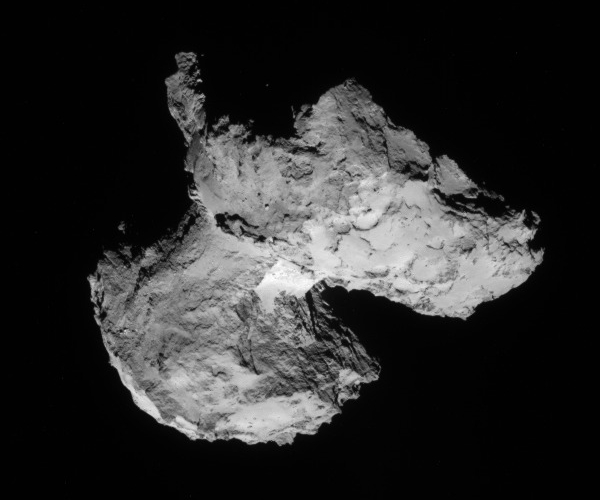
It shows the side of the comet nucleus that has not been featured in most images, as the topographical differences between its two sections is not as distinctly highlighted. What is highlighted is the neck that connects the two sections, lighter colored and thus likely made up of less dusty ice.

Also of interest here is the circular features on the larger bottom section. These certainly resemble craters, and are likely remnants of early impacts that are now been corroded away as the nucleus’s ice particles evaporate off the surface. The scientific question here is this: Why are crater features more evident on this side and section of the comet nucleus than on other areas of its surface?

0 comments

67P from 52 miles

67P from 52 miles, August 7, 2014

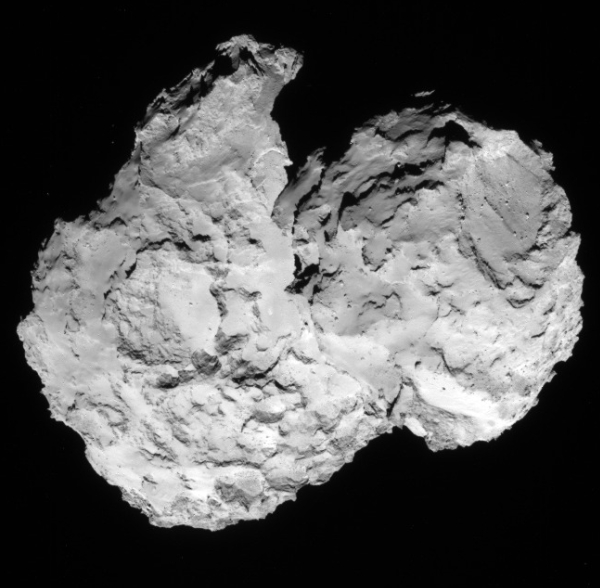
The image above was taken on August 7 from only 52 miles. For the first time I had to scale it down slightly so that it would fit on the webpage.

My impression with this image is that there actually might be hints of some very ancient craters at several of the vaguely circular pitted features. For example, look at the large feature on the end of the nucleus’s smaller component on the right. This might be a crater that now is significantly eroded as the comet’s surface evaporated away each time it approached the Sun every 6.5 years.

0 comments

Comet 67P on the day of rendezvous

67P/C-G on August 6

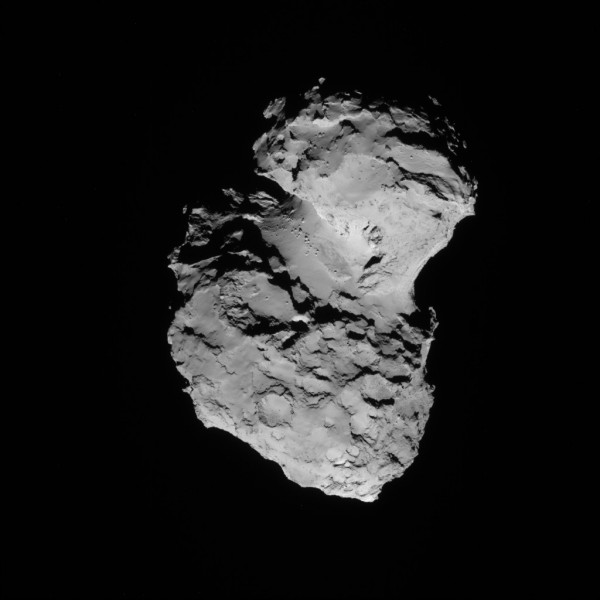
The image above was taken at a distance of 60 miles by Rosetta’s navigation camera on August 6, the day the spacecraft rendezvoused and began flying in tandem with it. It looks at the “backside” of the comet, the side where the distinction between its two components is less pronounced. Once again, no obvious craters, and the surface is pockmarked and corroded.

1 comment

Rosetta arrives

Rosetta has successfully achieved orbit around Comet 67P/C-G and has transmitted its first close up images. More information here and here about the rendezvous and what science the mission scientists plan to do as they orbit the comet.

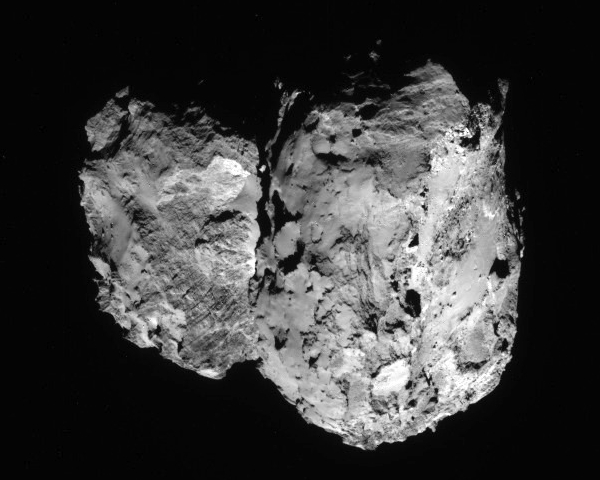
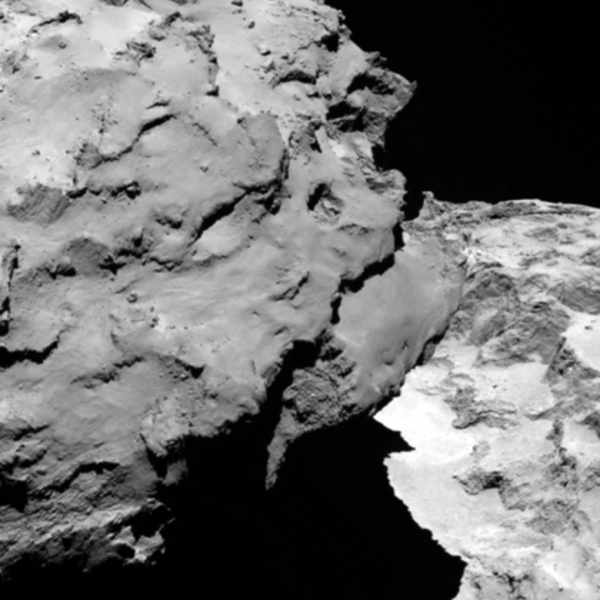
The image below is looking down and past the comet’s smaller component as it casts a shadow on the neck and the larger component beyond. As with the earlier images, the comet’s pitted and corroded surface, lacking any obvious craters, is reminiscent to me of a pile of dirty snow that has been dissolving away. In fact, when I lived in New York I would see this kind of look every winter. When the city would get a big snowfall snowplows would push it into large mounds on the side of the road. As time passed these piles would get dirty from the city’s soot and grime, and also slowly melt away. After several weeks it would look almost exactly like the surface of Comet 67P/C-G.

The images and data that will come down from Rosetta over the next year and half as it orbits the comet in its journey around the Sun will be most fascinating. Stay tuned!

67P/C-G up close

12 comments

Comet 67P/C-G at 126 miles

Comet 67P/C-G at 126 miles

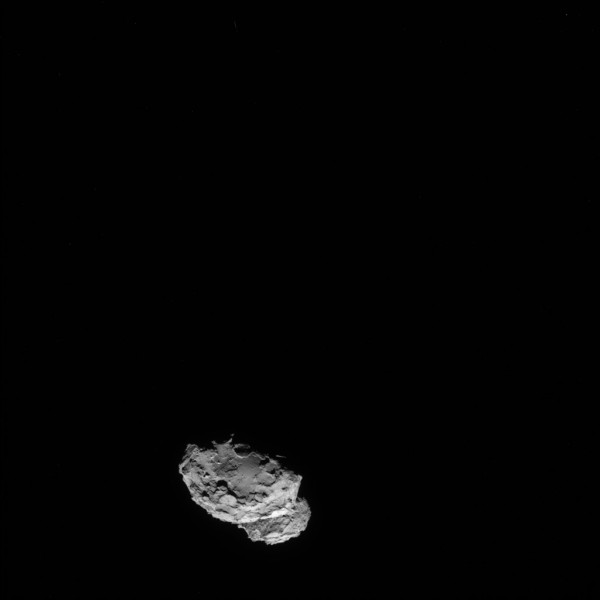
The image above was taken by Rosetta on August 4 from only 126 miles (234 kilometers). Unlike earlier images, this image is raw, uncropped and unprocessed. All I have done is rescale it to fit on my webpage. As they explain at the link,

As you can see, the comet is not centred in the full-frame image. This is a result of the rendezvous burn conducted the previous day, which adjusted Rosetta’s trajectory towards the comet. This effect is corrected for in the commands sent to the spacecraft after the new orbit has been determined.

The science team also notes that beginning tomorrow, the comet will be close enough that they will no longer have to provide a cropped close-up using the navigation camera and that this uncropped raw version will be sufficient.

Rendezvous and orbital insertion on Wednesday!

0 comments
1 6 7 8 9 10