The aurora of Saturn

Cool movie time! Using the Hubble space telescope scientists have compiled an animation showing the changes in Saturn’s north pole aurora over time.

In 2017, over a period of seven months, the NASA/ESA Hubble Space Telescope took images of auroras above Saturn’s north pole region using the Space Telescope Imaging Spectrograph. The observations were taken before and after the Saturnian northern summer solstice. These conditions provided the best achievable viewing of the northern auroral region for Hubble.

…The images show a rich variety of emissions with highly variable localized features. The variability of the auroras is influenced by both the solar wind and the rapid rotation of Saturn, which lasts only about 11 hours. On top of this, the northern aurora displays two distinct peaks in brightness — at dawn and just before midnight. The latter peak, unreported before, seems specific to the interaction of the solar wind with the magnetosphere at Saturn’s solstice.

The animation of all the images is embedded below. At the link is a second video showing the aurora in close-up

0 comments

Global mosiacs of Titan in infrared

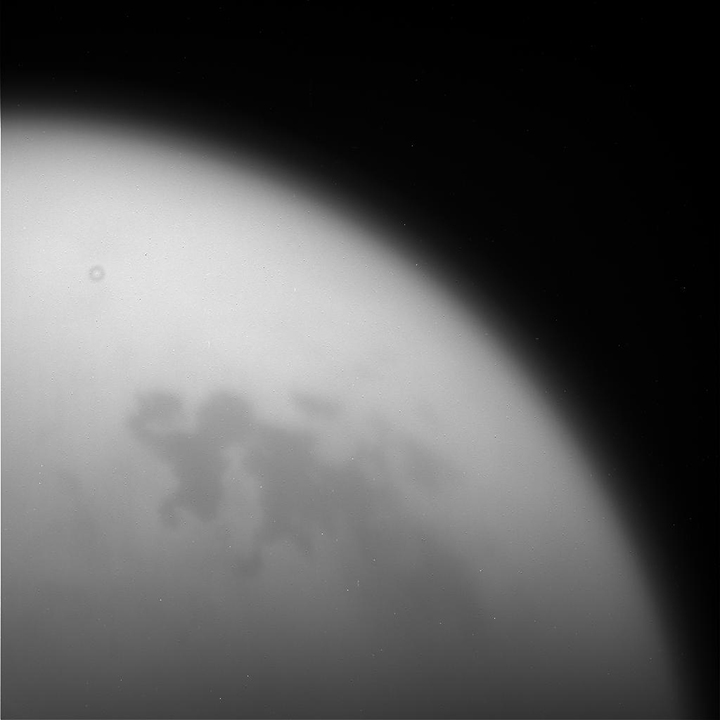
Titan in infrared

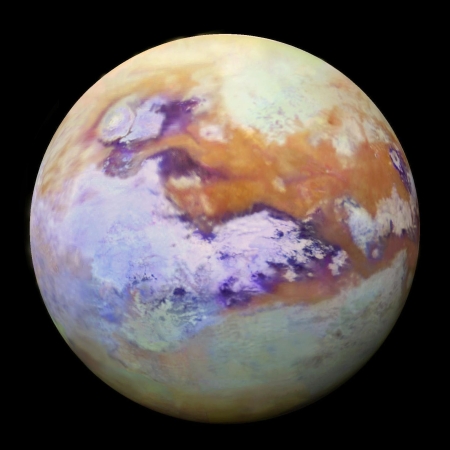
The Cassini science team today released global infrared mosaics of Titan, created from images accumulated during the more than 100 fly-bys of the moon during the spacecraft’s thirteen years in orbit around Saturn.

The image on the right, cropped and reduced in resolution to post here, is only one such global mosaic. Go to the story to see them all.

Making mosaics of VIMS images of Titan has always been a challenge because the data were obtained over many different flybys with different observing geometries and atmospheric conditions. One result is that very prominent seams appear in the mosaics that are quite difficult for imaging scientists to remove. But, through laborious and detailed analyses of the data, along with time consuming hand processing of the mosaics, the seams have been mostly removed. This is an update to the work previously discussed in PIA20022.

Any full color image is comprised of three color channels: red, green and blue. Each of the three color channels combined to create these views was produced using a ratio between the brightness of Titan’s surface at two different wavelengths (1.59/1.27 microns [red], 2.03/1.27 microns [green] and 1.27/1.08 microns [blue]). This technique (called a “band-ratio” technique) reduces the prominence of seams, as well as emphasizing subtle spectral variations in the materials on Titan’s surface. For example, the moon’s equatorial dune fields appear a consistent brown color here. There are also bluish and purplish areas that may have different compositions from the other bright areas, and may be enriched in water ice.

1 comment

Complex carbon molecules from within Enceladus

Scientists have determined, using Cassini data, that there are complex carbon molecules spewing from the tiger stripes on Saturn’s moon Enceladus.

Putting it all together, the scientists concluded that the Cassini spacecraft was encountering dust particles rich in carbon in large, complex “macromolecular structures”. The only place this material could have come from was the interior of Enceladus, from which ice, dust and gas is jetting out in geyser-like plumes. These plumes are fed by vapours escaping from a sub-surface ocean.

“So this is a direct sample of the Enceladus ocean,” Khawaja says.

What exactly the newly discovered organic materials are is open for debate, although Khawaja believes they most likely are made of large numbers of ring-like structures cross-linked by hydrocarbon chains. An important hint comes from the fact that the organic-rich grains don’t contain much water, implying that the materials in them don’t easily mix with water. Khawaja hypothesises that they formed deep inside Enceladus, then rose to the top of its underwater ocean, where they formed a thin film akin to an earthly oil slick.

Just to be very clear, they have not discovered life. What they have found however increases the chances that there is life within Enceladus’s underground ocean.

1 comment

Methane detected on Enceladus could come from microbes

The uncertainty of science: New research has found that the methane that Cassini detected being released from Enceladus’s interior could conceivably come from at least one Earth-type microbe.

Using various mixtures of gases held at a range of temperatures and pressures in enclosed chambers called “bioreactors,” Rittmann and his co-authors cultivated three microorganisms belonging to the oldest branch of Earth’s tree of life, known as Archaea. In particular, they focused on Archaean microbes that are also methanogens, which are able to live without oxygen and produce methane from that anaerobic metabolism. The team examined the simplest types of microbes, which could be the primary producers of methane at the base of a possibly more complex ecological food chain within the moon.

They tried to simulate the conditions that could exist within and around Enceladus’s hydrothermal vents, which are thought to resemble those found at a few deep-sea sites on Earth, often near volcanically active mid-oceanic ridges. According to their tests, only one candidate, the deep-sea microbe Methanothermococcus okinawensis, could grow there—even in the presence of compounds such as ammonia and carbon monoxide, which hinder the growth of other similar organisms.

There are a lot of fake news stories today trumpeting this result as proof that alien microbes can exist on Enceladus. The data does no such thing. All it shows that one methane producing microbe could possibly live in an environment that researchers guess might somewhat resemble the situation on Enceladus. However, as the article admits,

Scientists do not really know the precise conditions on Enceladus yet, of course. And in any case it is possible any life there, if it exists, is nothing like any DNA-based organism on our planet, rendering our Earth-based extrapolations moot. What’s more, these findings only show microbial life might exist in one particular subset of possible environments within the moon’s dark ocean.

This result is interesting, but it really proves nothing about Enceladus itself.

1 comment

Titan’s liquid hydrocarbon seas have a global sea level

New research using Cassini data has revealed that the liquid hydrocarbon oceans of Saturn’s moon Titan have a global sea level, with some small lakes perched at higher elevations.

The new study suggests that elevation is important because Titan’s liquid bodies appear to be connected under the surface in something akin to an aquifer system at Earth. Hydrocarbons appear to be flowing underneath Titan’s surface similar to the way water flows through underground porous rock or gravel on Earth, so that nearby lakes communicate with each other and share a common liquid level.

6 comments

Saturn’s rings are very young

Data from Cassini’s last ring-diving orbits has now strengthened the hypothesis that Saturn’s rings formed very recently, just a few hundred million years ago.

Saturn acquired its jewels relatively late in life. If any astronomers had gazed at the sky in the time of the dinosaurs, they might have seen a bare and boring Saturn.

It was then that some sort of catastrophe struck the gas giant. Perhaps a stray comet or asteroid struck an icy moon, tossing its remnants into orbit. Or maybe the orbits of Saturn’s moons somehow shifted, and the resulting gravitational tug-of-war pulled a moon apart. However it happened, two new lines of evidence from Cassini make it clear that the rings were not around in the early days of the solar system 4.5 billion years ago, as scientists had long believed, says Jeff Cuzzi, a ring specialist at NASA’s Ames Research Center in Mountain View, California. “It rules out the primordial ring story,” Cuzzi says. “That’s what it looks like to me.”

At the moment there is no consensus on what might have caused the rings formation so recently.

3 comments

Billionaire Yuri Milner considering funding mission to Enceladus

Capitalism in space: Billionaire Yuri Milner, who already funds several astronomy projects aimed at interstellar travel, is now considering funding a planetary probe to the Saturn moon Enceladus.

At the moment all he is doing is holding workshops with scientists and engineers to see if such a mission can be done for an amount he can afford. Considering that Elon Musk’s first concept to send a private probe to Mars, before SpaceX existed, was stopped because of high launch costs, thus becoming the inspiration for SpaceX itself in order to lower those costs, Milner’s private effort might actually be affordable now.

1 comment

The glory of Cassini’s Saturn

The glory of Saturn

Cool image time! The image on the right, reduced in resolution to post here, was taken by Cassini on August 17, 2017, one month before the spacecraft dived into Saturn to end its mission.

This view looks toward the sunlit side of the rings from about 19 degrees above the ringplane. The image was taken in green light with the Cassini spacecraft wide-angle camera on Aug. 12, 2017. Pandora was brightened by a factor of 2 to increase its visibility.

The view was obtained at a distance to Saturn of approximately 581,000 miles (935,000 kilometers) from Saturn. Image scale is 35 miles (56 kilometers) per pixel. The distance to Pandora was 691,000 miles (1.1 million kilometers) for a scale of 41 miles (66 kilometers) per pixel.

The moon Pandora can be seen in the full resolution image just beyond the outermost ring near the top of the screen.

0 comments

New findings from Cassini’s final months

Link here. Among a bunch of other interesting results, this one I found the most tantalizing:

The spacecraft’s Ion and Neutral Mass Spectrometer (INMS) returned a host of first-ever direct measurements of the components in Saturn’s upper atmosphere, which stretches almost to the rings. From these observations, the team sees evidence that molecules from the rings are raining down onto the atmosphere. This influx of material from the rings was expected, but INMS data show hints of ingredients more complex than just water, which makes up the bulk of the rings’ composition. In particular, the instrument detected methane, a volatile molecule that scientists would not expect to be abundant in the rings or found so high in Saturn’s atmosphere.

The results generally leave behind more questions than answers, but that is exactly why exploring the universe is so much fun.

0 comments

Storms on Titan dump a lot of liquid methane, quickly

A new climate model for Titan that suggests the planet’s methane rainstorms occur about once a Saturn year (29.5 years) and at about 60 degree latitude correlates with Cassini surface data that found a high concentration of alluvial fans at that latitude.

“The most intense methane storms in our climate model dump at least a foot of rain a day, which comes close to what we saw in Houston from Hurricane Harvey this summer,” said Mitchell, the principal investigator of UCLA’s Titan climate modeling research group.

Sean Faulk, a UCLA graduate student and the study’s lead author said the study also found that the extreme methane rainstorms may imprint the moon’s icy surface in much the same way that extreme rainstorms shape Earth’s rocky surface. On Earth, intense storms can trigger large flows of sediment that spread into low lands and form cone-shaped features called alluvial fans. In the new study, the UCLA scientists found that regional patterns of extreme rainfall on Titan are correlated with recent detections of alluvial fans, suggesting that they were formed by intense rainstorms.

1 comment

The kittens of Saturn’s rings

The scientists who used Cassini to identify about 60 transient clumps in Saturn’s rings have dubbed them “kittens” and have been naming them appropriately.

Saturn’s kittens are a group of small clumps and baby moons, or moonlets, that occupy the planet’s F ring. Like the rest of Saturn’s rings, this thin outer ring is made up of countless particles that range in size. When enough of those particles bump into one another and stick together, they aggregate into larger clumps — and become eligible for a kitten name.

So far, the list of Saturn’s kitten names includes several classics, like Fluffy, Garfield, Socks and Whiskers. These are unofficial nicknames for more-complicated (and less adorable) official titles like “Alpha Leonis Rev 9” (aka, Mittens). The technical names for these features come from events called stellar occultations, during which Cassini was able to detect the little clumps. In a stellar occultation, a star passes behind Saturn’s rings from Cassini’s point of view.

Most of these clumps will likely never be found again, so their unofficial kitten names are essentially just for fun.

4 comments

Cassini’s last image of Iapetus

Iapetus

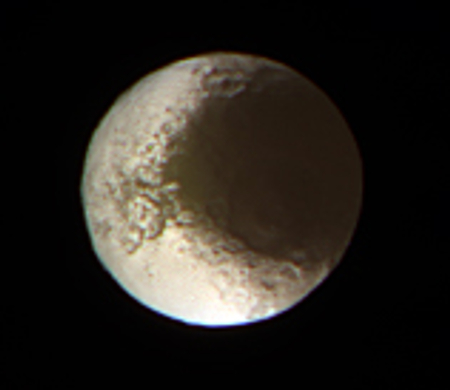
The image on the right is a cropped and scaled up version of one of Cassini’s last images of Saturn’s moon, Iapetus.

The moon is unique in that its east and west hemispheres have completely opposite albedos, with one being very dark and the other very bright. It also has a very distinctive large crater, seen in this image. Scientists do not quite understand what causes the dichotomy, though they have models that partly explain it, partly from material being deposited on the moon’s leading hemisphere combined with the temperature differences at different latitudes.

The cause of the extreme brightness dichotomy on Iapetus is likely to be thermal segregation of water ice on a global scale. Thermal effects are usually expected to act latitudinally. That is, polar areas are colder than equatorial terrain in most cases due to the more oblique angle of the solar irradiation. Therefore, an additional process is required to explain the longitudinal difference as well. In one model, dark, reddish dust coming in from space and preferentially deposited on the leading side forms a small, but crucial difference between the leading and trailing hemispheres, which is sufficient to allow the thermal effect to evaporate the water ice on the leading side completely, but only marginally on the trailing side.

It was this moon’s strange dichotomy that had Arthur Clarke use it in 2001: A Space Odyssey. While Cassini’s images clearly prove that the brightness difference was not created by an alien civilization, as imagined by Clarke, those images have not really provided us a full explanation for its cause. The uncertainty of science marches on!

0 comments

The Worst Part of Losing Cassini Is That It Has No Replacement

Link here. This article is an honest review of the current lack of concrete plans by anyone to send a new probe to Saturn. While there are some tentative missions in the works, nothing is certain.

[I]f looking back on Cassini’s major discoveries at Saturn, Titan, and Enceladus have left you thirsty for more, we have some bad news: That thirst is going to go unquenched for a while. Talks of Uranus and Neptune missions are tentative at best. The best hope for Saturn now comes from NASA’s New Frontiers program, which looks for excellent medium-cost missions has spawned spacecraft including Jupiter’s Juno and Pluto’s New Horizons. This round of New Frontiers missions must launch by 2024, and there are two Enceladus proposals, a Titan proposal, and a Saturn atmospheric probe under consideration. We may hear word about those proposals by the end of the year “Hang tight, we’re going through the evaluations now and we’ll be announcing at the end of the year what some of the finalists will be,” Jim Green, NASA Planetary Science Director, said at the Cassini press conference Friday morning.

This list of possible Saturn missions sounds great, but they are all competing against each other and a number of other equally (and possibly more) interesting missions to other places. And with the federal budget out of control and mired in debt, there isn’t really a lot of money to go around.

13 comments

Cassini’s mission ends

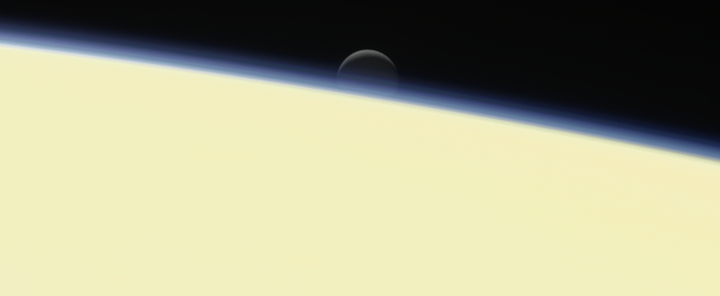
Enceladus as seen by Cassini two days before mission end

After a seven year journey and thirteen years in orbit around Saturn, Cassini’s mission ended early this morning with a dive into Saturn’s atmosphere.

The image above, cropped to show here, is actually one from a short movie, showing Enceladus setting behind the horizon of Saturn. The images were taking two days ago, but provide a fitting image for the mission’s end.

Some of the best images from the dive, including Cassini’s last image, can be found here.

While most of the press will rightly wax eloquent about the magnificence of this mission, my focus remains on what will come next. We no longer have any way to observe what is happening on Saturn. We are blind. We should not be.

16 comments

Cassini on final approach to Saturn

Engineers have confirmed that Cassini is now on its final approach to Saturn, with a scheduled dive into the gas giant set for Friday, September 15.

The mission’s final calculations predict loss of contact with the Cassini spacecraft will take place on Sept. 15 at 7:55 a.m. EDT (4:55 a.m. PDT). Cassini will enter Saturn’s atmosphere approximately one minute earlier, at an altitude of about 1,190 miles (1,915 kilometers) above the planet’s estimated cloud tops (the altitude where the air pressure is 1-bar, equivalent to sea level on Earth). During its dive into the atmosphere, the spacecraft’s speed will be approximately 70,000 miles (113,000 kilometers) per hour. The final plunge will take place on the day side of Saturn, near local noon, with the spacecraft entering the atmosphere around 10 degrees north latitude.

We will get Cassini’s last images about 90 minutes after its death.

0 comments

An oral history of the Cassini mission to Saturn

Link here. Those who have read my book on the building of the Hubble Space Telescope will recognize many of the same people and political maneuvers used to get the project off the ground and funded.

Note too that the idea of Cassini was first proposed in 1982, but it didn’t actually launch until 1997. Fifteen years. While today I think such a spacecraft could go from concept to launch much faster, this timeline gives us a guide on when the next Saturn orbiter might launch. At the earliest do not expect another mission to Saturn to launch before 2025.

2 comments

Cassini says goodbye to Saturn

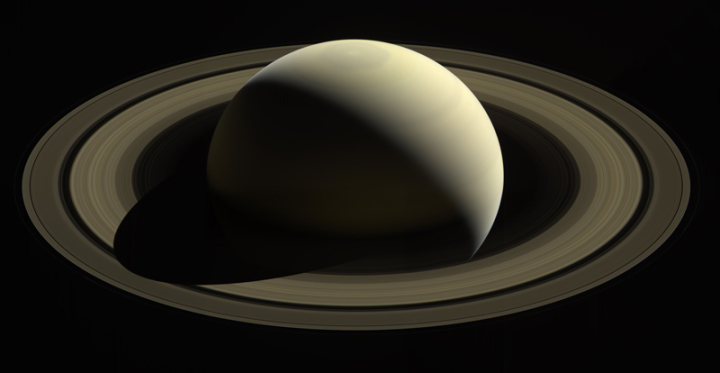
Saturn, October 2016

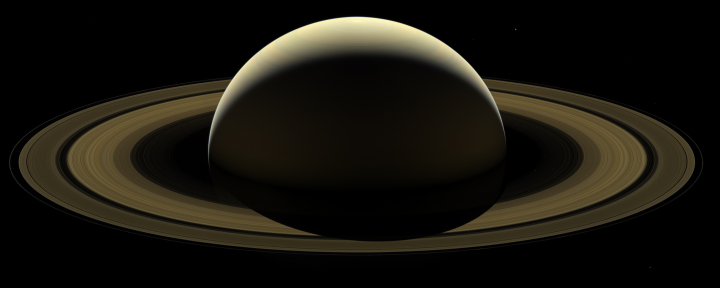
Cool image time! The picture above, reduced in resolution to show here, was taken in October 2016 during one of Cassini’s last distant orbits that gave it a global view of Saturn and its rings. Since it began its dives close to the gas giant such views have not been possible.

The mission ends this coming Saturday with a dive into Saturn. It was launched in October 1997, and after a seven year journey has spent the last thirteen years in orbit around the planet, providing us the first long term glimpse of a gas giant as its seasons evolved.

Cassini has been orbiting Saturn for nearly a half of a Saturnian year but that journey is nearing its end. This extended stay has permitted observations of the long-term variability of the planet, moons, rings, and magnetosphere, observations not possible from short, fly-by style missions.

When the spacecraft arrived at Saturn in 2004, the planet’s northern hemisphere, seen here at top, was in darkness, just beginning to emerge from winter (see Cassini’s Holiday Greetings​). Now at journey’s end, the entire north pole is bathed in the continuous sunlight of summer.

The spacecraft was also able to observe the seasonal changes that occurred to Titan. It also studied the plumes coming from the tiger stripe cracks on Enceladus, shown below the fold in a movie created by Cassini over a 14 hour time period in August 2017.

I expect that scientists will be exploring Cassini’s data archive for decades, finding many things not noticed in their initial viewing. Unfortunately, we will not have another spacecraft taking new pictures in orbit around Saturn to compare with Cassini’s past images for many decades to come. On Saturday, we go blind.
» Read more

5 comments

Saturn’s magnificent rings

Saturn's rings

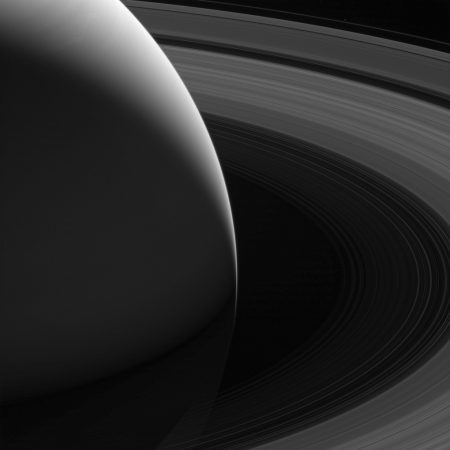
The Cassini science team released two sets of images taken by the spacecraft of Saturn’s rings.

The image above, reduced in resolution to show here, is from the second link. As they note,

The pale tan color is generally not perceptible with the naked eye in telescope views, especially given that Saturn has a similar hue.

The material responsible for bestowing this color on the rings—which are mostly water ice and would otherwise appear white—is a matter of intense debate among ring scientists that will hopefully be settled by new in-situ observations before the end of Cassini’s mission.

The different ringlets seen here are part of what is called the “irregular structure” of the B ring. Cassini radio occultations of the rings have shown that these features have extremely sharp boundaries on even smaller scales (radially, or along the direction outward from Saturn) than the camera can resolve here. Closer to Saturn, the irregular structures become fuzzier and more rounded, less opaque, and their color contrast diminishes.

Check out both. They reveal to me that our understanding of these rings remains essentially nil, even after more than a dozen years of study by Cassini.

5 comments
1 2 3 4 5 6 12