Craters in slush on Mars

Dust devil steak across a slushy plain on Mars
Click for full image.

Cool image time! The photo to the right, cropped and reduced to post here, was taken on October 27, 2020 by the high resolution camera on Mars Reconnaissance Orbiter (MRO). It was taken not for any particular research project, but as one of the periodic images the camera team needs to take maintain the camera’s proper temperature. When they need to do this, they often will take a picture in an area not previously viewed at high resolution. Sometimes the image is boring. Sometimes they photograph some geology that is really fascinating, and begs for some young scientist to devote some effort to studying it.

In this case the photo was of the generally featureless northern lowland plains. What the image shows us is a scattering of impact craters that appear to have cut into a flat plain likely saturated with ice very close to the surface.

How can I conclude so confidently that these craters impacted into ice close to the surface? The location gives it away.
» Read more

0 comments

The target landing ellipse on Mars for Perseverance

Perseverance's landing ellipse on Mars
Click for full image.

In just over a month, on February 18, 2021, the American rover Perseverance will come screaming through the thin atmosphere of Mars at a speed of over 12,000 miles per hour to hopefully land successfully in Jezero Crater.

The map to the right, cropped and reduced to post here, was released last week by the Perseverance science team and shows the landing ellipse in that crater. It also shows the much larger landing ellipses of previous landers/rovers. As they noted,
» Read more

3 comments

Giant iceberg from Antarctica breaking up

As should have been expected, the giant iceberg the size of Delaware that had broken from the Antarctic ice pack in 2017 and was drifting directly towards South Georgia Island (a wildlife preserve), is now breaking up without doing any harm to the island itself.

Seawater has been cutting like a knife through A-68A, the enormous Antarctic iceberg drifting in the southern Atlantic Ocean. On January 11, 2021, the Visible Infrared Imaging Radiometer Suite (VIIRS) on the NOAA-20 satellite acquired this image showing the remainder of A-68A, along with two large pieces that broke off in December 2020.

The U.S. National Ice Center (USNIC) reported on January 8 that A-68A measured 74 kilometers long and 44 kilometers wide. That equates to an area about twice the size of Houston—still sizable, but quite a bit smaller than its Delaware-sized status in July 2017 when it calved from the Larsen C Ice Shelf. The pieces that broke from A-68A in December (forming A-68D and A-68E) are smaller, but remain large enough to be tracked by the USNIC.

Every report about this, including today’s, waxes eloquently about the terrible threat the iceberg poses to the wildlife on South Georgia Island should it become grounded there, even though all past data, let me repeat, all past data indicated that it would not hit the island but drift around as it broke up.

And, surprise surprise, that is exactly what it has been doing.

4 comments

The colorful and bright knobs of Ariadnes Colles on Mars

Colorful and bright knob in Ariadnes Colles
Click for full image.

Today’s cool image gives us a sample of the strange colorful hills in an even stranger knobby depression on Mars called Ariadnes Colles. The photo to the right, cropped and color enhanced to post here, was taken on September 10, 2020 by the high resolution camera on Mars Reconnaissance Orbiter (MRO). It focuses on just one of those colorful hills. The color strip only covers the western half, which is why that is the only part of the hill in color.

Ariadnes Colles is a patch of chaotic terrain 110 by 100 miles in size, located in the southern cratered highlands due south of Mars’s volcano country, at latitude 34 degrees south. What makes this particular patch of chaos distinct from the many others on Mars is that the hills, knobs, and mesas within it are routinely bright and colorful, compared to the darker surrounding terrain. Moreover, as noted in this Mars Express press release for images of Ariadnes Colles from that orbiter,

In contrast to other chaotic terrains … Adrianes Colles is not a water-source region. It is still debated, therefore, whether Ariadnes Colles was formed by the action of water or wind.

The darker material in the southern areas is most likely sand or volcanic ash; some slopes of the flat-topped features have been covered by this dark material that was blown up on the slopes.

The sand or volcanic ash most likely come from the Medusae Fossae Formation several hundred miles to the north, the largest volcanic ash deposit on Mars. The colors on the hill likely come from a variety of minerals.

The overview map below shows the entire patch, with the location of the hill above indicated by the white dot in the red rectangle that shows the full image location.
» Read more

1 comment

Astronomers discover first periodic erupting supermassive black hole

Astronomers observing a galaxy 570 million light years away have discovered that the periodic energetic flares that occur there every 114 days are not supernovae but eruptions from the supermassive black hole at the center of the galaxy, caused each time an orbiting star gets too close during its perihelion and has material stripped away from it.

ASASSN-14ko was first detected by the All-Sky Automated Survey for Supernovae (ASAS-SN), a global network of 20 robotic telescopes headquartered at The Ohio State University (OSU) in Columbus. When Payne examined all the ASAS-SN data on the phenomenon, she noticed a series of 17 regularly spaced flares.

Based on this discovery, the astronomers predicted that the galaxy would experience another burst on May 17 of last year and coordinated ground- and space-based facilities to make observations. They have since successfully predicted and witnessed flares on September 7 and December 26.

Though the press release tries to sell itself by saying these flares were initially mistaken for supernovae, a close reading suggests the astronomers thought this for only a very short time. As soon as they took their first close look and noticed the regularly space events, they abandoned the supernovae idea immediately.

Most supermassive black holes at the center of galaxies are active, emitting large amounts of energy in bursts or in a steady stream. That is why astronomers label them Active Galactic Nuclei, or AGNs. This is the first to do so in a periodic manner.

That most are active illustrates the mystery of the supermassive black hole in the center of the Milky Way. Sagittarius A* (pronounced A-star) is not active, even though it really should be.

5 comments

NASA extends mission of Juno and InSight probes

NASA has decided to extend the missions of Juno and InSight probes, giving both several more years to gather data.

InSight main goal for the two-year extension will be to gather more seismic data of Mars. They will also continue their efforts to get the heat sensor into the ground, but that will have a lower priority.

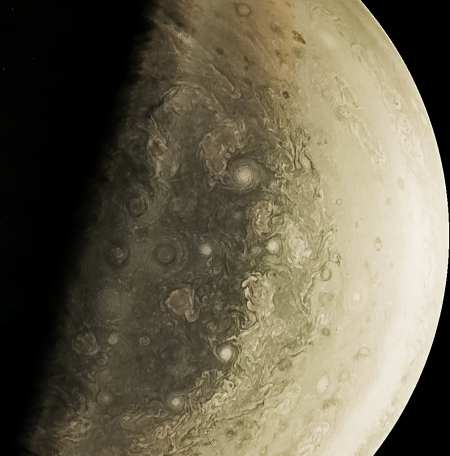
Juno will be able to slowly adjust its orbit to better study Jupiter’s north polar regions, thus developing a more complete first rough map of the gas giant’s internal structure and atmosphere. The changing orbit will also allow the first close fly-bys of some of Jupiter’s moons, the first in more than twenty years.

The moon flybys could begin in mid-2021 with an encounter with Ganymede, Jupiter’s largest moon, at a distance of roughly 600 miles (1,000 kilometers), Bolton said last year.

After a series of distant passes, Juno will swoop just 200 miles (320 kilometers) above Europa in late 2022 for a high-speed flyby. Only NASA’s Galileo spacecraft, which ended its mission in 2003, has come closer to Europa.

There are two encounters with Jupiter’s volcanic moon Io planned in 2024 at distances of about 900 miles (1,500 kilometers), according to the flight plan presented by Bolton last year. Juno will be able to look for changes on the surfaces of Jupiter’s moons since they were last seen up close by NASA’s Voyager and Galileo probes.

While it will take images, Juno’s camera is not particularly high resolution. The main effort will be to use its instruments to study the surface make-up of the moons.

9 comments

Hayabusa-2 begins journey to two asteroids

On January 5, 2021, after successfully delivering its samples of Ryugu to Earth, Hayabusa-2 fired up its ion engines and began its ten-year journey to two different asteroids.

Hayabusa2’s first extended-mission destination is the roughly 2,300-foot-wide (700 meters) asteroid (98943) 2001 CC21, which the probe will fly by at high speed in 2026, if all goes according to plan. A more in-depth rendezvous with yet another space rock, 1998 KY26, is scheduled to follow in 2031.

In a previous post I had mistakenly left out the first target asteroid. However, their primary target remains the tiny 100-foot-wide 1998 KY26, since it is so small. This will be the first close-up view of such a small asteroid, in space. Since such asteroids are many, it will tell us much about the make-up and history of the solar system.

2 comments

Partly engulfed Martian craters

An engulfed crater on Mars
Click for full image.

Cool image time! The photo to the right, rotated, cropped, and reduced to post here, was taken by the high resolution camera on Mars Reconnaissance Orbiter (MRO) on October 31, 2020. It shows a crater that appears buried in a sea of material so that pretty much the only thing visible is top of its rim.

The full image shows a second larger crater to the northwest that looks the same. In both cases the material fills the craters also fills the surrounding terrain.

Yet, both craters appear to be surrounded by a faint skirt of uplifted material.

What caused this situation?
» Read more

1 comment

Congress frees Europa Clipper from SLS

It appears that Congress has at last removed its requirement that the unmanned probe Europa Clipper must be launched on the continually delayed and very expensive SLS rocket.

Almost unnoticed, tucked into the 2021 fiscal NASA funding section of the recently passed omnibus spending bill, is a provision that would seem to liberate the upcoming Europa Clipper mission from the Space Launch System (SLS).

According to Space News, the mandate that the Europa Clipper mission be launched on an SLS remains in place only if the behind-schedule and overpriced heavy lift rocket is available and if concerns about hardware compatibility between the probe and the launcher are resolved. Otherwise, NASA is free to search for commercial alternatives to get the Europa Clipper to Jupiter’s ice-shrouded moon.

Not only will this secure Europa Clipper’s launch schedule, which had deadlines imposed by orbital mechanics that SLS was not going to meet, the more than $1 billion in savings by using a SpaceX Falcon Heavy will allow the probe to do more while giving NASA more money for other planetary missions.

This is excellent news. It signals that Congress’s long love affair with SLS because of the ample pork it sends to many districts might finally be waning. If so, there is a good chance it will finally be killed, freeing up its bloated budget.

Sadly, in a sane world some of those savings would be used to reduce the overall federal deficit even as some was also used to expand NASA’s space effort. We are not in a sane world, however, so expect no reduction in the federal budget, at all.

Still, this is a move by Congress towards some fiscal responsibility that will make NASA’s efforts more efficient. For that small improvement we should be grateful.

3 comments

Colliding galaxies!

Colliding galaxies!
Click here and here to see full images.

Cool images from Hubble! The two photos to the right, cropped and reduced to post here, shows two different galaxies undergoing a collision with another galaxy. Both images are from of a montage of six galaxy merger images from the Hubble Space Telescope, released yesterday.

To celebrate a new year, the NASA/ESA Hubble Space Telescope has published a montage of six beautiful galaxy mergers. Each of these merging systems was studied as part of the recent HiPEEC survey to investigate the rate of new star formation within such systems. These interactions are a key aspect of galaxy evolution and are among the most spectacular events in the lifetime of a galaxy.

It is during rare merging events that galaxies undergo dramatic changes in their appearance and in their stellar content. These systems are excellent laboratories to trace the formation of star clusters under extreme physical conditions.

The first galaxy merger to the right is dubbed NGC 6052, and is located in the constellation of Hercules about 230 million light-years away. This pair of colliding galaxies, according to the caption, “were first discovered in 1784 by William Herschel and were originally classified as a single irregular galaxy because of their odd shape. However, we now know that NGC 6052 actually consists of two galaxies that are in the process of colliding.”

The second image shows two galaxies, IC 694 and NGC 3690, about 700 millions after they had completed a close pass of each other. From the caption: “As a result of this interaction, the system underwent a fierce burst of star formation. In the last fifteen years or so six supernovae have popped off in the outer reaches of the galaxy, making this system a distinguished supernova factory.”

You can see all six merger images here, though to my eye these two are the most impressive.

2 comments

Draping moraines on Mars

Draping moraines on Mars
Click for full image.

Cool image time! The photo on the right, rotated, cropped, reduced, and annotated to post here, was taken by the high resolution camera on Mars Reconnaissance Orbiter on October 6, 2020. It shows the northern interior rim of 42-mile-wide Greg Crater in the southern cratered highlands of Mars.

What makes it interesting is the curving ridge that appears to drape itself around several larger hilltops. That ridge is a moraine, the debris or glacial till that accumulates at the foot of glaciers as push their way down hill. As the glacier had flowed those hills became obstacles, so that the glacier (and its moraine) were forced to go around.

The overview map and wider view from the context camera on MRO below give the setting.
» Read more

0 comments

Rover update: Curiosity on the shore of a sand sea

Curiosity stops on the shore of a sand sea, while Yutu-2 continues its journey west away from Chang’e-2. On the way: Perseverance and China’s first Mars rover on Tianwen-1.

A sand sea on Mars
Click for full image.

Curiosity

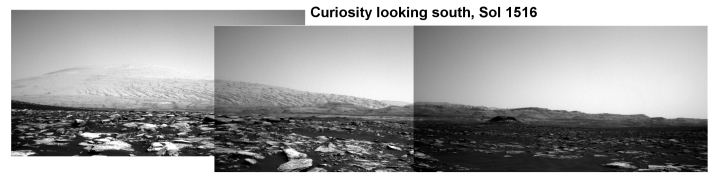
The photo on the right, taken in late December, shows the large sand lake the science team has labeled “the Sands of Forvie” that the rover has been working its way uphill to reach since it left the Mary Anning drill site back in November.

Since they arrived there, they have used the rover to roll across the sand, cutting into a ripple to expose its interior, followed by high resolution close-up images. They have also used the rover to analyze the chemical composition of the sand’s grains, from that interior section, from the top of several ripples, and from the troughs in between.

Once finished here, the rover will be turned east again to continue its journey around this sand sea to the very base of Mount Sharp. The overview map below shows the planned route.
» Read more

0 comments
1 246 247 248 249 250 729