
Drillers will stop injections for fear of earthquakes in Arkansas
Two drill companies will temporarily cease work in Arkansas to see if this action will cause the recent swarms of earthquakes there to ease.
Two drill companies will temporarily cease work in Arkansas to see if this action will cause the recent swarms of earthquakes there to ease.
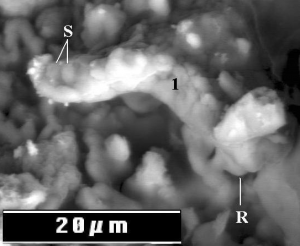
Very very intriguing: A NASA scientist has claimed in a peer reviewed paper the discovery of alien fossils in several meteorites recovered on Earth. From the paper’s last paragraph:
The absence of nitrogen in the cyanobacterial filaments detected in the CI1 carbonaceous meteorites indicates that the filaments represent the remains of extraterrestrial life forms that grew on the parent bodies of the meteorites when liquid water was present, long before the meteorites entered the Earth’s atmosphere.
The news article describing this discovery is a bit more breathless in style than I would like, and makes me suspicious about these results. Moreover, that NASA held no press release or press conference for a result of this significance gives me pause. (Though NASA might have felt burned from the reactions they got from the arsenic-based-biology press conference and decided therefore to take a low profile here.)
» Read more
Due to the budget situation, it appears that planetary scientists have scaled back their plans for future NASA missions to other planets.
We will know more on Monday, when the planetary community releases its much awaited decadal survey, outlining their recommendations for the next decade.
More science cheating: A former MIT researcher has been convicted of fraud.
A research anesthesiologist has been stripped of his professorship, fired from a German hospital, and is under criminal investigation for forging the medical research for more than 90 papers. Key paragraph:
German medical authorities are examining 92 of Boldt’s published papers amid allegations he forged documents, tested drugs on patients without their consent and fraudulently claimed payments for operations he never performed. Twenty-nine of the 92 papers have been identified as “highly suspected” of containing forged or distorted data, authorities said.
One third or more of his peer-reviewed papers are now suspect? Isn’t it the claim of peer-review science journals that this kind of fraud is impossible because the work will be carefully reviewed by the best people, most qualified to spot any fraud in their field? Yet, in this case this system failed at least one third of the time, if not more so, and did so frequently.
To me, this is further evidence that the best method for finding fraud is not review, but independent competition. Let others challenge the result or try to duplicate it. That way, we find out very quickly whether it is real or not.
The Glory climate satellite has crashed in the Pacific when its rocket failed during launch today.
The uncertainty of science: Unexpectedly large amounts of flowing water and refrozen ice found at the bottom of the Antarctic icecap. Key quote:
It’s too early to know whether this new finding means that global warming will melt ice sheets slower or faster than scientists have predicted. But the work does suggest that current models of ice sheet dynamics are missing a huge factor, said glaciologist Donald Blankenship of the University of Texas, Austin. “The take-home message of this work is that [the bottom of ice sheets] can no longer be ignored” in the models, he says.
Did you hear the news? Scientists have solved the mystery of the missing sunspots!
You didn’t? Well, here’s some headlines and stories that surely prove it:
The trouble is that every one of these headlines is 100 percent wrong. The research, based on computer models, only found that when the plasma flow from the equator to the poles beneath the Sun’s surface slows down, the number of sunspots declines.
» Read more
A look at some truly different commercial caves.
Puncturing the myth that more roads mean more congestion Key quote:
Read enough of these studies and you get a sense that much of the induced-demand hubbub is really a sub rosa extension of the war on the suburbs: Stop highway expansion and you can make life miserable enough for the minivan-driving masses that they’ll move out of their gauche “urban-fringe developments” and back to high-density metropolitan cores, where they belong.
In reading the full essay, I was struck by how much the scientific campaign against road construction reminded me of climategate.
29 teams, one purchased ride, and one mystery for the Google Lunar X Prize.
The Southwest Research Institute has purchased two tickets from Virgin Galactic for its scientists to fly on SpaceShipTwo.
The sponge-like Saturn moon. Key quote:
Hyperion measures about 250kms across; it rotates chaotically and has a density so low that it might house a vast system of caverns inside.
R.I.P. Leif J. Robinson, who served as editor of Sky & Telescope for twenty years, passed away Sunday at the age of 71 at his home in Costa Rica.
An evening pause: When the Sun gets active, such as the solar flare of February 15, 2011, the sky in the high latitudes gives us the world’s best light show.
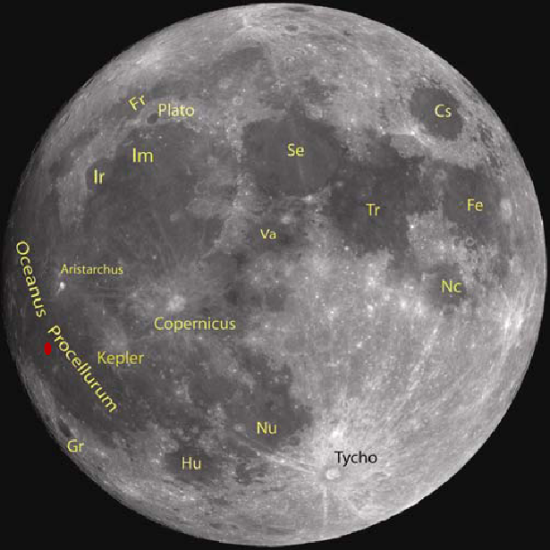
The discovery of new caves on the Moon keep coming. Today I have two new stories. The first is a discovery by professional scientists of a giant lava tube cave in the Oceanus Procellarum or Ocean of Storms. The second is the detection of a plethora of caves and sinks on the floor of the crater Copernicus, found by a NASA engineer who likes to explore the gobs of data being accumulated by Lunar Reconnaissance Orbiter and made available to all on the web.
The image below of the Moon’s near side, taken by India’s Cartosat-2A satellite and taken from the science paper, shows the location of lava tube in Oceanus Procellarum (indicated by the red dot) and the crater Copernicus.
First the professional discovery. Yesterday, the Times of India reported the discovery of lava tube more than a mile long on the Moon. I did not post a link to the article because I didn’t think the news story provided enough information to make it worth passing along. Today however, fellow caver Mark Minton emailed me the link where the actual research paper could be downloaded [pdf]. This I find definitely worth describing.
» Read more
Two high-priority climate missions dropped from NASA’s budget by the White House. And what’s most amazing: No one’s squealing!
“Removal of these missions was not what we desired and not what the administration desired, but it was a clear recognition and acknowledgement of the budget issues we face as a nation,” [said Steve Volz, associate director for flight programs at NASA’s Earth Science Division]. “It’s cleaner to be allowed to delete the scope that goes along with the dollars than to have to figure out how to do more with less.”