
Spirit appears dead
After more than six years, it appears that the Mars rover Spirit has finally died. The rover was originally designed to only operate 90 days.
After more than six years, it appears that the Mars rover Spirit has finally died. The rover was originally designed to only operate 90 days.
An evening pause: We’ve had animated machines and actors pretending to be machines. Now, let’s have a Rube Goldberg machine.
The Japanese space agency JAXA has put Hayabusa’s heat shield, outer capsule, and parachute on public display, to large crowds.
Mars Reconnaissance Orbiter takes a picture of the non-face on Mars.
The Mars rover Opportunity has spotted its first dust devil after six-plus years of travel.
Two NASA probes, originally launched to study the Sun and having completed their mission, have had their orbits adjusted so that they can study the Moon instead.
Radar images from Lunar Reconnaissance Orbiter appear to show deposits of approximately 1.6 trillion pounds of water ice on the Moon.
Solar sail engineers from around the world gathered in Brooklyn last week for the Second International Symposium on Solar Sailing. Ben Diedrich, fellow caver, solar sail expert, and the man behind wiki.solarsails.info, gave two papers. He also emailed me to say that “Japan’s contingent gave several talks – many of which compared analysis of deployment, flight, or steering with actual flight data” of Ikaros. A review of the program [pdf] revealed some fascinating uses for solar sails. I like this paper title the best: “Deflecting Apophis with a flotilla of solar sails.” [ed. Apophis is an asteroid with the potential of hitting the Earth.]
Update: Japanese scientists have now announced that they have been able to adjust Ikaros’s attitude using sunlight.
Another update: Ben Diedrich emailed me the link to read the actual proceedings from the conference. See pg 103 to read the paper on using solar sails to deflect Apophis.
An experiment flown in space for 10 days by the European Space Agency has found that three species of lichen can survive the hazards of outer space.
End of the world alert! Scientists have identified an almost half mile wide asteroid with a 1 in 1000 chance of hitting the Earth in 2182.
A cave exacavation in East Timor has uncovered the bones of the largest rat species on record, weighing over 13 pounds and living approximately one to two thousand years ago. The dig also uncovered 11 previously unknown rat species.
In its first six weeks of observation, the Kepler mission apparently found almost 150 planets similar in size to the Earth. The results, learned by accident because a talk given by one of the co-investigators was posted on the web, have not yet been officially announced because the project scientists feel a need for additional time to confirm them. Many of these so-called planets might turn out to be false positives, so some caution is in order.
On Saturday (July 24) the American Geophysical Union published a paper in Geophysical Research Letters, entitled “Northern Hemisphere winter snow anomalies: ENSO, NAO and the winter of 2009/10.” This paper attempted to explain the unusually cold 2009-2010 winter, with its record snow falls.
The conclusions of the paper were reasonable, noting that this past winter experienced both an El Nino event in the Pacific as well as a very negative (cold) North Atlantic Oscillation (NAO). To quote the paper’s conclusions: “In winters when an El Nino event and a negative NAO combine, analysis reveal that there are positive snow anomalies across the southern U.S. and northern Europe.”
The authors of the paper made no attempt to explain why these two climate events “combined” this past winter, which in the field of climate change is actually the essential question. What caused it? Moreover, did the deep and extended negative (cold) phase of the Arctic Oscillation (AO) contribute as well, and if so, why did the AO also go negative this winter? And finally, were all these climate events somehow related to the Sun’s unusally long and deep solar minimum?
That they didn’t answer these fundamental questions is not surprising. Climotogists have been struggling with them for decades, and to expect this quickly written paper focused on this one climate event — the cold winter of 2009-2010 — to answer them would be unreasonable. In fact, considering the state of our knowledge, it probably is impossible for any paper to answer these questions at this time.
What makes this particular paper really noteworthy, however, is a quote in its introductory paragraphs:
The wintry winter has encouraged deniers of global warming » Read more
It’s not the crime but the cover-up: Michael Mann refuses to answer reasonable questions from a reporter for The Dailer Caller.
As I mentioned previously, last weekend I was in West Virginia exploring and surveying some newly discovered cave passages. These pictures, taken by Nikki Fox, will give you a flavor of what it is like to visit a place never before seen by human eyes.
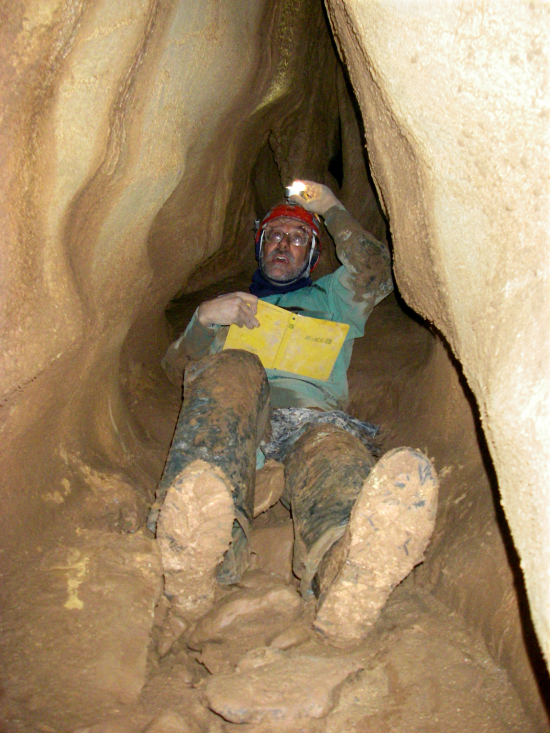
Here I am, trying to sketch the final section of a clean, generally dry flowstone and bedrock passage. Trust me, it isn’t easy drawing a place that your body almost fills.
The lead where this virgin passage began had been known for decades, but had never been entered because » Read more
Astronomers have concluded that the high levels of carbon monoxide that they have detected in the upper layers of Neptune’s atmosphere are the leftover fingerprint of a cometary impact some 200 years ago.
In today’s version of global warming fear-mongering, Senator John Kerry (D-Massachusetts) declared that the Arctic will be ice-free in “five or 10 years.” He apparently based this statement on a 2009 Geophysical Research Letters paper [pdf] that, using computer models, predicted an ice-free Arctic in September could occur as soon as the late 2020s but was more likely in the late 2030s.
Wanna bet? Since that 2009 paper was published, Arctic ice has seen a rebound in ice extent. Moreover, the Arctic oscillation remains in the deepest freeze it has seen in years. And the sun remains quiet, less active than we have seen it since scientists began tracking its behavior from space. Such inactivity means a dimmer sun, which in turn brings with it cold temperatures. Here is the most recent graph (updated on July 20) from the Total Solar Irradiance Time Series produced by Physikalisch- Meteorologisches Observatorium Davos (PMOD) using satellite data since 1978:
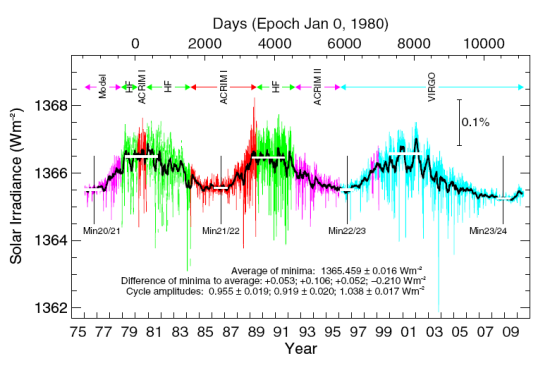
Even though the sun’s total irradiance has shown an up-tick recently as it slowly moves from solar minimum towards solar maximum, if you look closely you will see this up-tick still remains below the lowest points for the previous three solar minimums. And as I have noted here, we appear to be heading for the weakest solar maximum in two centuries.
Of course (as stock brokers say), the past performance of all of these trends is no guarantee of the future performance. Nonetheless, the data indicates clearly the simplistic nature of statements like Kerry’s.
On the subject of caves on the Moon, Paul Spudis has directed me to his very cogent October 2009 post for Air & Space magazine. Here he notes correctly that though lava tube caves on the Moon have value, they are unfortunately apparently not located in the best places for settlement.
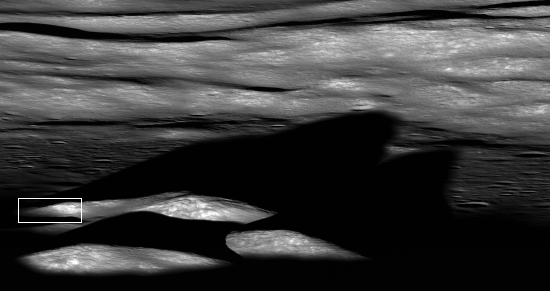
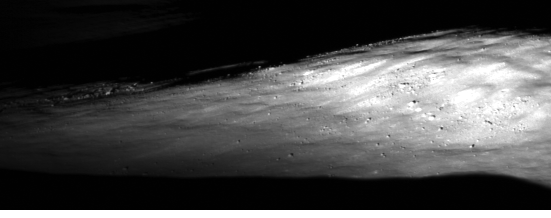
As the sun sets on Bhabha crater on the Moon’s farside, small boulders on the crater’s central peaks become visible in this Lunar Reconnaissance Orbiter image, with inset below. (It is very worthwhile to click on the link above and stroll through the full resolution image.) Scientists believe that the impact which created this crater excavated these boulders from deep within the Moon’s crust, thereby making them valuable tools for determining the geological history of the Moon. Of course, to use these tools requires the geologist to be there, something that might not happen for a while.
Keith Cowing at NasaWatch notes quickly that the current budget battles over NASA have people in NASA concerned about the future of the James Webb Space Telescope. The telescope has further cost overruns, and should NASA end up operating under a continuing resolution rather than a full budget, there won’t be enough money to keep the project above water.