
Impact crater in Egypt
Using Google Earth, a curator at an Italian museum has discovered a previously unknown, very young, and almost pristine impact crater hidden in the deserts of Egypt.
Using Google Earth, a curator at an Italian museum has discovered a previously unknown, very young, and almost pristine impact crater hidden in the deserts of Egypt.
A star with an appetite: Astronomers have used the Chandra X-Ray Observatory to take a closer look at an engimatic star in the constellation Pisces and found that the dust cloud that surrounds it as well as the unusual and enormous jets that shoot from it probably originated when the star evolved, expanded, and swallowed an orbiting companion, either a giant planet or companion star.
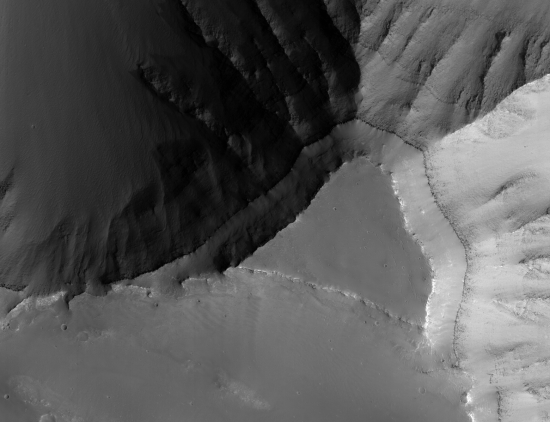
Want to poke around on Mars? Since it might be a while before you can actually go there, I suggest you instead make frequent visits to the images page for the HiRise camera on Mars Reconnaissance Orbiter. The pictures that appear here are routinely breath-taking. Below is a cropped image showing the flat top of a mesa in Coprates Chasma. The full image shows detailed layers down the side of the mesa as well as rippled dunes on the mesa top. Everything is remarkably reminescent of something you’d see if you visited the Grand Canyon. Only on Mars, this grand canyon is many times larger and deeper.
Astronomers have discovered a runaway star flying away from the Milky Way galaxy at about 450 miles per second. What makes this star even more interesting is that its flight path suggests that it was thrown from the very center of our galaxy by the 4 billion solar mass black hole that sits there.
This story about the Department of Energy’s decision in May to suspend payments to the University of East Anglia because of the climategate scandal might very well be a Potemkin village. The story notes that they are placing a hold on $200k. However, Anthony Watts notes that DOE has probably provided East Anglia significantly more funds, in the millions. The suspension in funds then is only about one specific and not very large contract, with nothing said about the other funding. Note also that the hold was placed in May, pending the results of East Anglia’s own investigation. Since that investigation was a whitewash, I expect DOE to release these funds in near future.
Mars Odyssey, in orbit around Mars, went into safe mode on July 14, due to problems with “an electronic encoder.” The spacecraft switched to a backup, and engineers have since been able to bring it back to life slowly. They hope to have everything working normally again by the end of this week.
Meanwhile, it turns out that the climategate investigation of Phil Jones at the University of East Anglia allowed Jones himself to review and approve the evidence that the investigation would look at!
The U.S. Department of Energy has temporarily suspended all research funding to the University of East Anglia, pending its review of the climategate controversy.
A headline that insists you read the story: Joe the Plumber (not that one) says he helped stop Gulf oil spill leak.
A paper published on Saturday in Geophysical Research Letters by the American Geophysical Union attempts to calculate the total ice loss at the polar caps and how it will affect the sea level. Key quote from the abstract: “Rapid losses of Arctic sea ice and small Antarctic ice shelves are partially offset by thickening of Antarctic sea ice and large Antarctic ice shelves.”
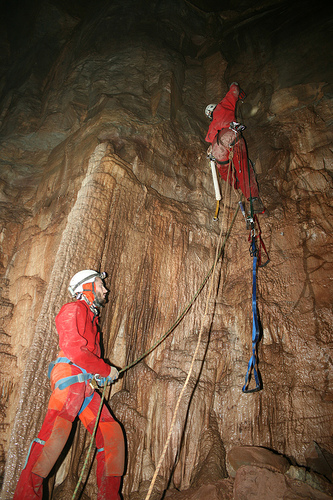
Posting today shall be very quiet, mostly because I am out in West Virginia, exploring a previously unknown upper level in a cave we are mapping. This passage was only discovered last month by Aaron Moses, John Harman, and Pete Johnson, who did a bolt climb of over 70 feet to reach a high lead in the wall of the cave. This weekend we will be pushing and mapping these virgin passages. Below is a picture taken by Brian Masney of Aaron Moses as he worked his way up the wall, with Pete Johnson providing a belay. More of Brian’s pictures can be seen on his Flicker webpage.
An evening pause: One of the best television science series ever produced was The Ascent of Man by Jacob Bronowski. Rather than simply describe science and knowledge, Bronowski instead pondered the nature of humanity. The best episode of the series was Knowledge or Certainty, in which Bronowski compared the humane uncertainty of science with the terrible consequences of dogma. As Oliver Cromwell said, “I beseech you, in the bowels of Christ, think it possible you may be mistaken.”
Want to know who invented the basic technology that made possible CD and DVD players possible? Take a look at this restrospective describing the discovery, from Physical Review Focus of the American Physcial Society.
It appears we are entering the dry season on Titan. Scientists have observed a 1 meter drop in the levels of Titan’s methane lakes over the last four years as the seasons on the moon go from summer to fall. Fun quote: “[The scientists] report that the shoreline of Ontario Lacus receded by about 10 kilometers (6 miles) from June 2005 to July 2009.”
An AP report today says that the infrared WISE space telescope has catalogued 25,000 new asteroids, 95 of which are near Earth objects. Actual data, however, has not yet been released.
Scientists say they have successfully produced a genetically modified mosquito that is unable to carry the malaria parasite. If so, and this mosquito can be bred throughout the mosquito population, it will eradicate malaria entirely.
James Fincannon of NASA has forwarded me two additional pictures of the same cave on the Moon, taken recently at different times by the camera on Lunar Reconnaissance Orbiter and made available by the Goddard Space Flight Center and Arizona State University.
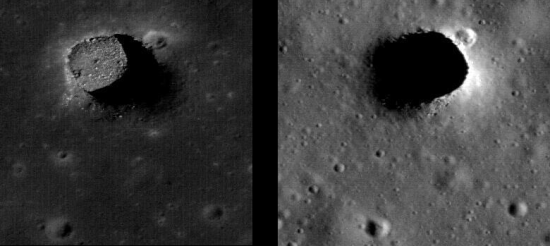
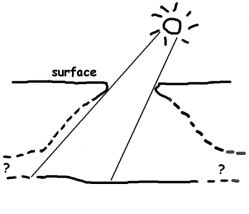
These images clearly show that the skylight looks down into a much larger space, with the underground room belling out from the skylight in all directions. This can be seen by how the angle of sunlight hitting the floor of the cave changes over time. Below is a very crude cartoon I have drawn to illustrate what I think we are seeing in the image on the left. The dashed lines indicate unseen walls whose precise location is not yet determined.
James also forwarded me this link, showing even more images of additional lava tube skylights on the Moon.
Still have doubts whether the climategate investigations were awhitewash? Then read this blistering condemnation by Clive Cook, senior editor at The Atlantic and a global warming advocate.
The third annual Lunar Science Forum is being held July 20-22 at the Ames Research Center in California. The list of papers, some of which are quite intriguing, can be found here. Fun quote from one abstract: “Purity levels of the ice suggest a degree of comingling of ice and regolith grains within the permanently shadowed crater.”
Steve Goddard has posted on Anthony Watt’s webpage a very detailed update on the state of the icecap covering Greenland. Surprise! There are no signs of it disappearing anytime soon. (Note that you might have to scroll to the right to see the text of Goddard’s post, as on some computers Watts’s webpage is unfortunately far too wide for the screen.)