A hiking paradise on Mars!

A hiking paradise on Mars
Click for original image.

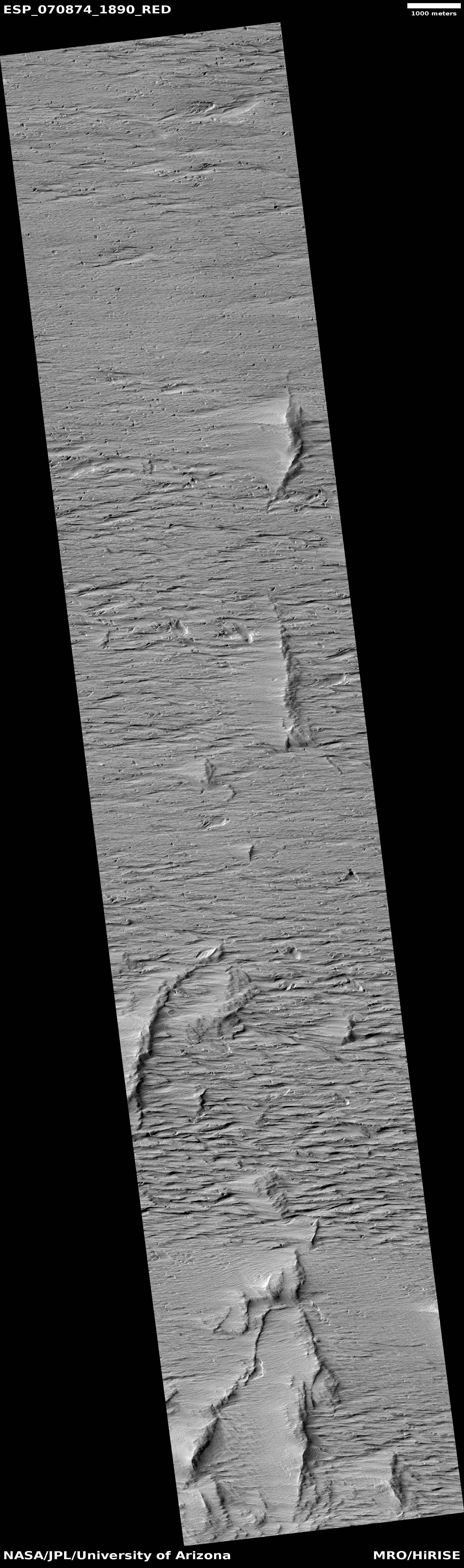
Cool image time! The picture to the right, cropped, reduced, sharpened, and annotated to post here, was taken on May 21, 2023 by the high resolution camera on Mars Reconnaissance Orbiter (MRO). It shows one of Mars’ more impressive mountains with the Sun somewhat low in the western sky, resulting in the long dark shadows on the eastern slopes.

The line is my quick attempt to mark the obvious route that would be taken along that ridge line to get from the bottom to the top. This could be a hiking trail, or a road. In either case, the elevation gain from the bottom of the ridge to the plateau on top would be about 3,900 feet in about a mile and a half, very steep for Earth — at approximately a 26 degree grade — but probably quite doable in the one-third Martian gravity.

The lower end of my proposed route however is hardly the bottom of the mountain. The slope, now alluvial fill made up of dust and debris from above, continues downhill for another 5,400 feet. All told, from top to bottom the elevation gain is about 9,300 feet over 8.5 miles.
» Read more

4 comments

Proposed exclusion zone restrictions revealed for new Sutherland spaceport in Scotland

A map of the proposed 50-square-kilometer exclusion zone that will be required for launches at the new Sutherland spaceport in Scotland has now been obtained by the Northern Times, which appears to be a local newspaper.

The zone would cover much of Melness Crofters’ Estate, and ironically it would also include a significant part of the neighbouring Eriboll Estate, owned by Danish entrepreneur Anders Holch Polvsen, who launched a failed legal challenge against the spaceport. Highland Council is in the process of finalising the details of the proposed restrictions which will then be put out for a 12-week public consultation and go before Highland councillors for final approval.

Ramblers Scotland, which promotes access to the outdoors, has said it will “carefully study” the final proposals.

Only during the launches does it appear the zone would be this large. Between launches the zone would be limited to a radius of 1.8 kilometers around the launchpads.

With twelve launches planned per year, this zone could seriously impact local activities, though how much is not clear. Not many people live in the area, and the land inside the zone is mostly used as grazing land or for recreational activities, many apparently organized by Ramblers Scotland. We should therefore expect some opposition to this plan when this zone is discussed during that 12-week public consultation time period.

1 comment

Scientists release infrared image of the Ring nebula, taken by Webb

The Ring Nebula, in false color by Webb
Click for original image.

Scientists yesterday released the first false-color infrared image of the Ring nebula taken by the Webb Telescope. That image, cropped to post here, is to the right. From the press release, which is heavy with platitudes but little information:

Approximately 2,600 lightyears away from Earth, the nebula was born from a dying star that expelled its outer layers into space. What makes these nebulae truly breath-taking is their variety of shapes and patterns, that often include delicate, glowing rings, expanding bubbles or intricate, wispy clouds. These patterns are the consequence of the complex interplay of different physical processes that are not well understood yet. Light from the hot central star now illuminates these layers.

Just like fireworks, different chemical elements in the nebula emit light of specific colours. This then results in exquisite and colourful objects, and furthermore allows astronomers to study the chemical evolution of these objects in detail.

It appears this image was produced using Webb’s near infrared instrument. Further data from its mid-infrared instrument has not yet been released. For a Hubble image of the Ring Nebula, in optical light that the human eye sees, go here.

1 comment

NASA agrees to let Axiom fly a fourth private manned mission to ISS

NASA and Axiom have now signed a new agreement allowing Axiom to fly a fourth private manned mission to ISS, tentatively scheduled for no earlier than August 2024.

Through the mission-specific order, Axiom Space is obtaining from NASA crew supplies, cargo delivery to space, storage, and in-orbit resources for daily use. The order also accommodates up to seven contingency days aboard the space station. This mission is subject to NASA’s pricing policy for the services that are above space station baseline capabilities.

The order also identifies capabilities NASA may obtain from Axiom Space, including the return of scientific samples that must be kept cold and other cargo, and the capability to use the private astronaut mission commander’s time to complete NASA science or perform tasks for the agency.

The company has already hired SpaceX to provide the transportation to and from ISS, using its Falcon 9 rocket and one of its fleet of four manned Dragon capsules.

1 comment

Despite good first images from Euclid, the orbiting telescope has a problem

Even though the first light images from Euclid have been sharp and exactly what astronomers want, the orbiting telescope designed to make a 3D map of billions of galaxies has an issue that will likely put some limits to that map.

When the telescope started booting up, ESA observers were concerned by the appearance of light markings on the first images relayed to Earth. This, it confirmed, was due to sunlight filtering into the telescope, “probably through a tiny gap”.

A correction to Euclid’s position was able to offset this issue. It means that while the ESA is confident Euclid will be fine to proceed with its mapping mission, particular orientations for the telescope may not be possible.

A limitation like this means that the telescope will not being able to look in some directions and get mapping images. Thus, the overall map will have gaps, though it appears at this moment that the scientists think those gaps will not seriously impact the telescope’s overall work. We shall see.

1 comment

Update on the technical progress at Boca Chica, preparing for the next Starship/Superheavy orbital test

Link here. Lots of progress had been made in getting the pad and the rocket ready for that next orbital test flight, with the first static fires tests of Superheavy using the launchpad’s new water deluge system are now expected in the coming week.

The company is also preparing additional prototypes of Superheavy and Starship for later orbital tests. even as it upgrades the assembly facilities, replacing temporary tents with actual buildings. More details, including videos, at the link.

Meanwhile, the only word from the FAA about SpaceX’s application for a launch permit has been a warning that it will not issue that permit until it is good and ready, suggesting the company should not expect to launch in August, as I have been predicting for months.

12 comments

The dry and mountainous terrain west of Jezero Crater

The dry and mountainous terrain west of Jezero Crater
Click for original image.

Since my earlier update today about Perseverance and Ingenuity mentioned the very diverse and strange geology known to exist west of Jezero Crater and where the rover is eventually headed, I thought it worthwhile to post another cool image of that terrain.

The picture to the right, rotated, cropped, reduced and sharpened to post here, was taken on May 22, 2023 by the high resolution camera on Mars Reconnaissance Orbiter (MRO). Labeled a “terrain sample” image, the location was likely chosen by the camera team in order to fill a gap in the camera’s schedule so that they can maintain its proper temperature. Having a gap that put the spacecraft over this region to the west of Jezero was however a great opportunity to get another look at this rocky, mountainous, and very parched terrain, located in Mars’ very dry equatorial regions.
» Read more

0 comments

Perseverance snaps new close-up of Ingenuity

Overview map
Click for interactive map.

Ingenuity as seen by Perseverance on August 2, 2023
Ingenuity as seen by Perseverance on August 2, 2023.
Click for original image.

Cool image time! With Perseverance and Ingenuity in the past week getting close together for the first time in months, the Perseverance team naturally turned its high resolution mast cameras at the helicopter. The picture to the right, cropped, reduced, and sharpened to post here, was taken on August 2, 2023 by the rover’s left mast camera, showing Ingenuity only about two hundred feet away.

The blue dot on the overview map above shows Perseverance’s present location, with the green dot marking Ingenuity’s. The picture to the right is therefore looking almost due south. The red dotted line indicates the rover’s planned route, moving towards Neretva Vallis, the gap in the rim of Jezero Crater from which the delta had flowed, eons ago. The rover’s goal is to eventually enter that gap and explore the very diverse and strange geology known to exist outside the crater to the west.

We should also expect even better images of Ingenuity in the next week. Its 54th flight is scheduled for today, in which the engineering team wants to send the helicopter on a simple straight up and down hop of sixteen feet in order to better “localize” the helicopter. With Perseverance less than two hundred feet away, its cameras should be able to assemble a great movie of that flight.

1 comment

New software detects its first potentially dangerous asteroid

New software designed to detect asteroids, developed for use with the Rubin Observatory presently being built in Chile, has successfully discovered its first potentially hazardous asteroid (PHA) using data from another smaller operational ground-based telescope.

The discovered asteroid is 600 feet long, large enough to pose a real threat should it ever hit the Earth. Fortunately, the data says that though its orbit can take it as close as 140,000 miles there is no impact likely in the foreseeable future.

When the Rubin telescope begins its planned ten year survey of the entire night sky in 2025, this software is expected to almost triple the number of known potentially-hazardous-asteroids, from 2,350 to almost 6,000.

Funded primarily by the U.S. National Science Foundation and the U.S. Department of Energy, Rubin’s observations will dramatically increase the discovery rate of PHAs. Rubin will scan the sky unprecedentedly quickly with its 8.4-meter mirror and massive 3,200-megapixel camera, visiting spots on the sky twice per night rather than the four times needed by present telescopes. But with this novel observing “cadence,” researchers need a new type of discovery algorithm to reliably spot space rocks.

Thus, the development of this new software.

3 comments

China’s Long March 4C launches weather satellite; SpaceX launches communications satellite

Two launches this evening. First China used its Long March 4C rocket to put a weather satellite into orbit, lifting off from its Jiuquan spaceport in northwest China. No word on where the lower stages crashed within China.

SpaceX then used its Falcon 9 rocket to put an Intelsat commercial communications satellite into orbit, lifting off from Cape Canaveral. The first stage successfully completed its sixth flight, landing on a drone ship in the Atlantic. The two fairing halves completed their eighth and tenth flights respectively.

As of posting the satellites from both launches had not deployed.

The leaders in the 2023 launch race:

52 SpaceX
31 China
9 Russia
6 Rocket Lab
6 India

American private enterprise still leads China in successful launches 60 to 31, and the entire world combined 60 to 51, while SpaceX by itself leads the world (excluding American companies) 52 to 51.

0 comments

Voyager Space partners with Airbus to build its Starlab space station

Voyager Space, one of the three companies with a contract from NASA to develop a commercial private space station, has now signed a partnership agreement with the European aerospace company Airbus to work together to build its Starlab space station.

The companies announced Aug. 2 the creation of a joint venture, also called Starlab, that will be responsible for the development and operation of the station. The joint venture builds upon an agreement announced in January where Voyager selected Airbus to provide technical support for the proposed station.

“This transatlantic venture with footprints on both sides of the ocean aligns the interests of both ourselves and Voyager and our respective space agencies,” said Jean-Marc Nasr, head of space systems at Airbus, in a statement. “Together our teams are focused on creating an unmatched space destination both technologically and as a business operation.”

Though no specifics of the deal were released, Voyager will continue to retain 51% control. It appears that Voyager’s goal with this deal is to get its foot in the door of Europe. With ESA no longer considering doing any work on the space stations of either China or Russia, it needs a place to go after ISS is retired. By signing up Airbus as a partner Voyager makes Starlab the most likely go-to station for these European companies and governments.

Isn’t private enterprise and freedom wonderful? Without even trying Europe is going to get a space station of its own, and it will do it by hiring this private consortium of American and European companies.

Hat tip to Jay, BtB’s stringer.

0 comments

The first glacial evidence found on Mars back in 2007

Glaciers on Mars?
Click for original image.

Cool image time! The picture to the right, cropped, reduced, sharpened, and annotated to post here, was taken on January 3, 2023 by the high resolution camera on Mars Reconnaissance Orbiter (MRO). It shows the eastern wall of what the scientists call a graben, a large depression caused when the ground inside the depression suddenly shifted downward.

The elevation difference between the high and low points is about 3,500 feet. The streaks on the lower half of the cliff wall are slope streaks, a phenomenon unique to Mars that remains at this moment unexplained. Though the streaks resemble avalanches, they do not change the topography in any way, have no debris pile at their base, and appear instead to be a stain that appears at random times of the year that fades with time.

What is intriguing about this picture however is the wavelike floor on its western half. At first glance these waves suggest some form of dust dunes or lava flows, but neither conclusion appears correct. Instead, we are looking at what was one of the first discoveries on Mars of what scientists have determined to be glacial features.
» Read more

0 comments
1 327 328 329 330 331 1,328