SpaceX successfully launches commercial satellite

Capitalism in space: Using a first stage for the third time, SpaceX today successfully launched a commercial communications satellite while recovering that first stage.

Fun fact: This first stage recovery today was the 47th time that SpaceX has successfully completed a vertical landing.

The leaders in the 2019 launch race:

30 China
20 Russia
13 SpaceX
7 Europe (Arianespace)

China now leads the U.S. in the national rankings 30 to 26.

11 comments

Dragon launch abort test set for January 4

NASA announced on December 6 that the launch abort test of SpaceX’s crew Dragon capsule will occur no earlier than January 4.

SpaceX and NASA originally hoped to launch the test flight, called an In-Flight Abort Test, sometime this month, but an exact launch date was never released. In a statement Friday, NASA officials said the mission will now lift off no earlier than Jan. 4 from Pad 39A of NASA’s Kennedy Space Center in Cape Canaveral, Florida, pending launch range approval from the U.S. Air Force.

The new launch target will push the SpaceX flight beyond the year-end holidays, as well as a planned Boeing launch of its first uncrewed Starliner astronaut taxi for NASA, which is slated to launch Dec. 20.

The article does not explain why a December test was not possible. The second paragraph of the quote above however might give a hint, in that a December launch might have interfered with those Christmas/New Year holidays, and both the agency and the company might have decided it was better for all to wait an extra week or so.

0 comments

SpaceX targets December for launch abort test, early 2020 for 1st manned Dragon mission

According to SpaceX officials, the company is aiming to perform its Dragon launch abort test before the end of this month, and then follow-up with the first manned Dragon mission to ISS in early 2020.

“We’re targeting December,” said [Jessica Jensen, director of Dragon Mission Management at SpaceX] today (Dec. 3) during a news conference discussing tomorrow’s (Dec. 4) planned launch of a robotic Dragon cargo mission to the International Space Station (ISS). “We’ll see if we can get there.”

SpaceX holds a multibillion-dollar NASA contract to ferry astronauts to and from the ISS using Crew Dragon and the Falcon 9. The capsule has already visited the orbiting lab once, on the landmark uncrewed Demo-1 mission this past March. If everything goes well with the [launch abort test], the company will be cleared for the first crewed mission — a test flight known as Demo-2 that will carry NASA astronauts Doug Hurley and Bob Behnken.

Demo-2 is targeted for early 2020, SpaceX founder and CEO Elon Musk has said. Contracted, operational ISS flights would follow shortly thereafter.

NASA officials have repeatedly said that early 2020 is too soon because of the paperwork that SpaceX has to complete prior to launch. It could be that Musk is gently applying pressure on them here to speed up this make-work so that the real business of spaceflight can proceed.

4 comments

SpaceX to test upper stage endurance as part of Dragon launch

Capitalism in space: SpaceX plans to perform a six hour orbital coast test of its Falcon 9 upper stage following the release of the Dragon cargo capsule tomorrow (scrubbed today due to high winds).

This is why the first stage will land on a drone ship rather than at Kennedy.

According to SpaceX the test is at the request of “other customers”, unnamed. The article adds this speculation:

Jensen says that the coast test will be performed for unspecified “other” customers, presumably referring to the US Air Force (USAF) and other commercial customers interested in direct-to-geostationary (GEO) launch services. Direct GEO launches require rocket upper stages to perform extremely long coasts in orbit, all while fighting the hostile vacuum environment’s temperature swings and radiation belts and attempting to prevent cryogenic propellant from boiling off or freezing solid. In simple terms, it’s incredibly difficult to build a reliable, high-performance upper stage capable of remaining fully functional after 6-12+ hours in orbit.

Although SpaceX said that the test was for “other” customers, that may well have been a cryptic way to avoid indicating that one such customer might be NASA itself. NASA is in the midst of a political battle for the Europa Clipper spacecraft’s launch contract, which is currently legally obligated to launch on NASA’s SLS rocket. Said rocket will likely cost on the order of >$2 billion per launch, meaning that simply using Falcon Heavy or Delta IV Heavy could save no less than ~$1.5 billion. Incredibly, that means that simply using a commercial launch vehicle could save NASA enough money to fund an entire Curiosity-sized Mars rover or even a majority of the cost of building a dedicated Europa lander. Such a launch would demand every ounce of Falcon Heavy’s performance, including a very long orbital coast.

These speculations could all be true. SpaceX might merely be doing what it always does, testing new engineering upgrades during operational missions. It will then be able to sell its rocket’s enhanced capability to all these customers.

0 comments

SpaceX ‘s decision to slash prices/provide reliable launch schedule upends smallsat industry

Capitalism in space: Apparently SpaceX’s decision in August to further slash its launch prices for smallsats while also establishing a regular launch schedule is causing major shifts in that industry.

From the first link::

The revamped smallsat rideshare program, the company announced late Aug. 28, will provide launch opportunities at least once per month starting in March 2020, at a cost of $1 million for a 200-kilogram smallsat.

From the second link:

With the new SpaceX price list, the cost of reaching low Earth orbit falls so dramatically “you should select the cheapest launcher even if it does not go exactly where you need it and then use propulsion to go where you need to be,” Henri said. “From a total system cost standpoint, that will make the most sense.”

This situation is comparable to the shifts that occurred in the ship business when its technology changed from sails to engines. Sailing ships generally did not sail on a schedule. Instead, they sat at port until they filled their cargo holds, then waited for favorable weather before sailing. Customers could only wait.

Once ships were powered this all changed. Ship companies established firm schedules so customers knew exactly when their cargo would ship. This also led to a reduction in the price of shipping.

SpaceX’s ability to reuse its first stage often and quickly is now allowing them to treat the Falcon 9 rocket more like a powered ship rather than a sailing ship. Rather than only launching when they’ve filled their cargo capacity, they can afford to launch on a regular and reliable schedule, allowing customers to jump on board at their own convenience.

3 comments

Explosion during Starship tank tests

During tests today of SpaceX’s Starship Mk1 test prototype there was a sudden explosion, damaging the spacecraft. Below is a clip from today’s live stream showing the explosion.

They had been doing a variety of tank and venting tests for the past day. (The link includes a video showing the first pressurization test yesterday.)

The Mk1 (Mark 1) was being built with an initial hoped-for schedule targeting the first orbital flights by next year. No one took that seriously, and today’s incident reinforces that skepticism. At the same time, SpaceX has routinely recovered very quickly from its engineering test failures, treating them as opportunities for improving their designs. It is for this reason that most knowledgeable observers of the company also expected any delays to that target schedule to never be very extended.

Moreover, earlier this week SpaceX revealed that it had already decided not to fly this version and proceed to their next version. A Mk2 version is being built in Florida, so in Boca Chica they will proceed to the Mk3, with the goal to get to build toward the final operational version, what Musk labeled the Mk5. Based on past SpaceX policy, however, expect them to begin commercial flights with the earlier versions as they upgrade to the Mk5.

UPDATE: It appears the explosion occurred during a maximum pressurization test, which means they now have data telling them the limits of their tank design.

33 comments

NASA expands list of companies certified to bid on lunar launch/payload contracts

Capitalism in space: NASA today announced that it is expanding the list of companies eligible to bid on lunar launch/payload contracts from 9 to 14.

From the NASA press release:

NASA has added five American companies to the pool of vendors that will be eligible to bid on proposals to provide deliveries to the surface of the Moon through the agency’s Commercial Lunar Payload Services (CLPS) initiative.

The additions, which increase the list of CLPS participants on contract to 14, expand NASA’s work with U.S. industry to build a strong marketplace to deliver payloads between Earth and the Moon and broaden the network of partnerships that will enable the first woman and next man to set foot on the Moon by 2024 as part of the agency’s Artemis program.

…These five companies, together with nine companies selected in November 2018, now are eligible to bid on launch and delivery services to the lunar surface. [emphasis mine]

The added companies are SpaceX, Blue Origin, Ceres Robotics, Sierra Nevada, Tyvak Nano-Satellite Systems.

I have highlighted the most important word in this press release, which is most interestingly buried to make it as little noticed as possible. The addition of SpaceX to this list and the mention that the program has now added the ability to for the companies to bid on launch contracts means that NASA’s goal here is to create a situation where it can replace SLS with a bidded contract to private industry that will costs far less and can launch frequently and on time, features that SLS is completely incapable of, and SpaceX can provide easily and reliably. This analysis by me is further reinforced in that Boeing, the builder of SLS, was not included in this list, even though only last week that company offered SLS to NASA in a wider array of launch configurations, for exactly this purpose.

If NASA had made this fact too obvious it might upset certain people in Congress (I’m talking to you Richard Shelby R-Alabama) who are wedded to SLS and its wasteful pork spending in their home states and districts.

The fact remains however that eventually SLS is going to go away. The Trump administration appears very wedded to its Artemis program to get back to the Moon by 2024, and it is apparently discovering that to make that landing happen the administration needs better alternatives.

3 comments

Inspector general slams NASA’s management for bonus payments to Boeing

In a report [pdf] issued yesterday, NASA’s inspector general blasted the agency’s manned commercial space management for issuing a $287 million bonus payment to Boeing to help it avoid delays in developing its Starliner capsule — which would have caused gaps in future American flights to ISS — even though the cost to use Russian Soyuz capsules would have been far less.

Worse, the agency never even allowed SpaceX to make its own competitive offer.

NASA agreed to pay Boeing Co (BA.N) a $287 million premium for “additional flexibilities” to accelerate production of the company’s Starliner crew vehicle and avoid an 18-month gap in flights to the International Space Station. NASA’s inspector general called it an “unreasonable” boost to Boeing’s fixed-priced $4.2 billion dollar contract.

Instead, the inspector general said the space agency could have saved $144 million by making “simple changes” to Starliner’s planned launch schedule, including buying additional seats from Russia’s space agency, which the United States has been reliant on since the 2011 retirement of its space shuttle program.

…NASA justified the additional funds to avoid a gap in space station operations. But SpaceX, the other provider, “was not provided an opportunity to propose a solution, even though the company previously offered shorter production lead times than Boeing,” the report said. [emphasis mine]

I’ve read the report, and from it the impression is clear that when NASA management discovered that Boeing was facing delays in Starliner and needed extra cash, it decided to funnel that cash to it, irrespective of cost. While it is likely that the agency did so because it did not wish to buy more Russian Soyuz seats, it makes no sense that it didn’t ask SpaceX for its own competitive bid. By not doing so the management’s foolish bias towards Boeing is starkly illustrated

Eric Berger at Ars Technica also notes that the report makes clear how Boeing’s prices for Starliner are 60% higher than SpaceX’s Crew Dragon prices, further illustrating how the agency favors Boeing over SpaceX.

Boeing’s per-seat price already seemed like it would cost more than SpaceX. The company has received a total of $4.82 billion from NASA over the lifetime of the commercial crew program, compared to $3.14 billion for SpaceX. However, for the first time the government has published a per-seat price: $90 million for Starliner and $55 million for Dragon. Each capsule is expected to carry four astronauts to the space station during a nominal mission.

What is notable about Boeing’s price is that it is also higher than what NASA has paid the Russian space corporation, Roscosmos, for Soyuz spacecraft seats to fly US and partner-nation astronauts to the space station. Overall, NASA paid Russia an average cost per seat of $55.4 million for the 70 completed and planned missions from 2006 through 2020. Since 2017, NASA has paid an average of $79.7 million.

I don’t have a problem with NASA favoring Boeing over Russia, considering the national priorities. I can also understand the agency’s willingness to keep buying some Starliner seats in order to guarantee an American launch redundancy. However, giving Boeing even more money to keep its schedule going, when SpaceX is available to fill the gaps, demonstrates the corruption in the agency’s management. They haven’t the slightest understanding of how private enterprise and competition works.

The report is also filled with the same tiresome complaints about the on-going delays to the manned commercial program, focusing greatly on past technical issues (now mostly solved) while hiding in obscure language how it is NASA’s paperwork that is likely to cause all further delays.

34 comments

SpaceX completes Crew Dragon static fire tests

SpaceX yesterday successfully completed a static fire engine test of its Crew Dragon capsule, demonstrating that it has fixed the issues that caused the April 20th explosion during an earlier test that destroyed a capsule.

Wednesday’s test occurred just 207 days after the April anomaly, a quick turnaround time given the complexity of the systems at hand. The incident earlier this year occurred just milliseconds before the engines were to have ignited, and was eventually traced to valves leaking propellant into high-pressure helium lines.

SpaceX made numerous changes to Crew Dragon as a result of the anomaly, including the replacement of the valves with burst-discs. The company has also been performing several smaller-scale tests of the redesigned system at their test facility in McGregor, Texas. Last month, SpaceX Tweeted a video of one such test.

Wednesday’s test was the first full-scale firing of all eight of Crew Dragon’s SuperDraco’s at once since the April incident.

This success clears the way for the launch abort test using this same capsule, now tentatively scheduled for mid-December.

0 comments

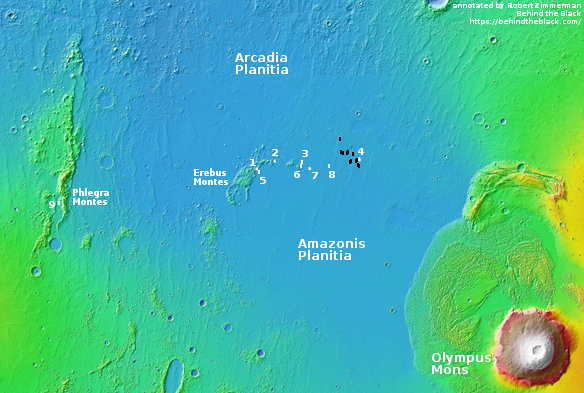
SpaceX completes 1st round of Starship’s Mars landing site images

All locations photographed of the candidate landing region for SpaceX's planned Mars missions

On August 28, 2019 I broke the story that SpaceX is beginning to obtain images of candidate Starship landing sites from Mars Reconnaissance Orbiter (MRO).

It now appears that SpaceX has completed its first round of Starship requests from MRO. In the image releases from Mars Reconnaissance Orbiter (MRO) since September, only three new Starship locations were taken, and all three were the unreleased candidate sites I noted in my September 16, 2019 update.

Below is the full list of all of the Starship images, their locations indicated on the map above by the numbered white boxes:

With the release of these last photographs, the initial list of proposed images of candidate Starship landing sites on Mars has apparently been completed. No additional images at any other locations appear to have been suggested. The MRO science team has taken stereo images of each one of the nine locations, eight of which were in Amazonis Planitia, and one in Phlegra Montes.

This however is not the first round of pictures requested by SpaceX of the Arcadia Planitia region in connection with the company’s desire to land spacecraft on Mars.
» Read more

9 comments

SpaceX successfully launches 60 Starlink satellites

Capitalism in space: SpaceX today successfully launched 60 more satellites in its Starlink internet satellites, while also reusing for the first time a Falcon first stage for a fourth time, reusing a fairing for the first time. The first stage successfully completed a barge landing. No word on whether they were able to recover the fairings.

I have embedded the replay of the live stream below the fold. They now have proved the capability of recovering and reusing 70% of their rocket.

The leaders in the 2019 launch race:

22 China
17 Russia
11 SpaceX
6 Europe (Arianespace)

The U.S. now leads China 23 to 22 in the national rankings.
» Read more

4 comments
1 143 144 145 146 147 234