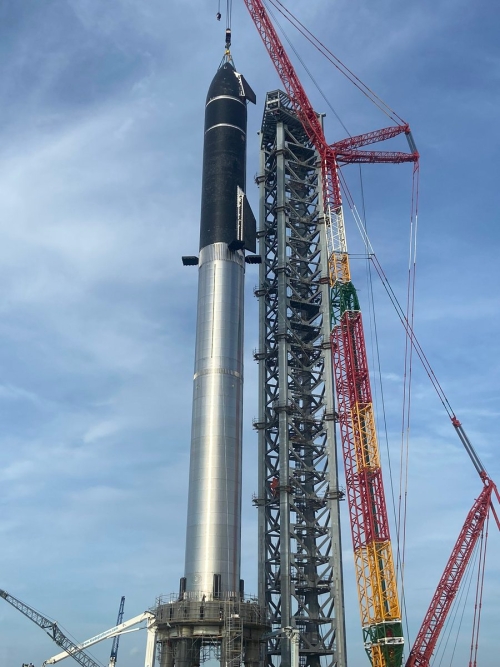
Starship/Superheavy update

Link here. SpaceX is moving on several fronts in preparation for the next Starship/Superheavy tests:

  • Engines have been installed in Starship prototype #20 which will be tested this week
  • A new Raptor engine factory is under construction
  • Launch tower construction continued
  • Future prototypes continue to be built

Lots of details and videos at the link. Based on road closures, the prototype #20 static fire test will occur today, and will be the first such test on a Starship using orbital Raptor engines.

10 comments

FAA extends comment period for SpaceX Starship/Superheavy environmental reassessment

Capitalism in space: The FAA today announced that it has extended the comment period for its environmental reassessment of SpaceX’s operations at Boca Chica, Texas two weeks until November 1st.

From the email announcement:

The Federal Aviation Administration (FAA) has received requests for an extension of the public comment period for the Draft Programmatic Environmental Assessment for the SpaceX Starship/Super Heavy Launch Vehicle Program at the SpaceX Boca Chica Launch Site in Cameron County, Texas (Draft PEA). In consideration of these requests, the FAA is extending the public comment period.

The agency has also changed the dates for the two public hearings it will hold to October 18 and October 20. It will announce more information on those hearings on October 15th.

5 comments

SpaceX schedules likely first static fire tests for orbital Starship and Superheavy

Capitalism in space: SpaceX has scheduled a weeklong series of road closures at Boca Chica, beginning next week, suggesting they are about to begin the first static fire tests for the orbital prototypes of both Starship (#20) and Superheavy (#4).

The company has been installing or replacing engines on both prototypes, with the installation apparently now complete on Starship #20.

Starship’s current design features three gimballing sea-level Raptors and three vacuum-optimized variants with much larger nozzles – all in close proximity inside a 9m-wide (30 ft) skirt. As such, the first Starship static fire with any combination of Raptor Center and Raptor Vacuum engines will be a significant milestone for SpaceX. Eventually, that will likely culminate in the first static fire(s) of a Starship (likely S20) with all six Raptors installed – a test that will effectively qualify that prototype for its first orbital launch attempt.

As for Superheavy #4, they have been replacing some of its 29 engines while it sits on the launchpad, for reasons that are not clear.

It appears the company is aiming to get all of its ground-testing completed while the FAA’s approval process for the permit for the orbital flight is ongoing. This will make it possible to launch as soon as approval is obtained.

This strategy carries some risk. As long as the testing proceeds smoothly it will provide positive coverage during the FAA’s public comment period, running until mid-October. Should a test fail dramatically, however, the explosion could generate the wrong response during that comment period. Not surprisingly, SpaceX is willing to accept that risk.

5 comments

FAA now taking public comments on the licensing of SpaceX to launch Starship/Superheavy from Boca Chica

Capitalism in space: The FAA today announced by email that it is now taking public comments on the “Draft Programmatic Environmental Assessment (PEA)” it requires from SpaceX before it can issue a launch license at Boca Chica, Texas for Starship/Superheavy orbital launches.

From the email:

The FAA invites interested agencies, organizations, Native American tribes, and members of the public to submit comments on all aspects of the Draft PEA. Public comments are due on Monday, October 18, 2021. Comments or questions on the Draft PEA can be addressed to Ms. Stacey Zee, SpaceX PEA, c/o ICF, 9300 Lee Highway, Fairfax, VA 22031. Comments may also be submitted by email to SpaceXBocaChica@icf.com. Before including your address, phone number, e-mail address, or other personal identifying information in your comment, be advised that your entire comment – including your personal identifying information – may be made publicly available at any time. While you can ask us in your comment to withhold from public review your personal identifying information, we cannot guarantee that we will be able to do so.

The FAA will also hold two public hearings on October 6th and 7th, though it provided no information yet on where those hearings will be held.

This announcement means that the Starship/Superheavy orbital test flight cannot occur any earlier than October 18, 2021, and will actually occur at least several weeks or months later, based on the schedule outlined on slide 32 of this FAA presentation [pdf]. Once the 30-day public comment period ends the FAA must then hold “an industry workshop” reviewing the comments and then issue an update of the PEA, or a rejection of it.

Though the chances of the FAA rejecting SpaceX’s permit are practically nil, I fully expect this process to be slow-walked by the FAA under orders of the Biden administration in order to do whatever it can to prevent this orbital flight occurring before SLS’s first launch, now expected in early ’22.

I hope I am wrong, and that the FAA surprises me. We can only wait and see.

Update: If you think I am crazy thinking that the politics of the Biden administration will cause a slowdown in the FAA’s process, just read this story about the FAA suddenly imposing flight restrictions at the southern border to block drone flights by media outlets that show the illegal immigrant crisis there.

“We’ve learned that the FAA just implemented a two week TFR (Temporary Flight Restrictions) over the international bridge in Del Rio, TX, meaning we can no longer fly our FOX drone over it to show images of the thousands of migrants,” Fox News reporter Bill Melugin tweeted. “FAA says ‘special security reason.’”

Fox’s report resulted in a quick lifting of this flight restriction on their drone, but the action by the Biden administration shows that it is quite willing to interfere with normal aviation regulations for its own political reasons.

14 comments

Update on status of first orbital Starship/Superheavy

Capitalism in space: The first planned orbital Superheavy booster, prototype #4, has been moved back to the orbital launch site, this time with all of its 29 engines fully installed.

It appears SpaceX engineers are about to begin an extensive test campaign of this booster and its engines. They need to test the fueling of all 29 engines. They need to test fire the engines as a unit. And they need to do a full static fire of them all to see if they will work together as planned.

All these tests, which based on SpaceX’s past pace, will likely take about three to four weeks, which means that the orbital test flight cannot occurr before the end of September, as previously guessed. More likely they will not be ready to fly before the end of October, at the soonest.

That schedule is also impacted by the FAA’s bureaucracy, which still needs to approve the environmental assessment required before any Starship orbital flight. That approval process has been ongoing, but could still take several more months, especially if the effort by some fearful environmentalists to stop the flight gains political momentum.

11 comments

The problem Starship poses to NASA and Congress

An interesting essay published earlier this week in The Space Review raises the coming dilemma that both NASA and Congress will soon have to face once Starship is operational and launching large cargoes and crews to orbit, both near Earth and to the Moon.

That dilemma: What do about SLS and Lunar Gateway once it becomes ridiculously obvious that they are inferior vessels for future space travel?

I think this quote from the article more than any illustrates the reality that these government officials will soon have to deal with in some manner:

[When] the Lunar Starship ever docks with Gateway, the size comparison with Gateway will appear silly and beg the question as to whether Gateway is actually necessary. Does this even make sense? Couldn’t two Starships simply dock with each other and transfer propellant from one to another. Is there really a need for a middleman?

The author, Doug Plata, also notes other contrasts that will make SLS and Lunar Gateway look absurd, such as when two Starships begin transferring fuel in orbit or when a Starship launches 400 satellites in one go, or when a private Starship mission circles the Moon and returns to Earth for later reuse.

All of these scenarios are actually being planned, with the first something NASA itself is paying for, since the lunar landing Starship will dock with Lunar Gateway to pick up and drop off its passengers for the Moon.

The bottom line for Plata is that the federal government needs to stop wasting money on bad programs like SLS and Lunar Gateway and switch its focus to buying products from commercial sources like SpaceX. They will get far more bang for the buck, while actually getting something accomplished in space.

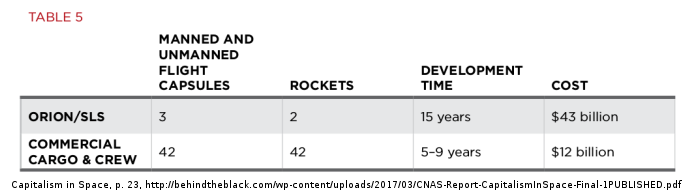
Though he uses different words, and has the advantage of recent events to reference, Plata is essentially repeating my recommendations from my 2017 policy paper, Capitalism in Space [free pdf]. Plata draws as his proof for his argument the recent developments with Starship. I drew as my proof a comparison between SLS and what private commercial space was doing for NASA, as starkly illustrated by this one table:

The cost difference between SLS and private space

The government has got to stop trying to build things, as it does an abysmal job. It instead must buy what it needs from private commercial vendors who know how to do it and have proven they can do it well.

If the government does this, will not only save money, it will fuel an American renaissance in space. As we see already beginning to see happen now in rocketry and the unmanned lunar landing business.

20 comments

Musk’s Boring Co offers to dig tunnel for resident transportation during launch closures

Capitalism in space: Elon Musk’s Boring Company has proposed digging a tunnel so that people can still access Boca Chica’s beaches even during periods when SpaceX is doing launch operations and needs to close the surface roads.

The Boring Company (TBC) met with Cameron County officials to discuss the possibility of a tunnel project running from South Padre Island (SPI) to Boca Chica Beach.

The Boring Company pitched the idea of an SPI-Boca Chica tunnel to Cameron County administrator Pete Sepulveda Jr. and county engineer Benjamin Worsham early this summer. Cameron County officials have been thinking of giving people access to part of Boca Chica Beach even during closures.

The county has said it likely cannot afford to pay for such a thing, but Musk’s company is still proposing to do an in-depth study to find out what will be necessary to make it happen.

It could very well be that Musk might find some cash to help pay for this himself. The public relations would be excellent, and it would I think be the right thing to do. It is also possible that the local communities will have more cash themselves because of the booming economy SpaceX is bringing them.

2 comments

NASA freezes work on SpaceX’s lunar lander version of Starship

In response to Blue Origin’s lawsuit that is attempting to cancel the contract award to SpaceX for adapting its Starship upper stage rocket as a manned lunar lander, NASA yesterday officially paused all work by it and SpaceX on this project.

From NASA’s statement:

NASA has voluntarily paused work with SpaceX for the human landing system (HLS) Option A contract effective Aug. 19 through Nov. 1. In exchange for this temporary stay of work, all parties agreed to an expedited litigation schedule that concludes on Nov. 1. NASA officials are continuing to work with the Department of Justice to review the details of the case and look forward to a timely resolution of this matter.

The optics for Blue Origin remain ugly. Not only does the company appear more interested in fighting court battles than building spaceships and rockets, it now is acting to prevent others from doing so.

The timeline of events however is interesting. Blue Origin filed its lawsuit on August 13th. NASA issued the first $300 million payment to SpaceX for this $2.9 billion contract on August 16th. Even with this announcement today, the payment suggests that NASA is doing what it can to make the contract award an accomplished fact that the courts will not find easy to overturn.

1 comment

Blue Origin files lawsuit against Starship lunar contract award

What a joke: Jeff Bezos’s company Blue Origin on August 13th filed a lawsuit in federal court, attempting to overthrow the contract award NASA gave SpaceX’s Starship in its manned lunar lander Artemis project

In a court filing on Friday, Blue Origin said it continued to believe that two providers were needed to build the landing system, which will carry astronauts down to the Moon’s surface as early as 2024. It also accused Nasa of “unlawful and improper evaluation” of its proposals during the tender process. “We firmly believe that the issues identified in this procurement and its outcomes must be addressed to restore fairness, create competition and ensure a safe return to the Moon for America,” Blue Origin said.

The article then goes on to list the basic facts that make this lawsuit absurd. First, NASA had not been appropriated enough money by Congress to award two contracts, and had it done so, it would have violated the law. Second SpaceX’s bid was the lowest bid, far less than Blue Origin’s expensive price. Third, SpaceX was already test flying early prototypes of its Starship lander, while Blue Origin had built nothing. Fourth, many other technical issues made SpaceX’s bid superior.

Finally, the GAO, as an independent arbitrator, has already ruled against a Blue Origin protest, stating unequivocally that NASA had done nothing wrong in its contract process.

This lawsuit makes Blue Origin appear to be a very unserious company. Rather than putting its energies towards building rockets and spacecraft to demonstrate its capabilities, it focuses its effort on playing legal games in the courts. Such behavior will only make it seem less appealling when next it bids on a NASA or Space Force contract.

15 comments

Eric Berger: FAA regulators should get out of the way

In a essay today for Ars Technica, Eric Berger makes note of the progress that SpaceX is making on its Starship/Superheavy rocket, and points out that the one major obstacle that SpaceX cannot control and that stands in its way is the revised “environmental assessment” the FAA still must approve to permit the rocket to launch from Boca Chica.

Perhaps the biggest hurdle of all will be clearance from the Federal Aviation Administration, which is working with SpaceX to conduct an environmental assessment of launching such a mammoth rocket from these South Texas wetlands. After a “draft” of this assessment is published, there will be an approximately 30-day period for public comments. This will be followed by other steps, including a determination by the FAA on whether SpaceX’s proposed environmental mitigations will be enough or if more work is required.

The stacking of the rocket late last week, and the photos released by Musk of that stacking, Berger sees as Musk’s effort to quietly apply pressure on those bureaucrats to get their work done already. As he writes, “Holding back Starship means holding back this progress, Musk wanted regulators to understand.”

Read the whole essay. In addition to illustrating the poltical games required by SpaceX to get past the stifling rules of our modern government, it very nicely shows how America has changed since the early 20th century. Then, no such regulators stood in the way, and Americans were thus about to build fast and with great skill, reshaping the cities of the world forever.

Though I expect the politics of the moment to favor SpaceX, forcing the FAA to get its work done quickly to allow the rocket to take off as planned, this is only going to happen because of the political clout SpaceX has with the public, and thus with politicians. For small companies no such clout exists, and thus expect U.S. innovation to continue to suffer in the coming years because we have given our govenrment too much power over our lives.

8 comments

The trials and tribulations of Blue Origin’s BE-4 engine

Link here. The article tries to provide some explanations for the delays at Blue Origin that have put the BE-4 engine years behind schedule.

The first and most important fact gleaned from the article is that flightworthy versions of this engine will not be ready this summer as promised, and will likely not get delivered to ULA for its Vulcan rocket before the end of the year, causing its inaugural launch to be delayed to the second half of ’22. This also means that Blue Origin’s own orbital rocket, New Glenn, will likely not launch until late next year, at the earliest.

Moreover, the engines that Blue Origin will deliver to ULA will not be fully tested, and might require replacement if tests on other engines reveal more problems.

The article’s most important revelation about the delays however is this:

One of the most persistent problems, sources said, is that the BE-4 engine testing and development program has been relatively “hardware poor” in recent years. Effectively, this means that the factory in Washington has not had enough components to build development engines, and this has led to extended periods during which no testing has occurred on the stands in Texas.

It was surprising to hear this because back in the spring of 2017 Blue Origin stated publicly that its development program was hardware rich. After arriving as CEO in late 2017, however, [Bob] Smith appears to have focused more on a substantial reorganization of Blue Origin’s leadership rather than hardware development. Other programs were prioritized, too, so the BE-4 team did not get all the resources and freedom it needed to proceed at full throttle. [emphasis mine]

To put it more bluntly, Smith decided it was more important to rearrange the deck chairs rather than launch lifeboats into the water. As a result, Blue Origin has essentially wasted the last four-plus years.

There are signs that the company has changed course away from Smith’s focus, but we shall have to wait and see. The childish press release issued by Blue Origin yesterday, claiming its manned lunar lander was far better than SpaceX’s Starship and should have been chosen by NASA, suggests that the course change has not been as thorough as one would hope. The amount of intellectual dishonesty contained in that release is somewhat disturbing, especially coming from a rocket company:

Blue Origin appears to be, at minimum, cherry picking its comparisons. The graphic notes that the Starship-Super Heavy system hasn’t launched yet. Starship has launched six miles into the air on several occasions, but not with its Super Heavy booster. It also points out that SpaceX’s Starship facilities in Boca Chica, Texas have never accommodated an orbital launch. Blue Origin, though has never launched any rocket to orbit from anywhere.

The graphic doesn’t, however, note the cost of the Starship lunar lander. SpaceX’s proposal estimates that it will cost NASA $2.9 billion, while Blue Origin’s gave a price of $5.9 billion. [emphasis mine]

For the management of a rocket company to not recognize the fundamental facts indicated by the highlighted words above, or to make believe they are unimportant, does not bode well for that rocket company. Rather than focusing on getting its rocket finally off the ground, the management appears instead unwilling to face some hard facts, and fix them.

Meanwhile, SpaceX keeps barrelling along, focused not on petty managment issues or whiny complaints, but on actually building rockets that fly.

8 comments

SpaceX stacks Starship on top of Superheavy

Superheavy with Starship on top
Click for original image.

Capitalism in space: Only three days after the company had rolled Superheavy prototype #4 to the launchpad, SpaceX today stacked Starship prototype #20 on top, uniting for the first time the entire rocket.

All told, the rocket is 395 feet high, about 32 feet taller than the Saturn-5.

The photo to the right, reduced slightly to post here, was posted by Elon Musk earlier today. It also makes obvious several things that will be different for this Starship flight compared to the previous suborbital hops. Starship’s dark exterior is because it is covered with thermal tiles designed to protect it as it returns to Earth flying through the atmosphere at orbital speeds.

Note also the grid fins on Superheavy. Apparently they will be open during the entire flight, instead of unfurling shortly after stage separation as is done with Falcon 9.

I am not sure what the vertical attachments near the bottom of Superheavy are for. The plan is for the stage to land in the Gulf of Mexico, so it does not need landing legs. Could these be attachment points for holding the rocket to the launchpad?

I have been predicting a late September/early October date for this rocket’s first orbital launch test. SpaceX is sure working hard to beat that timeline. They still need to do tank tests and static fire tests of the whole assembly, but based on past schedules, they might get this done in only a few weeks. If so, it means they might be able to launch before the end of August.

My god, if only other American rocket companies worked in this manner. Imagine what wonders they all could accomplish.

19 comments
1 26 27 28 29 30 44