FAA, local Texas DA, and environmental group out to get SpaceX and Starship

Two news articles today suggest that a number of government officials, environmental groups, and some news media are beginning to team up to damage SpaceX and hinder its ability to succeed.

First we have this Verge article, aimed at suggesting that SpaceX violated its launch license and ignored FAA warnings not to launch during a December 9th test flight of the eighth Starship prototype.

Minutes before liftoff, Elon Musk’s SpaceX ignored at least two warnings from the Federal Aviation Administration that launching its first high-altitude Starship prototype last December would violate the company’s launch license, confidential documents and letters obtained by The Verge show. And while SpaceX was under investigation, it told the FAA that the agency’s software was a “source of frustration” that has been “shown to be inaccurate at times or overly conservative,” according to the documents.

The article generally takes the side of the FAA, suggesting that SpaceX was lax and nonchalant about the risks relating to weather and launch conditions, and proceeded with its launch even though FAA officials thought it unsafe. It also quotes Wayne Monteith, the head of the FAA’s space division, blasting SpaceX for showing “a concerning lack of operational control and process discipline that is inconsistent with a strong safety culture,” claiming that FAA software showed a risk to nearby buildings and homes should the rocket explode in the air.

However, buried far down in the article it also notes,
» Read more
23 comments

SpaceX’s focus shifts from Starship hops to the first near-orbital flight

Capitalism in space: Work at SpaceX’s Boca Chica spaceport in Texas has now definitely shifted away from doing Starship short hops, focusing instead on the first near-orbital flight using both Starship and Superheavy.

Not only is almost all recent work at Boca Chica centered on building the orbital launchpad with its tower for Superheavy, the company has apparently decided to end development of Starship prototypes 15-19, designed for hops only.

The fate of Starship SN15, following its milestone success with a smooth test flight and landing last month, is still unknown. It is likely awaiting preparations to go on display at Starbase. It is already sitting on display stands.

SN16 continues to reside in the High Bay, all but ready for rollout to the suborbital pad. However, that appears increasingly unlikely, as SpaceX focuses on the upcoming orbital attempt from the launch site next door to where SN15 completed its momentous test.

SN17’s fate is known, with sections of what was to become that Starship now observed as being scrapped at the Production Site.

Meanwhile, SN20’s aft dome [intended for orbit] has also been spotted by Mary (@bocachicagal), sporting three mounts for RVacs, indicating SN20 may be the first Starship to fly with both sea level and vacuum optimized engines.

All signs continue to suggest that orbital test flight will occur before the end of the summer.

4 comments

Pentagon getting serious of hauling cargo with Starship

Capitalism in space: In the budget proposal submitted by the Biden administration the Pentagon included a request for $47.9 million to help develop the infrastructure it will need to use SpaceX’s Starship rocket as a method for transporting cargo point-to-point on Earth.

“The Department of the Air Force seeks to leverage the current multi-billion dollar commercial investment to develop the largest rockets ever, and with full reusability to develop and test the capability to leverage a commercial rocket to deliver AF cargo anywhere on the Earth in less than one hour, with a 100-ton capacity,” the document states.

Although this does not refer to Starship by name, this is the only vehicle under development in the world with this kind of capability. The Air Force does not intend to invest directly into the vehicle’s development, the document says. However, it proposes to fund science and technology needed to interface with the Starship vehicle so that the Air Force might leverage its capabilities.

Clearly, some Air Force officials are intrigued by the possibility of launching 100 tons of cargo from the United States and having the ability to land it anywhere in the world about an hour later.

The proposal is calling for a fourfold increase in funding for this work, as the Air Force is already spending slightly less than $10 million this year on this work.

The bottom line is that it appears SpaceX already has at least one real customer for its giant rocket. And if the military is that interested now, it likely means many more private customers are beginning to line up.

12 comments

SpaceX barrelling like a juggernaut toward first Starship/Superheavy orbital flight this year

Starship #15 about to land
Starship prototype #15 about to land, May 5, 2021

A series of articles at Teslarati in the past two days suggest strongly that the next Starship flight will be on top of a Superheavy first stage, and will likely be the first near orbital flight from Texas around the globe to splashdown softly in the Pacific Ocean northeast of Hawaii.

And it will likely happen this year!

First there was the report from locals in the McGregor, Texas, area indicating that SpaceX has completed a full duration launch burn of a Raptor engine.

A local resident and unofficial SpaceX observer has reported hearing a test of one of Starship’s Raptor engines that lasted more than five minutes at the company’s McGregor, Texas development facilities.

If accurate, it could be the longest static fire of a Starship engine that SpaceX has ever completed in the two years since full-scale Raptor testing first began. Whether it was successful or not, a five or six-minute static fire would also confirm that SpaceX is well into the process of qualifying Raptor for Starship’s first orbital launch attempts.

This burn is somewhat longer than the engine burns during the Starship test hops, and approaches the burn time required for Superheavy during a launch.

Next there was the report describing the newest known engine configurations SpaceX is planning for Superheavy itself, with the first version possibly having 29 engines and a future more powerful version sporting 32.
» Read more

15 comments

Starship prototype #15 removed from launchpad; likely not to fly again

Capitalism in space: SpaceX engineers have removed Starship prototype #15, the first to successfully land after a test flight, from the launchpad and rolled back towards their assembly building.

They had already removed its three Raptor engines and landing legs for inspection, but taking the ship off the launchpad strongly suggests the company has decided to not fly it again.

The immediate assumption is that they will now fly prototype #16, built and ready for launch. The article however speculates something far more intriguing:

There’s a limited possibility that Starship SN16 – all but finished – could be sent to the launch site instead of heading straight to the scrapyard, but any testing would necessarily delay orbital pad construction and any flight activity would likely have to expend SN16 in the ocean rather than risk a land landing.

Ultimately, it’s looking more and more likely that SpaceX would rather go all-in on Starship’s inaugural orbital launch attempt, even if that means little to no ground or flight test availability for a few months.

Prototype #20 had been assigned that for that first near-orbital flight. Does this mean SpaceX has decided abandon #16 through #19 and to go straight to that orbital flight? To do this would also mean they have decided to forego any separate testing of Superheavy, and will instead fly it the first time with a Starship upper stage attached. It would also be the only possible way they could meet their July target date for that orbital flight.

If #16 does not move immediately to the launchpad and there are no Starship test flights for the next month or so, it will tell us that this is likely their plan.

7 comments

SpaceX begins stacking Superheavy prototype for flight

Capitalism in space: It appears that the third Superheavy prototype, BN3 (Booster #3), is now being stacked and prepared for the first near-orbital flight of Starship, which SpaceX is still hoping to launch before the end of this year.

SpaceX has at least six BN3 sections – amounting to 22 rings and two of three tank domes – either completed or awaiting integration. The process of stacking BN3 began sometime in the last 7-10 days when SpaceX joined two four-ring sections – including the booster’s common dome, likely pictured above.

SpaceX has mostly completed BN3’s engine section, including a thrust dome with plumbing cutouts for a full 28 Raptor engines. Most recently, what looks like a Super Heavy fuel manifold appeared in Boca Chica. That manifold will attach to the end of a supersized Super Heavy transfer tube – also spotted in work – used to route methane through the liquid oxygen tank to fuel its Raptor engines. Fueling 28 large, high-performance Raptors is no mean feat and requires a rat’s nest of plumbing to feed them more than 15 metric tons (~30,000 lb) of propellant every second at full throttle.

Put simply, a majority of Super Heavy booster BN3’s hardware appears to be ready or almost ready for integration. The eight rings now stacked represent approximately 20% of the rocket’s full height, leaving another 30 or so rings – 54m (~180 ft) – to go.

That flight, the flight plan of which has already been submitted to the FCC, would take off from Boca Chica, circle about three-quarters of the globe, and land in the Pacific to the northwest of Hawaii. While not a full orbit, this flight would demonstrate an orbital capability while allowing for a controlled safe re-entry at a planned location, a wise approach for that first orbital attempt.

4 comments

Senate revises NASA authorization to protect lunar lander award to SpaceX’s Starship

Even as the full Senate today begins its review of NASA’s newest authorization, the bill has been modified to grandfather in the contract award that NASA gave to SpaceX to build its manned lunar lander using Starship.

An earlier version of the bill had included language inserted by Senator Maria Cantwell (D-Washington) demanding NASA award within 30 days a contract for a second lunar lander. The modified bill extends that timeline to 60 days, but also specifically protects SpaceX’s contract award:

The Administrator shall not, in order to comply with the obligations referred to in paragraph (1), modify, terminate or rescind any selection decisions or awards made under the human landing system program that were announced prior to the date of enactment of this division.

The revised bill still puts NASA in a ridiculous position. Combined with Cantwell’s amendment, the agency will now be forced to name a second lunar lander contract within sixty days. Though it recommends doubling the money for this program ($10 billion over five years instead of ten), it does not actually appropriate it. Moreover, that new budget recommendation is still about one half of what NASA had originally requested in order to fund the construction of two lunar landers.

Not surprisingly, the entire bill [pdf] has become a pork-laden collection of spending put together without any concern for the needs for the nation. Instead, ithe 1,445-page long bill “is the proverbial ‘Christmas tree’ with a Table of Contents that alone is 15 pages” that different senators keep adding items to, making it a hodge-podge of incoherence.

The bill itself however still has to be approved by both the Senate and the House. While this should act as a corrective to make it more sane, don’t expect that. Instead, the more likely result will be that the two houses of Congress will combine together their own personal earmarks into one humongous bill.

3 comments

SpaceX in FCC filing outlines first orbital flight plan for Starship

The flight plan for Starship's first orbital flight
Click for full images.

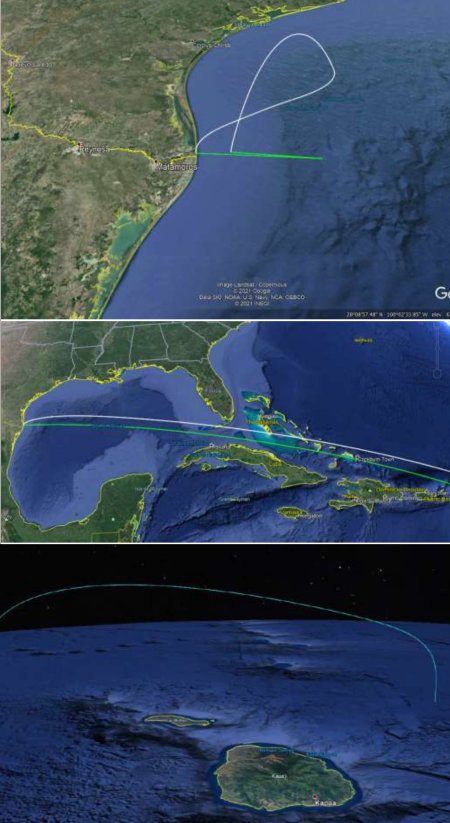
Capitalism in space: This week SpaceX filed the flight plan for the first orbital flight of its Starship/Superheavy rocket, taking off from Boca Chica and landing in the Pacific Ocean near Hawaii.

The images to the right are from the filing, which also states:

The Starship Orbital test flight will originate from Starbase, TX. The Booster stage will separate
approximately 170 seconds into flight. The Booster will then perform a partial return and land in the Gulf of Mexico approximately 20 miles from the shore. The Orbital Starship will continue on flying between the Florida Straits. It will achieve orbit until performing a powered, targeted landing approximately 100km (~62 miles) off the northwest coast of Kauai in a soft ocean landing.

No date is listed as yet, though the filing suggests they are aiming for a launch before the end of the year. It also appears that though both Starship and Superheavy will make controlled vertical landings, both will target locations in the ocean. It could be that SpaceX plans to place its two refurbished oil rigs at both of those locations, but this is not stated in the filing.

Achieving this flight before the end of the year remains a serious hill to climb, though if any company could do it, SpaceX is the most likely.
» Read more

8 comments

Roscosmos announces two commercial tourist flights to ISS

Capitalism in space: Roscosmos, the government corporation that controls of all of Russia’s space industry, announced today that it will be flying two different commercial tourist flights to ISS, both occurring before the end of this year.

The first will take place in October.

Roscosmos [is] sending an actress and a director to the ISS in October with the aim of making the first feature film in space. The film, whose working title is “Challenge,” is being co-produced by the flamboyant head of Roscosmos, Dmitry Rogozin, and state-run network Channel One.

The second will take place in December, and will fly Japanese billionaire Yusaku Maezawa (the man who has already purchased a Moon mission on SpaceX’s Starship) and his assistant Yozo Hirano in a Soyuz capsule to ISS for twelve days.

Let’s review the upcoming tourist flights now scheduled:
» Read more

17 comments

SpaceX to refly Starship prototype #15 next?

Capitalism in space: SpaceX has rolled Starship prototype #15 to the launchpad in an apparent bid to immediately send it on its second flight, only two weeks after its first successfully 30,000 foot flight.

While SpaceX has yet to actually install Starship SN15 on Mount B, the prototype has been attached to a crane and said installation is imminent – possibly just waiting for winds to die down. As of publishing, SpaceX has removed SN15’s six ‘used’ landing legs but hasn’t replaced them – a necessary step before the Starship can fly again.

…It’s worth noting that even after SpaceX reinstalls Starship SN15 on a launch mount, there’s no guarantee that the prototype will fly again. Before any reflight, SpaceX will almost certainly put the rocket through at least one additional tank proof test and static fire its Raptor engines. Issues or damage that escaped initial post-flight inspections could easily arise during that process and it’s more likely than not that one or more of SN15’s three Raptors will be removed for detailed inspection or replaced outright.

If this prototype does fly next, the next question will be how high and how far. My guess would be that they will fly it to a much higher altitude to further refine the spacecraft’s flight capabilities on return. It makes no sense to simply repeat the last flight. Now is the time to push the design again, even if it means the loss of the prototype.

8 comments

Starship #15 launches AND lands successfully

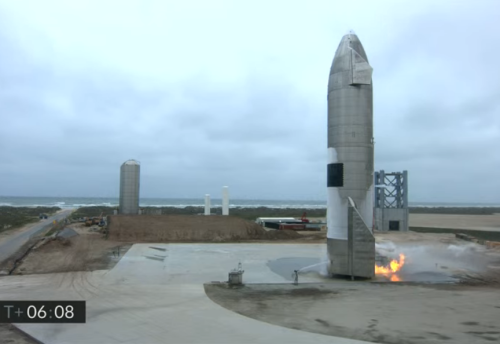
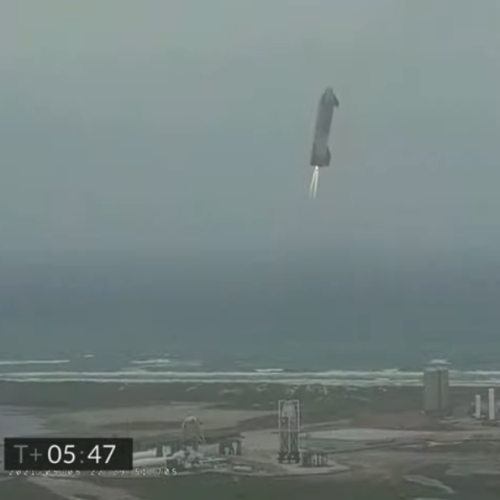
Starship #15 about to land

Starship #15 after landing

Capitalism in space: On the 60th anniversary of Alan Shepard’s suborbital flight, making him the first American to fly in space, SpaceX has successfully launched and landed its fifteenth Starship prototype.

The flight appeared remarkably smooth, except for the cameras on board which dropped out for much of the flight. The first image shows the rocket coming down just before touch down. At this moment it was dropping very smoothly, and landed very gently on the landing pad.

The second image was taken about thirty seconds after landing. There was a fire at the rocket’s base being extinguished by the water fire control system. Other than that, the rocket appears whole and undamaged.

As I write this, it is about ten minutes after landing, the fires at the rocket’s base have been put out, and all seems under control. I expect that SpaceX engineers will finally have a fully intact prototype that they can inspect for future design revisions. For example, the skin of this prototype has many thermal tiles attached. They can now see if their attachment system works.

I have embedded the 16 minute live stream of the flight below the fold. Enjoy!
» Read more

62 comments

How to watch the first flight of Starship prototype #15

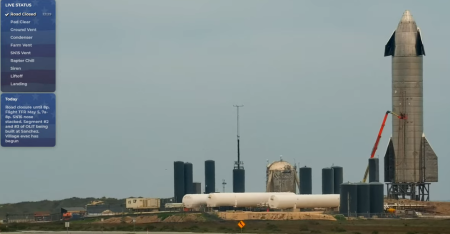
Starship #15 on launchpad, May 5, 2021
Screen capture from LabPadre Nerdle camera live stream.

UPDATED and BUMPED. The SpaceX live stream is now embedded below the fold. It is set to go live in about five minutes before launch, with the launch now set for about 5:25 pm (Central).

Capitalism in space: The roads have now closed at Boca Chica, Texas, in preparation for today’s test flight of SpaceX’s 15th Starship prototype.

The following live streams are presently available if you wish to watch:

I will add other live streams as they become available. If SpaceX adds its own live stream I will embed it below.
» Read more

3 comments
1 28 29 30 31 32 44