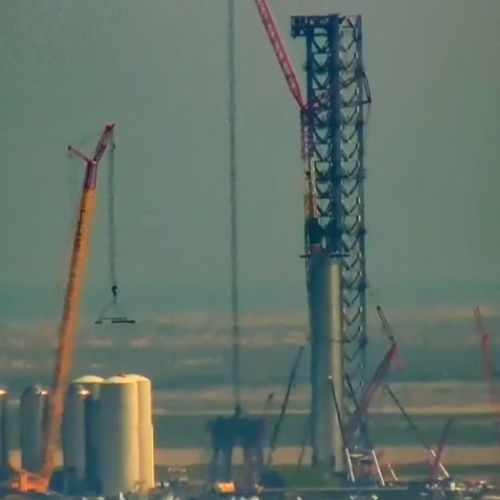
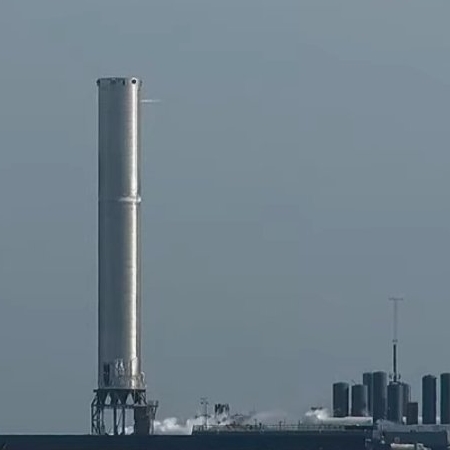
Superheavy prototype #4 rolls to orbital launchpad
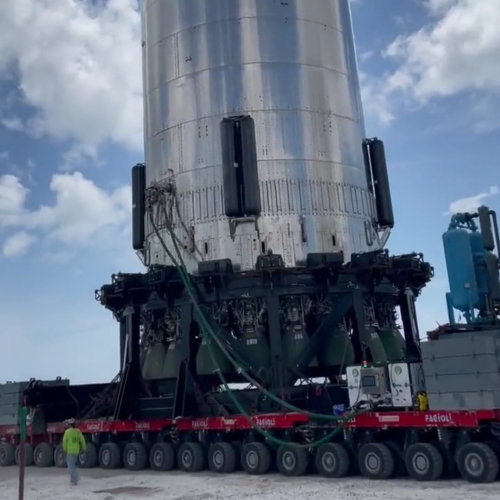
Superheavy #20 on the way to launchpad

Superheavy on launchpad
Click for live stream.

Capitalism in space: SpaceX today rolled its 4th Superheavy prototype from its assembly building in Boca Chica, Texas, moving it to the orbital launchpad in preparation for having the 20th Starship prototype stacked on top and assembled for the rocket’s first orbital test flight.

The first image to the right is a screen capture taken from a short movie posted in an Elon Musk tweet. It shows the base of this Superheavy, with its 29 Raptor engines. The engines appear surrounded by the support structure that holds the stage to the truck mover.

The second image to the right is a screen capture from Labpadre’s live stream Saphire camera, captured shortly before this post was published. Superheavy is 230 feet tall. Starship is 165 feet tall. Combined that equals just under 400 feet, which is still about 30 feet taller than the Saturn-5.

Yet, Superheavy is easily dwarfed by the launch tower behind it, and when they stack Starship on top the combined rocket will still be only three quarters as tall as the tower. They are using that tower not only for launches, but for stacking of Starship as well as a capture devise for when later Superheavies return to Earth. Instead of having landing legs, Superheavy will eventually lower itself into position next to the tower and hover there so that the tower can grab it.

All this means the tower needs to be taller than the combined rocket. I would also expect that a second tower will be necessary eventually for that landing grab.

Before they stack Starship #20 on top they will likely do pressure and tank tests of Superheavy, and maybe a few dress rehearsal countdowns leading to short static fire tests.

It still appears to me that we are looking for an orbital test flight sometime in late September, early October.
21 comments

SpaceX installs 29 Raptor engines on Superheavy #4

Capitalism in space: SpaceX has now installed 29 Raptor engines on the fourth Superheavy prototype, intended to be the first to attempt an orbital launch, even as the company also prepares Starship prototype #20 for that flight.

In a marked increase to the already-impressive production cadence at SpaceX Starbase, it’s all hands on deck with Booster 4 and Ship 20 preparations ahead of the duo being sent to the launch site. Booster 4 was stacked on Sunday, with all 29 Raptors installed by Monday morning. While the orbital launch attempt is not imminent, the duo is expected to undergo a series of ground testing objectives, including multiple Static Fire tests for the booster. This will also provide time to complete the final elements of the Orbital Launch Site (OLS), from which the duo will conduct the milestone test flight.

Following a short ground testing campaign with Booster 3, which included cryo proofing and a three-engine Static Fire test, the focus is now on what will become the first integrated stack of a Super Heavy booster and a Starship vehicle. This is set to be achieved in double-quick time, following a call to arms from SpaceX to its workforce. This included the transportation of hundreds of workers from other sites in the country, as per a memo leaked on Facebook.

As predicted, SpaceX did not succeed in launching Superheavy/Starship on its first orbital test flight in August. However, as predicted the company is clearly pushing to attempt that flight before the end of the summer. Right now, based on the pace of operations, what has been accomplished, and what needs to be accomplished, I estimate that flight will likely occur sometime around late September to early October.

It also seems very obvious that SpaceX is trying very hard to beat SLS into orbit. If successful, it will underline most starkly the difference between free enterprise and government operations. The former got it done in about four years, for less than $6 billion. The latter has taken seventeen years, and about $60 billion, and has still not launched.

And even if SLS launches first, that contrast remains.

12 comments

GAO rejects protests by Blue Origin and Dynectics over lunar lander award

The Government Accountability Office (GAO) today rejected the protests by Blue Origin and Dynectics against the award by NASA of its manned lunar lander contract to SpaceX’s Starship spacecraft.

In denying the protests, GAO first concluded that NASA did not violate procurement law or regulation when it decided to make only one award. NASA’s announcement provided that the number of awards the agency would make was subject to the amount of funding available for the program. In addition, the announcement reserved the right to make multiple awards, a single award, or no award at all. In reaching its award decision, NASA concluded that it only had sufficient funding for one contract award. GAO further concluded there was no requirement for NASA to engage in discussions, amend, or cancel the announcement as a result of the amount of funding available for the program. As a result, GAO denied the protest arguments that NASA acted improperly in making a single award to SpaceX.

GAO next concluded that the evaluation of all three proposals was reasonable, and consistent with applicable procurement law, regulation, and the announcement’s terms.

Finally, GAO agreed with the protesters that in one limited instance NASA waived a requirement of the announcement for SpaceX. Despite this finding, the decision also concludes that the protesters could not establish any reasonable possibility of competitive prejudice arising from this limited discrepancy in the evaluation.

This decision will likely allow NASA to proceed with the contract, and for SpaceX to begin work on the revisions it will need to make to Starship to make it a lunar lander.

The decision also puts companies like Blue Origin and Dynectics on notice: You need to prove you have the goods, or you won’t win customers. Commit some of your own funds to research and development, start building actual prototypes you can test, and the world will begin to beat a path to your door.

20 comments

SpaceX completes first static fire test of Superheavy prototype #3

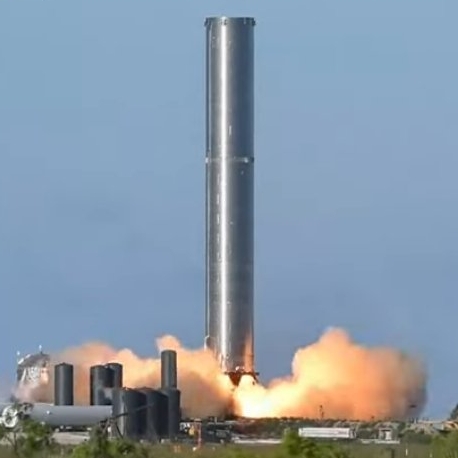
Superheavy booster #3 fires
Superheavy booster #3 fires.

Capitalism in space: SpaceX yesterday successfully completed the first static fire test of the third Superheavy prototype, firing up three Raptor engines for about two seconds.

I have embedded the live stream from NASASpaceflight.com below the fold, cued to just before the engines fire. Because there was a delay of a few minutes from when the static fire was expected and when it actually happened, the announcers had began talking and were caught off guard by the burn.

Next up:

Booster 3 provides a first-time operation for fueling the huge booster with Liquid Oxygen (LOX) and Liquid Methane (CH4) during the test. How much propellant will be loaded, and the schedule for the sequence was unknown. However, NSF’s Adrian Beil wrote a feature on the expectations based on previous experiences with Starship being applied to Super Heavy.

Based on those evaluations, it was expected that Super Heavy would also undergo a Starship-like countdown of 45-60 minutes, with fueling beginning in the 30-40 minute range. Engine chill would then follow at T-12 minutes, ahead of the firing. As with previous Static Fires, the T-10 minute siren sounded, as per the alert notice to local residents. However, as with Starship, mini-holds can be expected, pushing the ignition time to the right. This proved to be the case on Monday.

The booster fired up all three engines for the expected duration, confirmed by Musk before he noted that “depending on progress with Booster 4, we might try a 9 engine firing on Booster 3.”

Booster #4 will be put on the orbital launchpad rather than the test pad, and is likely the booster to be used for the first orbital test flight of Starship, likely to be launched before the end of summer.
» Read more

8 comments

Maezawa reveals status of competition to join him on a private Starship mission to Moon

Capitalism in space: In a video released yesterday Japanese billionaire Yusaku Maezawa provided an update on his Dear Moon competition for choosing the eight individuals who will join him on his private Starship mission around the Moon.

The mission has changed a lot since it was first announced in 2018. Maezawa had planned to invite artists onboard the Starship and venture with them on a circuit around Earth’s only natural satellite. But earlier this year, he changed the process and opened up spots to practically everyone, calling on budding lunar explorers to register for a ticket aboard the Starship and then produce videos on why they want to go to space.

I have embedded the video below. In it Maezawa reveals that he received more than a million applications from every single country on Earth, with many sending short videos describing why they should be chosen. The video provides a sampling of clips from those videos.

What struck me most while watching the video is how completely confident all the applicants were that this private mission on Starship will fly. Even though this is a manned mission around the Moon, something that has only been done nine times, and not for a half century, all seemed entirely sure Maezawa’s mission would happen, and wanted to be on it. I was also struck by the variety of applicants from many places.

Capitalism and freedom is opening the heavens for all humans. And it is about time.

» Read more

5 comments

NASA pushing for an SLS launch before the end of the year

According to a statement by NASA administrator Bill Nelson earlier this week, the agency is working hard in its stacking of the SLS rocket in Florida, with the goal of launching before the end of the year.

That statement was revealed in the last sentence of this article describing the work on getting SLS ready, work that appears to be moving along briskly with few surprises.

The present official targeted launch date is set for November. The agency had said it would take between six to ten months to get the rocket ready after the core stage arrived at Kennedy in May. This pointed to a launch sometime between November and March. Right now it appears that NASA is trying very hard to meet that earlier date.

This aggressive effort to launch on schedule is behavior quite out of character for the NASA of the past three decades. In the past, the agency would have moved leisurely along, so that those four months of margin would have almost certainly been used and the launch would have been delayed until March.

I suspect this push now to launch on time is partly generated by a fear that SpaceX’s Starship will reach orbit before SLS. If that happens it will be a major embarrassment to NASA, considering that the agency has spent about three times longer and ten times more money on its rocket than SpaceX.

Isn’t competition wonderful? It even makes government work more efficiently.

Stay tuned. There is still a lot of time between now and November. This race between comparable rockets being built by the government and a private company appears to be neck and neck as we head down the stretch.

8 comments

FAA threatens shutdown of SpaceX’s Starship program at Boca Chica

Banned by the FAA?
Starship banned by the FAA?

They’re coming for you next: An FAA official revealed yesterday that the agency has not approved the launch tower that SpaceX is building for its Starship/Superheavy rocket in Boca Chica, Texas, and threatened that if disapproved the government would force the company to tear it down.

The Federal Aviation Administration warned Elon Musk’s SpaceX in a letter two months ago that the company’s work on a launch tower for future Starship rocket launches is yet unapproved, and will be included in the agency’s ongoing environmental review of the facility in Boca Chica, Texas. “The company is building the tower at its own risk,” an FAA spokesperson told CNBC on Wednesday, noting that the environmental review could recommend taking down the launch tower.

The FAA last year began an environmental review of SpaceX’s Starship development facility, as Musk’s company said it planned to apply for licenses to launch the next-generation rocket prototypes from Boca Chica. While the FAA completed an environmental assessment of the area in 2014, that review was specific to SpaceX’s much-smaller Falcon series of rockets.

This revelation from FAA officials is most interestingly timed, coming on the same day as this garbage article about the terrible environmental damages some activists imagine SpaceX’s launch facility might someday cause. As is usual for a mainstream news source, the article makes no reference to the wildlife preserve that surrounds the Kennedy Space Center in Florida, where we have empirical proof for more than a half century that a spaceport does no harm to the environment and actually acts to protect it from development.

Nor was this the only such attack article in the past two days. Here is just a sampling:
» Read more

30 comments

Superheavy passes first tank test

Superheavy after tank test, July 12, 2021
Screen capture from NASASpaceflight.com live stream,
shortly after tank test of Superheavy

Capitalism in space: SpaceX’s first fullscale complete Superheavy prototype, dubbed #3, passed its first tank test yesterday.

Booster 3 was likely filled with a few hundred tons of liquid nitrogen relative to the more than 3000 tons its tanks could easily hold and the fraction of that total capacity SpaceX’s suborbital launch site can actually supply. Teams have been working around the clock for months to outfit Starship’s first orbital launch site with enough propellant storage for at least one or two back to back orbital launches – on the order of 10,000 tons (~22M lb) – but the nascent tank farm is far from even partially operational. That’s left SpaceX with its ground testing and suborbital Starship launch facilities, which appear to be able to store around 1200 tons of propellant.

Assuming the suborbital pad’s main liquid oxygen and methane tanks can also both store and distribute liquid nitrogen, which isn’t guaranteed, SpaceX thus has the ability to fill approximately 30-40% of Super Heavy B3’s usable volume. Frost lines aren’t always a guaranteed sign of fill level but if they’re close, SpaceX likely filled Booster 3’s tanks just 5-10% of the way during the rocket’s first cryoproof.

While the company still says it is aiming for a July orbital launch, that seems highly unlikely. They still have to do a Superheavy tank test with full tanks, plus static fire tests. They also need to get the orbital launchpad finished, with a full tank farm.

Nonetheless, SpaceX is moving fast towards flight of this heavy lift reusable rocket. I still think the odds are 50-50 it will complete its first orbital flight before SLS, even though its development began more than a decade later and has cost a tenth of the money ($6 billion vs $60 billion).

9 comments

Northrop Grumman wins contract to build Lunar Gateway’s habitable module

Capitalism in space: NASA yesterday announced that it has awarded Northrop Grumman the construction contract for building HALO, (Habitation and Logistics Outpost), the module where astronauts will live and work on its Lunar Gateway space station.

Combined with earlier development contracts this contract, worth $935 million, brings the total fixed-price cost to about $1.1 billion.

[HALO], one of the first for the Gateway, will serve as a habitat for visiting astronauts and a command post for the lunar orbiting facility. It will have docking ports for Orion spacecraft, cargo vehicles like SpaceX’s Dragon XL and lunar landers, as well as for later modules to be added by international partners. HALO is based on the Cygnus spacecraft that Northrop Grumman uses to transport cargo to the International Space Station, but extensively modified with docking ports, enhanced life support and other new subsystems.

This module is not expected to launch before 2024. Moreover, it is supposed to work in conjunction with what NASA calls its Artemis 3 mission, the third launch of SLS and the first to dock with Gateway. SLS however is so far only funded through its first two flights, and has a schedule that is presently highly uncertain.

There is great irony here. HALO, based on the Cygnus cargo freighter, will be about that size. If the present schedule for SpaceX’s Starship continues as expected, it will be flying to the Moon at about the same time, and will have a cargo bay big enough to store several Cygnus freighters inside. And though no work has yet been done to make that cargo bay habitable, Starship’s cost per launch, about $2 million, is so far below the $1.1 billion cost for HALO that it will certainly cost much less than HALO to make it a habitable station. And it will be gigantic in comparison.

21 comments

First orbital Raptor engine delivered to Boca Chica

Capitalism in space: SpaceX has delivered to its Boca Chica launch site the first Raptor vacuum engine optimized for orbital operation.

The Starship prototype that will use this engine, as well as fly on the first orbital test flight, is #20.

While most of S20’s upgrades are a mystery, the ship’s thrust dome – spotted in work at Boca Chica earlier this month – has already confirmed that the prototype will be the first with the necessary hardware for Raptor Vacuum engine installation. That likely means that S20 will also be the first Starship to attempt to static fire six Raptor engines*, potentially producing more thrust than a Falcon 9 booster. On June 27th, one such vacuum-optimized Raptor (RVac) arrived in Boca Chica for the first time ever, making it clear that the comparatively brand new engine may already be ready to start integrated Starship testing.

*Update: SpaceX CEO Elon Musk says that the Raptor Vacuum delivered to Boca Chica on June 27th is, in fact, meant for Starship S20, seemingly confirming that the prototype will fly with a full six Raptor engines.

While this delivery as well as statements by both Musk and Gwynn Shotwell, SpaceX CEO, all point to an intended orbital test flight in July, the article at the link outlines the many tasks still undone that must be completed before that flight, all of which suggest that it will be August at the earliest before that flight can happen.

Nonetheless, SpaceX is barreling forward toward that first orbital flight, with clearly a goal to beat SLS’s first orbital flight, presently scheduled for November.

5 comments

Many of Mars’ geological mysteries, all in one photo

Knobs, streaks, and lava channels on Mars
Click for full image.

Today’s cool image is fun because it contains a plethora of Martian mysteries, all packed into a very small space. The photo to the right was taken on April 29, 2021 by the high resolution camera on Mars Reconnaissance Orbiter (MRO). I have rotated, cropped, and reduced it to post here.

The uncaptioned picture was labeled “Small Channel Winding between Knobs in Tartarus Colles.” The knobs, which can be seen on either side of the thin channel within the canyon, are actually a major Martian puzzle. Tartarus Colles has a lot of them, and planetary geologists are not really sure how they formed. One 2009 paper [pdf] suggested that the cones were formed by the violent interaction of lava and ice. This earlier paper [pdf] hypothesized that both water and lava had to be flowing over the surface at the same time, producing the steam and the energy that popped the lava cones, kind of like the small convection bubbles seen when tomato sauce simmers.

The scientific literature however is not deep, and there appears to be much uncertainty about this conclusion.

The photo however contains other major Martian puzzles.
» Read more

0 comments

SpaceX confirms it is shifting to Starship orbital test flights

Capitalism in space: By shifting both the 15th and 16th Starship prototypes to its garden at Boca Chica of retired spacecraft, SpaceX has essentially confirmed that it has shifted operations there from short test hops to Starship orbital test flights.

Built as the first of several planned backups to Starship SN15, which debuted a number of significant upgrades in April and May, it appears that Starship serial number 16 (SN16) has been retired to a display stand after its only sibling became the first full-size prototype to successfully survive a launch and landing on May 5th. SN16 actually reached its full height before SN15 lifted off and was more or less complete by May 10th. Since then, the prototype has remaining more or less untouched, seemingly waiting for SpaceX to decide its fate in lieu of Starship SN15’s major success.

Ultimately, with SN16 now sitting side by side with SN15 at what will likely become a sort of open-air SpaceX museum, it appears that the company has made up its mind.

In other words, prototype #16, though built and ready to fly, will likely never do so. Instead, the company is focusing its operations on preparing for the first orbital test flights using Starship prototype #20 stacked on top of a Superheavy, with the first flight planned to circle three-quarters of the globe to land in the Pacific northeast of Hawaii.

Since neither #20 nor its Superheavy are fully assembled, that flight will likely not occur in July, as SpaceX had initially suggested as its targeted launch date. However, with all work now focused on that orbital test flight, it is almost certain they will attempt it before the year is out.

The big question is whether Starship’s first orbital flight will beat out SLS’s first orbital flight, presently scheduled for November but expected to be delayed.

4 comments
1 27 28 29 30 31 44