Reviewing the development of Starship/Super Heavy

Link here. This five-part article is a detailed review of SpaceX’s development of its new completely reusable heavy-lift rocket, with Super Heavy being the first stage booster and Starship being the orbital upper stage capable of returning to Earth, landing vertically, and being reused.

From the article’s conclusion:

The Starship program is unique and one of the most ambitious in the history of rocketry. The design has now gone through at least twelve known versions and four different names!

Its first version was a single or triple-core rocket back in 2013, which has evolved into the single-core stainless steel Starship design under construction today. Even as the design’s size has fluctuated dramatically, its repertoire of missions and roles has expanded.

It started out as a rocket meant to colonize Mars but now is envisioned as an all-purpose carrier rocket to replace the Falcon 9 rocket family. It is expected to launch satellites into Earth orbit, fly people point-to-point on Earth, ferry cargo and crew to and from the Moon, in addition to its original role as a Mars colonization vehicle.

Two significant points: First, SpaceX as a company has shown itself remarkably capable of shifting design and development tracks, on a dime, if it realized there was a better way to do things. Second, the company has also smartly rethought this big rocket’s reason for existing. In the beginning they focused on Musk’s goal of getting to Mars. That concept however had few if no customers, and therefore have little chance of producing profits. Overtime the company adjusted their design goals to expand the rocket’s purposes so that its capabilities would serve as many customers as possible.

The result is a useful product that still could take people to Mars.
8 comments

Starship prototype #8 gets its nosecone

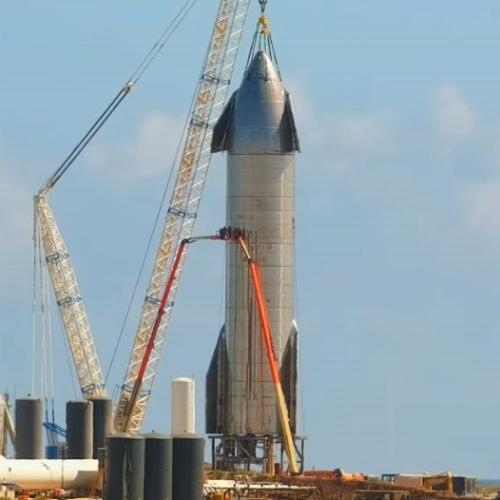
Starship prototype #8, with nosecone
Screen capture from LabPadre live stream.

Capitalism in space: SpaceX has now installed the nosecone on Starship prototype #8 in advance of its first vertical hop to 50,000 feet, or more than ten miles, expected sometime in November.

Curiously, hours prior to nose installation, SpaceX apparently removed one of Starship SN8’s three Raptor engines while also revealing that a spare fourth engine was already in Boca Chica. In other words, the prototype likely has only two Raptor engines installed at the moment, meaning that SpaceX will need to install another before the company can prepare for SN8’s next major test campaign.

According to CEO Elon Musk, the plan was to static fire Starship SN8’s three Raptor engines, perform final inspections and checkouts, perform another static fire, and finally attempt the first high-attitude Starship flight test. As of October 22nd, SpaceX has seemingly completed the two steps. Nosecone freshly installed, it’s likely that SpaceX will use the second triple-Raptor static fire opportunity to test the engines while feeding propellant solely from Starship’s liquid oxygen and methane header tanks – the latter of which is located in the nose.

The removal of one engine suggests they found something in that engine they didn’t like during last week’s static fire test, though that is mere speculation on my part.

The addition of the nosecone, with its own fins, clearly changes the appearance of prototype #8, making it look truly like a rocket ship. In fact, it looks more like the rocket ship imagined by science fiction writers for decades prior to the advent of spaceflight in the 1960s. The irony is that this is the first real rocket since the V2 in World War II to have this look.

5 comments

SpaceX completes static fire test on Starship prototype #8

Capitalism in space: SpaceX last night successfully completed the static fire test on its eighth Starship prototype, for the first time firing three Raptor engines simultanously.

Video of the test, cued to just before ignition, is embedded below the fold.

The company will now install the nosecone on the prototype, repeat this static fire test again in about a week, and then prepare it for its first flight, an expected 50,000 foot hop. I expect that hop to occur in early to mid-November, about the same time the next manned Dragon flight will occur.

» Read more

3 comments

SpaceX begins installing Raptor engines on Starship prototype #8

Capitalism in space: With Starship prototype having successfully passed its tank tests SpaceX has begun installing three Raptor engines in preparation for static fire tests followed by a 50,000 foot high hop.

Once the Raptors are installed, Starship SN8 is expected to undergo an extensive test program, opening with fueling tests, a spin prime test, and preburner tests, before the first Static Fire test.

That opening Static Fire test will be the first time three Raptors have been fired up simultaneously.

Once that opening Static Fire test has been completed, a data review will be conducted on engine performance and related systems – such as the Ground Support Equipment (GSE) – which will allow the nosecone to be installed on to SN8 at the launch site.

At that point the prototype will be ready for its hop. Based on the pace SpaceX is setting (and assuming all goes well), this flight should occur sometime in the next month, possibly at almost the same time as the next manned Dragon flight to ISS.

0 comments

Starship prototype #8 passes tank tests; engine installation next

Capitalism in space: SpaceX’s eighth Starship prototype has passed its tank, thruster, and even fin tests, setting it up for the installation of its three Raptor engines.

Once installed, they will perform several static fire tests, on the launchpad. If those tests are successful, the company will then proceed with a full 50,000 foot test flight. Based on the pace of operations, my guess is that this hop will occur in about two to four weeks.

I’ve embedded one of the videos at the link below the fold, showing a variety of activity at the site.

In other SpaceX news, the Tesla that was put in solar orbit on the first Falcon Heavy test launch has just made its first “fly-by” of Mars, getting to within 5 million miles of the red planet. At that distance the planet really isn’t very close, which is why I put the word fly-by in quotes. That Tesla’s future:

The Roadster will eventually barrel into either Venus or Earth, likely within the next few tens of millions of years, a 2018 orbit-modeling study determined . But the chances of an Earth or Venus impact in the next million years are just 6% and 2.5%, respectively.

» Read more

0 comments

Military considering using Starship for point-to-point transportaion

Capitalism in space: The U.S. military has begun a study in partnership with SpaceX on whether it will be possible to use Starship as a cargo ship for moving large shipments from point-to-point on the Earth.

Army Gen. Stephen Lyons, commander of U.S. Transportation Command, announced the agreement Oct. 7 at a National Defense Transportation Association virtual conference. “Think about moving the equivalent of a C-17 payload anywhere on the globe in less than an hour,” Lyons said. The C-17 is a very large military cargo plane capable of transporting a 70-ton main battle tank.

Makes sense. This decision also suggests the military is impressed with SpaceX’s progress on Starship, and has also largely abandoned its earlier skepticism of the company.

4 comments

Starship prototype #8 on launchpad

Capitalism in space: The eighth Starship prototype, with landing flaps (looking just like fins) has now been moved to its launchpad in preparation for static fire tests followed by a 50,000 foot or nine mile hop.

According to Elon Musk, SpaceX will static fire SN8 twice before attempting its 15 km (~50,000 ft) launch debut. More likely than not, SpaceX will attempt a triple-engine static fire with the Starship as-is, install SN8’s nosecone and forward flaps, and attempt a second static fire while only drawing propellant from tbe rocket’s smaller header tanks (one of which is located in the tip of its nose).

Previously the hop was supposed to go to 60,000 feet, or 11 miles. It appears they’ve scaled it back slightly.

If all these tests go well, the company’s license for the flight opens as soon as October 11th, though it is likely it will not happen quite that soon. More likely by the end of the month, or early in November. Regardless, the prototype looks quite impressive with its flaps, and in fact is now beginning to resemble a spaceship, not a silo.

0 comments

SpaceX destroys Starship prototype #7, as planned

Capitalism in space: SpaceX last night successfully pressurized its seventh Starship prototype to failure, as planned.

The culmination of three nights and more than 20 hours of concerted effort, SpaceX was finally able to fill Starship test tank SN7.1 with several hundred tons of liquid nitrogen before dawn on September 23rd. With just an hour left in the day’s test window, SpaceX closed the tank’s vents, allowing its cryogenic contents to boil into gas and expand with no outlet. At 4:57 am CDT, SN7.1 burst, bringing its lengthy test campaign to a decisive end.

I have embedded video of the test below the fold.

With the completion of this test the way is now clear for the 60,000 foot hop of Starship prototype #8, no earlier than October 11th.
» Read more

10 comments

The frozen and changing mid-latitudes of Mars

Glacial erosion on Mars
Click for full image.

Using “frozen” and “changing” to describe any single location might seem contradictory, but when it comes to the mid-latitudes of Mars, high resolution images keep telling us that both often apply, at the same time and at the same place.

The photo to the right, rotated, cropped, and reduced to post here, is a typical example. Taken on May 8, 2020 by the high resolution camera on Mars Reconnaissance Orbiter (MRO), it shows what the scientists label as “mesas and ridges.” Drainage is to the south, and it sure looks like some sort of glacial flow is working its way downward within the canyons between those mesas.

Overall the terrain has the appearance of a frozen ice sheet, or at least terrain that has a shallow ice table close to the surface. It also looks like chaos terrain in its infancy, the erosion process not yet cutting down enough to make the mesas stand out fully.

The location of these mesas and ridges is shown in the context map below, which also shows that this location is at the same latitude as SpaceX’s Starship prime Martian landing site, and only about 400 to 500 miles to the east.
» Read more

0 comments

Next Starship test flight to go to 60,000 feet

Capitalism in space: SpaceX has decided, after two successful 500 foot hops using its fifth and sixth Starship prototypes, to forego further hops with those prototypes and instead test fly prototype number eight to a height of 60,000 feet, about 11 miles.

Starship SN5 and SN6 were set to become a tag-team, flying 150-meter hops to refine the launch and landing techniques that SpaceX has pioneered with its Falcon 9 rocket. However, with SN5’s hop proving to be a success, followed by a notable improvement with SN6’s leap to 150 meters a few weeks later, it’s likely SpaceX is now confident of advancing to the next milestone.

The company has applied for an FCC license to do the flight anytime from Oct ’20 to April ’21, with October 11th being the first available date.

In the meantime the company plans a pressure tank test to failure of prototype #7, probably later this week.

In other related news at the second link, Boeing and Firefly have also applied for FCC licenses, the former for a Starliner demo mission from November ’20 to May ’21, the latter for its first launch of its smallsat Alpha rocket, also from November ’20 to May ’21.

13 comments

Update on Starship development

Capitalism in space: Link here. The update outlines the status of Starship prototypes #5, #6, #7, #8, #9 as well as the first Super Heavy prototype, all of which are being prepped for future tests.

It is expected that #7 will be tested next, a tank pressure test intended to be tested to failure sometime in the next few weeks. The goal here is to obtain the engineering limits of the alloy being used in this particular prototype so that engineers will know how to use it in future builds.

0 comments

The icy Erebus Mountains near where Starship will land on Mars

Overview of all SpaceX images in Arcadia Planitia

Glacial filled crater in Erebus Montes
Click for full image.

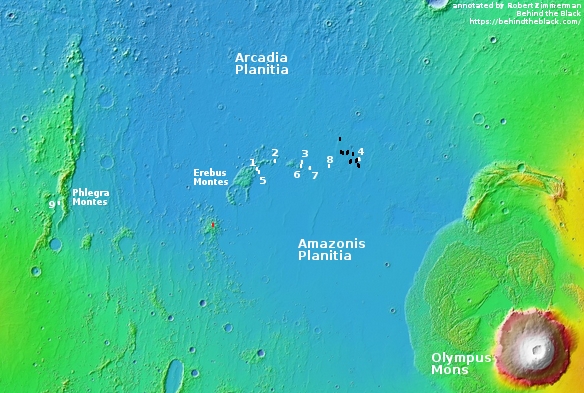
It has been several months since I posted any new photos of the region on Mars which SpaceX considers its prime candidate landing site for its Starship spacecraft/rocket, now under development. The map to the right shows the location of all the images that SpaceX has obtained from the high resolution camera on Mars Reconnaissance Orbiter (MRO) of this landing region, located in the northern lowland plains at the border between Arcadia and Amazonis and to the east of the Erebus Mountains. (See my post on November 13, 2019 for an analysis of the reasoning for SpaceX to choose this region, along with links to each of the numbered images.)

Time to take another look, this time at the very center of the southern cluster of the Erebus mountains. The crater to the right, its location indicated by the tiny red rectangle on the map above, was taken by MRO on May 6, 2020, and shows the typical glacial features scientists find in mid-latitude Martian craters. The floor appears filled with glacial material, with the repeated cyclical flows repeatedly coming down off the north-facing interior rim. That rim would generally be colder and get less sunlight, so snowfall is more likely to pile up there and then flow downward like a glacier, only to sublimate away once it moves out of shadow.

What makes these mountains enticing, only about 400 miles from the Starship landing zone, is not simply what is inside this crater, but what surrounds it. Below is the wider view provided by MRO’s context camera.
» Read more

1 comment
1 35 36 37 38 39 44