
R.I.P. Grace Lee Whitney
R.I.P. Grace Lee Whitney, who played Yeoman Janice Rand in the original Star Trek.
R.I.P. Grace Lee Whitney, who played Yeoman Janice Rand in the original Star Trek.
The competition heats up: In anticipation of its Wednesday, May 6, launchpad abort test of its Dragon capsule, SpaceX has put out a press release providing an overview of the test and what will happen.
The launch window opens at 7 am (Eastern), but don’t be surprised if it doesn’t happen then. They have a very long launch window, and could do it almost anytime during the day.
An evening pause: Some silliness from Johnny Carson and Dom Deluise.
NOAA today posted its monthly update of the solar cycle, showing the Sun’s sunspot activity in April. As always, I am posting it here, with annotations to give it context, as I have done since 2010.

The graph above has been modified to show the predictions of the solar science community. The green curves show the community’s two original predictions from April 2007, with half the scientists predicting a very strong maximum and half predicting a weak one. The red curve is their revised May 2009 prediction.
Though sunspot activity increased in April, it remained well below the predicted numbers from the 2009 prediction, as has sunspot activity generally done for this entire solar cycle.
Note that if you extrapolate the red curve of the 2009 prediction down to its end you find that the solar minimum was predicted to occur sometime after 2020. Based on the rate of activity we have seen for the past year, it is very possible that the minimum will occur sooner, and will likely last longer.
But then again, the sun does what the sun wants to do. We don’t exactly understand the root causes of the solar cycle, and can only watch it unfold time after time as we try to peel back its mysteries.
The competition heats up: India has successfully completed a full duration test of its upgraded cryogenic rocket engine.
This gets them much closer to not only having the ability to launch all of their own geosynchronous satellites, it gets them closer to building a rocket capable of putting human capsules into orbit.
An evening pause: Bolling, on the piano, and Jean-Pierre Rampal, on the flute, let it all hang out.
Hat tip Danae.
Worlds without end: Astronomers have discovered an exoplanet that is too big for its tiny host star.
Present theory says that a Jupiter-sized planet should not have formed around this M-class dwarf star. But it has. In addition, the planet has the mass of Saturn but has been puffed up to the size of Jupiter. Yet, the star doesn’t provide it enough heat to cause it to puff up in this manner.
Finding out what’s in it: Nearly half of the Obamacare exchanges that were set up by state governments are in financial trouble.
Many of the online exchanges are wrestling with surging costs, especially for balky technology and expensive customer-call centers — and tepid enrollment numbers. To ease the fiscal distress, officials are considering raising fees on insurers, sharing costs with other states and pressing state lawmakers for cash infusions. Some are weighing turning over part or all of their troubled marketplaces to the federal exchange, HealthCare.gov, which is now working smoothly.
Note how the only solution suggested is to raise fees, which will end up raising the costs for consumers. These exchanges cost billions to set up, and even now do not have enough money to work right? I am not surprised, as they are a government monopoly, just like the entire Obamacare law, with no competition or incentive to do better. The result is increased cost of medical treatment, with no benefits for anyone.
In the heat of competition: Sources at Virgin Galactic suggest that the company has still not made up its mind on the type of engine it will use on SpaceShipTwo.
Messier sums up the situation perfectly:
The lack of clarity about SpaceShipTwo’s main propulsion system is highly unusual. It’s difficult if not impossible to think of another space project that was uncertain about its primary propulsion system after nearly a decade of development.
Increasingly I do not see this spaceship ever flying, which saddens me. They had a ten year head start over everyone else, and have squandered it.
Maybe it is time to get out: The Office of Hawaiian Affairs (OHA), which had approved the Thirty Meter Telescope (TMT) in 2009, has formally withdrawn its support.
I think the testimony to OHA by the opponents of the telescope says it all:
Thursday’s vote followed a day of emotional testimony at OHA’s offices in Honolulu.
“We have compromised and negotiated 13 times already, and enough is enough,” said testifier Mehana Kihoi. She said scientists did not understand the significance of the mountain to Hawaiian people. “These are people with no sacred place, no connection, no culture,” she said. Kihoi had spent more than 28 days occupying the mountain with other protesters and choked back tears as she described the spiritual experience of being there. “When you place your hands and your bare feet into the soil, you feel that warmth, you feel her heart. At 3 a.m., when … you feel her breath come down and sit on your bones, you know that she is alive.” She called on trustees to oppose the project: “Money comes and goes; our aina [land] is forever.”
Longtime Native Hawaiian activist Walter Ritte said stopping the TMT was no longer enough and that Hawaiians needed to take a stronger stand on the mismanagement of the mountain summit. “They’ve misused it to the point that they need to get all of those telescopes off Mauna Kea,” he said. “It’s a matter of principle.” [emphasis mine]
The comments of the first woman reveal an underlying bigotry and hatred of non-Hawaiians. The comments of the second person reveal a hostility to science and the advancement of knowledge that is most striking.
My instinct is to tell them to go to hell and to pull out all the telescopes, and financial support, to the islands. Maybe a tourist boycott should be started, since they obviously find non-Hawaiians and Western culture so offensive. We’d suddenly discover that these self-righteous claims are as shallow as I’ve described, bigoted and small-minded. Suddenly Hawaiians would be begging Westerners to return to the island.
My second and stronger instinct is to also tell them to go to hell, and to push through construction so that we do not bow to this kind of bigotry.
Unfortunately, our society no longer has the courage to do either. We will bow to these demands, and bigotry will win again.
The competition heats up: New detailed photos of Sarah Brightman’s training for her September tourist trip to ISS have been released.
The photos appear to dispel the rumors that Brightman might be replaced with her backup tourist for the flight to ISS.
Some might consider this flight nothing more than a publicity stunt. While it surely is that, for Brightman it also is a dream come true. And the publicity will not simply be good for her career, it will do wonders to sell the idea of space tourism and space exploration.
In fact, there is never really any downside to freedom and allowing people to follow their dreams, and this tourist flight to ISS will prove it.
An evening pause: A very nice performance. Hat tip Edward Thelen.
After four years in orbit around Mercury and eleven years in space, engineers have confirmed that Messenger has crashed into Mercury.
A new audit by he IRS inspector general has concluded that the agency has taken “significant actions” to end the harassment of conservative groups.
The agency’s inspector general says the IRS is doing a better job processing applications for tax-exempt status. His report said the IRS has eliminated intrusive, unnecessary questions, and has cleared a backlog of applications that had languished for months and years.
One of the reasons these harassment tactics have stopped is that most of the IRS management involved in the scandal has been replaced. I wouldn’t rest easy, however. The majority of federal employees are liberal Democrats, and many would be glad to lend a helping hand to that party if they could. Right now they are being careful because they know they are being watched. The second we stop watching them is when we can expect them to start some form of harassment of conservatives again.
And anyone who thinks I am being paranoid I think is being naive.
Students at Rice University have built a chair and table expressly designed for use in a low gravity environment like the Moon or Mars.
The students interviewed astronauts to get an idea of what was needed, and did the design under NASA supervision. Their design is clever in that it can be packed easily, but I still wonder about the weight of transport. I don’t see the first explorers to Mars being able to afford bringing their furniture with them. I expect they will instead figure out ways to improvise chairs and tables from the materials on hand.
The circumstances behind the failure of Russia’s Progress freighter this week are now pointing to the moment when the freighter separated from the Soyuz rocket’s third stage.

The competition heats up: Blue Origin completed on Wednesday its first test flight of its reusable suborbital spacecraft, New Shepard.
After reaching an altitude of 307,000 feet, or 58 miles, the capsule successfully separated from its first stage, what they call the propulsion module, and safely parachuted back to Earth. The first stage, designed to also be recoverable, was not recovered successfully. According to Jeff Bezos’s explanation, they “lost pressure in our hydraulic system” and that they were trying to land it vertically, like SpaceX’s Falcon 9 first stage.
The cropped image on the right of the full resolution image, gives us a close-up of the capsule and propulsion module. The small fins on the propulsion module suggest the capability for a vertical landing, but it is unclear from the image whether the module has legs, though other images and videos strongly suggest there are legs on this module.
The flight itself, getting above 50 miles, reached space according to most definitions. In fact, Blue Origin with this flight has accomplished what Virgin Galactic has been promising to do for more than a decade, a suborbital test flight of its spacecraft. Blue Origin’s flight was unmanned, but it demonstrated that their design works. They will of course have to re-fly the capsule as well as land that first stage successfully to prove the design’s re-usability, but this flight shows that they are off to a very good start. And their webpage clearly shows that they are almost ready to start selling tickets for suborbital flights.
The most significant success of this launch, however, is the performance of the BE-3 rocket engine. Blue Origin has convinced ULA to hire it to build the engines for its new Vulcan rocket. This success justifies that decision.
I have embedded their videos of the full flight below the fold.
» Read more
An evening pause: Time for more silliness, with a bit of gentle humor making fun of those among us who are most philosophical.
Hat tip Diane Zimmerman.
Images taken between April 12 and April 18 by New Horizons of Pluto not only show one complete rotation of the planet as well as its moon Charon, the images also show a bright spot at Pluto’s pole that could be a polar cap.
The article calls it an “ice cap” but that is premature. At Pluto that cap could be made of a number of materials, not just water. We will not know until New Horizons gets closer.
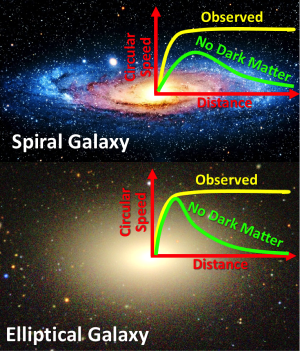
The uncertainty of science: Using new data gathered by the 10-meter Keck telescope in Hawaii, astronomers have found that the outer stars of elliptical galaxies exhibit the same behavior as the outer stars of spirals, suggesting once again the existence of dark matter.
One of the most important scientific discoveries of the 20th century was that the spectacular spiral galaxies, such as our own Milky Way, rotate much faster than expected, powered by [the] extra gravitational force of invisible “dark matter” as it is now called. Since this discovery 40 years ago, we have learned that this mysterious substance, which is probably an exotic elementary particle, makes up about 85 percent of the mass in the Universe, leaving only 15 percent to be the ordinary stuff encountered in our everyday lives. Dark matter is central to our understanding of how galaxies form and evolve – and is ultimately one of the reasons for the existence of life on Earth – yet we know almost nothing about it.
“The surprising finding of our study was that elliptical galaxies maintain a remarkably constant circular speed out to large distances from their centers, in the same way that spiral galaxies are already known to do,” said Cappellari. “This means that in these very different types of galaxies, stars and dark matter conspire to redistribute themselves to produce this effect, with stars dominating in the inner regions of the galaxies, and a gradual shift in the outer regions to dark matter dominance.”
What is most fascinating about this press release, however, is that it also noted that dark matter is only one explanation for the data, and that the failure of Newtonian physics at large distances, instead of dark matter, might also provide an explanation.
However, the [solution] does not come out naturally from models of dark matter, and some disturbing fine-tuning is required to explain the observations. For this reason, the [problem] even led some authors to suggest that, rather than being due to dark matter, it may be due to Newton’s law of gravity becoming progressively less accurate at large distances. Remarkably, decades after it was proposed, this alternative theory (without dark matter) still cannot be conclusively ruled out.
Physicists call this other theory MOND, for modified Newtonian dynamics. It is not a very popular theory, however, and is almost always ignored, even though it appears to work as well as dark matter to explain the motion of stars in galaxies. Instead, most scientists favor dark matter.
For this press release to mention it as suggests the new data favors it over dark matter, which would make this a significant discovery.
