Nancy Roman passes away at 93

R.I.P. Nancy Roman, NASA’s first chief astronomer, died on Christmas at the age of 93.

Her name is largely forgotten, but her support for building the Hubble Space Telescope in the 1960s and the 1970s was critical in getting it done. As important, her support for all in-space astronomy in these early years eventually made it possible. During her term NASA built and launched the first space telescopes. Some were duds. Some were incredible successes. Regardless, her leadership proved that astronomy in space made sense, leading to the achievements that have followed in the half century that has followed.

God speed, Nancy Roman.

1 comment

Musk tweets peek at Starship hopper

Starship test hopper

Capitalism in space: Elon Musk this week tweeted an image of the Starship test hopper, adding that they hope to begin test flights by March.

β€œThis test hopper is at full body diameter of 9m / 30 ft, just not full height. Super Heavy will be full height & diameter,” Musk tweeted, indicating that the company will go directly to building a full-scale version of the rocket booster, rather than a truncated test version.

It seems to me that Musk continues to embarrass all other rocket companies, both private and governmental, with his effective use of current technology to innovate and produce new designs. While everyone else seems locked into building the same old things, his company is using what it knows to try to build something smarter and more efficient.

SpaceX’s track record suggests that it will do exactly what it is trying to do, even if it likely takes longer than they predict. Others should take heed, or they will all get left behind.

24 comments

Japan quits global whaling regulatory body

Japan yesterday announced that it is quitting the International Whaling Commission, a global whaling regulatory body founded shortly after World War II to regulate commercial whaling that has instead in recent years attempted to ban all commercial whaling, except for favored native tribes in Russia and the Arctic.

The article’s last few paragraphs provide the real political background to this move by Japan:

An IWC-Japan divorce is the culmination of a wide ideological divide at the commission between ardent anti-whaling nations and countries seeking recognition of limited commercial whaling activities as legitimate. The anti-whaling forces have the upper hand, even though IWC’s expansion has seen more pro-whaling countries joining in recent years.

At the Brazil gathering, Japan had attempted to nudge the IWC toward reforms that would have potentially paved the way for a resumption of commercial whaling. The IWC was initially established to regulate whaling but has enforced an outright moratorium on commercial whaling operations since the 1980s in a desperate bid to prevent the extinction of several whale species. Many whale species have since recovered to a degree, but a few are still considered endangered.

Japan’s reform push was easily voted down. Instead, a majority of IWC members voted to have the commission turn its back on commercial whaling for good. That successful resolution also condemned Japan’s scientific whaling practices, widely regarded as a clandestine commercial operation as Japan’s whaling fleet takes hundreds of whales each year, with the meat ending up in grocery stores and restaurants.

IWC also approved subsistence whale hunts for Arctic aboriginal communities.

The large Japanese delegation at Brazil didn’t hide its frustration. The government accuses IWC members of hypocrisy for allowing culture exemptions from the moratorium for Alaskan and Russian native groups, but not for Japan and Scandinavian whaling cultures.

In other words, this commission has become increasingly political. Rather than focusing on protecting whale populations while allowing whaling by all parties, it has decided to pick and choose who can whale, and has decided to ban Japan while giving others the right to whale.

This political bias is not much different than what was seen at the Paris climate accords. Those agreements put odious restrictions on U.S. commercial activity, while putting no restrictions on China and others. It was this political bias, totally divorced from any sincere effort to reduce CO2 emissions, that prompted Trump to exit that agreement.

30 comments

Gale Crater dunes: dry and volcanic in origin

Using data from orbit and from the rover Curiosity, scientists have determined that the material in the dunes in Gale Crater that Curiosity has visited are very dry and volcanic in origin.

This dryness is in contrast with the underlying ground, which shows evidence of water. The data also suggests that the material either came from multiple volcanic sources producing different compositions, or some of the sand was somehow changed at a later time.

In other words, the sand in the dunes came from elsewhere.

0 comments

Russian Soyuz launches 28 satellites

A Russian Soyuz rocket today launched 28 satellites, the bulk of which were commercial smallsats.

The primary payload was two Russian Earth observations satellites.

The leaders in the 2018 launch race:

37 China
21 SpaceX
15 Russia
11 Europe (Arianespace)
8 ULA

This should close out Russia’s launch total for the year, that country’s lowest yearly total since the very beginnings of the space age in the 1960s.

1 comment

Dried mud cracks on Mars?

Mud cracks on Mars?

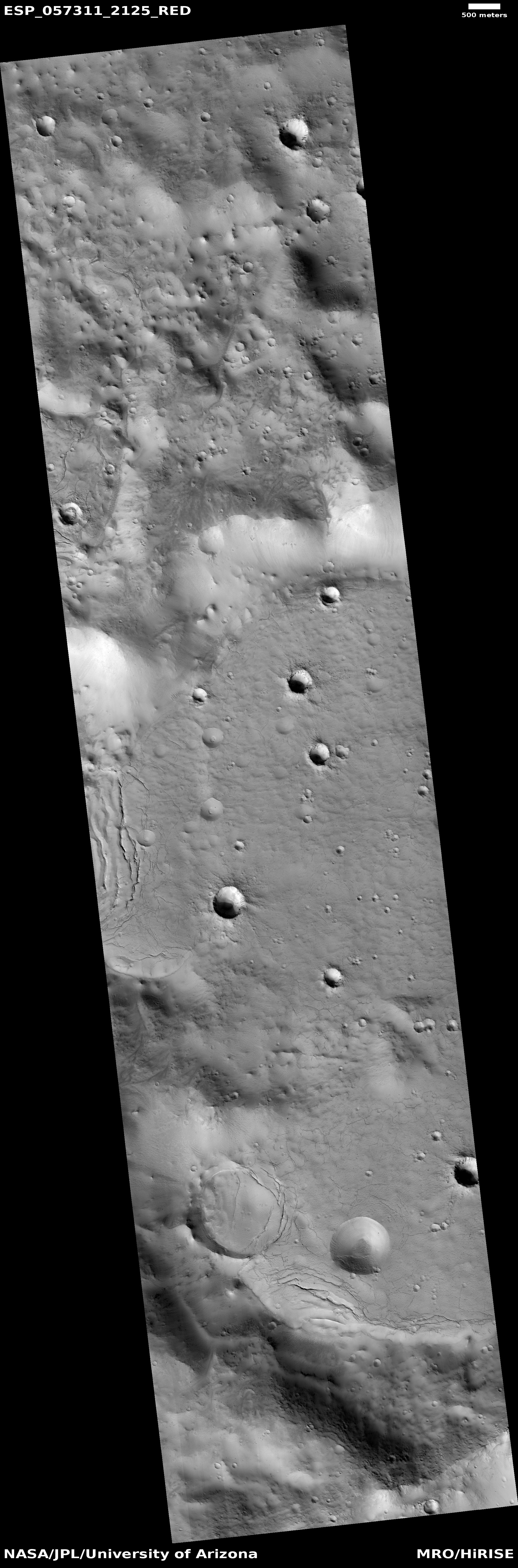
Cool image time! The image to the right, cropped and rotated to post here, was one of the uncaptioned photographs in the December Mars Reconnaissance Orbiter (MRO) image release. If you click on the image you can see the entire photograph. I have cropped the most interesting area, though cracks can be seen in other areas in the image.

What we appear to have here is a darker lower valley filled with dried mud, which over time has cracked as it dried. At its edges there appear to be ripples, almost like one sees on the beach as waves wash the shore. The perimeter slopes even show darker streaks as if the water in some places lapped up the slopes, and in others flowed downward into the valley.

Later, several meteorite impacts occurred, the largest of which produced concentric dried cracks on its outside perimeter. This impact also provides a rough idea of the depth of the mud in this valley.

Mud of course suggests that this lower valley once was filled with water. Was it? It is not possible now to come to a firm conclusion, but this image’s location shown by the red dot in the overview map below and to the right, provides a clue that strengthens this hypothesis.
» Read more

0 comments

A Christmas Carol

As I have done in the past, to celebrate this Christmas day I give you the classic 1951 version of Charles Dickens’ A Christmas Carol, starring Alastair Sim It remains the best version, by far.

Dickens did not demand the modern version of charity, where it is imposed by governmental force on everyone. Instead, he was advocating the older wiser concept of western civilization, that charity begins at home, that we as individuals are obliged as humans to exercise good will and generosity to others, by choice.

It is always a matter of choice. And when we take that choice away from people, we destroy the good will that makes true charity possible.

3 comments

China launches military satellite

The new colonial movement: China today used its Long March 3C rocket to launch a military communications satellite.

This was China’s 37th successful launch in 2018, only three launches less than their predicted 40 launches for the year. It almost doubles their previous record of 20 in 2016.

The leaders in the 2018 launch race:

37 China
21 SpaceX
14 Russia
11 Europe (Arianespace)
8. ULA

China leads in the national rankings, 37 to 34, over the U.S.

0 comments
1 2 3 4 155