Coronavirus and the madness of crowds

Yesterday I got a bit of frustrating and disappointing news. The 51st Lunar and Planetary Science Conference (LPSC-51) to be held in the Houston suburbs beginning on March 15 (to which I was planning to attend) had been canceled due to coronavirus/COVID-19 fears. From the organizers’ email:

We regret to inform you that LPSC 51 will be cancelled due to concerns about COVID-19. This difficult decision has been made after a careful assessment of the risks as determined by the CDC and WHO; consultation with NASA PSD leadership; and consideration of community feedback. We are fully committed to ensuring that our conference attendees remain safe and well.

The organizers had earlier in the week sent out an email stating that they were considering their options because of the epidemic, and would announce a decision on March 6. That they pushed forward the cancellation decision by two days was almost certainly prompted by the revelation yesterday that a case of coronavirus had been confirmed in Houston.

To say this is a disappointment is an understatement. I was very much looking forward to meeting face-to-face many of the planetary scientists I have been corresponding with during the past few years. I was also eagerly anticipating getting an up-front look at the most recent discoveries in the exploration of the solar system, and to pass those discoveries on to my readers.

My disappointment however must pale in comparison to the disappointment of the scientists involved, especially the younger ones trying to establish themselves in the field. They need conferences like this to not only promote their work, but to network and to learn for themselves what others in their field are doing.

What makes this decision more appalling to me is how completely pointless and fear-driven it is. While it makes sense to try to slow the spread of the disease while scientists scramble to understand it and possibly develop a vaccine, it also makes no sense to stop living and to cease all effort out of mindless fear and ignorant panic.

And what we have today is the latter. This planetary conference was not the only one cancelled this week. On March 2 the American Physical Society panicked and cancelled its only annual convention, only 36 hours before it was about to begin, out of a fear that a gathering of 11,000 scientists from all over the world would help spread the disease.

This decision was absurd, however, as a large bulk of the conference’s attendees had already arrived. The cancellation thus accomplished practically nothing to stop coronavirus, while succeeding ably in stymying the spread of knowledge.

The simple fact is that though COVID-19 is a concern and must not be ignored, it is hardly the worldwide crisis being touted by our mindless press, odious politicians, and largely politically correct intellectual community.

A rational look at the facts give a bit of context that deflates the balloon of this madness. Several facts, both good and bad:
» Read more

45 comments

DARPA finally picks Northrop Grumman for satellite servicing

Capitalism in space: Following the successful docking of Northrop Grumman’s Mission Extension Vehicle-1 (MEV) to a decommissioned commercial communications satellite on February 27, 2020, DARPA has finally selected that company as its partner in its government-funded satellite servicing program.

For reasons that have been puzzling, DARPA previously rejected the MEV and chose in 2017 as its partner what was then a mostly Canadian company, causing legal protests. That company however backed out of the program in January, and with the success of MEV, DARPA could no longer justify its strange aversion to Northrop Grumman.

Northrop Grumman had planned to market MEV to commercial companies. The infusion of support from DARPA will accelerate that process.

0 comments

Florida to reconfigure Cape Canaveral roads to accommodate New Glenn

Capitalism in space: Because the first stages of Blue Origin’s New Glenn rocket will be so large and heavy, Florida is instituting a project to widen roads and move light and utility poles in order to accommodate the transport from the factory to the launchpad.

The road widening will make room for the stage, which must follow a route not usually used. The more direct route however requires the stage to cross a bridge that cannot take its weight. If New Glenn does begin to fly regularly, however, I would expect money will eventually be found to rebuild that bridge.

1 comment

India’s next lunar landing attempt set for 2021

The Indian government has confirmed that the launch of Chandrayaan-3, India’s next attempt to land a lander and a rover on the Moon, has been delayed until the first half of 2021.

This delay is not really a surprise. After the failure of Vikram to land on the Moon in November 2019, they immediate initiated Chandrayaan-3 with the hope it could launch only one year later. Considering it took almost a decade to build Vikram, that short schedule seemed unrealistic, though getting it done much more quickly using what they learned is not unreasonable. A launch in 2021 is entirely doable for India. I hope they make it happen.

0 comments

Japan suspends funding to TMT

The Japanese government has confirmed that it has suspended payment of its annual contribution to the budget of the Thirty Meter Telescope (TMT) because of the project’s inability to begin construction on Mauna Kea in Hawaii.

Japanese astronomers strongly prefer placing TMT on Mauna Kea because it is relatively close to Japan, unlike the proposed replacement site in the Grand Canary Islands in the Atlantic.

I would say this is the next nail in the coffin for TMT in Hawaii. The National Science Foundation (NSF) has money to fund construction of a big telescope for U.S. astronomers, but has not been able to decide on whether to give the money to TMT, or to the Giant Magellan Telescope (GMT), already under construction in Chile, or to both.

Astronomers have been lobbying for dual funding, using the argument that the two telescopes are in the opposite north and south hemispheres. Moving TMT to the Grand Canaries, at a higher latitude than Hawaii, strengthens this argument. With the apparent exit of Japan it could be that the way is now cleared to give up on Hawaii and for TMT to make the move to a more welcoming site.

Hawaii’s protesters, supported by the state’s Democratically-controlled government, will of course celebrate. What they will be celebrating however will be the death-knell of science in Hawaii.

1 comment

OSIRIS-REx makes closest reconnaissance of Bennu yet

The spacecraft OSIRIS-REx yesterday made its closest reconnaissance yet of the asteroid Bennu, sweeping past its primary touch-and-go landing site Nightingale by a distance of only 820 feet.

The main goal of yesterday’s low flyover was to collect high-resolution imagery of the site’s surface material. The spacecraft’s sample collection mechanism is designed to pick up small rocks less than 0.8 inches (2 cm) in size, and the PolyCam images from this low pass are very detailed, allowing the team to identify and locate rocks of this size. Several of the spacecraft’s other instruments also took observations of the Nightingale site during the flyover event, including the OSIRIS-REx Thermal Emissions Spectrometer (OTES), the OSIRIS-REx Visual and InfraRed Spectrometer (OVIRS), the OSIRIS-REx Laser Altimeter (OLA), and the MapCam color imager.

After completing the flyover, the spacecraft returned to orbit – but for the first time, OSIRIS-REx reversed the direction of its safe-home orbit and is now circling Bennu clockwise (as viewed from the Sun). This shift in orbital direction positioned the spacecraft for its next close encounter with the asteroid – its first rehearsal for the sample collection event.

The touch-and-go sample grab is targeted to take place in August.

0 comments

Protein molecules found in meteorite

Scientists have discovered bits of a protein molecule inside a meteorite that fell in Algeria in 1990 and was quickly recovered.

The protein is called hemolithin.

For hemolithin to have formed naturally in the configuration found would require glycine to form first, perhaps on the surface of grains of space dust. After that, heat by way of molecular clouds might have induced units of glycine to begin linking into polymer chains, which at some point, could evolve into fully formed proteins. The researchers note that the atom groupings on the tips of the protein form an iron oxide that has been seen in prior research to absorb photons—a means of splitting water into oxygen and hydrogen, thereby producing an energy source that would also be necessary for the development of life.

The real significance of this find is what it reveals we do not know. Most asteroid material from the very beginnings of the solar system (the type of material that would contain such a protein) is very fragile, and does not survive the journey though the Earth’s atmosphere. Thus, our meteorite sample obtained here on Earth, which is our entire sample, is very biased.

When we start getting samples back from asteroids (as both Hayabusa-2 and OSIRIS-REx are about to do), our understanding of the early solar system, as well as that of asteroids, will change radically. This story only gives us a hint of that fact.

Hat tip reader and fellow caver John Harman.

2 comments

Birth of a planetary nebula

Beginnings of a planetary nebula

Astronomers, using the Atacama Large Millimeter/submillimeter Array (ALMA) telescope in Chile have created a multi-spectral radio image of a dying star in its very initial stages of becoming a beautiful planetary nebula.

[Using ALMA,] the team obtained a very detailed view of the space around W43A. “The most notable structures are its small bipolar jets,” says Tafoya, the lead author of the research paper published by the Astrophysical Journal Letters. The team found that the velocity of the jets is as high as 175 km per second, which is much higher than previous estimations. Based on this speed and the size of the jets, the team calculated the age of the jets to be less than a human life-span.

“Considering the youth of the jets compared to the overall lifetime of a star, it is safe to say we are witnessing the ‘exact moment’ that the jets have just started to push through the surrounding gas,” explains Tafoya. “The jets carve through the surrounding material in as little as 60 years. A person could watch their progress throughout their lifetime.”

Over time those jets, thought to be caused by the interaction of the central star with a smaller secondary star that orbits it, will interact increasingly with the surrounding gas. The result will be a quite spectacular planetary nebula.

0 comments

Upgrades to Deep Space Network to block commands to Voyager 2

A scheduled eleven month upgrade to one of the three Deep Space Network antennas used to communicate with planetary missions will prevent scientists from sending commands to Voyager 2 during that time period.

Data will still be downloaded, but if anything should go wrong, such as happened in January, it will be impossible to do anything about it. In January engineers were able to troubleshoot the problem and upload corrections. During these upgrades a fix will have to wait. To reduce the chance of serious issue, engineers will put Voyager 2 into a more dormant state during this time period.

The repairs are essential however, even if it means we lose Voyager 2. This network must work for all the other Moon and Mars missions planned for the next few decades, and an upgrade has been desperately needed for years.

1 comment

Mars rover Update: March 4, 2020

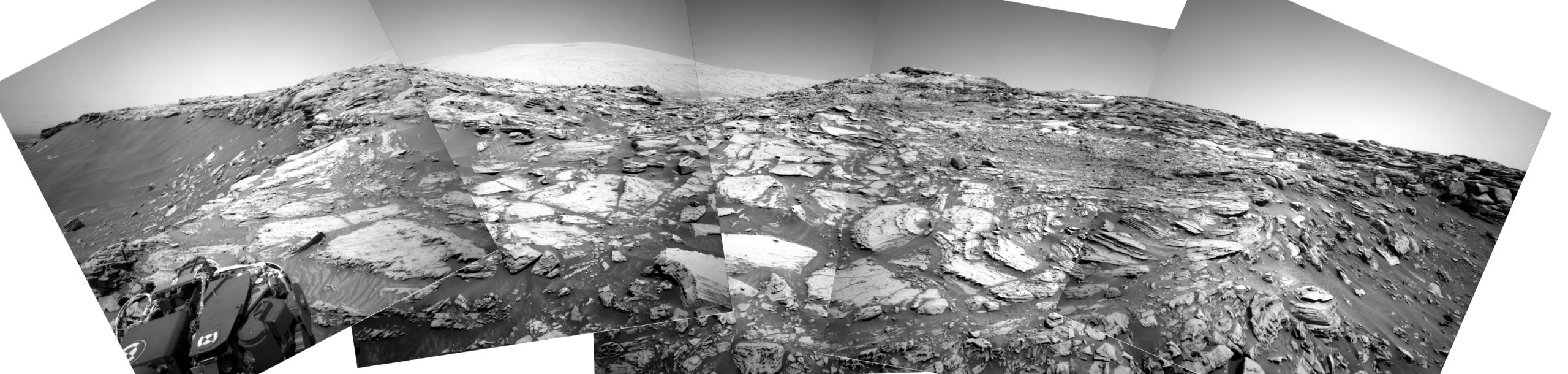
Panorama looking south and uphill
Click for full resolution.

Curiosity

[For the overall context of Curiosity’s travels, see my March 2016 post, Pinpointing Curiosity’s location in Gale Crater.

For the updates in 2018 go here. For a full list of updates before February 8, 2018, go here.]

Map of Curiosity's travels

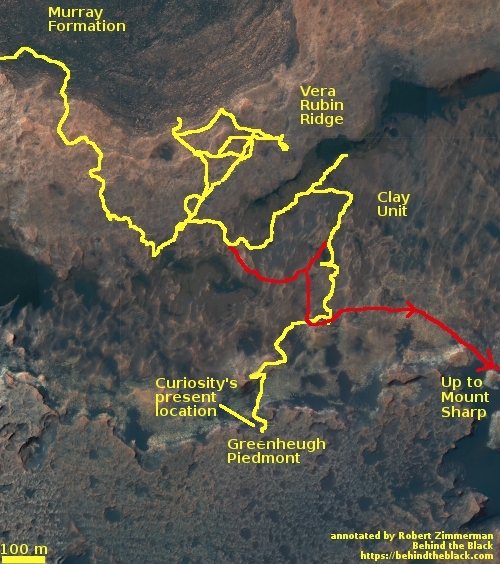
Since my last rover update on January 13, 2020, Curiosity has finally moved on from the base of Western butte, where it spent more than a month drilling a hole and gathering a great deal of geological data. Rather than head downhill and around the plateau and back to its planned route (as indicated by the red line in the map to the right), the Curiosity science team decided to push upward and onto the Greenheugh Piedmont (as indicated by the yellow line).

They had always planned to reach the top of this plateau, but not for several years. First they were going to head east to study a recurring slope lineae (see my October 2019 update), an example of a dark streak that darkens and fades seasonally and could provide evidence of water seepage from below ground.

Instead, they decided the close proximity of the top of the piedmont and its geology was too tempting. The piedmont is apparently made up of a layer that is very structurally weak, and breaks up easily, as you can see by the panorama above. It also appears to sit on softer, more easily eroded material, which thus accentuates this break up. If you look at the left part of the panorama you can see what I mean. The piedmont layer there is the thin unbroken layer sitting on what looks like sand. As that sand erodes away the layer quickly breaks into small pieces, as shown in the rest of panorama.

Traveling on the piedmont will likely be difficult and threaten Curiosity’s wheels. I suspect this reality prompted them to choose to get to the top and obtain data now, rather than wait several more years of rough travel that might have made access to the piedmont difficult if not impossible.

They presently sit just below the top, and are studying their options before making that last push.
» Read more

3 comments
1 141 142 143 144 145 169