Stalemate continues in Israel

With 99% of the votes counted from this week’s election Israel, it appears that the stalemate between the right and left party coalitions (that has forced three elections in the past year) will continue, with neither obtaining sufficient seats in the Knesset (Israel’s parliament) to form a majority.

The stalemate this past year has forced some consolidation in the number of parties, but not enough. Netanyahu’s conservative block remains the largest at 58 seats, but it needs 61 to form a government.

The problem remains the small party Yisrael Beytenu, which was once part of the conservative block but pulled out last year. Their leader, Avigdor Liberman, has repeatedly demanded the formation of a unity government, comprised of Netanyahu’s conservative Likud party with the liberal Blue-and-White party, thereby cutting out the smaller religious parties that form the rest of Netanyahu’s block.

Though this position appears to have caused Yisrael Beytenu to lose one seat in the most recent election, its base, made up mostly of Russian immigrants, has remained firm. These votes, while tending to be conservative, seem also hostile to religion, thus explaining Liberman’s demands.
2 comments

Trump refuses to renew FISA without changes

President Trump yesterday once again told Congressional leaders that he will let the law that authorizes the FISA court to expire rather than sign a renewal with no changes in the law.

The surveillance provisions are set to expire on March 15, and the White House indicated to Republican leaders Tuesday that it would support only a temporary, 30-day extension to allow Congress to iron out the reforms.

House Democratic leaders have indicated publicly they are open to bipartisan compromise.

“Just got back from the White House. @realDonaldTrump made it abundantly clear that he will NOT accept a clean reauthorization of the Patriot Act without significant FISA reform! I agree with him!” Kentucky GOP Sen Rand Paul tweeted Tuesday.

Paul has been pushing for some fundamental changes, and it is very clear now that he has Trump backing him.

As far as I am concerned, we will be better off letting this unconstitutional law expire entirely. It was specifically designed to to give the courts and federal agencies a method for violating the Constitution in order to allow them more freedom for providing us better security. The result however has been that those agencies did a poor job of protecting us even as they misused the law in an effort to overthrow a legal election.

That Congress was even contemplating a renewal without changes illustrates once again how little they care about the interests of the American people, or the Constitution. They apparently like such violations, and want the ability to allow them to continue. Trump (and Senator Paul) are forcing them to do their proper jobs.

6 comments

Primary turnout numbers for Trump

While most of the press has been focused entirely on the results to the Democratic Party’s presidential primary elections, few have noticed that President Trump has actually been getting a very large turn-out of voters in those same primary states, sometimes exceeding the entire Democrat total, even though his opponents stand no chance of gaining the nomination and there is really no reason to come out to vote for him.

The article at the link posts the numbers in every state that has so far held a primary election. In three of those eleven elections Trump topped all Democrats combined. In three other states his numbers exceeded 90% of the Democratic total, and in a fourth it was within 80%.

Of the four remaining states, three are so solidly Democratic (California, Massachusetts, and Vermont) that no one expects Trump to win them. Yet, Trump’s numbers in California were still 60% of the Democratic totals.

What does this tell us? It suggests that Trump’s support remains very passionate, and very large. It also suggests that in the November election Trump can expect a strong turn-out. Whether that turn-out can give him the majority in the total vote remains unknown, as he would still need to draw a lot of votes from the populous coastal Democratic strongholds in New York and California.

The totals here also strongly suggest that Trump will not lose any of the states he won in 2016, and might gain a few, meaning he is on track to win the election easily. That the Democratic candidate is likely going to be either communist Bernie Sanders or senile Joe Biden further reinforces that conclusion.

67 comments

Jupiter in glorious color

Jupiter in glorious color
Click for full image.

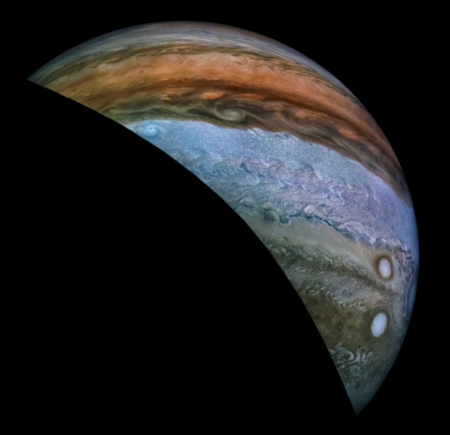
Cool image time! The photograph on the right, reduced to post here, was color enhanced by citizen scientist Emma Walimaki from the original Juno image in order to bring out the features and storms visible in the upper storm layers of Jupiter.

The photo was taken during Juno’s 25th close fly-by of the gas giant, and thus we are only seeing a small portion of Jupiter’s sphere.

In comparing this image with the original, it appears that Walimaki simply made the colors that were already there brighter and more distinctive. Thus, these colors represent real data. Jupiter’s cloud tops are really blue, orange, tan, and brown, unlike Earth’s consistently and boringly white water clouds.

3 comments

Blue Origin update on New Shepard and New Glenn

Capitalism in space: Blue Origin officials today provided an update on both its suborbital New Shepard spacecraft as well as its New Glenn orbital rocket.

First, the company’s CEO, Bob Smith, was quoted as saying that New Shepard would fly three more flights unmanned prior to its first manned flight, and that manned flight will occur before the end of this year.

Smith has made similar promises in the past, so if you are skeptical it is entirely understandable. They have already flown their second New Shepard craft six times successfully. It is unclear if they are they going with a new craft for these manned flights, or using this older test vehicle.

Second, the company released two short public relations videos touting the completion of the first fairing for their orbital New Glenn rocket. In addition, they still expect production of that rocket’s BE-4 engine to begin this year, with a first maiden flight next year.

That predicted launch date still fits the revamped schedule they announced back in October 2018, which suggests they have not experienced any major issues. The next year however will tell the tale.

5 comments

Summer at the Martian North Pole

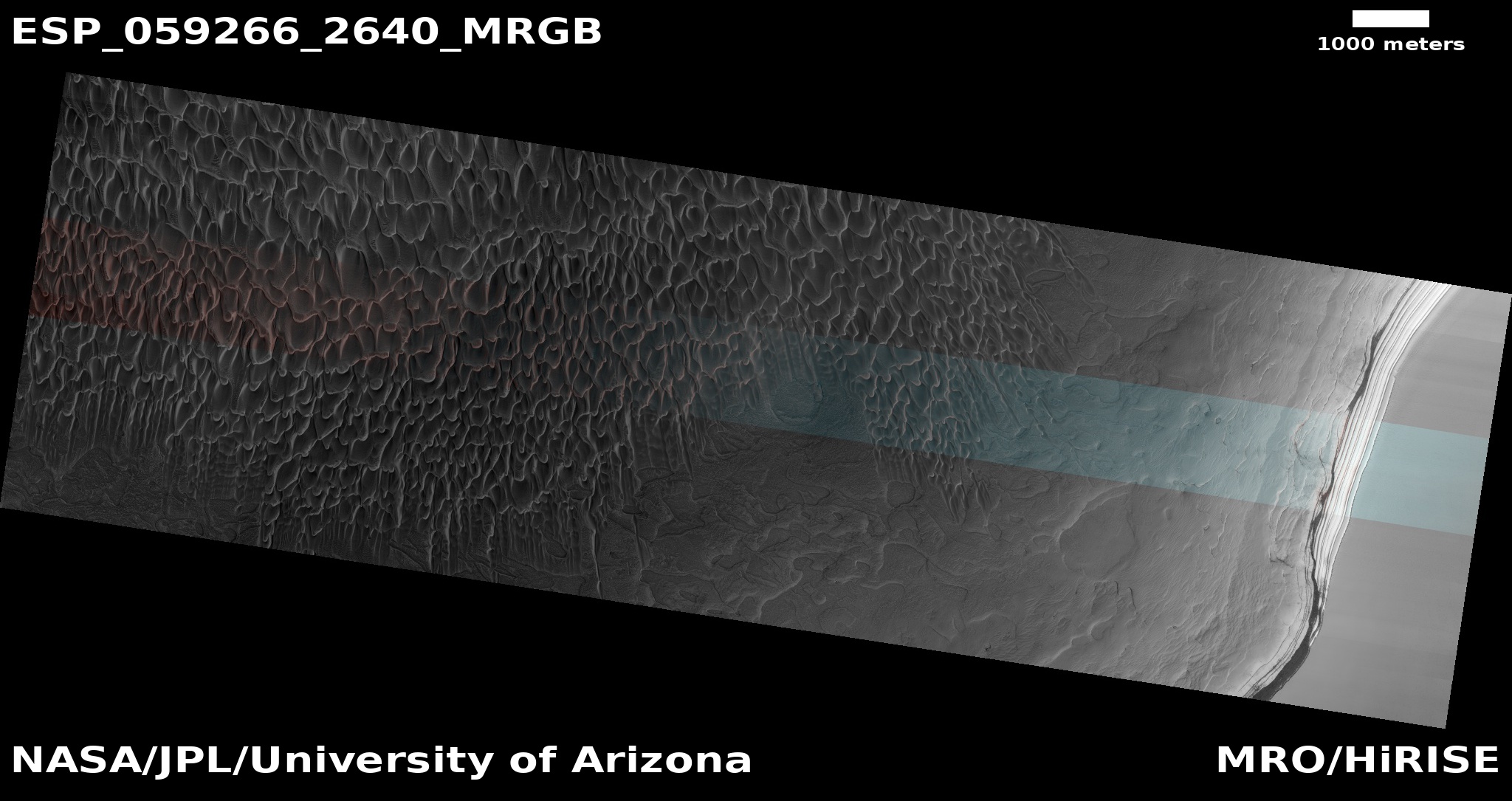
Buzzell pedestal crater in context with polar icecap scarp
Cool image time! The image above, cropped, reduced, and brighten-enhanced to post here, was taken by the high resolution camera of Mars Reconnaissance Orbiter (MRO) on December 26, 2019 of the dunes just below the 1,500 to 3,000 foot high scarp that marks the edge of the Martian north polar icecap. I have brought up the brightness of the dune area to bring out the details.

This one image shows a range a very active features at the Martian north pole. At this scarp scientists have routinely photographed avalanches every Martian spring, as they have been occurring, caused by the warmth of sunlight hitting this cliff wall and causing large sections to break off. As Shane Byrne of the Lunar and Planetary Lab University of Arizona explained in my September 2019 article,

On Mars half of the images we take in the right season contain an avalanche. There’s one image that has four avalanches going off simultaneously at different parts of the scarp. There must be hundreds to thousands of these events each day.

Buzzell dunes, March 19, 2019
Click for full image.

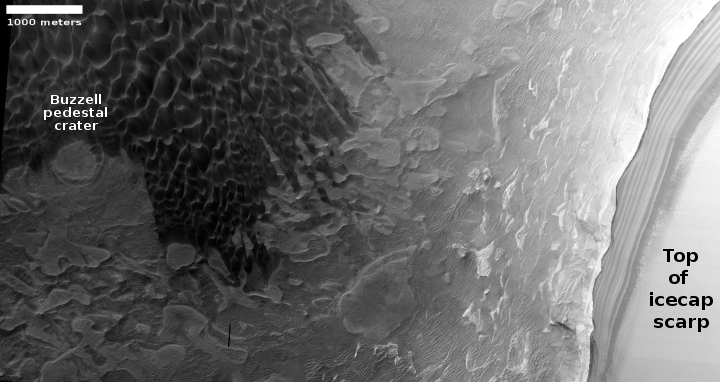
On the left side of the image is an area of dunes that Candice Hansen of the Planetary Science Institute in Arizona has dubbed “Buzzell.” As spring arrives here, she has MRO regularly take images of this site (as well as about a dozen others) to monitor the changes that occur with the arrival of sunlight on the vast dune seas that surround that polar icecap.

The image to the right zooms in on one particular distinct feature, a pedestal crater, surrounded by dunes, that I have labeled on the image above. This image was taken just as spring began, with the Sun only five degrees above the horizon. At that time the dunes and pedestal crater were mantled by a frozen layer of translucent carbon dioxide that had fallen as dry ice snow during the sunless winter and then sublimates away each Martian summer.

Since March I have periodically posted updates to monitor the disappearance of that CO2 layer. (See for example the posts on August 2019 and November 2019.) Below are two more images, showing the ongoing changes to this area from early to late summer.
» Read more

2 comments

ExoMars2020 parachute tests delayed until late March

The European Space Agency (ESA) has decided to delay until late March the next high altitude tests of the revamped ExoMars2020 parachutes, despite the success of recent ground tests.

The tests of the 15-meter-diameter supersonic and 35-meter-wide subsonic parachutes—an essential part of the entry, descent and landing phase of the mission—had been scheduled for December and February. The delay comes despite six ground tests demonstrating successful parachute extraction – the point at which damage was caused in earlier, failed high altitude tests.

Both tests need to be successful for the go-ahead for launch of 300-kilogram Rosalind Franklin rover during the July 25 to Aug. 13 Mars launch window. Any failure would mean a wait of 26 months for the next launch window, opening late 2022.

There will be a meeting next week of the project’s top management, from both Russia and Europe, and I strongly suspect that they are going to decide to delay launch to the 2022 launch window. Not only have the parachutes not been tested successfully at high altitude, they recently discovered an issue with the glue holding the solar panel hinges on the ExoMars Rosalind Franklin rover.

1 comment

Astra scrubs first orbital launch

Capitalism in space: Astra, competing for DARPA launch challenge, is about to attempt the first orbital launch of its Rocket 3.0. Live stream of launch embedded below.

The rocket is carrying three cubesats. DARPA’s goal is for the development of a rocket system that can very quickly go to launch. In this case Astra only found out what its payloads were about a month before launch, and had to proceed to launch in mere weeks. They will win $2 million. They can get another $10 million if they launch again by the end of March.

The launch went into an unplanned hold 53 seconds before launch. Their launch window extends to 6:30 pm (Eastern), so there is still a chance they can lift-off today.

They have now scrubbed the launch. No word yet on when they will reschedule. Their failure to launch today however means they will not win the $2 million launch challenge. It was unclear from the broadcast if they would win the $10 million if they manage two launches by the end of March. (According to this website, that award is also lost.) It was even unclear whether they would even try to launch their three cubesat payloads.

In fact, as I watched the post-scrub interviews, I began to get suspicious about this whole event. Astra has been very secretive about its work. They have never successfully launched before. Could this merely have been a demonstration that they could get a rocket set up on an empty concrete pad, with payload, in only a matter of weeks, knowing that the launch was simply impossible? I have no idea, but I do wonder.

My suspicions do not mean Astra won’t launch eventually. I just now have doubts they ever were ready today.

1 comment

OSIRIS-REx bypasses laser altimeter issue

The science team for OSIRIS-REx has figured out a bypass for the failure of one of the spacecraft’s laser altimeters, originally used during close flyovers of the surface of the rubble-pile asteroid Bennu.

The mission has made the decision to use OLA’s High Energy Laser Transmitter (HELT) to provide the ranging data to focus PolyCam during the Mar. 3 flyover of site Nightingale. OLA consists of two laser subsystems, the HELT and the Low-Energy Laser Transmitter (LELT). OLA’s LELT was originally scheduled to provide these data, however, as a result of the anomaly that occurred during the Recon B site Osprey flyover, the team has determined that the LELT system is no longer operable. Despite the LELT’s condition, the HELT system has continued to operate as expected, and will be used to focus PolyCam for the remaining reconnaissance passes.

According to Erin Morton, head of communications for OSIRIS-REx in the Principal Investigator’s Office, the failure of LELT will not impact the touch-and-go sample grab, presently scheduled for sometime in August.

We don’t need OLA [either the low or high energy transmitters] for the sample collection event. OLA’s main purpose was to collect the altimetry data needed to make topographical maps for the sample site decision. It successfully accomplished that last year – which means that the instrument has completed all of its primary mission requirements. OLA isn’t used for navigation.

Instead, they are using an autonomous system that compares previous high resolution images with images taken during descent. In addition, they have a lidar system available as well.

1 comment

Glacial breakup on Mars

glacial breakup on Mars
Click for full image.

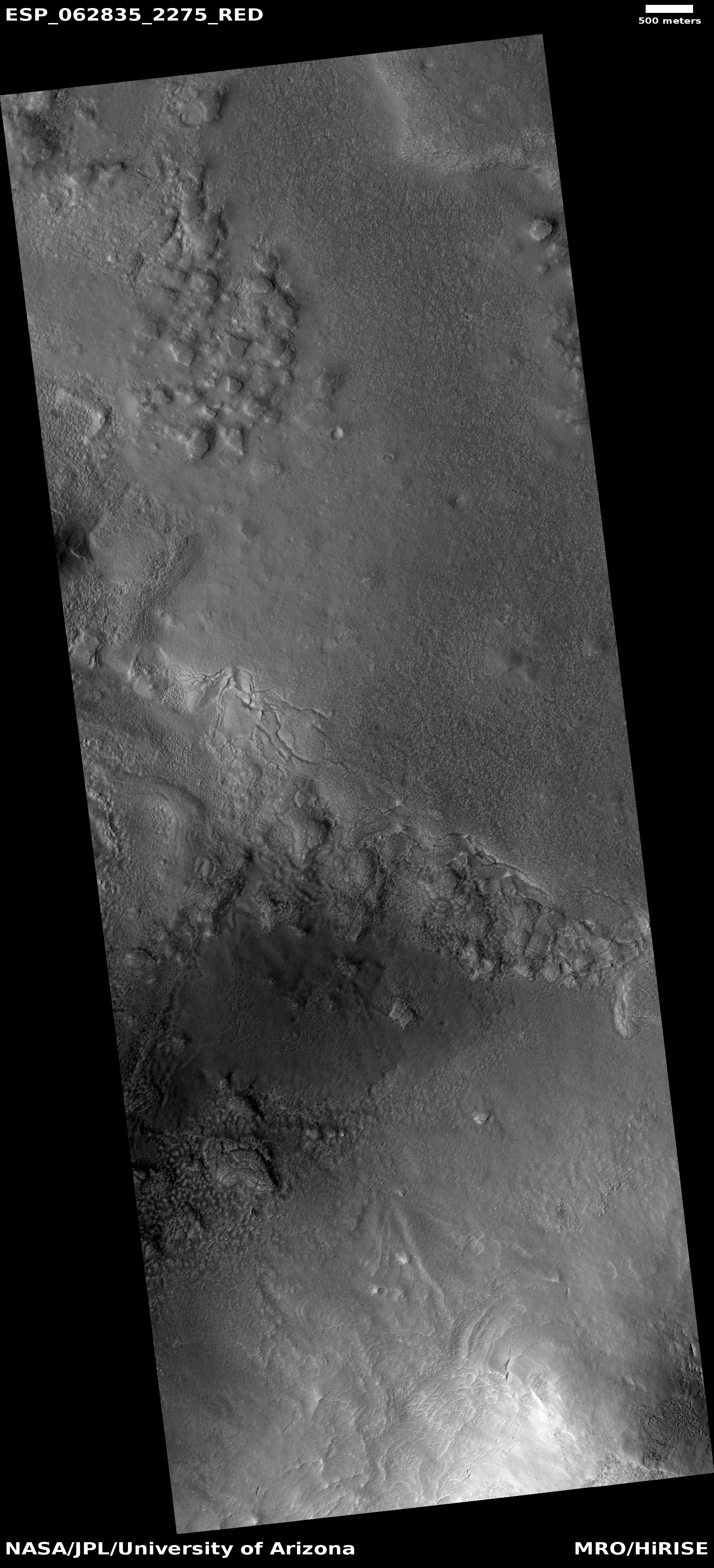
Cool image time! The photograph to the right, cropped and reduced to post here, was taken by the high resolution camera on Mars Reconnaissance Orbiter on December 22, 2019 and was titled “Contact Between Debris Apron and Upper Plains in Deuteronilus Mensae”.

The section of the full image that I have focused on shows what appears to be the downhill break-up of the surface debris covering an underlying water ice glacier. The grade is downhill to the south.

I am confident that this is buried glacial material based on recent research:

Both of these reports found lots of evidence of shallow ice in Deuteronilus Mensae, a region of chaos terrain in the transition zone between the Martian northern lowlands and the southern highlands.

With this image we see what appears to be the slippage of that ice downslope, causing breakage and cracks on the surface, with much of that surface made up of the dust and debris that covers the ice and protects it. Towards the bottom of the image it even appears that the disappearing ice is unveiling the existence of a bunch of buried bedrock mesas, typical of chaos terrain, previously hidden by the ice because it filled the surrounding canyons.

Below is a close-up of the photograph’s most interesting area of break-up.
» Read more

1 comment
1 142 143 144 145 146 169