SLS likely launch mid- to late-2021

According to comments by one NASA official last week, the first flight of SLS will likely not occur until the middle or late 2021, a further delay than the most recent prediction of April 2021.

NASA Associate Administrator Steve Jurczyk said on Friday that the first launch of the Space Launch System (SLS) with an uncrewed Orion spacecraft, Artemis I, will take place in mid-late 2021. He also said NASA will award contracts “within weeks” for the Human Landing System (HLS) as NASA strives to meet the Trump Administration’s goal of landing astronauts on the Moon by 2024 — the Artemis program. Embracing Artemis is the first step towards a trillion dollar cislunar space economy according to space industry executive Tory Bruno who spoke at the same conference in Laurel, MD. He urged everyone to stop “squabbling” and support the program.

There is a lot more in the article, including a lot of advocacy by Jurczyk and others for Lunar Gateway. I also found certain aspects of the Trump administration’s effort to make their 2024 target date for manned lunar landing, specifically related to the quick development of that Human Landing System (HLS), somewhat concerning:

We can’t thrash on the requirements. So on HLS, we said 90 days, we’re going to nail down the requirements. And if we can’t agree, NASA’s just going to tell you, use ours. We’re going to negotiate technical standards. Either use ours or show equivalency to yours, but after 90 days if we can’t get agreement, you’re going to use ours. … 90 days and we’re done with Human Landing System requirements.

I am all for doing it fast but one needs to also do it smart. I wonder about this approach.

Jurczyk noted that the administration and NASA are doing a lot of work outlining their plans for the whole Artemis exploration program following that lunar landing, and hope to reveal it by the end of March. Since this program still remains unfunded by Congress, that announcement will be part of the political campaign to obtain those funds.


4 comments

Chang’e-4 and Yutu-2 complete 15th lunar day on Moon

Chinese engineers have put both Chang’e-4 and Yutu-2 into sleep mode after successfully completing their fifteenth lunar day on the far side of the Moon.

According to the story from China’s state-run press, Yutu-2 has now traveled just under 400 meters, or about 1,311 feet. We do not have a map outlining its total path, though past data suggests it has generally traveled westward away from Chang’e-4. Other than this detail, the story provides little other information.

0 comments

Explosion during static fire test of SpaceX’s Starship-SN1 prototype

Capitalism in space: It appears that about two seconds into a static fire engine test tonight of SpaceX’s Starship-SN1 prototype, something went wrong, there was an explosion, the prototype suddenly lifted into the air and then crashed to the ground in a bigger explosion.

The video below shows the event three times. We shall have to await word from SpaceX as to what happened. So far it appears that no one was hurt.

23 comments

Falcon Heavy wins launch contract for NASA’s Psyche asteroid mission

Capitalism in space: NASA today awarded the launch contract for its Psyche asteroid mission, set to launch in July 2022, to SpaceX’s Falcon Heavy rocket.

The total bid price was $117 million, which according to the release includes “the launch service and other mission related costs.” Though this is higher than the normal price SpaceX charges for a Falcon Heavy launch ($100 million), it is far lower than the typical price of a ULA launch. Furthermore, Falcon Heavy has more power, so it can get the spacecraft to the asteroid faster.

0 comments

Photos prior to MEV-1 docking to Intelsat 901 satellite

Northrop Grumman has released photos taken by its Mission Extension Vehicle-1 (MEV-1) as it approached the decommissioned geosynchronous communications satellite Intelsat 901, just prior to docking.

As this was the first ever rendezvous and docking with a geosynchronous satellite, these are the first photos ever of such a spacecraft in that orbit. It was also the first docking with a spacecraft not designed for docking. MEV-1 managed it by using the satellite’s engine nozzle as a docking port.

Intelsat 901 has been in orbit for 18 years, and was only decommissioned because it had run out of fuel. From the pictures it looked solid and undamaged, ready to go again.

5 comments

Peering into a Martian pit

Peering into a pit
Click for full image.

Cool image time! The science team for the high resolution camera on Mars Reconnaissance Orbiter last week released the above image of a pit to the west of the giant volcanoes Arsia and Pavonis Mons. The left image is without any adjustments in exposure. The right image has brightened the pit’s interior to bring out details in order to see what’s there. As planetary scientist Ross Beyer of Ames Research Center noted in his caption:

The floor of the pit appears to be smooth sand and slopes down to the southeast. The hope was to determine if this was an isolated pit, or if it was a skylight into a tunnel, much like skylights in the lava tubes of Hawai’i. We can’t obviously see any tunnels in the visible walls, but they could be in the other walls that aren’t visible.

Wider view of pit
Click for full image.

Because the image has been rotated 180 degrees, north is down. The northern wall of the pit appears to be either very vertical, or overhung. A tunnel might head north from here, but because of the angle of the photograph, this cannot be confirmed.

To the right is a wider look from the full photograph, showing the surrounding terrain, with north now to the top. In line with this pit is a depression that crosses the east-west canyon to the north. This alignment strongly suggests that a fault or fissure exists here, and that an underground void along this fissure line could exist. It also suggests that a deeper and larger void could exist below that larger canyon.

This pit, and the accompanying fissures, were likely caused by crack-widening along these faults, produced as this volcanic region bulged upward.

Map of knowns pits surrounding Arsia Mons

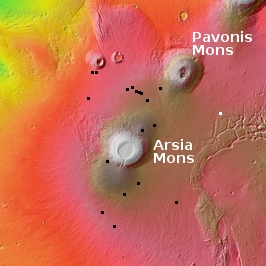
This pit is also one of the many many pits found near these volcanoes. The map to the right shows by the black boxes all the pits documented by the high resolution camera on MRO in the past few years, with this new pit indicated by the white box.

Beginning in November 2018 until November 2019 I was almost doing a monthly post reporting the new pits photographed by MRO. Since November however the number of new pit images dropped. This is not because every pit has been imaged, but because it appears they have completed their initial survey.

Below is a list of all those previous pit posts:
» Read more

2 comments

Review of Kepler data uncovers seventeen more possible exoplanets

Worlds without end: In reviewing the entire Kepler database of 200,000 stars, scientists have found seventeen more candidate exoplanets, including one only 1.5 times the mass of the Earth that is also in the habitable zone.

From the paper’s abstract:

We present the results of an independent search of all ~200,000 stars observed over the four year Kepler mission (Q1–Q17) for multiplanet systems, using a three-transit minimum detection criterion to search orbital periods up to hundreds of days. We incorporate both automated and manual triage, and provide estimates of the completeness and reliability of our vetting pipeline. Our search returned 17 planet candidates (PCs) in addition to thousands of known Kepler Objects of Interest (KOIs), with a 98.8% recovery rate of already confirmed planets. We highlight the discovery of one candidate, KIC-7340288 b, that is both rocky (radius $\leqslant 1.6{R}_{\oplus }$) and in the Habitable Zone (insolation between 0.25 and 2.2 times the Earth’s insolation). Another candidate is an addition to the already known KOI-4509 system.

I must emphasize that these are candidate exoplanets, meaning their existence has not been confirmed by other observations, and could very well turn out to be false positives.

Still, that this independent review matched the previous list of Kepler candidates within 98.8% means that the list of exoplanet candidates from Kepler is solid and worth further study. With thousands of candidates, however, that further study is likely going to take a very long time. And the backlog will be growing significantly with the many thousands of additional exoplanet candidates expected to be found by TESS.

0 comments

The modern blacklist in climate science

Link here. This story, which outlines the effort by global warming scientists to blacklist any scientist who expresses skepticism about human-caused global warming, is really not news. This odious effort was documented more than a decade ago in the climategate emails, where people like Michael Mann and others revealed their attempts to block publication of any papers by such skeptics.

The horrible part of the story however is how the blacklist effort has grown in fury and effectiveness since those climategate emails were released. Instead of being outraged that these scientists were warping peer review, the climate field rallied around them in support. Now, not only do global warmists try to block publication by any skeptics, they now work to deny them funding and to get them fired from their jobs.

And they have been increasingly successful. Do not expect any really honest science to come from the climate field for years to come. It has created for itself a very secure bubble. Nothing can challenge its work, even when that work involves data tampering and falsification.

12 comments

Trump pushing for major FISA reform or he will let law expire

It appears that President Trump is now demanding a major rewrite of the law that authorizes the FISA court or else he will allow the law to expire.

Congress has approximately 10 working days to reauthorize three expiring provisions of the USA Freedom Act, a 2015 bill that overhauled the country’s surveillance laws, with Attorney General William Barr and Senate Majority Leader Mitch McConnell (R-Ky.) backing a “clean” extension.

But Trump threw a grenade into those already fragile plans Thursday, when Sen. Rand Paul (R-Ky.) told reporters that the president supports his effort to include broader reforms of the Foreign Intelligence Surveillance Act (FISA) as part of any reauthorization of the intelligence programs. “I’ve talked to the president, and I plan on insisting on getting a vote,” Paul said, asked by The Hill about including broader FISA reforms in a bill would authorize the expiring provisions of the USA Freedom Act.

Paul wants a vote on an amendment that would prevent FISA warrants from being used against Americans. Paul’s proposal would also prevent FISA information from being used against Americans in a domestic courtroom. The president, according to Paul, is supportive of his amendment.

Trump’s apparent support for including broader changes to the surveillance court associated with FISA comes as he’s railed repeatedly about his campaign being “spied” upon by the Obama-era FBI. [emphasis mine]

The simple fact is that the FISA court has always been unconstitutional. As written, it is designed — and been used — to bypass the fourth amendment’s requirement that no searches be conducted of a person’s private property without probably cause and a search warrant. Paul’s amendment would simply bring the FISA court into line with constitutional law.

It would be criminal if both Congress and Trump allow this court to be renewed without making this change, especially considering the abuse committed by the Obama administration and government officials of the court in the past four years. Yet, Attorney General Barr as well as Senate leader Mitch McConnell (R-Kentucky) are calling for exactly that.

Barr indicated during the lunch that Trump would support a clean extension of the three programs. McConnell threw his support behind extending the authorities during a press conference after the powwow with Barr. “These tools have been overwhelmingly useful according to our intelligence advisors, and I hope that when the Senate deals with these expiring provisions in a couple of weeks, we will be able to continue to have them in law, which will, of course, provide maximum protection for the American people,” McConnell told reporters.

As good as McConnell has been in getting Trump’s conservative judges confirmed to the courts, he sometimes infuriates me. Considering the abuse of power seen in the FBI, Justice Department, and Obama administration, it makes no sense to renew these laws unchanged.

3 comments

More SLS launches planned/proposed?

According to this article from Ars Technica, NASA is considering shifting gears in its Artemis lunar program to become more dependent on SLS rather than a mix of SLS and commercial rockets.

The new plan, if implemented, would substantially cut commercially developed rockets—such as SpaceX’s Falcon Heavy and Blue Origin’s New Glenn—back from the Artemis program. Previously, NASA had said it would launch elements of its Human Landing System on commercial rockets, because such vehicles cost much less than the estimated $2 billion rate per launch of the SLS vehicle. Now, perhaps, private rockets may be called upon to launch smaller pieces such as a lunar rover to the Moon’s surface.

The source document, which appears to be very preliminary and which NASA calls “inaccurate”, also calls for four SLS launches leading up to the 2024 lunar landing, something that seems very very unlikely. Not only would it require Boeing to move faster in building additional SLS rockets, something the company has routinely been unable to do, this schedule assumes funding from Congress for SLS, something that remains unclear.

It also appears from the proposed launch schedule that Lunar Gateway is fading from view. This makes great sense, as the Gateway only causes delays and higher costs for any lunar landing program, something the Trump administration clearly wishes to avoid.

5 comments

SpaceX proposing big launch rate increase in Florida

Capitalism in space: According to documents filed with the FCC, SpaceX is planning a big increase in the number of launches from its two launchpads in Florida in the next few years.

SpaceX projects performing 38 launches from Florida in 2020, 30 from SLC-40 and eight from LC-39A. By 2023, the company projects as many as 70 launches, 50 from SLC-40 and 20 from LC-39A, an annual rate that holds steady through 2025. The vast majority would be Falcon 9 launches, although it expects as many as 10 Falcon Heavy launches a year, all from LC-39A.

These numbers include both Dragon cargo and crew launches, Starlink satellite launches, and a variety of other commercial customers, including launches into polar orbits, something that in the past was reserved for Vandenberg on the west coast, not Florida. The launch estimates are also likely high, as they come from an environmental assessment. SpaceX probably wants to get clearance for this many launches, just in case things go far better than expected. They will likely do less, though I would not be surprised if the numbers are still record-setting.

In addition, the documents outline SpaceX’s plans to build a mobile launch tower to accommodate national security payloads that must be installed on their rocket vertically. Falcon Heavy could provide this service, but right now its payloads get installed horizontally.

0 comments
1 143 144 145 146 147 169