Northrop Grumman completes test of Omega rocket 2nd stage

Capitalism in space: Northrop Grumman yesterday successfully executed a static fire test of the second stage of its OmegA rocket, set for first launch next year.

The first two stages are solid rockets, based on the solid rockets used by the space shuttle. They still have to test the liquid-fueled third stage.

The rocket’s development has essentially been funded by the military, and will thus be used mostly by them to launch national security payloads.

1 comment

Another professor arrested for lying about working with China

Another professor, this time from the University of Tennessee, has been arrested for lying about his ties to China in a NASA proposal.

Anming Hu, an associate professor in the department of mechanical, aerospace and biomedical engineering at the university’s flagship Knoxville campus, was charged with three counts of wire fraud and three counts of making false statements…

Prosecutors say Hu defrauded the National Aeronautics and Space Administration by failing to disclose the fact that he was also a professor at the Beijing University of Technology in China. Under federal law, NASA cannot fund or give grant money to Chinese-owned companies or universities.

According to the indictment, as the University of Tennessee last December was preparing a proposal on Hu’s behalf for a NASA-funded project, Hu provided false assurances to the school that he was not part of any business collaboration involving China.

I wonder how much technical information he passed to China’s space effort.

4 comments

First image of possible asteroid in orbit around the Earth

asteroid orbiting the Earth?
Click for full image.

The Gemini telescope in Hawaii has produced the first image of what might be only the second asteroid ever discovered in orbit around the Earth.

The newly discovered orbiting object has been assigned the provisional designation 2020 CD3 by the International Astronomical Union’s Minor Planet Center. If it is natural in origin, such as an asteroid, then it is only the second known rocky satellite of the Earth ever discovered in space other than the Moon. The other body, discovered in 2006, has since been ejected out of Earth orbit. 2020 CD3 was discovered on the night of 15 February 2020 by Kacper Wierzchos and Teddy Pruyne at the Catalina Sky Survey operating out of the University of Arizona’s Lunar and Planetary Laboratory in Tucson, Arizona.

The photo to the right has been cropped to post here. The streaks are stars, since the telescope was tracking the asteroid in an attempt to cull the most resolution of it from the image.

This object is only a few yards across, and could very well be a piece of space junk from a mission launched many decades ago. It is also not in a stable orbit around the Earth, and is expected to be ejected from that orbit in April.

5 comments

The coming small satellite revolution

Today I received a press release from the Universities Space Research Association (USRA), announcing a half-day symposium in Washington, D.C. on March 26, 2020 entitled ““The SmallSat Revolution: Doing More with Less.” The announcement was an invitation for the working press to register and attend, noting that the speakers will include, among others, Thomas Zurbuchen, NASA’s associate administrator science, Jeffrey Mamber, president of NanoRacks, and Patricia Cooper of SpaceX.

As interesting as this might sound at first glance, I will not attend. For one thing, it is on the other side of the continent, and I can’t afford to fly cross country for such a short meeting. For another, I don’t see the point. I attended a lot of these DC symposiums when I lived in Maryland, and though they were often very educational and the free food (paid for almost always by the taxpayer) was always enjoyable, I routinely found them somewhat lacking in newsworthy content.

Thirdly, and most important, yesterday I attended a much more newsworthy one day conference here in Tucson on exactly the same subject, dubbed the Arizona Academic CubeSat Symposium. Unlike the Washington event above — which will likely be a mostly superficial look at the burgeoning cubesat industry — yesterday’s symposium was focused on letting students and scientists describe actual and very ambitious cubesat projects presently under construction or design.

In less than seven hours I saw the following:
» Read more

9 comments

VIPER lunar rover delayed, NASA seeks new bids for delivering it to Moon

NASA earlier this week revealed that it is delaying the launch of its VIPER lunar rover until 2023, even as it announced that it is seeking new bids from commercial companies for delivering it to Moon.

In the past two months NASA has apparently been trying to reorganize its unmanned lunar exploration, resulting it a variety of puzzling and sometimes sudden shifts in policy and direction. First they announced they are going to issue a request for proposals, then they delayed it, then they issued it only to withdrew it one week later, with no explanation.

This week’s announcement is another attempt to release this request, accompanied by the delay in VIPER. Though NASA says the delay is to allow “for upgrades so that the rover can conduct longer and more exciting science on the Moon”, I think instead it is to simplify it so that the commercial companies will be able to launch and land it. VIPER’s heritage designs come from an earlier NASA rover project dubbed Resource Prospector that was cancelled because it was going to be too expensive and complex. I think the private companies building landers for such a rover told NASA that they couldn’t handle those heritage designs, forcing NASA to rethink.

If my suspicions are true, this is actually a very good sign. NASA is allowing the private sector to guide it in ways to save money and work more efficiently. That guidance might cause some initial delays as NASA shifts course, but in the long run it will make for a better run operation, costing less while accomplishing more.

3 comments

Chinese scientists publish radar results from Chang’e-4 lander

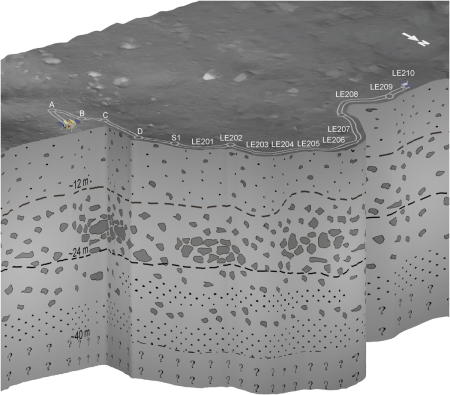
Layers as seen below ground by Chang'e-4 radar

The new colonial movement: Chinese scientists today published their first ground-penetrating radar results from their Chang’e-4 lander on the far side of the Moon.

Using a ground-penetrating radar instrument on Chang’e-4, researchers have found that the rover is likely sitting on different layers of ejecta—debris from multiple impacts over time that rained down at high velocities to blanket the lunar surface and now fill the crater. “[We] see a very clear sequence of [layers],” says Elena Pettinelli of Roma Tre University in Italy, one of the paper’s co-authors.

The rover’s radar instrument was able to penetrate up to 40 meters below the surface of the moon, more than twice the distance achieved by its predecessor, the Chang’e-3 mission, which landed on the lunar near side in December 2013. Data from the latest mission show three distinct layers beneath the rover: one made of lunar regolith, or soil, down to 12 meters; another made of a mix of smaller and larger rocks down to 24 meters; and a third with both coarse and fine materials extending the rest of the 40-meter depth.

The figure to the right comes from the paper [pdf] Though the layers have not been dated, their differences suggest different past events in the formation of this surface.

These results are excellent, but they also have many uncertainties. Radar can tell you a lot, but the only way you can really ever know anything about what’s below ground is to go there and actually do some digging.

1 comment

Starship moved to launch site

Capitalism in space: SpaceX’s Starship-SN1 prototype has been transported to its launch site at Boca Chica in preparation for a series of tests prior to its first launch hop, hopefully to a height of 12 miles.

Whether SN01 is still destined for flight, it’s safe to say that Starship SN01 tank testing could begin in a matter of days — SpaceX currently has early-morning roadblocks indicative of such testing scheduled from February 29th to March 2nd. SpaceX is likely to kick off by filling SN01 with water to check its tanks for leaks, followed by liquid nitrogen – chemically neutral but still incredibly cold. After that, SN01 would likely graduate to Raptor engine installation and a wet dress rehearsal (WDR) with liquid oxygen and methane before moving on to a static fire attempt, if all goes well.

I have embedded below the fold a fifteen minute video showing the transport operation. The pace is slow, so I suggest playing it at 2x normal speed, using the settings.

My immediate thought in watching this video is that SpaceX’s mobile transport vehicle certainly cost far less than the two mobile launchers NASA built for SLS (for a cost of about a billion dollars). In fact, SpaceX’s entire Starship development program will likely cost less than what NASA spent on just its mobile launchers.

» Read more

15 comments

Sea Launch launch platform finally moving to Russia

A giant Russian ship has arrived in California and has loaded for transport to Russia the Sea Launch giant mobile launch platform that now belongs to the Russian airline company S7.

The tale behind this move is long and convoluted. Sea Launch had been a partnership between Boeing, Russia, and the Ukraine, designed to lower the cost to launch with a launch platform that could be moved into the best location for each launch. After a launch failure the company went bankrupt, however, and Boeing wanted out. In addition, Russia invaded the Crimea, going to war against the Ukraine, making that part of the partnership impossible.

Russia didn’t have the money to buy Boeing out, so Boeing put a lien on the platform, preventing anyone from using it. Eventually, Russia paid Boeing off by providing the company several passenger seats on their Soyuz spacecraft that it could sell, which as far as I can tell have not been used. Along the way the Russian airline company took possession, though in truth it is really the Russian government in charge. They hope to use it to launch a next generation Soyuz rocket upgrade, supposedly built by S7.

7 comments

Northrop Grumman completes first robotic docking to a satellite

Capitalism in space: Northrop Grumman’s Mission Extension Vehicle (MEV) on February 25, 2020 completed first robotic docking to a satellite for the express goal of extending that satellite’s life.

This was the first time ever that a commercial robotic satellite docked with a second commercial satellite for such a purpose. It was also the first time such a docking has been done using no government funds.

More information here.

MEV-1 will stay docked to this satellite for about five years, providing it attitude control and guidance. The robot will then move the satellite into a safe graveyard orbit, detach, and be then capable of docking with a second satellite to extend its life as well. Moreover, Northrop Grumman is building a second MEV, with the hope it will be hired to save other satellites.

This achievement lays the foundation for a new stage in commercial space. It proves that unmanned robots can dock with objects in space, both to repair them and extend their life, but also to remove them from orbit and thus reduce the quantity of space junk.

1 comment
1 144 145 146 147 148 169