
August 18, 2020 Zimmerman/Batchelor podcast
Embedded below the fold in two parts.
» Read more
Embedded below the fold in two parts.
» Read more
An evening pause: Performed live 1979.
Hat tip Diane Zimmerman.

Click image for full movie.
The OSIRIS-REx science team has released a movie made by the spacecraft’s navigation camera during its August 11th final rehearsal prior to the planned sample grab-and-go now set for October.
The image to the right is a capture of one image when the spacecraft was closest to the asteroid, about 131 feet above the surface. The target landing site, dubbed Nightingale, is the somewhat smooth area near the top half of the frame.
These images were captured over a three-hour period – the imaging sequence begins approximately one hour after the orbit departure maneuver and ends approximately two minutes after the back-away burn. In the middle of the sequence, the spacecraft slews, or rotates, so that NavCam 2 looks away from Bennu, toward space. Shortly after, it performs a final slew to point the camera (and the sampling arm) toward the surface again. Near the end of the sequence, site Nightingale comes into view at the top of the frame. The large, tall boulder situated on the crater’s rim (upper left) is 43 feet (13 meters) on its longest axis. The sequence was created using nearly 300 images taken by the spacecraft’s NavCam 2 camera.
Nightingale might be their best choice, but it remains about half the size they had originally wanted for their grab-and-go site, with far too many objects larger than planned. They designed the grab-and-go equipment to catch objects smaller than 0.8 inches. Little at this location, or on the entire surface of Bennu, is that small. The asteroid is truly a pile of gravel, with no dust.
Russia’s Nauka module for ISS has finally arrived at its launch site at Baikonur, Kazakhstan, to be prepared for its launch, now scheduled for April 2021.
After its arrival and fitting-out, Nauka will become the primary laboratory module on the Russian segment. Currently, Russia has two small laboratory modules – Rassvet and Poisk – both of which will be dwarfed by Nauka. Additionally, Nauka will take the title of the heaviest Russian module on the Station, at 24.2 tons. Zvezda currently holds this honor, at 20.3 tons.
The module is thirteen years later than first planned and has been under construction for more than a quarter century.
The new colonial movement: The United Arab Emirates’ (UAE) Mars Hope orbiter has successfully completed its first course correction on its journey to Mars.
The success of this maneuver is a big deal, as it appears it was controlled from the UAE’s control center by its engineers. Up to now this project has mostly been a joint U.S/UAE project, launched by Japan, with U.S. universities doing the heavy lifting while training UAE personnel. Now the UAE engineers are in charge, and so they have to get it right.
They have another half dozen course corrections scheduled before arrival in February 2021, when the spacecraft will have its big maneuver, entering Martian orbit.
Despite being required for years by a legal congressional mandate to use SLS to launch Europa Clipper to the moon of Jupiter, NASA engineers have suddenly discovered unspecified “compatibility issues” that might make use of the rocket problematic.
At an Aug. 17 meeting of NASA’s Planetary Science Advisory Committee, Lori Glaze, director of NASA’s planetary science division, said the Europa Clipper mission had recently discovered compatibility issues involving the Space Launch System, the vehicle preferred by Congress to launch the spacecraft. “There have been some issues that have been uncovered just recently,” she said of the use of SLS for Europa Clipper. “We are in a lot of conversations right now with human exploration and others within the agency about what kind of steps we can take going forward.”
She did not elaborate on the compatibility issues regarding SLS. Such issues, industry sources say, likely involve the environment the spacecraft would experience during launch, such as vibrations. That environment would be very different for Europa Clipper, a relatively small spacecraft encapsulated within a payload fairing, than for the Orion spacecraft that will be the payload for most SLS launches.
“We are currently working to identify and resolve potential hardware compatibility issues and will have more information once a full analysis has been conducted,” NASA spokesperson Alana Johnson said in an Aug. 18 statement to SpaceNews. “Preliminary analysis suggests that launching Clipper may require special hardware adjustments, depending on the launch vehicle.”
This is a joke. It is also absurd and disgusting. Finally, it is also par for the course for NASA and all of today’s government, at all levels. They can’t do anything competently. From the beginning Europa Clipper was mandated to fly on SLS. And yet, they didn’t design the two to be compatible?
Based on this example we should of course demand that the government and these bureaucrats be given more power and more control over our lives. Of course.
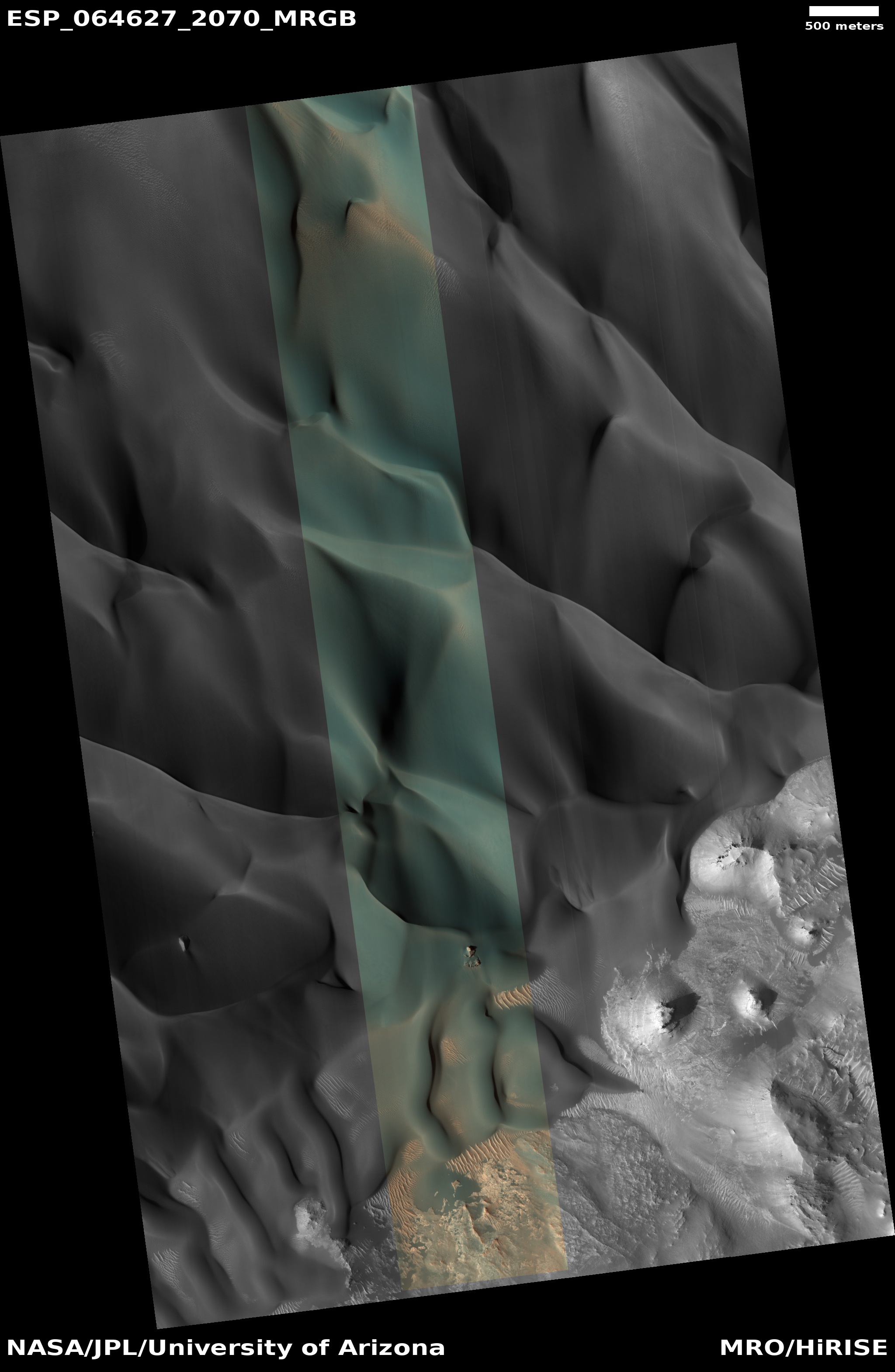
Click for full image.
Cool image time! The photo to the right, rotated, cropped, and reduced to post here, was taken by the high resolution camera on Mars Reconnaissance Orbiter on May 10, 2020, and shows the dune field inside a large unnamed sixty-mile-wide crater in the highlands of Mars.
Scientists have been using MRO to monitor this site to track both dust devils and dune changes since at least 2009. In 2009 the focus was on the numerous dust devil tracks, and in fact I posted in March 2020 a comparison of an earlier image with a more recent picture, showing how the earlier tracks had vanished in recent pictures, probably wiped clean by the global dust storm in 2018.
This time however I am less interested in the science, which I covered in detail in that previous post, but in the beauty of these dunes. They are large and majestic, and the color strip tells us that they exhibit striking colors of green, gold, and tan. Is there a place on Earth with dunes of such colors? If so, it is rare.
Make sure you click on the image to see the full resolution photograph. It is even more breath-taking.
Astronomers using the robotic Zwicky Transient Facility (ZTF) at the Palomar Observatory in California on August 16 spotted a tiny asteroid just after it had zipped past the Earth at a distance of only 1,830 miles, the closest any asteroid has ever been seen to do so without hitting the ground.
Asteroid 2020 QG is about 10 to 20 feet (3 to 6 meters) across, or roughly the size of an SUV, so it was not big enough to do any damage even if it had been pointed at Earth; instead, it would have burned up in our planet’s atmosphere.
“The asteroid flew close enough to Earth that Earth’s gravity significantly changed its orbit,” says ZTF co-investigator Tom Prince, the Ira S. Bowen Professor of Physics at Caltech and a senior research scientist at JPL, which Caltech manages for NASA. Asteroids of this size that fly roughly as close to Earth as 2020 QG do occur about once a year or less, but many of them are never detected.
The ability to spot these things is continuing to improve, though it does not appear they have yet obtained enough information to predict 2020 QG’s full orbit, or when or if it will return.
Though it really has been a foregone conclusion for more than a year, the Australian government this week gave its stamp of approval allowing the return capsule of Hayabusa-2 to land in Australia on December 6, 2020, bringing with it samples from the asteroid Ryugu.
What would we do without government bureaucrats!?
A good sign: Conservative firebrand and outsider Laura Loomer easily won her Republican primary today in Florida, beating five opponents by a large margin.
Loomer gained prominence on social media over the past few years for a number of stunts, including handcuffing herself to Twitter’s headquarters to protest her suspension from the platform and hopping the fence at Speaker of the House Nancy Pelosi’s house to protest immigration. In addition to her suspension from Twitter, Loomer has also been suspended from GoFundMe, Facebook, Uber, and Lyft.
After being suspended from multiple platforms, Loomer’s campaign message was that of free speech, “making America safe again,” and the Second Amendment. With the help of large donors, Loomer raised more than $1 million while campaigning.
She will now face the Democratic incumbent, Lois Frankel, in the November election.
An evening pause: This makes a great bookend to yesterday’s evening pause. And yes, they are having as much fun playing as the musicians yesterday.
Hat tip Mike Nelson.
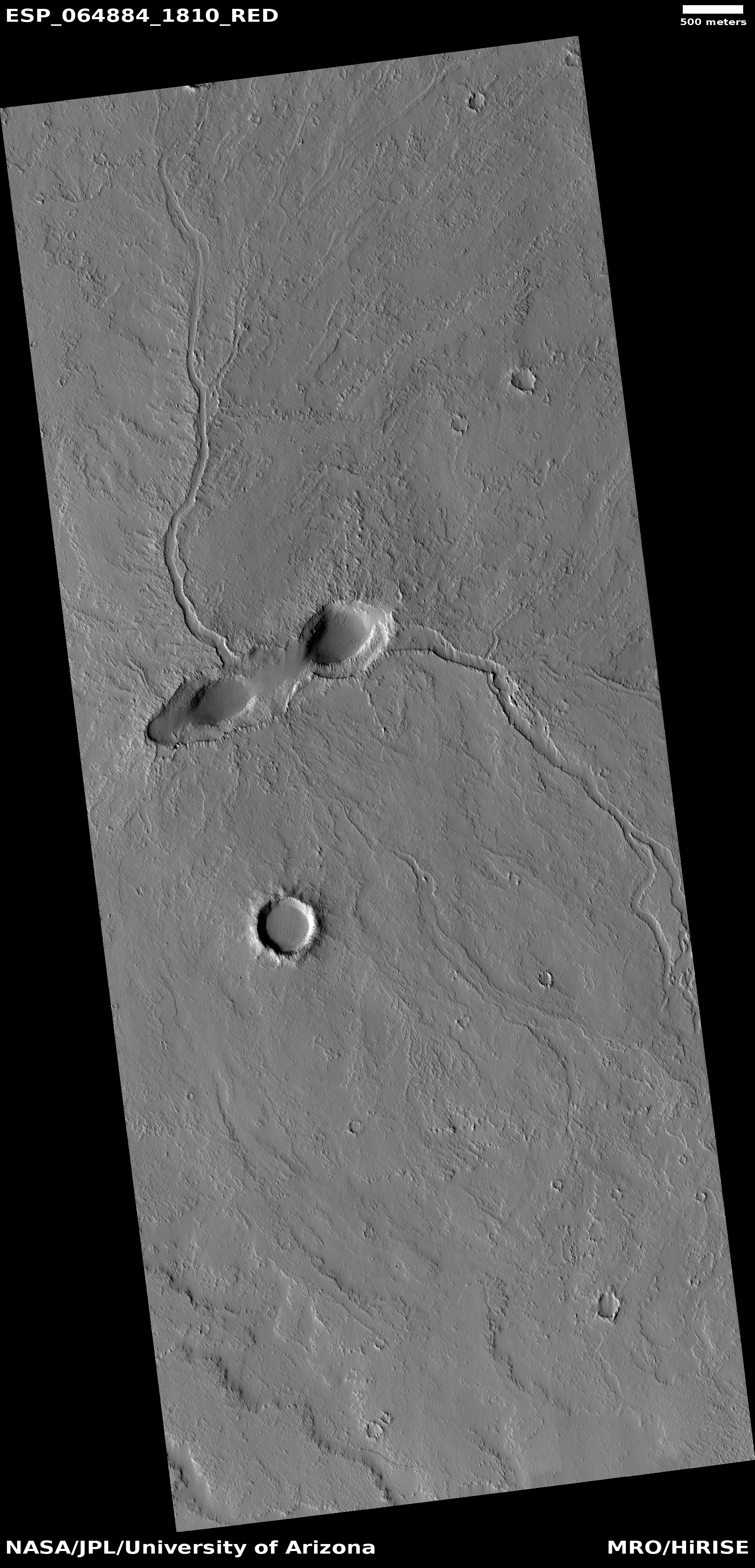
Click for full image.
Today’s cool image is of a recent high resolution image taken on May 30, 2020 by Mars Reconnaissance Orbiter (MRO) of what they label as a volcanic vent near Pavonis Mons, the middle giant volcano in the string of three that sit between Olympus Mons, the biggest Martian volcano in the solar system, and Valles Marineris, the biggest canyon in the solar system.
MRO took a previous picture of this vent back in 2010, when they labeled it instead a “small volcano.” Both labels are essentially correct. The two depressions here clearly were a vent for lava at some point in the past. The depressions also fit the definition of a small volcano, as they sit at a high point with two rills flowing down from them. In some ways they could be considered small calderas at the top of a volcano.
» Read more
The coming dark age: Stanford University has chosen to eliminate the requirement that applicants take basic admissions tests as part of their application process.
This includes the MCAT test for medical students and the GRE for physics students. The administration made the decision because of the restrictions being imposed on society due to COVID-19.
What this means of course is that the education standards required of doctors and engineers at this school will now decline. They will simply know less about their fields, because Stanford will not require them to learn it.
However, I am sure Stanford will make sure these future doctors and physicists will be able to explain white privilege and the all-compassing existence of racial and gender bigotry in every procedure they do. Without question. What’s more important, learning how to be a good doctor or condemning the imagined past evils of America?
Capitalism in space: According to its founder and CEO Peter Beck, the smallsat rocket company Rocket Lab is now planning a private Venus mission to be launched in 2023.
The 2023 mission will employ Rocket Lab’s two-stage Electron booster and Photon satellite bus. The 57-foot-tall (17 meters) Electron is a viable option for interplanetary missions now, thanks to recent advances in battery technology that boost the performance of the rocket’s Rutherford engines. With that improvement, Electron is now capable of lofting up to 660 lbs. (300 kilograms) of payload to low-Earth orbit instead of 500 lbs. (225 kg), Rocket Lab representatives have said.
“It opens the window for Venus, and it opens the window for recovery,” Beck said. (The company is working to recover and reuse the Electron’s first stage. Returning boosters will make guided re-entries to Earth’s atmosphere, which will require more fuel, which in turn will require more powerful engines to get the added weight off the ground.)
Photon, which has yet to make its spaceflight debut, won’t descend into Venus’ sulfurous skies on the coming mission. The current plan calls for the spacecraft to deploy one or more smaller probes into the planet’s atmosphere, Beck wrote in a Twitter post on Aug. 4.
There is a certain irony here, if Beck launches a private interplanetary science mission ahead of Elon Musk. Musk created the rocket company SpaceX expressly because he wanted to do a private science mission to Mars and needed an affordable rocket to do it. Since then he has been so focused on making that rocket company succeed he has not devoted any effort to that initial science mission concept. Beck, who came much later, now appears set to beat Musk to this first milestone.
Capitalism in space: SpaceX today successfully launched three commercial Earth reconnaissance satellites plus another 58 Starlink satellites.
They have now put 653 Starlink satellites into orbit.
The first stage, which was flying a record sixth time, successfully landed on its platform in the Atlantic. They also caught one of the fairing halves, and are retrieving the second half out of the ocean. Both fairings were also reused.
The leaders in the 2020 launch race:
19 China
13 SpaceX
9 Russia
4 ULA
The U.S. now leads China 21 to 19 in the national rankings.
Link here. Sweden imposed almost no rules when the Wuhan virus arrived. And though Sweden’s death toll was higher than many other places, consider this:
Of the 5,783 deaths, how many do you think were of people under the age of 40-years-old? 20%? 10%? No. Not even close. In Sweden, 26 people under the age of 40-years-old have died from COVID-19. That means less than one-half of one percent of the deaths associated with the coronavirus were of people younger than middle age. What’s more is that they have now essentially flattened the curve completely to the point that they often report zero deaths on any given day. [emphasis in original]
Also, only one school-age child died. Only one.
This is not a disease to be feared if you are healthy, especially if you are healthy and young. We should stop panicking.
An evening pause: 2CELLOS is Luka Sulic and Stjepan Hauser. This was performed live in Tokyo in July 2015. And boy, were they all having fun doing it.
Hat tip David Eastman.
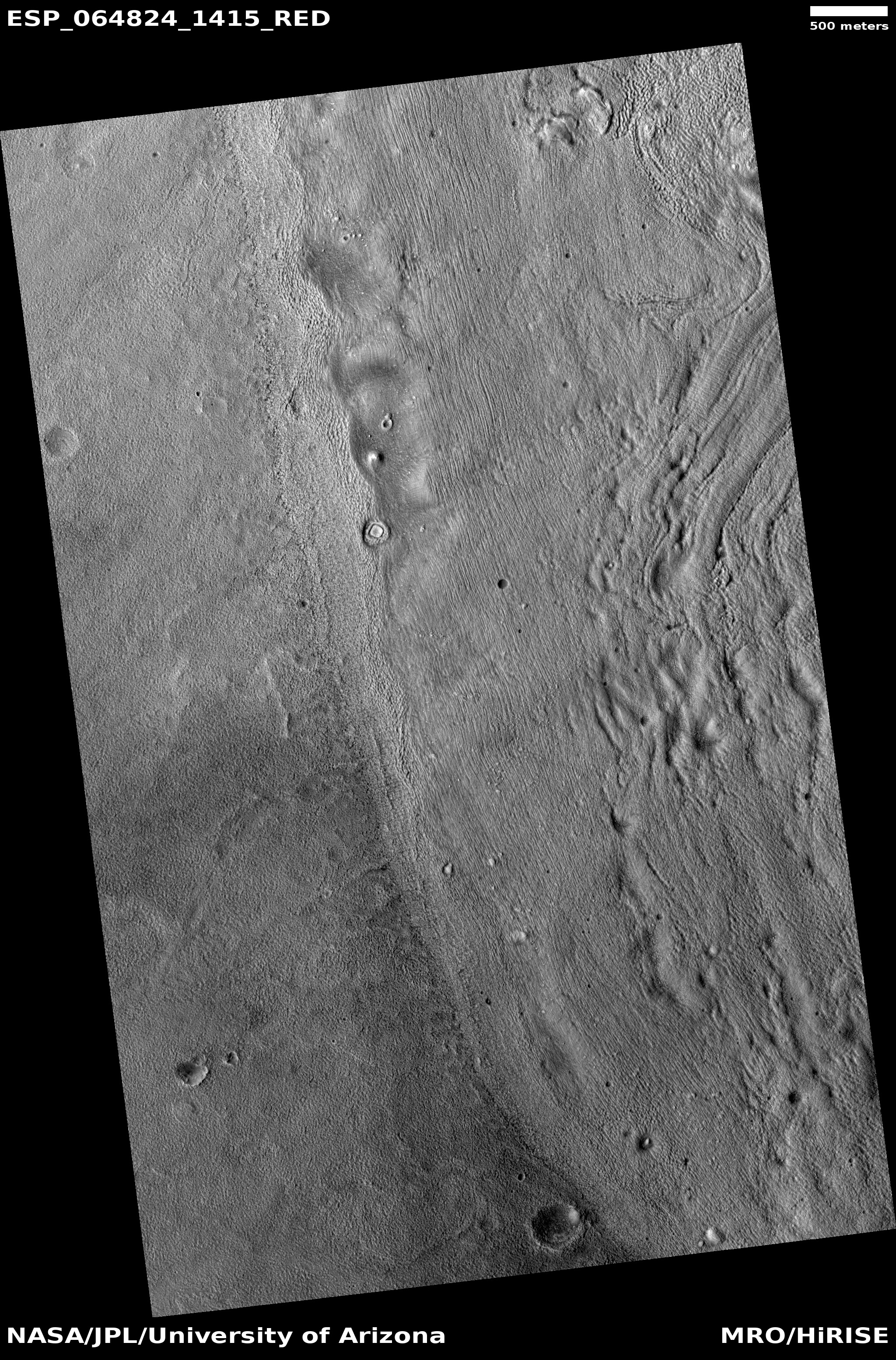
Click for full image.
Today’s cool image, taken on May 25, 2020 by the high resolution camera on Mars Reconnaissance Orbiter (MRO), provides a nice example of the typical foot of an inactive buried glacial flow on Mars. The image to the right, rotated, cropped, and reduced to post here, focuses on the center of the full image. Uphill is to the right. The glacier’s edge runs down the middle left of the photo.
Scientists call this a lobate flow because its shape resembles a lobe, smooth and rounded as it comes down the slope. Located at 38 degrees south latitude to the east of Hellas Basin and just to the north of one of that basin’s major infeeding canyons, Harmakhis Valles, this flow comes down the west side of a large mountain. The overview map below provides the context, with the white rectangle indicating the photo’s location.
» Read more
Cool movie time! Below is a short movie created by citizen scientist Gerald Eichstädt from images taken by Juno as it swung past Jupiter on its 28th close pass since arriving in orbit in 2016.
In natural colors, Jupiter looks pretty pale. Therefore, the still images are approximately illumination-adusted, i.e. almost flattened, and consecutively gamma-stretched to the 4th power of radiometric values, in order to enhance contrast and color.
Like for all its previous flybys, Juno approached Jupiter roughly from north, and left Jupiter looking towards the soutern hemisphere. Closest approach to Jupiter was 3,500 km above the nominal IAU 1-bar level, and near 25.3 degrees north (planetocentric), according to long-term planning of November 2017.
The uncertainty of science: According to a new paper published today, Oumuamua wasn’t a hydrogen iceberg as proposed by other scientists earlier this year.
Traveling at a blistering speed of 196,000mph in 2017, ‘Oumuamua was first classified as an asteroid, and when it later sped up, was found to have properties more akin to comets. But the 0.2km radius interstellar object didn’t fit that category, either, and its point of origin has remained a mystery. Researchers focused on the giant molecular cloud (GMC) W51—one of the closest GMCs to Earth at just 17,000 light years away—as a potential point of origin for ‘Oumuamua, but hypothesize that it simply could not have made the journey intact. “The most likely place to make hydrogen icebergs is in the densest environments of the interstellar medium. These are giant molecular clouds,” said Loeb, confirming that these environments are both too far away and are not conducive to the development of hydrogen icebergs.
The hydrogen iceberg theory was for many reasons very very speculative, and not very convincing, which is why I never posted a link to it when it became clickbait for the mainstream press several months ago. The object’s behavior as it zipped through the solar system, combined with its elongated shape, still leave us with questions. While some scientists have definitely stated it could not have been an alien spacecraft, that likely conclusion remains as uncertain as the theory that it was a hydrogen iceberg.
The only way we will definitely know is to go and look at it. And such a mission remains possible, with launch dates in 2021, 2022, or 2023, with technology we presently have, if we were to move fast.