Astra wins three-launch contract from NASA

Capitalism in space: Astra, which as yet not achieved its first orbital launch, has won a three-launch contract from NASA valued at just under $8 million.

Astra, the Alameda-based space launch startup that recently announced its intent to go public via a SPAC merger, has secured a contract to deliver six cube satellites to space on behalf of NASA. Astra stands to be paid $7.95 million by the agency for fulfilment of the contract. This will be a key test of Astra’s responsive rocket capabilities, with a planned three-launch mission profile spanning up to four months, currently targeting sometime between January 8 and July 31 of 2022.

There is no word on when the first flight of its rocket, dubbed Rocket, will occur. The company has completed two test launches, with the second nearly making orbit.


2 comments

Military admits F-35 is impossible to use, expensive, and an utter failure

Another typical federal project: The military has now admitted that Lockheed Martin’s F-35 fighter jet, a decades-long project to replace the F-16, is an utter failure and must be replaced.

The list of basic problems with the jet are truly appalling.

In spite of its advanced technology and cutting-edge capabilities, the latest stealth fighter suffers from structural flaws and slew of challenges.

Most recent among them is a structural engine flaw and shortage in its production. The F-35’s engine problem is partly based in not being able to deliver them for maintenance as fast as needed, in addition to a problem with the heat coating on its rotor blades which shortens engine lifespan considerably. Defense News described it as a “serious readiness problem”, suggesting that as soon as 2022, nearly 5 to 6 per ent of the F-35 fleet could be effectively grounded as it waits for engine replacements.

Another challenge is the plane’s software. Most modern fighter jets have between 1 to 2 million lines of code in their software. The F-35 averages 8 million lines of code in its software, and it’s suffering from a bug problem. To fix this, the US Department of Defense is asking three American universities to help figure it out.

The fighter jet also suffers from a slightly embarrassing touchscreen problem. After making the switch from hard flipped switches to touch screens, pilots report that unlike a physical switch that you’re confident has been activated, touch screens in the plane don’t work 20 percent of the time says one F-35 pilot.

The worst part of this story is that this kind of incompetence has been par for the course for big federal projects like this for decades. Our government in Washington is corrupt and unqualified to even be dog catcher, but we voters don’t seem to have the courage to fire them. We certainly don’t fire the politicians who appear quite willing to encourage this corruption.

47 comments

Study: Only 10% chance of catching COVID from infected person within household

Holy moley! A new study of more than 7,000 households in Boston with at least one infected person has found that there is only 10% chance that another member of the household will become infected also.

US researchers analysed data from more than 7,000 homes in Boston and found more than 25,000 people lived there between March 4 and May 17, 2020. In this time frame 7,262 people caught Covid but they only passed it on to a further 1,809 people they lived with, a transmission rate of 10.1 per cent.

The paper also found the likelihood of passing the virus on to someone you live with was lower for bigger hosueholds. For example, someone in a home with three to five people — one of whom was infected — was 20 per cent less at risk than a two-person house.

The study also found that infection was closely correlated with other illnesses. If you had other health issues, such asthma, cancer, were overweight, or had liver disease your chances of getting infected rose significantly.

This report is consistent with other research, that has found infection rates in households ranged from 16.6 to 19.5 percent. All tell us that even if you spend a lot of time with someone infected, if you are healthy your risk of catching COVID is relatively low. And if you are healthy your chances are dying are almost nil.

So I ask: When you are out hiking by yourself in the great outdoors, why the heck are you wearing a mask? And why do you stupidly put one on when you might pass someone else five feet away for about two seconds? Are you that fearful of life?

11 comments

Today’s blacklisted American: The pioneers who settled the west

The Oklahoma Land Rush: cancelled
The Oklahoma Land Rush, wiped from history.

They’re coming for you next: A local community college in Oklahoma has removed a monument that commemorated the pioneers who settled the state in the 1800s because some people complained it was “not inclusive.”

The monument depicted the Oklahoma land run of 1889, which occurred on the day the U.S. government opened Oklahoma up to homesteaders for settlement. Apparently, there were complaints about this depiction on social media (which usually translates as a Twitter mob) as well as threats of violence. The college’s response to these mob threats?
» Read more

24 comments

Skiing dry ice boulders on Mars, captured in action!

Grooves in dune created by sliding dry ice blocks
Click for full image.

Today’s cool image is an update on a previous cool image published in April 2020 about how scientists believe the grooves seen on the slope of a giant dune in Russell Crater on Mars are believed to be formed by frozen blocks of carbon dioxide sliding down the slope when spring arrives. The photo to the right, taken on March 3, 2020 by the high resolution camera on Mars Reconnaissance Orbiter (MRO) and rotated and cropped to post here, shows these grooves. As I wrote then,

Because the block is sublimating away, the gas acts as a lubricant so that it can slide down the hill. If large enough, the dry ice block will stop at the base of the hill to disappear in a small pit. If small enough, it actually might completely vaporize as it slides, explaining the grooves that appear to gradually fade away.

The scientists actually did a test on Earth, buying a dry ice block at a grocery store and releasing it at the top of a desert dune. Go to my April 2020 link above to see the very cool video.

Several planetary scientists did further combing through many MRO photos of this dune and now think they have spotted examples where the camera actually captured a block as it was sliding downhill.
» Read more

1 comment

Virgin Galactic delays its next suborbital flight again

Capitalism in space: Virgin Galactic announced yesterday that it is now delaying the next manned flight of its suborbital Unity spaceship in order to address what appear to be still unresolved technical problems that almost caused the last manned flight to crash.

In an earnings call Feb. 25 timed to the release of its fourth quarter and full year 2020 financial results, company executives blamed an aborted test flight of SpaceShipTwo Dec. 12 on electromagnetic interference (EMI) that caused a flight computer to reboot just as the vehicle ignited its hybrid rocket engine. The vehicle glided to a safe landing at Spaceport America in New Mexico.

Mike Moses, president of Virgin Galactic, said a new flight control computer system is the likely source of increased levels of EMI. The company took steps to shield components from that interference to avoid a similar reboot and prepared to make a powered test flight as soon as Feb. 13. But in the final days of preparations, technicians noted continued EMI issues with vehicle systems.

The flight they had hoped to do this month has now been pushed back to May. They have also announced that then devote the rest of this year doing more test flights and will hold off any tourist flights until ’22.

Michael Colglazier, chief executive of Virgin Galactic, said the company is sticking to the flight test program it announced last fall. The May flight will be followed by two more: one with two pilots and a “full cabin” of company employees to test the passenger cabin of the vehicle, followed by one with company founder Richard Branson on board. Colglazier said the company isn’t yet announcing specific dates for those flights, but expects both to take place this summer.

That will be followed by a flight for the Italian Air Force, confirming an agreement signed in October 2019. That flight will carry a set of research payloads and three Italian payload specialists, and generate revenue for the company. Colglazier said that flight would likely take place in late summer or early fall and generate revenue for the company, “and will conclude our product test program.”

The company also claims that its second SpaceShipTwo spacecraft will begin testing this summer.

We shall see. The track record of this company has been abysmal, and its been that way for almost two decades of non-achievement.

4 comments

Relativity touts next generation rocket before its first generation rocket has even launched

Capitalism in space: In an interview with CNBC the CEO of Relativity Space, Tim Ellis, pushed his company’s plans to develop a completely reusable rocket, dubbed the Terran-R, even though they have as yet completed even one test launch of their first rocket, the Terran-1.

Called Terran R, the reusable rocket is “really an obvious evolution” from the company’s Terran 1 rocket, Relativity CEO Tim Ellis told CNBC – the latter of which Relativity expects to launch for the first time later in 2021. “It’s the same architecture, the same propellant, the same factory, the same 3D printers, the same avionics and the same team,” Ellis said. “I’ve always been a huge fan of reusability. No matter how you look at it – even with 3D printing, and dropping the cost, and [increasing the] automation of a launch vehicle – making it reusable has got to be part of that future,” Ellis added.

Terran R is the first of several new initiatives that Ellis expects Relativity to unveil in the year ahead, with the company having raised more than $680 million since its founding five years ago. Just like Terran 1, Relativity will build Terran R with more than 90% of the parts through additive manufacturing – utilizing the world’s largest 3D printers as what Ellis calls “the factory of the future.”

Relativity, valued at $2.3 billion, ranks as one of the most valuable private space companies in the world. Its investors include Tiger Global Management, Fidelity, Baillie Gifford, Mark Cuban and more.

All well and good, but maybe before Ellis brags about his next generation rocket he might be better served to focus on getting that first rocket successfully off the ground later this year. It is a good thing his company is thinking of making its rockets reusable, but right now he is overselling while under-performing, a very bad sales technique. Better to do what Scotty of Star Trek did routinely, undersell while over-performing.
» Read more

3 comments

Apollo 16 Lunar Rover “Grand Prix”

An evening pause: This seems especially appropriate with the arrival of another rover on Mars last week.

On their first day of three on the lunar surface, John Young and Charles Duke deployed their rover and took it for a test drive before heading out to nearby Plum Crater for two hours of sample gathering and exploration.

This footage shows Young driving with Duke filming and reporting what he sees. The goal was to gather engineering data on how the rover’s wheels functioned in the very dusty lunar soil.

This short clip nicely illustrates the ambitious achievement of the American Apollo missions that should give pause to any arrogant modern young engineer. This was before home computers and CAD-CAM. It was designed by hand and slide-rule, using inches, pounds, and feet. And it worked, and worked magnificently. Oh if we today could only do as well.

Hat tip Björn “Local Fluff” Larsson.

8 comments

Starship #10 completes another static fire test after quick engine swap

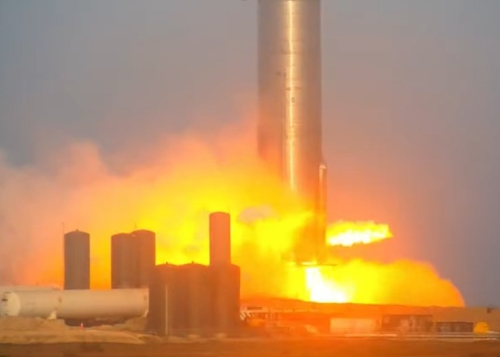
Starship #10 at 2nd static fire test
Screen capture from LabPadre live stream.

Capitalism in space: In what to me appears a remarkable tour de force, SpaceX today completed the second dress rehearsal countdown and static fire test of its tenth Starship prototype.

What made this a tour de force is that the previous test, only two days before, had found issues with one of the prototype’s three Raptor engines. In less than two days, SpaceX engineers were able to replace that engine and fire up the rocket again.

Compare that to the operations of Boeing and NASA in trying to do a single static fire test of SLS’s core stage. Preparations for the first test took months, and when this had an issue it is now going to take at least a month (if not more) before they can attempt a second test.

If today’s Starship static fire test came up clean with no problems, a test flight to about 30 to 40,000 feet could come as early as tomorrow.

2 comments

First launch of Blue Origin’s orbital rocket delayed to ’22

Capitalism in space: In what had increasingly appeared likely in recent months, Blue Origin today announced that it is delaying the first launch of its orbital New Glenn rocket from late this year to sometime in ’22.

Blue Origin noted that the updated timeline follows the U.S. Space Force to stop its support for the New Glenn development effort as part of its procurement program for national security launches. That support, which could have added up to $500 million, was closed out at the end of last year.

The Space Force ended up choosing United Launch Alliance and SpaceX for the next round of national security launches. Jarrett Jones, Blue Origin’s senior vice president for New Glenn, told Space News that losing out on that round of launch contracts represented a $3 billion hit to anticipated revenue, and forced the company to “re-baseline” its development plans.

Personally I think this excuse is absurd. Jeff Bezos has been investing about $1 billion per year in Blue Origin. Moreover, in its announcement the company claimed it has invested $2.5 billion of that money in developing New Glenn. This is almost as much as SpaceX has raised to build Starship/Super Heavy, which is in development and in only about two years has already produced multiple prototypes and two test flights. Moreover, SpaceX developed Falcon Heavy for about a half billion dollars, and did it in less than seven years.

New Glenn has been in development for more than four years, and we have yet to even see it assembled in any form at all. The loss of that government military contract should have made no difference if Jeff Bezos and Blue Origin were really serious about building this rocket. He has given the company more than enough investment capital to get it done. They have just not delivered so far.

If I was Bezos, I would be taking a very hard look at the management at Blue Origin, with the intent to make some significant changes.

9 comments
1 141 142 143 144 145 167