ESA contracts Airbus to build three more Orion service modules

The European Space Agency (ESA) late last week announced that it has awarded Airbus a contract to build three more service modules for NASA’s Orion capsule.

This new contract supplements the existing contract that already has Airbus building three service modules. With six service modules in the pipeline, the ESA is signaling that it is very confident the Artemis program will continue.

The key question remains: Will it continue with SLS as the rocket of choice? Right now there simply aren’t the funds to build six SLS rockets. Congress has only funded two. Moreover, the pace of construction for SLS means that, if funded, it will likely take a decade at least for it to launch these six capsule/service modules. Since SpaceX’s Starship/Super Heavy will likely be operational in about half that time, and will also be capable of much more for far less, I suspect that if these additional Orion capsules get launched, they will do so on something other than SLS.

5 comments

SLS-backer Senator Richard Shelby (R-Alabama) to retire

Senator Richard Shelby (R-Alabama), long time firm supporter of the very expensive and long-delayed Space Launch System (SLS) rocket, has announced that he will not run for office again when his term expires in ’22.

The 86-year-old Shelby was first elected to the Senate in 1986 after eight years in the House. Shelby served in the House, and the first eight years in the Senate, as a Democrat, switching to the Republican party in 1994.

Shelby is best known in the space community for his role shaping NASA programs as a member of the Senate Appropriations Committee. That has included stints as chairman of the commerce, justice and science subcommittee, whose jurisdiction includes NASA, as well as of the full committee. With Democrats in control of the Senate, he is currently the ranking member of the full committee.

“I have worked to enhance Alabama’s role in space exploration and the security of our nation,” Shelby said in the statement announcing his decision not to run for reelection. That’s included support for programs based at the Marshall Space Flight Center in Huntsville, Alabama, such as the Space Launch System. “As chairman of the appropriations committee, I have more than a passing interest in what NASA does. And I have a little parochial interest, too, in what they do in Huntsville, Alabama,” he said at a March 2019 industry event

As the article makes clear, Shelby used his clout unceasingly to keep SLS funded. When NASA simply hinted in 2019 that it might switch to another rocket to launch Orion he made his displeasure known, and NASA immediately backed down.

His resignation now, at the same time that other members of Congress as well as the Biden administration appear to be separating the Artemis lunar program from SLS, is a strong signal that the political winds are blowing badly against SLS. Shelby has probably realized that he no longer has the same support for SLS in the rest of Congress that he once had, and knows there is a good chance it will go away, along with much of the pork he has been funneling to Alabama with it. When that happens, his chances of getting reelected drop precipitously. He probably doesn’t have to inclination to fight what might be a losing battle, especially at the age of 86.

The second static fire test of SLS’s core stage is presently scheduled for the fourth week in February. All had better go well, as time is running out in getting the rocket’s first launch off in ’21. Right now that schedule is very iffy. Further problems will make it impossible.

And any major failures would probably lead to the entire program’s cancellation. It would take years for SLS to recover the loss of the core stage, time the program does not have.

3 comments

Fiftieth anniversary of Apollo 14 lunar landing

Apollo 14 as seen by LRO
Click for full image.

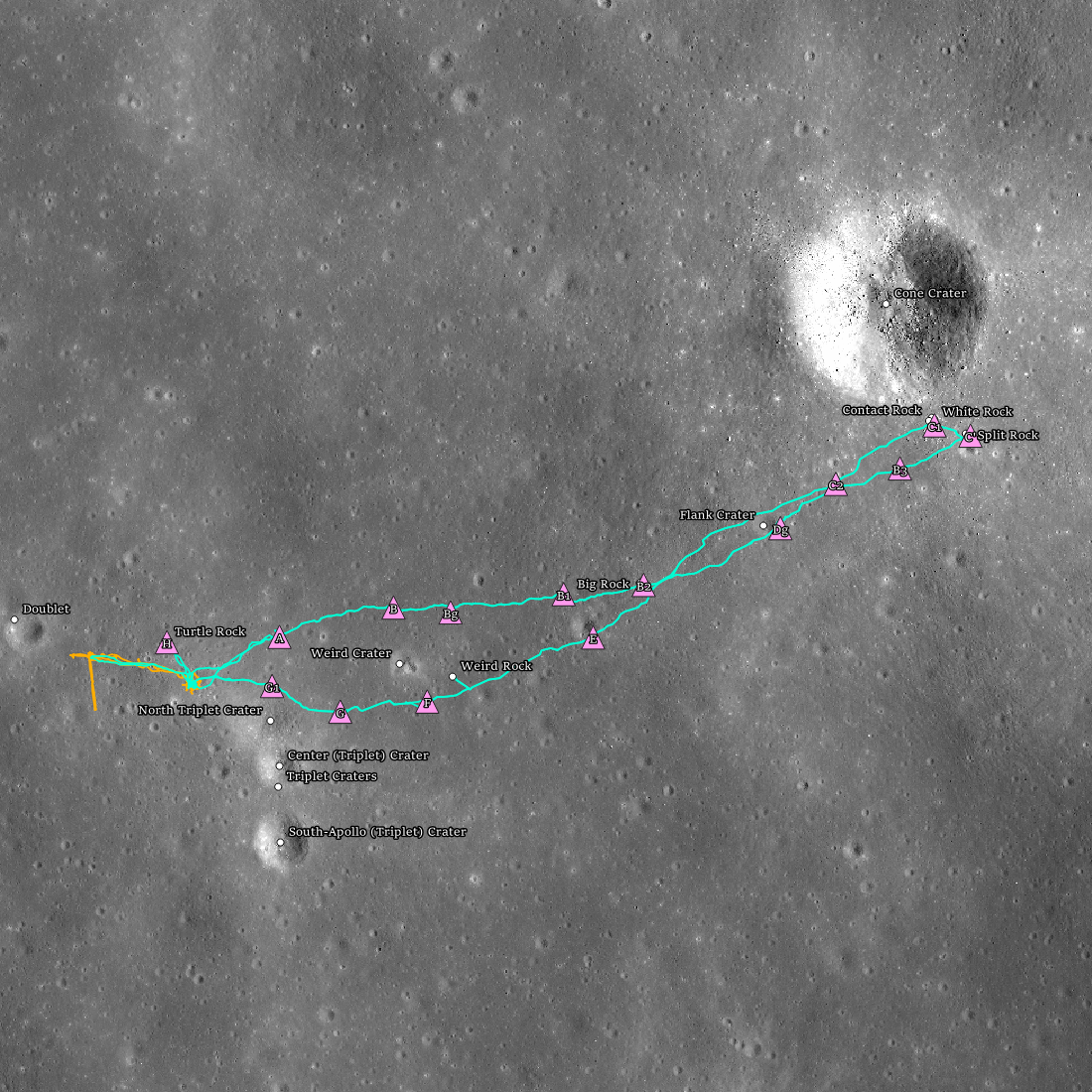
In honor of the fiftieth anniversary today of the landing of Apollo 14 on the Moon, the Lunar Reconnaissance Orbiter (LRO) science team has used images from the spacecraft to map out what the astronauts did on the surface, as shown in the reduced image to the right. The orange and teal lines indicate the routes followed during the two EVAs, with the pink triangles indicating stopping points along the way.

Unlike Apollo 11 and 12, which focused on engineering goals such as landing precisely on the Moon, Apollo 14 focused on addressing science goals. Antares (lunar module) landed in the Fra Mauro highlands, the original destination of the failed Apollo 13 mission, essentially taking on that mission’s objectives. This was the first crewed landing in the lunar highlands and not in the mare.

The Apollo 14 astronauts who landed on the Moon, Alan Shepard (Commander) and Edgar Mitchell (Lunar Module Pilot), completed two extra-vehicular activities (EVAs) while on the surface. They spent a total of 9 hours and 22 minutes setting up equipment, taking photographs, collecting samples, and exploring.

This was the last mission where the astronauts had to walk. The next three Apollo missions brought a rover with them, so that they could drive to their research sites.

5 comments

Musk: Starlink to go public once operational

Capitalism in space: According to a tweet by SpaceX founder Elon Musk, once the Starlink internet satellite constellation is operational and has a “reasonable well” cash flow it will issue and IPO and become a publicly traded stock.

“SpaceX needs to pass through a deep chasm of negative cash flow over the next year or so to make Starlink financially viable,” Musk wrote in another tweet. “Every new satellite constellation in history has gone bankrupt. We hope to be the first that does not.”

Based on the company’s pace of launching satellites and rolling out service, this moment could occur as early as late this year. More likely it will occur in mid-22.

I would also expect that stock to quickly rise in value, and based on the history of all of Musk’s companies, will continue to rise thereafter. Expect also that a significant portion of the investment capital that Starlink will raise will be used to finance the development of Starship and Super Heavy, because Starlink will need that larger rocket to maintain its satellite constellation.

9 comments

UAE’s Hope or Al-Amal Mars Orbiter orbital insertion

UPDATE: The probe has apparently achieved orbit.

The new colonial movement: The United Arab Emirates’ (UAE) Mars orbiter, Hope, or Al-Amal in Arabic, is about to insert itself into orbit around the red planet, with that insertion to be confirmed by 11:08 (Eastern).

If you want to watch, I have embedded the live stream below the fold. A warning: The insertion is a relatively interesting event to watch, as the orbiter works autonomously and the signal confirming it happened arrives after the event. Most of the stream is propaganda for the UAE.
» Read more

2 comments

OSIRIS-REx has begun its return to Bennu

On January 14th the OSIRIS-REx team fired the spacecraft’s engines to halt its drift away from the asteroid Bennu and begin its return for one last reconnaissance before heading to Earth with its samples.

OSIRIS-REx executed the first maneuver on Jan. 14, which acted as a braking burn and put the spacecraft on a trajectory to rendezvous with the asteroid one last time. Since October’s sample collection event, the spacecraft has been slowly drifting away from the asteroid, and ended up approximately 1,635 miles (2,200 km) from Bennu. After the braking burn, the spacecraft is now slowly approaching the asteroid and will perform a second approach maneuver on Mar. 6, when it is approximately 155 miles (250 km) from Bennu. OSIRIS-REx will then execute three subsequent maneuvers, which are required to place the spacecraft on a precise trajectory for the final flyby on Apr. 7.

OSIRIS-REx is scheduled to depart Bennu on May 10 and begin its two-year journey back to Earth. The spacecraft will deliver the samples of Bennu to the Utah Test and Training Range on Sep. 24, 2023.

While they will gather images of the whole asteroid, their number one goal will be to get high resolution photos of the sample-grab site Nightingale to see how it was changed by that sample grab. The spacecraft pushed into the asteroid’s rubble pile about 1.6 feet, and that act certainly disturbed both the interior and surface. By comparing the before and after pictures scientists can garner a lot of information about the asteroid’s make-up, density, and structure. It will also teach future engineers what to expect when next they try to touch another rubble-pile asteroid.

0 comments

Today’s blacklisted American: Chase Bank blacklists Pro-Trump Covfefe Coffee

Covfefe Coffee, blacklisted
Click image to buy their product.

They’re coming for you next: Chase Bank has suddenly decided that it can’t do business with the coffee company, Covfefe Coffee, apparently for the simple reason that the coffee company is unabashedly pro-Trump and supports the standard American values of freedom and liberty that made this nation the haven for the oppressed for more than two centuries.

Chase Bank has abruptly stopped a pro-Trump coffee company from using its payment processing service, WePay, and is currently preventing them from withdrawing any funds.

Covfefe Coffee, founded in 2018, brands itself as “Coffee For Deplorables By Deplorables.” The company, which says their goal is to “provide proud to Americans access to world-class coffee without having to fund your political and cultural opponents,” was informed via email on Wednesday that they would no longer be able to use their payment processing service because payments were “for one or more of the activities prohibited by” their terms of service. [emphasis mine]

Nor has this been all. Amazon suspended the company’s advertising on that platform in 2019 for using the phrase “Make America Great Again,” a phrase that Amazon thinks “incites hate.”

What this really tells us is that the people at Amazon and Chase Bank hate America, and want it to fail. Anyone who thinks different must be blacklisted and preventing from succeeding.

To understand how hateful Amazon and Chase are being, you need only read what Covfefe says on its own website:
» Read more

22 comments

The Icy Surface of Mars

The extent of ice on Mars

Two newly published science papers in the past few days have once again reinforced the growing evidence that much of Mars from 30 degrees latitude to its poles is very icy, with much of that ice found close to the surface.

The map above, adapted and annotated by me from figures 4 and 12 of one of those papers (“Widespread Exposures of Extensive Clean Shallow Ice in the Mid‐Latitudes of Mars”), show the areas on Mars where the evidence suggests ample and easily accessible ice, underground but close to the surface.

The red dots and diamonds indicate recent impact craters that temporarily exposed the underground ice layer that would normally not be visible. The white dots and diamonds indicate ice scarps with visible ice layers in their cliff faces. The size of these locations is greatly exaggerated.

The two hatched lines at 30 degrees latitude, north and south, indicate the closest to the equator that scientists have detected evidence of glacial ice. It is also the closest to the equator that the second new paper, “Water Ice Resources Identified in Martian Northern Hemisphere “, has found evidence of underground ice in the north. From the abstract of this second paper:
» Read more

4 comments

Lockheed Martin picks ABL’s rocket to make its first UK launch

Capitalism in space: Lockheed Martin has chosen the smallsat rocket company ABL Space Systems to launch its first UK satellite payload from Shetland.

Lockheed said Feb. 7 that ABL will perform a launch of its RS1 rocket from the Shetland Space Centre, a spaceport to be developed on the island of Unst in the Shetlands, in 2022. The rocket, on a mission called the UK Pathfinder launch, will place into orbit a tug developed by Moog in the UK that will then deploy six 6U cubesats.

The launch will fulfill an award made by the British government in 2018 to support development of a domestic launch capability. The $31 million contract to Lockheed Martin covered a launch, then planned for a spaceport at Sutherland in northern Scotland, as well as Moog’s orbital maneuvering vehicle.

Lockheed did not disclose at the time, though, which vehicle it would use for the launch. The company does not have a small launch vehicle of its own compatible with the spaceport, but has invested in companies working on such vehicles, including ABL Space Systems and Rocket Lab.

It appears Lockheed choose ABL over Rocket Lab because of its mobile launch capability. As designed, its RS1 rocket needs no permanent infrastructure at the launch site. All they need is a concrete pad.

This decision also heightens the competition between the two presently proposed UK spaceports in Sutherland, Scotland, and Unst, Shetland. While planning at Sutherland started earlier, local opposition appears to be slowing it down.

ABL is one of six smallsat rocket companies planning a first orbital launch in 2021. While it is unlikely all will do so, the likelihood is increasing that several will, which will make things very busy in the rocket industry.

0 comments

Starship update: Prototype #10 being readied for launch

Link here. Not only have the engines been installed on the tenth Starship prototype, the static fire test is set for this week, maybe as early as today. It appears they are trying to launch the next test flight before the end of February.

At landing they will now fire all three engines, in case one or more fail to light (as happened with prototype #9), and then shut down all but one immediately and let that do the landing burn. This adds redundancy and increases the odds of a successful landing.

The article also provides a detailed update on the status of future Starship and Super Heavy test articles. While #11 is being readied for launch, it appears that, based on what has been learned from #8 and #9, they are dismantling prototypes #12-14 and incorporating changes to #15, which will likely fly after #11.

One aspect of this development program struck me today. These prototypes are essentially expendable rockets. Like it did with its early expendable Falcon 9, SpaceX is using these throw-away prototypes to test ways to make them more reusable and reliable. Unlike the Falcon 9s, however, the company isn’t using these prototypes to launch payloads, at least not at this stage. It isn’t good enough that these prototypes can successfully launch. They must be able to land as well.

I suspect that once during this test program the full rocket begins to reach orbit SpaceX will add payloads, even as they continue to test re-entry and landing. The early flights might produce rockets that successfully bring satellites into space but end up getting destroyed upon return. Those loses will then be used to make later ships better and more likely to return intact.

Eventually, we will have a rocket entirely reusable and flying multiple times, just like the Falcon 9 first stage.

9 comments
1 150 151 152 153 154 167