Today’s blacklisted American: Journalist Andy Ngo

They’re coming for you next: Journalist Andy Ngo has spent the last two years being pretty much one of the few real journalists covering the violent, fascist, storm-trooper tactics of the leftist Antifa and Black Lives Matter movements, carefully documenting in both print and visuals their riots and attacks of innocent citizens.

His reporting has been so effective that Antifa thugs attacked him in 2019, sending him to the emergency room in Portland.

Furthermore, those same Portland brownshirts stormed a local bookstore, causing its evacuation and early closure, because it happened to be selling Ngo’s book on Antifa activities in Portland, Unmasked. The protests eventually forced the bookstore to remove the book from its shelves, though it still sells it online.

Nor has that been the sum total of Antifa’s effort to blacklist Ngo. They have been issuing him death threats, and even though Ngo told the Portland police, even naming some names, the police did nothing.

Ngo was thus forced to flee Portland temporarily, moving to London. The irony is that his parents were refugees who came to the United States to gain freedom and the right to speak freely. Now their son has fled the U.S. for the same reasons.

When asked how he would describe Antifa in one sentence, he said, “For their world to live and thrive, America has to die.”

The worst part of these attacks has been the shallow willingness of the mainstream media to go along with the false slanders and lies against Ngo and to spread them.

National publications, such as Rolling Stone and Salon used a local alternative weekly “blog,” as Ngo puts it, to smear him using epithets with which we’re only all too familiar: racist extremist. “And then so whenever you google me now and [view] my Wikipedia page, all you see are these false accusations,” he explained. “All of this has been an attempt to get me canceled; to make me out to be someone I’m not, make me out to be a far-right extremist.”

It is all part of Obama’s legacy of hate, where slanders and libels by the left are now their first go-to argument in any debate.

Ngo deserves great kudos and support, however. Unlike many who fold to this fascist pressure, he has stood strong, and continued his reporting, honestly and in detail. Furthermore, the attacks have actually helped sales of Unmasked, making it a major bestseller. For a short while was number one on Amazon, and is still #37 as of today.

His fearless willingness to fight is of course the right response. Buying his book is another. We must not bow to these bullies and tyrants. We must look them in the eye and defy them. Only then will we ever have the chance to once again become free.

19 comments

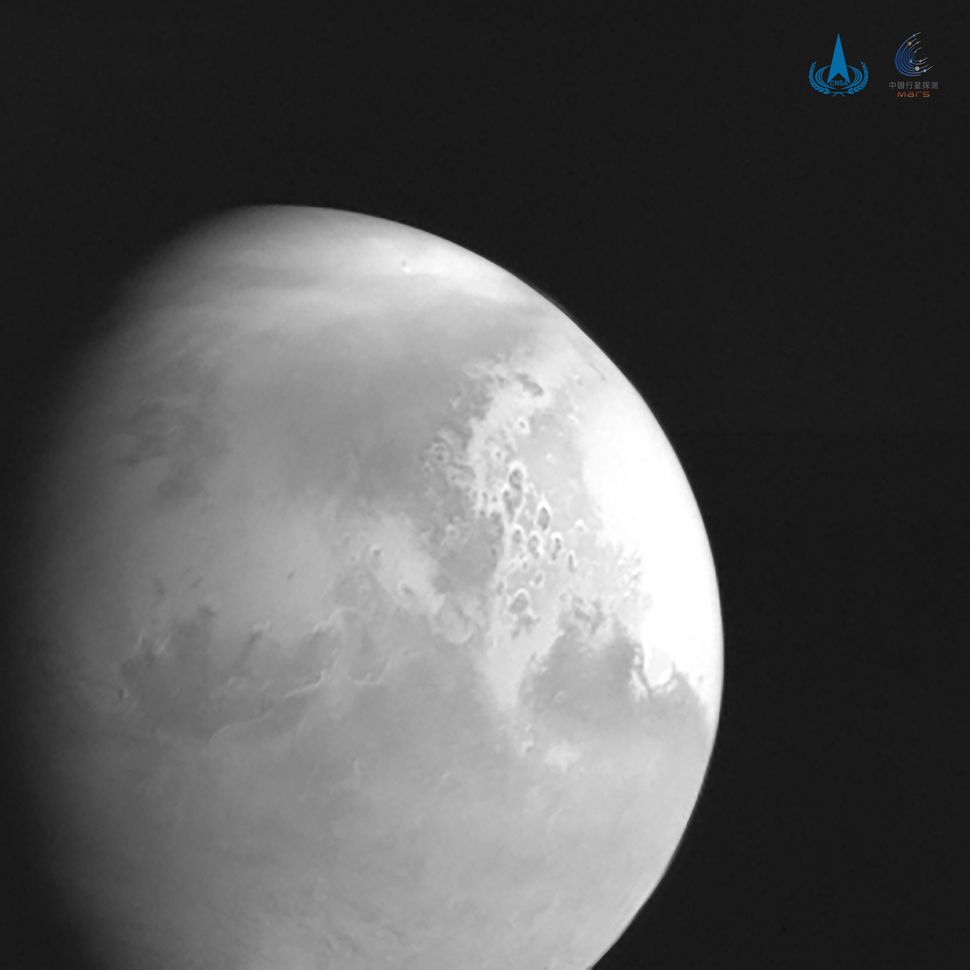
Tianwen-1 takes first picture of Mars

Mars as seen by Tianwen-1 for the first time
Click for full image.

The new colonial movement: China’s Tianwen-1Mars spacecraft has taken its first picture of Mars, cropped and reduced to post here to the right.

The photo shows Valles Marineris as the darker splotch in the center-right of the hemisphere, with the northern lowland plain that this canyon feeds into, Chryse Planitia, the triangular dark area to the north east. Both Viking-1 and Mars Pathfinder landed in this region. The whitish border area on the triangle’s eastern flank is the area that Europe’s Rosalind Franklin rover will hopefully land in ’23.

The whitish area that caps the north pole is likely the annual mantle of dry ice that covers the planet’s polar regions down to about 60 degrees latitude each winter. Right now it is early spring in the northern hemisphere, and that mantle has only begun to sublimate away. In another few months that mantle will disappear entirely, exposing the terrain below it.

Finally, the very bright edge on the planet’s eastern limb is either caused by a cloud layer, or is simply an over-exposure. Hard to say which.

1 comment

Hydrazine on the surface of Saturn’s moon Rhea?

The uncertainty of science: Scientists using data from several Cassini flyby’s of the Saturn moon Rhea now think that hydrazine, a very toxic chemical routinely used by spacecraft as fuel, might exist on its surface.

Their effort was an attempt to identify an unknown spectroscopy absorption feature at a specific wavelength.

In comparison to chloromethane, the production of hydrazine monohydrate was easier to explain due to chemical reactions involving water-ice and ammonia or delivery from Titan’s nitrogen rich atmosphere. Elowitz et al. considered the possibility of contamination of the UVIS data by a hydrazine propellant from the Cassini spacecraft, although it was highly unlikely since the hydrazine thrusters were not used during icy satellite flybys.

The team confirmed the specific signature of a 184-nm feature on Rhea’s surface using the UV spectrometer observations made by the Cassini spacecraft. In addition to that, the irradiation of ammonia by charged particles from Saturn’s magnetosphere induced the dissociation of ammonia molecules to form diazene and hydrazine. The source of ammonia on Rhea could be primordial, incorporated into its interior during formation and brought to the surface within a period of endogenic activity, as evident in Cassini ISS imagery, although ammonia was unlikely to survive indefinitely on the surface. The team suggest further analysis to understand the potential for satellite-to-satellite transfer of materials across Titan’s atmosphere to explain the presence of hydrazine monohydrate on Rhea.

Though useful as a fuel, its poisonous nature will make any exploration of these moons very hazardous, and will also likely make its usefulness difficult initially in that exploration

2 comments

Betelgeuse is closer and smaller than previously thought

Betelgeuse's fading
Images taken by Europe’s
Very Large Telescope in Chile

The uncertainty of science: A new analysis by scientists of Betelgeuse, triggered by its dip in brightness in 2020, has concluded that the red giant star is both closer and smaller than previously estimated.

Their analysis reported a present-day mass of 16.5 to 19 solar mass—which is slightly lower than the most recent estimates. The study also revealed how big Betelgeuse is, as well as its distance from Earth. The star’s actual size has been a bit of a mystery: earlier studies, for instance, suggested it could be bigger than the orbit of Jupiter. However, the team’s results showed Betelgeuse only extends out to two-thirds of that, with a radius 750 times the radius of the sun. Once the physical size of the star is known, it will be possible to determine its distance from Earth. Thus far, the team’s results show it is a mere 530 light years from us, or 25 percent closer than previously thought.

The research also suggested that the star is in the initial stages of burning helium rather than hydrogen, and so it likely more than 100,000 years from going supernova.

As for the dimming, the scientists concluded (as other have) that the dimming in ’20 was due to the passage of a dust cloud in front of the star.

5 comments

ULA’s CEO advocates old way of doing things

In a webinar yesterday the CEO of ULA, Tory Bruno, argued that there is too much money being invested in new rocket companies and the money would be better spent developing in-space activities instead.

To be attractive to investors, these new space activities should be dual-use with both commercial and national security applications, Bruno said.

The launch market is becoming dangerously “overheated” for a couple of reasons. One is simply that there are too many launch companies chasing a “more or less fixed size” pool of customers, Bruno said. In the large rocket market, he said, prices are falling and the demand for satellite launches “has remained stubbornly inelastic.”

“It’s down to a third or even a fourth of the cost of what access to space was just a handful of years ago,” Bruno said. “Yet we have seen no increase in the overall size of the launch market nor have we seen a corresponding tripling or quadrupling of space activity.”

While Bruno is correct when he says that there are likely too many new launch companies, he is so wrong about his belief that the customer base “has remained stubbornly inelastic” that he is practically in the wrong galaxy. The lower costs he complains about are exactly why there is so much investment capital being poured into the new launch companies, because those investors see those lower costs attracting many new customers, something that is demonstrated by the growth of the launch rate in the past few years (something that I expect will explode in the next two years).

Many of these new companies will fail, for any number of reasons. No matter. A large number will succeed, and attract more than enough customers to make a profit.

What Bruno really is complaining about are the new lower launch costs. ULA can’t match them, and for this reason faces a crisis in that it might not be able to attract any customers at all in the coming years, even with the introduction of its new Vulcan rocket. And though Bruno has done a good job trying to make ULA competitive in this new market, he appears to have generally failed to change the company significantly. For example, why hasn’t ULA tried to market its Atlas 5 and Vulcan rockets for multi-payload smallsat launches, as SpaceX did with the recent launch of 143 smallsats on one Falcon 9? I can’t think of any reason why ULA’s rockets couldn’t do the same. Yet the company has done nothing to try to market itself to this smallsat industry. Instead, they have let Rocket Lab, Virgin Orbit, and now SpaceX grab it, along with at least four or five new smallsat rocket companies about to do their first launches.

Instead, Bruno advocated during this webinar that the federal government get involved, acting to encourage investors to leave the launch market and instead focus on building companies that only do things in space.

What a deal! The government helps to limit the number of new rocket companies, thus protecting ULA’s market share. ULA in turn can continue to charge its high prices, because the new in-space companies the government subsidized will have few launch options. In fact, the high launch prices that would result from a smaller launch market would likely force the federal government to also subsidize the launch costs for the new in-space companies so they can even afford to get to orbit.

All for the benefit of old big space companies like ULA, who for decades did nothing to innovate or lower the cost to launch.

I think what Bruno is really signaling to us here is that he is not hopeful for the future of his company in today’s present competitive free market, and is thus advocating government intervention to save his company.

8 comments

The new invasion of Mars begins next week!

In the next two weeks three spacecraft will arrive at Mars, including two orbiters and two rovers. This post is simply a heads up so that my readers will know what to expect and when to expect it.

First, we have the arrival in Mars orbit of the United Arab Emirates’ (UAE) Hope orbiter on February 9th at 10:30 am (Eastern). The spacecraft was built in a partnership with U.S. universities and the UAE. Once in orbit it will focus on studying the Martian atmosphere.

Next will arrive China’s Tianwen-1 orbiter on February 10th. The exact time it will do its engine burn to enter orbit has not been announced, as far as I can tell. Once in orbit it will begin a four month reconnaissance of the landing site for its presently unnamed rover, which will descend to the surface in May.

Finally, on February 18th at 12:55 am (Pacific) the American rover Perseverance will land in Jezero Crater on Mars. Essentially an upgraded copy of the Curiosity rover, it will land in the same way, lowered by cables from its re-entry sky crane rocket above it. It will then spend years studying the geology of Mars, while also storing samples that a later mission can recover and return to Earth.

All in all February is going to be an exciting month for the exploration of Mars. Stay tuned for some cool stuff!

3 comments

Starlink now has over 10,000 users

Capitalism in space: SpaceX revealed yesterday that its Starlink internet constellation now has over 10,000 users in both the U.S. and elsewhere.

The update on Starlink’s customer base came in a petition to the FCC, with SpaceX asking that Starlink be designated an “Eligible Telecommunications Carrier” or ETC. The company noted that receiving this designation is necessary for Starlink to provide service to regions in “Alabama, Connecticut, New Hampshire, New York, Tennessee, Virginia and West Virginia.”

SpaceX was awarded access to those regions under the FCC’s Rural Digital Opportunities Fund, an auction to bring broadband services to rural areas. The FCC in December awarded SpaceX with nearly $900 million in federal subsidies in the first phase of the auction.

“Designating Starlink Services as an ETC is in the public interest because it will enable the company to receive support that will facilitate rapid deployment of broadband and voice service to the Service Areas at speeds and latency comparable to terrestrial systems in urban locations,” SpaceX wrote in the filing on Thursday.

One of my readers, Steve Golson, emailed me yesterday to tell me he is one of those rural customers, as he is located in Maine.

We are at latitude 43.2°N which was too far south for their early beta program, but they’ve just opened it up to us. I signed up back in June 2020, when the Starlink beta signup first went live. Yesterday I received this email:

“Starlink is now available in limited supply in your service area. … Availability is limited so orders must be completed within 15 minutes of landing on the order page. If you are not able to order at this time, the Starlink team will continue to send updates as more capacity becomes available.”

I ordered right away, and I was notified that the dish shipped today, with delivery late next week by FedEx Ground. Cost is $500 for the dish, WiFi router, power supply, cables, mounting tripod. Monthy cost is $99. That’s the beta cost, but I suspect their final costs will be similar.

Now I’m getting a roof mount ready. You *really* need an unobstructed view of the whole sky. The very cool Starlink app (iOS and Android) shows you how much of your sky needs to be unobstructed.

He promises to give further updates as his service rolls out.

2 comments

NASA awards Firefly lunar contract

Capitalism in space: NASA yesterday announced that it has awarded the new smallsat rocket company Firefly a $93 million contract to build a lunar lander for delivering scientific payloads to the Moon’s surface.

This is the first delivery awarded to Firefly Aerospace, which will provide the lunar delivery service using its Blue Ghost lander, which the company designed and developed at its Cedar Park facility. This facility also will house the integration of NASA and any non-NASA payloads, and also will serve as the company’s mission operations center for the 2023 delivery.

The lander is based on the design of Israel’s Beresheet lunar lander that failed in its landing attempt in 2019. After that failure a group of Israeli engineers from that project formed their own company, and partnered with Firefly to build a new lander, which is now dubbed Blue Ghost.

The NASA contract itself replaces OrbitBeyond, which had won a lunar landing contract initially but had backed out in 2019.

Finally, the timing of this announcement immediately after Firefly had revamped its board of directors to remove its main Ukrainian backer from an obvious management position is most telling. Suggests to me that they did that revamping in direct response to NASA’s concerns, and once done NASA could then move forward with the contract award.

0 comments

Biden administration endorses Artemis program

During a press conference yesterday Biden’s press secretary Jen Psaki stated that the Biden administration plans to continue the Artemis manned lunar program that was initiated by the Trump administration.

“Through the Artemis program, the United States government will work with industry and international partners to send astronauts to the surface of the moon — another man and a woman to the moon,” Psaki told reporters in a White House press briefing Thursday. “Certainly, we support this effort and endeavor,” she added.

The Biden administration was under pressure to endorse Artemis, coming from its own party. Both Democrats and Republicans in Congress want the pork it represents to them. This statement now aligns Biden with Congress. The American effort to return to the Moon, established by Trump, is now practically engraved in stone.

What the statement that Psaki read did not detail is whether that support will include the SLS rocket or the Orion capsule. Nor did her statement indicate any time schedule for a landing, which adds weight to the supposition that they are going to abandon the Trump’s effort to push for a 2024 manned landing on the Moon.

Moreover, the letter sent to the White House on February 3rd by eleven Democrats endorsing Artemis (available here [pdf]), also said nothing about SLS or Orion. Instead, it was more intent on encouraging the White House to award contracts to the private sector to build the manned lunar lander. NASA had announced on February 1st that it was delaying its decision on who should build it, and those Democrats did not want that delay to result in the contracts getting killed.

Both statements tell us is that SLS itself is presently on very thin ice. Congress wants Artemis, but Artemis is no longer synonymous with SLS. For the past two years the Trump administration had been awarding contracts to numerous private companies to design and build many components of Artemis, rather than have NASA do the designing and building (as it had with SLS). Those contracts have created a cohort of new vested interests that rely on Artemis, all of which I am sure are screaming at their representatives in Congress to keep their work funded.

Furthermore, SpaceX’s development of Starship is clearly showing everyone that an alternative to SLS does exist, and could be operational for much less and much sooner.

To my mind, all this evidence suggests that the Washington political world is getting itself ready for the possibility of abandoning SLS. They don’t want to, but if alternatives to its pork are available that are also more productive, they are steeling themselves for making the difficult political decision of switching.

This evidence also suggests that the Biden administration will continue the policies I outlined in my 2017 policy paper Capitalism in Space (available as a free download here [pdf]) and adopted by the Trump administration. I had recommended that all design and construction should be taken from NASA and given to many different private companies, with that private sector also owning what they build while competing for those government dollars. NASA would outline the project’s goals and concept, and then act merely as a customer which would find others to execute those goals and concepts, as quickly and as cheaply as possible.

If the Biden administration is embracing these recommendations, this is very good news. While the motives of these corrupt politicians might be bad, the result could be very good for the U.S. Allowing the private sector to do the job means it might actually get done, rapidly and for much less. It will also help fuel the growth of a very robust American space industry, which once established will soon no longer depend solely on the government for its business. The lower cost required by the competition to get NASA business will encourage others to buy the products, and soon thereafter the government will become irrelevant to this industry’s success.

This is the model used in the early 20th century to jump start the airline industry. It worked. It now looks like NASA and the govenment will do it in space.

10 comments

China’s Long March 3B rocket launches military satellite

China yesterday used its Long March 3B rocket to place a military communications satellite into orbit.

No word on whether this first stage or strap-on boosters lander near any residential communities.

The 2021 launch race:

4 SpaceX
3 China
1 Rocket Lab
1 Virgin Orbit
1 Russia

The U.S. still leads China 6 to 3 in the national rankings. SpaceX’s had planned to do another Starlink launch this morning but has rescheduled it for the weekend.

0 comments
1 151 152 153 154 155 167