Ronnie O’Sullivan’s record break in Snooker

An evening pause: Hat tip Phill Oltmann, who has tried several times to explain Snooker to me and failed. The game however appears to be a variation of the U.S. pool game hi-low, though maybe more complicated.

The point is that in the video below, O’Sullivan starts the game and proceeds to clear the table, and he does it in less than six minutes, the fastest time ever. It is amazing to watch.

2 comments

The Ukraine War: Increasing Ukrainian gains in the past week

The Ukraine War as of March 24, 2022
The Ukraine War as of March 24, 2022. Click for full map.

The Ukraine War as of March 31, 2022
The Ukraine War as of March 31, 2022. Click for full map.

Another week has passed in the Ukraine war, and with it we begin to see increasing evidence that not only has the Russian invasion stalled, but that the Ukraine is beginning to push back with more and more effectiveness.

The two maps to the right are from the Institute for the Study of War (ISW) and have been simplified, annotated, and reduced to post here. The top was from ISW’s March 24, 2022 report, the bottom from its report today. The dark red areas are regions either controlled by Russia or areas of confirmed Russian advance. The light red indicates areas the Russians claim to control without confirmation. The blue areas mark areas retaken by the Ukraine in battle. The circles indicate areas of recent heavy fighting.

The green arrows I have added to both maps indicate areas where there have been changes since the week prior. Like last week, the arrows point almost entirely to areas where Russian control has ebbed, either because the Russians have chosen to retreat, or because Ukrainian forces have pushed them out. The summary from ISW is succinct:
» Read more

65 comments

Pushback: University’s blacklisting of a student quickly ends when confronted by lawyers


Boris Badenov: The school administrators at
Southern Illinois University

Today’s blacklist story came and went so quickly that no one in the press really ever had a chance to cover it. I however want to highlight it today because it tells us a great deal about today’s bankrupt academic culture, and its paper tiger nature if challenged.

On February 10, 2022, Jamie Ball, the director for Equal Opportunity, Access and Title IX Coordination at Southern Illinois University in Edwardsville, sent notices to Maggie DeJong, a student in the school’s Art Therapy Counseling Program, telling DeJong that she was forthwith forbidden to interact in any way with three other students.

Because DeJong attended classes and also worked at the same facility as these three students, the orders essentially blacklisted her from school through the end of the ’22 semester.

Ball provided no facts or reasons for the “no-contact” orders, other than saying that any contact between DeJong and these three students “would not be welcome or appropriate at this time.” Ball’s order also admitted that no harassment or violation of school policy had occurred. Her order was simply “to prevent interactions that could be perceived by either party as unwelcome, retaliatory, intimidating, or harassing.”

In other words, Ball was punishing DeJong for something that might happen, likely based on secret accusations made by those three students.

On February 23rd, less than two weeks later, lawyers from the Alliance Defending Freedom (ADF) sent the school’s Chancellor, Randy Penbrook, a letter [pdf] outlining the illegality of this action, and demanding the no-contact orders be immediately rescinded.
» Read more

18 comments

A large Martian river basin with delta

Map of Hypanis Valles river basin on Mars
Click for full image.

Cool map time! The map to the right, reduced to post here, is figure 1 in a new paper outlining the known geology of what appears to be a large ancient and now dry river basin with delta on Mars, found north of Valles Marineris and draining into the northern lowland plain dubbed Chryse Planitia where both Viking-1 and Mars Pathfinder landed, in 1976 and 1997 respectively.

The river basin itself is called Hypanis Valles. The white splotch at the river basin’s outlet is dubbed the Hypanis Deposit, and is thought by some scientists to be a delta of material that was placed there when the river was active 3.6 billion years ago and poured into what some scientists believe was an intermittent ocean in Chryse Planitia. From the paper’s conclusion:

As proposed in prior works, Hypanis may have formed subaqueously as a delta, and may record a water level drop of about 500 m[eters, or about 1,600 feet] as a shoreline retreated to the northeast. We identified kilometer-sized cones and mounds which appear to have erupted onto the surface. Characteristics of these features more closely resemble those of outgassing, sedimentary diapirism, and mud volcanism rather than of igneous volcanism.

The intermittent ocean theory has problems however. For this delta to have formed underwater that ocean would have to have been much much larger than estimated based on the present known data, extending out to cover almost all of Chryse Planitia, in some places to a very great depth.

Some scientists have hypothesized that the ocean need not have been that large because a land dam would have confined it to a smaller region at the river’s outlet. This research however found no evidence of such a dam. However, the paper also noted that “Further work could examine the role of ice or glaciers in the formation of Hypanis and determine if an ice dam would be plausible.”

And of course there remains the more fundamental mystery of liquid water on the Martian surface, which makes the river basin itself a puzzle. No generally accepted model allowing for surface liquid water on Mars presently exists. The possibility that ice and glaciers could have done the job comes to mind again. Though the geology in this region reveals what looks like to our Earth eyes to be a very large river system, now dry, this is not Earth but an alien planet. Tributary systems like this might form from different and as yet not understood processes on Mars, some of which might involve glaciers.

0 comments

Scientists: On Mars surface elevation doesn’t matter that much in terms of radiation protection

In a paper published in February, scientists determined from models and data that the thickness of Martian cave ceilings required to protect you from radiation is not that much different whether you are on top of Olympus Mons (the Mount Everest of Mars), or at the bottom of Hellas Basin (Mars’ Death Valley).

From the paper’s conclusion:

Overall, the atmospheric thickness is not a dominant parameter for the required shielding. However, at a low-altitude crater where the surface pressure is above 1,000 Pa, the required subsurface shielding is about 10โ€“20 cm [4 to 8 inches] less than at the top of high mountains where the pressure is below 100 Pa. Moreover, solar activities which determine the GCR flux arriving at Mars play an role. To reduce the annual effective dose to be below 100 mSv, the required shielding is 1.5โ€“1.6 m [about 5 feet] during solar minimum and 0.9โ€“1.1 m [a little more than 3 feet] during solar maximum. For a threshold of 50 mSv, the required shielding is 2.1โ€“2.2 m [about 7 feet] during solar minimum and 1.7โ€“1.9 m [about 6 feet] during solar maximum.

Essentially, what this research suggests is that to properly shield any underground facility, you need to cover it with at least seven feet of material, or be in a cave where the ceiling is that thick. It really doesn’t matter how much atmosphere is above you. Even at its thickest at the lowest elevation, Mars’ atmosphere doesn’t provide much protection.

0 comments

Astronomers think they have detected the most distant star ever

The most distant star ever detected?
Click for full image.

The uncertainty of science: Using the Hubble Space Telescope astronomers now think they have detected the most distant single star ever located, the light of which is estimated to have come from a time only less than a billion years after the Big Bang itself.

The star, nicknamed Earendel by astronomers, emitted its light within the universe’s first billion years. It’s a significant leap beyond Hubble’s previous distance record, in 2018, when it detected a star at around 4 billion years after the big bang. Hubble got a boost by looking through space warped by the mass of the huge galaxy cluster WHL0137-08, an effect called gravitational lensing. Earendel was aligned on or very near a ripple in the fabric of space created by the cluster’s mass, which magnified its light enough to be detected by Hubble.

The arrow in the image, cropped and reduced to post here, points to the theorized star. Note the arc that tiny dot lies along. This arc is the result of the gravitational lensing, and illustrates quite bluntly the large uncertainties of this discovery. We are not seeing the star itself, but the distorted light after it passed through the strong gravitational field of the cluster of galaxies. The scientists conclusion that this dot is thus a single star, must be view with great skepticism.

Nonetheless, the data is intriguing, and will certainly be one of the early targets of the James Webb Space Telescope, which could confirm or disprove this hypothesis.

4 comments

New Shepard completes another commercial suborbital flight

Capitalism in space: Blue Origin’s New Shepard suborbital spacecraft today successfully completed its fourth manned commercial flight, carrying six passengers to a height of about 70 miles for total flight time of a little less than eight minutes.

I have embedded the live stream below the fold, cued to just before launch. Everything went almost routinely, which is a very good thing for a rocket company.

The most interesting aspect of this flight was that one of the passengers was George Nield, who had:

…previously served as associate administrator for the US Federal Aviation Administration (FAA) Office of Commercial Space Transportation from 2008 to 2018, being responsible for launch licensing and regulation for all commercial launch activities during that time.

During Nield’s term, the government worked very hard to help get launches off the ground, which laid the groundwork for the success of both SpaceX’s orbital Falcon 9 and Falcon Heavy rockets, as well as the suborbital spacecraft of Blue Origin and Virgin Galactic. His effort also helped jumpstart the new smallsat rocket industry.

Since his retirement, the FAA’s attitude toward regulation has become more oppressive, especially since the beginning of the Biden administration in 2021.

» Read more

0 comments

Another update on the lie that was COVID

How governments determined policy against COVID
How our governments continue to determine policy against COVID

One week ago I published a short essay listing a number of news stories that, as I wrote then, “illustrate starkly the foolishness and the over-reaction to COVID.”

It appears I might have to make this a weekly feature. In the last seven days I’ve collected a whole bunch of new articles, all of which provide further evidence of the lie that was COVID. Not only did our political and health leadership in government routinely lie to us, they often exhibited a remarkable ignorance about some basic science. Until there is reckoning that cleans house in these government agencies, Americans should never believe anything they say.

Most of the stories this past week document the overall failure of the COVID shots to do what these government officials promised: to prevent infection. To understand the significance of this fact, one must go back and review the claims made by government health officials when these shots were first developed. From the beginning these officials repeatedly claimed that the shots would prevent transmission of the virus, and protect people from any Wuhan flu infection if they got the jab. Just watch some of the videos here. Over and over again so-called experts claimed back in the spring of 2021 that the shots would “prevent transmission.”

NOT. » Read more

17 comments

March 30, 2022 Zimmerman/Pratt on Texas podcast

Robert Pratt invited me to appear on his radio podcast once again, first for a short five minute segment to discuss the Biden administration’s effort to block Starship launches in Boca Chica, and second a long 40 minute discussion about some of my recent blacklist stories.

The short segment starts 13 minutes into his podcast from yesterday, available here.

The long blacklist discussion can be found here.

0 comments

Active volcanoes on Pluto?

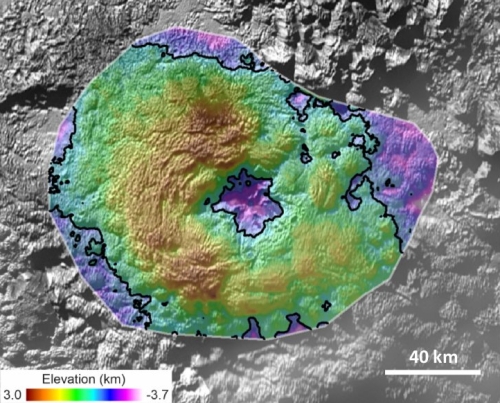
Elevation map of Wright Mons on Pluto

The uncertainty of science: According to new research published yesterday, scientists now posit that there might be recent volcanic activity on Pluto, based on data and images sent back by New Horizons during its fly-by of the planet in 2015.

You can read the paper here. From its abstract:

The New Horizons spacecraft returned images and compositional data showing that terrains on Pluto span a variety of ages, ranging from relatively ancient, heavily cratered areas to very young surfaces with few-to-no impact craters. One of the regions with very few impact craters is dominated by enormous rises with hummocky flanks. Similar features do not exist anywhere else in the imaged solar system. Here we analyze the geomorphology and composition of the features and conclude this region was resurfaced by cryovolcanic processes, of a type and scale so far unique to Pluto. Creation of this terrain requires multiple eruption sites and a large volume of material (>104 km3) to form what we propose are multiple, several-km-high domes, some of which merge to form more complex planforms. The existence of these massive features suggests Plutoโ€™s interior structure and evolution allows for either enhanced retention of heat or more heat overall than was anticipated before New Horizons, which permitted mobilization of water-ice-rich materials late in Plutoโ€™s history. [emphasis mine]

The image to above is Figure 10 in the paper’s supplementary material [pdf]. It shows the volcano-like appearance of Wright Mons on Pluto, a mound approximately 3,000 feet high with a central depression equally deep, with a volume “similar in magnitude to that of the Hawaiian volcano Mauna Loa.”

These conclusions are quite tantalizing, but the amount of data is sparse, and thus it is wise not to take them too seriously. For example, the scientists have no idea how Pluto could presently have any form of liquid or active volcanism. Another mission to Pluto — studying it over a long time from orbit — will be required to determine how active the planet really is, or if it is active at all.

2 comments

Europe’s deep space communications network to support India’s next two missions beyond Earth orbit

The new colonial movement: Based upon a 2021 agreement, the European Space Agency (ESA) today outlined how its deep space communications network of antennas will support India’s next two missions beyond Earth orbit.

ESAโ€™s global deep-space communication antennas will provide essential support to both missions every step of the way, tracking the spacecraft, pinpointing their locations at crucial stages, transmitting commands and receiving โ€˜telemetryโ€™ and valuable science data.

In June 2021, ESA and the Indian Space Research Organisation (ISRO) signed an agreement to provide technical support to each other, including tracking and communication services to upcoming Indian space missions via ESAโ€™s ground stations.

The first missions to benefit from this new support agreement will enable India look to the Sun and the Moon with the Aditya-L1 solar observatory and Chandrayaan-3 lunar lander and rover, both due to launch in 2022 from the Satish Dhawan Space Centre in Sriharikota Range (SDSC SHAR), India.

Though scheduled for launch this year, ISRO (India’s space agency) has not yet announced firm launch dates for either.

This arrangement signals an effort by India and Europe to remain independent of the American Artemis program, which is NASA’s central program for manned missions beyond Earth orbit. To partner with NASA for such missions the Trump administration had demanded nations sign the Artemis Accords, though that requirement might have been eased by the Biden administration for deep space communications.

Regardless, this agreement gives both India and ESA flexibility for remaining outside the accords, at least for now. Neither India nor most of the partners in the ESA have signed, with France and Germany the most notable European nations remaining outside the accords.

0 comments
1 148 149 150 151 152 192