Freedom successfully splashes down in the Atlantic
Freedom has successfully splashed down in the Atlantic. The crew and capsule is still in the ocean and must be recaptured, but that should be pro forma.

Map by Michael Zeiler (GreatAmericanEclipse.com). Click for original.
The U.S. public will get to see two different solar eclipses during a six month period, starting one year from today.
The map to the right, cropped and reduced to post here, shows the dates and the path of both eclipses.
On 14 October 2023, anyone under clear skies within a path that sweeps from Oregon to Texas and then through parts of Central and South America will see an annular (“ring”) eclipse. Just six months later, on 8 April 2024, a total solar eclipse will sweep from Mexico to Texas to the Canadian Maritimes, plunging day into night and revealing the magnificent solar corona for anyone fortunate to be within the path of totality and under clear skies. Nearly everyone in North America will have a partial solar eclipse both days.
As always with eclipses, great care must be taken to watch it. With the 2017 eclipse Diane and I had good filters, but even so I noticed my eyes were very tired for several days afterward.

University of Central Florida: Its hostility to free
speech had better change soon!
Bring a gun to a knife fight: In a settlement late last month [pdf] resulting from an April ruling against it by the courts, the University of Central Florida agreed to end its programs and policies designed to censor and even blacklist students who expressed opinions the university did not like.
The lawsuit [pdf] was brought by the legal organization Speech First, a student membership organization which acts to stop colleges from squelching the first amendment rights of students.
UCF officials agreed to pay $35,000 in legal fees, rewrite a harassment policy and discontinued the bias response team in a settlement with Speech First.
…The settlement “led to the elimination of UCF’s Stasi-like bias response team and ensured that the university’s policies actually consider the fundamental rights of their students,” Cherise Trump, the group’s executive director, wrote in a news release [pdf]. “Our win in the Eleventh Circuit not only set precedent in all of Florida, Alabama, and Georgia, but it also guarantees that universities recognize that the law is not on their side when they want to violate their students’ rights and shut down dissenting ideas.”
The college’s bias response teams were structured to report and punish any student for…
» Read more
Cool image time! The photo to the right, cropped to post here, was taken on January 12, 2022 by one of the high resolution cameras on the Mars rover Perseverance, and shows the Martian moon Phobos.
As noted in an update today by Claire Newman, one of the members of the science team,
This provides a measurement, using visible light, of the amount of dust in the nighttime atmosphere, which can be compared to similar measurements made by looking at the sun during the daytime, and to nighttime measurements of dust abundance made in the infrared by MEDA [another Perseverance instrument].
There have been three attempts to land on Phobos, all by the Russians, all of which failed. At present a Japanese mission to Phobos, dubbed Mars Moons eXploration or MMX, is scheduled to launch in 2024. This is a planned sample return mission, and will also include a rover.

Artist’s impression of solar panel
As part of its planned route to get to the Trojan asteroids in Jupiter’s orbit, the planetary probe Lucy is scheduled to fly only 220 miles above the Earth’s surface on October 16th.
Lucy will be passing the Earth at such a low altitude that the team had to include the effect of atmospheric drag when designing this flyby. Lucy’s large solar arrays increase this effect.
“In the original plan, Lucy was actually going to pass about 30 miles closer to the Earth,” says Rich Burns, Lucy project manager at NASA’s Goddard Space Flight Center in Greenbelt, Maryland. “However, when it became clear that we might have to execute this flyby with one of the solar arrays unlatched, we chose to use a bit of our fuel reserves so that the spacecraft passes the Earth at a slightly higher altitude, reducing the disturbance from the atmospheric drag on the spacecraft’s solar arrays.”
That solar array remains unlatched (as shown in the graphic above), but because it is almost completely deployed and is producing about 90% of its intended electricity, engineers have ceased efforts to complete deployment and latching.
Capitalism in space: The first launch attempt of a suborbital rocket for Skyrora, a rocket startup from the United Kingdom, failed on October 8, 2022 shortly after liftoff.
The launch was from Iceland, with the rocket crashing in the ocean about 1,600 feet from the pad. No one was injured. The rocket, Skylark-L, was designed for a suborbital flight to test equipment that will be used in the orbital rocket, Skyrora-XL.
Skylark-L is Skyrora’s 11m suborbital rocket, capable of reaching 4x the speed of sound and an altitude of over 125 km. 70% of the technology tested in the Skylark-L launch attempt will be applied to the systems of the Skyrora-XL vehicle, providing a key incremental learning opportunity to increase technological readiness ahead of vertical orbital launch next year.
As this was an engineering flight, the failure is actually a good thing, as it will provide Skyrora’s engineers information about changes needed to make their rocket function properly. Don’t expect that first orbital launch however next year, as the company promises. These things always take longer than expected.
The SpaceX manned capsule Freedom has undocked from ISS, carrying three astronauts completing a six month mission, with a scheduled splashdown planned for 4:50 pm (Eastern) off the western coast of Florida.
I have embedded NASA’s live stream below, for those that wish to watch. Note that though NASA inserts itself into this event, once the spacecraft has left ISS everything — including all workers involved in splashdown operations — is solely under the supervision of SpaceX, with NASA’s participation only that of a customer, albeit a very powerful one. This is a capsule and splashdown designed, built, run, and most important, owned by a private American company, not the government.
» Read more
An evening pause: A tour of Oxford, set to the music used in the first two Morse television series, Inspector Morse and Inspector Lewis, both of which were set in Oxford. As for the music, I wonder if my readers know the trick/pun Pheloung used as a basis for the theme’s main melodic line.
Hat tip Diane Zimmerman.
The National Science Foundation has made it official: It will not rebuild the Arecibo Observatory in Puerto Rico, though it will fund the facility as an education center instead.
Now, the National Science Foundation (NSF), which owns the site, has determined that despite scientists’ pleas, Arecibo Observatory won’t be getting any new telescope to replace the loss. The new education project also doesn’t include any long-term funding for the instruments that remain operational at the observatory, including a 40-foot (12 m) radio dish and a lidar system.
…Instead, the NSF intends to build on the observatory’s legacy as a key educational institution in Puerto Rico by transforming the site into a hub for science, technology, engineering and math (STEM) education, due to open in 2023, according to a statement. The observatory is also home to the Ángel Ramos Foundation Science and Visitor Center, which opened in 1997.
It seems unclear how this education center will function. Will it be a school that students attend? Or simply a type of museum with a visitors center? This new plan appears to call for about $2 million per year in funding, which does not appear enough to do much of anything, other than to keep the lights on and hang some pretty astronomy pictures on the walls.
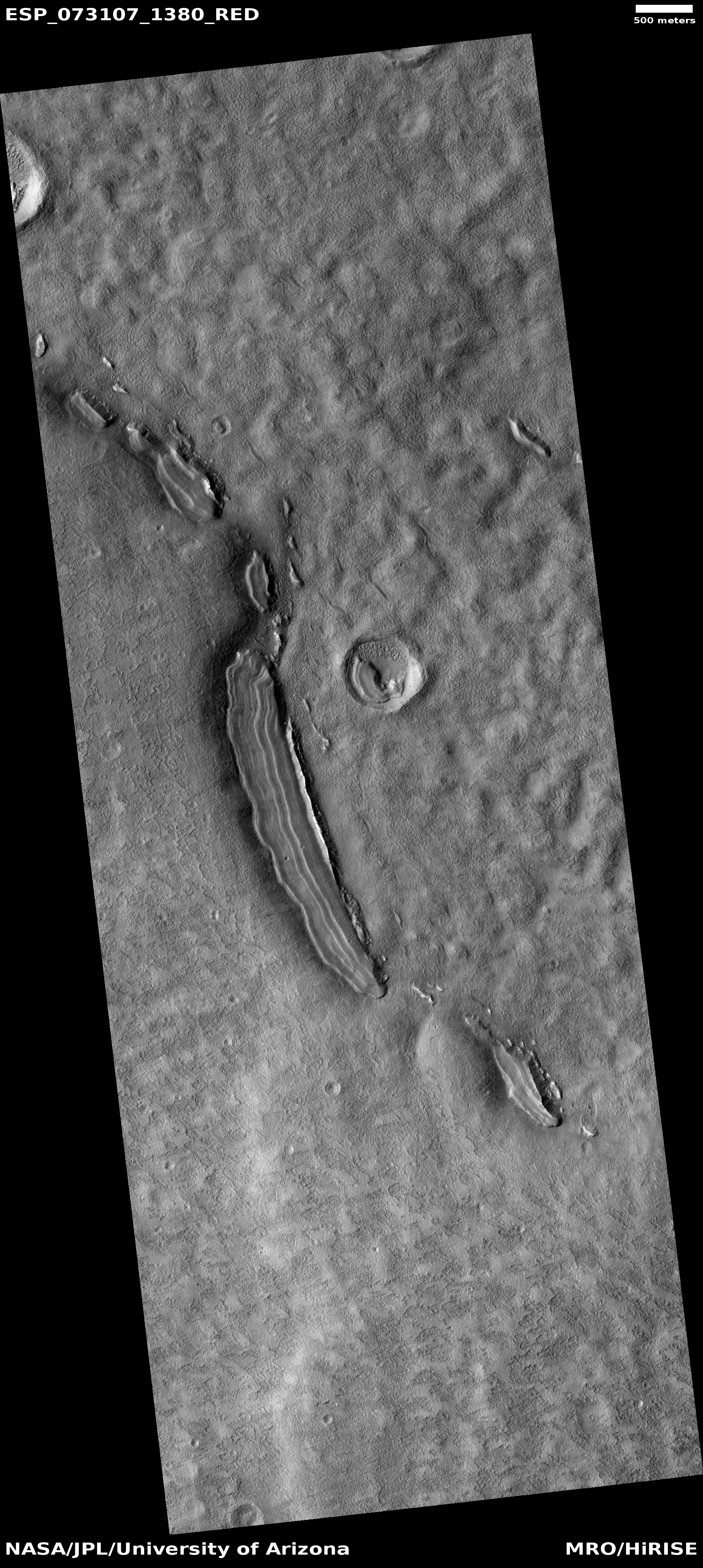
Cool image time! The photo to the right, cropped and reduced to post here, was taken on July 20, 2022 by the high resolution camera on Mars Reconnaissance Orbiter (MRO). It shows what the scientists have labeled a “Splitting Slope Streak” on a mound/hill near the equator and located almost midpoint between the giant volcano Olympus Mons about 2,000 miles to the east and the almost as big volcano Elysium Mons about 2,500 miles to the west. The white cross on the overview map above marks this location, north of the Medusae Fossae volcanic ash deposit.
The slope streak in question is the biggest and darkest at about 7 o’clock. Slope streaks are a feature unique to Mars that remain as yet unexplained. They are not ordinary avalanches, despite their appearance. They seem to have no effect on the topography, and thus are more a stain on the surface. Moreover, some are bright, some dark, and all happen randomly and fade with time. Some think they may be brine-related, while others link them to dust. No theory explains them completely.
What makes this slope streak interesting is that it is relatively new. Compare it with the picture taken in 2016 below.
» Read more

School board president Roxanne McDonald,
thinking she is in charge.
Bring a gun to a knife fight: A school board meeting in Dearborn, Michigan, had to be shut down when a mostly Muslim crowd of parents (with some Christians as well) became outraged by what appeared to be resistance by the school board to their demand that various books advocating the queer agenda be removed from the public school libraries.
As the meeting progressed, interruptions from the crowd became louder and increasingly frequent, despite calls from board members for decorum and respecting the right of others to speak.
Chants of “vote them out,” broke out when school board president Roxanne McDonald said a three-minute limit per speaker would be strictly enforced. The room was also far over its occupancy limit, and after the crowd ignored multiple orders for people to move into two overflow rooms, board members ended the meeting prior to the public comment period.
The video below shows the situation leading up to the board shutting down the meeting. Watch it and tell me if you do not think board president Roxanne McDonald is a self-righteous petty dictator who has utter contempt for the parents who are there.
» Read more
The catalog of known near Earth asteroids that have been identified using a number of survey telescopes in space and on the Earth now totals 30,039. As defined at the link:
An asteroid is called a near-Earth asteroid (NEA) when its trajectory brings it within 1.3 Astronomical Units (au) of the Sun. 1 au is the distance between the Sun and Earth, and so NEAs can come within at least 0.3 au, 45 million km, of our planet’s orbit.
Currently, near-Earth asteroids make up about a third of the roughly one million asteroids discovered so far in the Solar System. Most of them reside in the asteroid belt between Jupiter and Mars.
NEAs are also called NEOs (Near Earth Objects). The chart above, produced by the Center for NEO Studies which tracks these objects, shows the number of NEAs discovered over time.
Of the 30,039 now known, about 1,400 have orbits with “a non-zero” chance of hitting the Earth. None however will do so in the next hundred years at least.
Though the pace of discovery is vastly improving — as indicated by the steep rise in the curve in the graph — only when that curve begins to flatten out will we know that we are getting close to having a more-or-less complete survey of these objects.