
February 24, 2023 Zimmerman/Batchelor podcast
Embedded below the fold in two parts.
To listen to all of John Batchelor’s podcasts, go here.
» Read more
Embedded below the fold in two parts.
To listen to all of John Batchelor’s podcasts, go here.
» Read more
An evening pause: Seems appropriate to usher in the weekend. From the Johnny Carson Show, 1976.
Hat tip Gene Shipp.
Courtesy of BtB’s stringer Jay.
Such a hub can only be the precursor to many more modules and expansion.
While these pseudo-companies remain owned and supervised by the government, they and their employees do not necessarily have full top secret clearance. Building a separate launchpad keeps them quarantined away from things the Chicoms would rather keep secret.
The capsule is unpressurized, but has “many systems in place.” It will allow ISRO to test the launch abort systems to be used during the later manned Gaganyaan mission. Two abort tests are planned for later this year.
The program described at the link calls for an Earth observation satellite to be launched in 2027, followed by the Moon probe in ’27. Later Earth satellites will launch in ’29 and ’30, with an undescribed deep space mission targeting ’31.
Today’s blacklist column is a follow-up of an earlier column from August 2022, when I provided a detailed list of the various legal non-profit firms that now take on cases to defend the blacklisted. The number of such firms has grown, and I decided it was time to provide a new more complete list.
These non-profit law firms are all dedicated to fighting the left’s shameless effort to illegally and immorally blacklist, blackball, censor, and destroy its opposition, and have been increasingly successfully in winning their cases. The list, though obviously not all inclusive, describes what appear to be the most active and successful non-profit law firms presently winning first amendment cases nationwide. (Note too that the ACLU is not on the list, as that organization a long time ago abandoned its foundational goal of protecting free speech and has instead become an agent acting to increase the left’s power over ordinary citizens.)
In choosing among these law firms, make sure you review their entire website and the many cases they are handling. Some firms might be less appropriate for your situation, and it is necessary on your part to do the due diligence to figure this out.
» Read more

Click for original image.
Cool image time! The picture to the right, cropped, reduced, and sharpened to post here, was taken on November 29, 2022 by the high resolution camera on Mars Reconnaissance Orbiter (MRO). It shows what the scientists label “curved ridges.”
These might be inverted channels, the beds on which either water or ice flowed, compacting it down so that it became very resistant to erosion, and thus remains when the surrounding terrain was worn away. However, none of them seem to follow any grade. A more likely explanation is that these are ancient moraines, the debris pile pushed ahead of a glacier and then left behind when the glacier goes away.
The location is the reason I favor this explanation.
» Read more
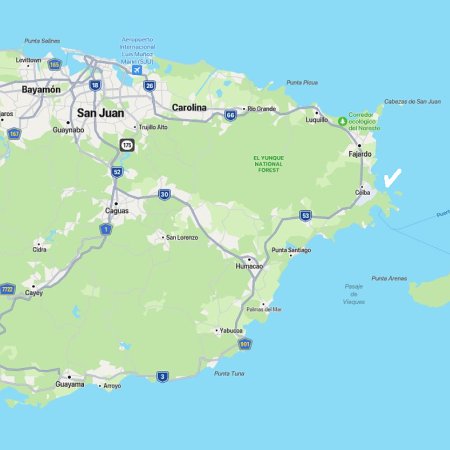
The arrow points to the city of Ceiba
Puerto Rico’s Ports Authority has now issued a call for proposals from potential operators of the spaceport the authority wishes built at an airport in the town of Ceiba on the island’s eastern tip.
The developer — which would operate the Spaceport for several years, depending on the negotiation — would design and build the infrastructure needed for horizontal launches at JAT, using private capital, equity and investment.
…“Vertical launches in Puerto Rico are challenging, considering the population density, among others. However, we want to do a feasibility study for vertical launches in Puerto Rico, with an emphasis on the use of barges and launches in high seas,” the agency stated in the RFP.
Note that the first goal would be to make the airport usable for rocket companies that use an airplane for their first stage, such as Virgin Orbit and Northrop Grumman. The next step would be figure out where a vertical launchpad could be safely and practically established.
Researchers in Japan, Europe, and the U.S. have now identified many carbon-based molecules in the Ryugu samples brought back to Earth by Japan’s Hayabusa-2 asteroid probe. From their paper, published in Science yesterday:
We identified numerous organic molecules in the Ryugu samples. Mass spectroscopy detected hundreds of thousands of ion signals, which we assigned to ~20,000 elementary compositions consisting of carbon, hydrogen, nitrogen, oxygen, and/or sulfur. Fifteen amino acids, including glycine, alanine, and α-aminobutyric acid, were identified. These were present as racemic mixtures (equal right- and left-handed abundances), consistent with an abiotic origin. Aliphatic amines (such as methylamine) and carboxylic acids (such as acetic acid) were also detected, likely retained on Ryugu as organic salts.
The presence of aromatic hydrocarbons, including alkylbenzenes, fluoranthene, and pyrene, implies hydrothermal processing on Ryugu’s parent body and/or presolar synthesis in the interstellar medium. Nitrogen-containing heterocyclic compounds were identified as their alkylated homologs, which could have been synthesized from simple aldehydes and ammonia. In situ analysis of a grain surface showed heterogeneous spatial distribution of alkylated homologs of nitrogen- and/or oxygen-containing compounds.
The large number of carbon-based molecules is not unlike data from similar carbonaceous chondrite meteorites, though the differences appear to suggest Ryugu experienced chemical processes in connection with water during its lifetime.
Note for clarity: Organic molecules are not life. This is a term scientists use for any carbon-based molecule.

The Aine corona on Venus, about 124 miles in diameter.
Click for original image.
Using archival data from the Magellan radar imaging Venus orbiter from the early 1990s, scientists think they have identified the regions Venus that are most likely to have active volcanoes, places that have a unique Venusian circular feature called coronae.
The researchers focused on 65 previously unstudied coronae that are up to a few hundred miles across. To calculate the thickness of the lithosphere surrounding them, they measured the depth of the trenches and ridges around each corona. What they found is that ridges are spaced more closely together in areas where the lithosphere is more flexible, or elastic. By applying a computer model of how an elastic lithosphere bends, they determined that, on average, the lithosphere around each corona is about 7 miles (11 kilometers) thick – much thinner than previous studies suggest. These regions have an estimated heat flow that is greater than Earth’s average, suggesting that coronae are geologically active.
Thus, more volcanic activity, releasing the planet’s interior heat outward.
This research confirms other work done looking at coronae back in 2020.
According to ULA’s CEO, the company has now scheduled the first launch of its Vulcan rocket for May 4, 2023, a delay of about a month from the previous schedule.
The delay to the new date was caused by a variety of factors. First, the launch window for the prime payload, Astrobotic’s Peregrine lunar lander, is only open certain days of the month. Second, that lander is just finishing final testing, and the extra time was needed to get it to Cape Canaveral and stacked on the rocket. Third, the extra time was needed to complete all the dress rehearsal countdown tests prior to launch. However, the biggest reason for the delay appears to have been one of Blue Origin’s BE-4 rocket engines.
ULA and Blue Origin are finishing the formal qualification of the BE-4 engine, which Bruno described as the “pacing item” for the launch. “It’s taking a little bit longer than anticipated.”
He revealed that, in a qualification test of one of two engines, the liquid oxygen pump had about 5% higher performance than expected or seen on other engines. “When the performance of your hardware has even a small shift that you didn’t expect, sometimes that is telling us that there could be something else going on in the system that is potentially of greater concern.”
ULA and Blue Origin decided to take the engine off the test stand and disassemble it. Engineers concluded that the higher performance was just “unit-to-unit variation” and not a problem with the engine itself, Bruno said.
If Blue Origin was manufacturing and testing these engines as it needs to do, in large numbers, it would have known a long time ago the range of “unit-to-unit variation” in performance. That this is not known at this late time once again tells us that the company is still struggling to build these engines routinely. Yet it will soon need to produce plenty in short order in order to sustain not only ULA’s Vulcan launch schedule but the launch schedule of its own New Glenn rocket.
From one of its interior spaceports China today successfully launched a classified “remote sensing” satellite using its Long March 2C rocket.
No information about the payload was released by China, not even a satellite name. Nor was there any word on whether the expendable first stage landed near habitable areas.
The 2023 launch race:
12 SpaceX
7 China
3 Russia
1 Rocket Lab
1 Japan
1 India
American private enterprise still leads China 13 to 7 in the national rankings, and the entire world combined 13 to 12. SpaceX on its own is now tied with the entire world 12 to 12.

Click for interactive map.
On February 22, 2023, the Mars helicopter Ingenuity completed its 45th flight on Mars, flying 1,627 feet in 2 minutes and 24 seconds. This was 13 feet farther than planned, and 5 seconds longer, the extra distance likely because the helicopter needed to find a good landing spot.
The green dot on the map to the right indicates Ingenuity’s new position. The blue dot marks Perseverance’s position. The rover has been moving fast, quickly climbing up onto the delta behind Ingenuity only days after it has completed each recent flight. It appears the Perseverance science team wishes to reach the top of the delta as fast as possible, where it can then begin drilling for more core samples.
It is becoming increasing clear the limitations of Perseverance. It was designed to obtain these core samples for return to Earth, but in the process many of the geological tools and sensors that Curiosity carries were eliminated. The result is the Perseverance can’t actually find out as much about the geology in Jezero Crater as Curiosity can. This doesn’t mean it can’t do any geological work, because it certainly can, but all of the analysis of drill samples that Curiosity does is beyond Perservance’s capabilities. It basically can only do contact science and close inspection. The analysis of its drilled samples must wait until the samples are returned to Earth, about a decade from now.
An evening pause: Performed live 1996.
Hat tip Tom Biggar.
The Russians today successfully launched an unmanned Soyuz capsule to ISS to replace the capsule damaged by a coolant leak in December.
The new capsule will dock to ISS in two days, on February 25th. Then on February 27th a Falcon 9 rocket will launch four astronauts on its Endurance reusable Dragon capsule. The damaged Soyuz capsule will be de-orbited shortly thereafter.
Because of the new Soyuz was intended to remain in orbit with its crew until September, Roscosmos and NASA agreed to keep the crew from the damaged Soyuz on ISS until then, making the mission of these two Russians and American Frank Rubio about a year long. There is a chance Rubio could set a new record for the longest American mission, depending on the exact day his mission returns.
The 2023 launch race:
12 SpaceX
6 China
3 Russia
1 Rocket Lab
1 Japan
1 India
American private enterprise still leads China 13 to 6 in the national rankings, and the entire world combined 13 to 11. SpaceX alone still leads the entire world 12 to 11.
Courtesy of BtB’s stringer Jay.
Mostly fantasy. The company claims to have a fleet of seven F-104s, but no second stage rocket yet, nor any date for when it will be ready. According to this slideshow [pdf] designed to garner investors, it will be based on hypersonic technology.
The only comparison that really matters is that the former is about to fly for the first time, while the latter remains in an never-ending state of limbo.
The company for pr purposes is making believe there is a competition between Wallops and its New Zealand launchsite as to who will launch first. Both are preparing to launch when ready — which is all the crews really care about, if the company is focused on the right things.
The link takes you to Relativity’s live stream, set to go live in 12 days. As the first test launch, the possibility of failure is high, which makes the company’s willingness to live stream it quite courageous.
Though this mission has been delayed endlessly, and Russia has also been forced to delay its later planned unmanned lunar probes due to its lack of certain components formerly obtained from the west before its invasion of the Ukraine, I now expect this launch to happen on that date or reasonable close to it.

They’re coming for you next: Rookie cop Jacob Kersey was forced to resign from his new job on the Port Wentworth, Georgia, police force when his superiors demanded he no longer express his own personal Christian beliefs on his own private Facebook account.
The screen capture to the right was the Facebook post by Kersey that instigated his problems. On January 3rd, the day after he posted it, his supervisor ordered him to take the post down. The situation then devolved as follows, as described in the letter [pdf] sent to the City of Port Wentworth by Kersey’s legal representative, First Liberty:
» Read more

Click for original image.
Cool image time! The picture to the right, rotated, cropped, reduced, and sharpened to post here, was taken on January 1, 2023 by the high resolution camera on Mars Reconnaissance Orbiter to fill a gap in its shooting schedule so that the scientists could maintain the camera at its proper temperature.
In other words, the picture was not taken as part of any particular research project. Its target was in a sense chosen almost at random, though the science team always tries to find something of interest in such situations. In this case I think they succeeded, as these soft terraced buttes illustrate well the alien nature of Mars. The ground is barren, with absolutely no evidence of any life, and it appears that the buttes have been softened and eroded by eons of wind action. You can see evidence of this by the handful of dust devil tracks that cross the buttes.
There is more.
» Read more
Using the infrared instrument on the Keck telescope in Hawaii, astronomers have discovered a dwarf binary star system invisible to the human eye, with the tightest orbit ever seen.
The two stars are so close that it takes them less than one Earth day to revolve around each other; each star’s “year” lasts just 17 hours.
The newly discovered system, named LP 413-53AB, is composed of a pair of ultracool dwarfs, a class of very low-mass stars that are so cool that they emit their light primarily in the infrared, making them completely invisible to the human eye. They are nonetheless one of the most common types of stars in the universe.
Previously, astronomers had only detected three short-period ultracool dwarf binary systems, all of which are relatively young — up to 40 million years old. LP 413-53AB is estimated to be billions of years old — similar in age to our Sun — but has an orbital period that is about four times shorter than all the ultracool dwarf binaries discovered so far.
The two stars’ mutual orbit generally places them only about 600,000 miles apart. For comparison, the Moon orbits the Earth at a distance of 240,000 miles.
Link here. The article does a careful review of the previous dress rehearsal countdowns and static fire tests, especially the last which successfully fired 31 of Superheavy’s 33 Raptor-2 engines for 7 seconds, in order to understand what will happen during the countdown on the day the rocket does its first orbital launch, now expected within weeks.
It appears right now that SpaceX is preparing to replace one or both of those failed engines, and do it with Superheavy prototype #7 still mounted to the launchpad. Starship prototype #24 has not yet been stacked on top, but work is presently being done to it nearby to prepare it for launch. For example, workers recently have removed the attachment points used by cranes before the chopsticks existed and put thermal tiles there instead.
Based on the pace of work, SpaceX should be ready to launch by mid-March. All that will prevent this will be the FAA, which still has not approved the launch license.
The uncertainty of science: Astronomers using the Webb Space Telescope have identified six galaxies that are far too massive and evolved to have formed so quickly after the Big Bang.
The research, published today in Nature, could upend our model of the Universe and force a drastic rethink of how the first galaxies formed after the Big Bang. “We’ve never observed galaxies of this colossal size, this early on after the Big Bang,” says lead researcher Associate Professor Ivo Labbé from Swinburne University of Technology.
“The six galaxies we found are more than 12 billion years old, only 500 to 700 million years after the Big Bang, reaching sizes up to 100 billion times the mass of our sun. This is too big to even exist within current models.
You can read the paper here [pdf]. The “current models” Labbé is referring to are all the present theories and data that say the Big Bang occurred 13.7 billion years ago. These galaxies, however, found less than a billion years after that event, would have needed 12 billion years to have accumulated their mass.
If confirmed, these galaxies essentially tell us that the Big Bang is wrong, or very very VERY incomplete, and that all the data found that dates its occurrence 13.7 billion years ago, based on the Hubble constant, must be reanalyzed.
It is also possible these galaxies are actually not galaxies, but a new kind of supermassive black hole able to form very quickly. Expect many scientists who are heavily invested in the Big Bang to push for this explanation. It might be true, but their biases are true also, which means that Webb is presenting us with new data that calls for strong skepticism of all conclusions, across the board.
The Mars orbiter MAVEN has had to shut down its inertial measurement unit (IMU), used to tell the spacecraft its orientation in space and pointing direction, after it experienced a problem and caused the spacecraft to enter safe mode temporarily.
The IMU had been powered up in preparation for a minor maneuver targeted to reduce eclipse durations in 2027. On Feb.17, MAVEN exited safe mode and is currently operating in all stellar mode, a mode that does not rely on IMU measurements such that the IMU can be powered off to conserve its lifetime. The maneuver will be waived as the team evaluates the path forward. Relay activities and nominal science operations are scheduled to resume on Feb. 23.
“Relay activities” is NASA’s vague way of describing MAVEN’s job as a communications satellite for the rovers on the surface of Mars. Losing this satellite would hamper those operations somewhat, though there are several other orbiters available to pick up the task, with Mars Odyssey presently tasked to able to handle most communications relays.