Pushback: Non-profit legal firm warns 200 law schools they will be sued if they defy the Supreme Court’s decision ending all racial quotas

AFL logo
Only one in an army of lawyers willing to
fight for freedom and the Bill of Rights

Bring a gun to a knife fight: One day after the Supreme Court ruled on June 29, 2023 [pdf] that affirmative action was nothing more than outright racial discrimination and that universities must stop using race as a criteria for admitting students or hiring faculty, the non-profit legal firm America’s First Legal (AFL) wasted no time and sent demand letters to the deans of every law school in the United States, numbering 200, warning them to stop these racist policies or it will sue them.

America First Legal’s letter demands that law schools immediately halt these discriminatory and unlawful practices. It further puts the deans of every law school on notice: if they do not stop, America First Legal will bring legal action against them.

The letter to the Harvard University Law School, found here [pdf], is a good sample. In it AFL makes very clear it will immediately take action if this or any other law school develops “an admissions scheme through pretext or proxy to achieve the same discriminatory outcome.”
» Read more

6 comments

Swirls draining into a Martian crater

Swirls draining into a Martian crater
Click for original image.

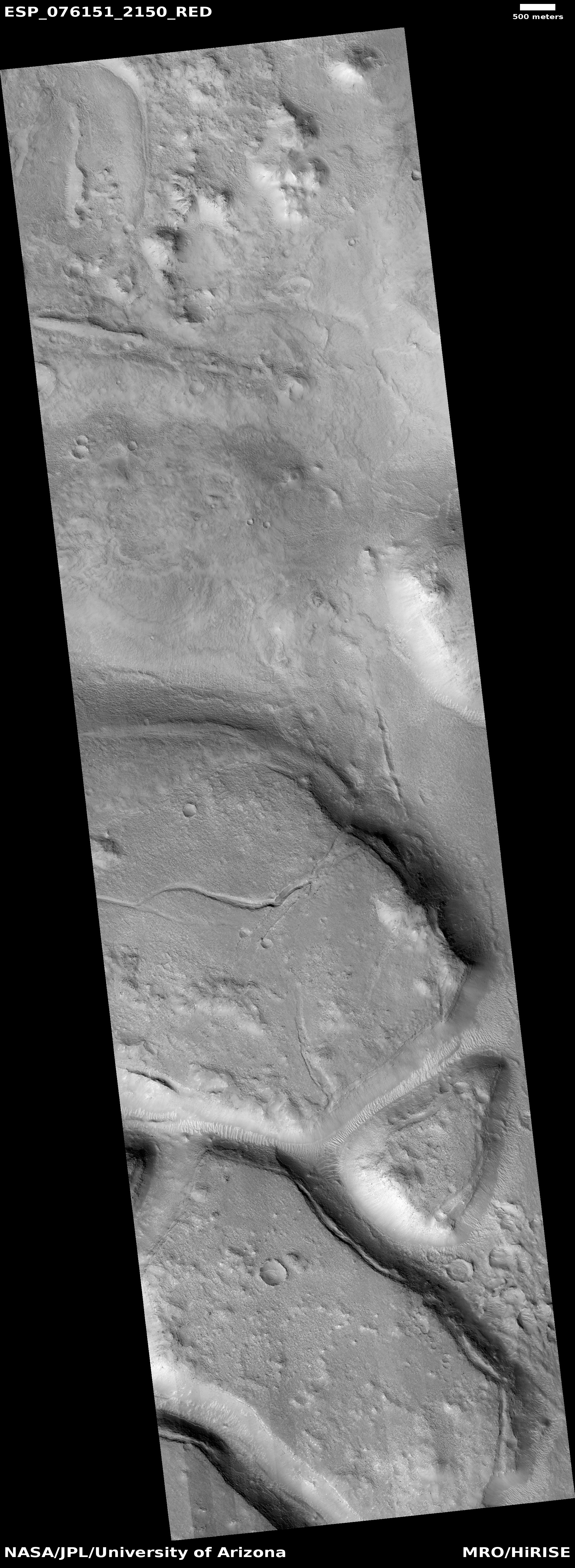
Cool image time! The picture to the right, rotated, cropped, reduced, sharpened, and annotated to post here, was taken on April 8, 2023 by the high resolution camera on Mars Reconnaissance Orbiter (MRO).

The picture shows a terrain of swirls and terraced mesas. Because the shadows are deceptive, I have annotated the picture to show the actual drainage pattern of those swirls, suggesting that whatever material forms these swirls is not only draining about 200-250 feet down into the low point at the picture’s center, the swirls are also draining toward the small 1,000-foot-wide crater in the upper left. That crater however appears to lie on top of the swirls, which means it came after them.

What are the swirls made of?
» Read more

0 comments

Scientists claim discovery of most distant supermassive black hole yet

The overwhelming uncertainty of some science: Using data from the infrared Webb Space Telescope, scientists are now claiming they have discovered most distant supermassive black hole yet, sitting at the center of an active galaxy only about a half billion years after the Big Bang. From the press release:

The galaxy, CEERS 1019, existed just over 570 million years after the big bang, and its black hole is less massive than any other yet identified in the early universe. Not only that, they’ve easily “shaken out” two more black holes that are also on the smaller side, and existed 1 and 1.1 billion years after the big bang. Webb also identified eleven galaxies that existed when the universe was 470 to 675 million years old. The evidence was provided by Webb’s Cosmic Evolution Early Release Science (CEERS) Survey, led by Steven Finkelstein of the University of Texas at Austin. The program combines Webb’s highly detailed near- and mid-infrared images and data known as spectra, all of which were used to make these discoveries.

CEERS 1019 is not only notable for how long ago it existed, but also how relatively little its black hole weighs. This black hole clocks in at about 9 million solar masses, far less than other black holes that also existed in the early universe and were detected by other telescopes. Those behemoths typically contain more than 1 billion times the mass of the Sun – and they are easier to detect because they are much brighter. (They are actively “eating” matter, which lights up as it swirls toward the black hole.) The black hole within CEERS 1019 is more similar to the black hole at the center of our Milky Way galaxy, which is 4.6 million times the mass of the Sun. This black hole is also not as bright as the more massive behemoths previously detected. Though smaller, this black hole existed so much earlier that it is still difficult to explain how it formed so soon after the universe began.

I have great doubts about this research, especially because the press release makes no effort to explain how the black holes were identified. Black holes emit no light, and were only first confirmed by watching the orbits of stars or objects near them over long periods of time. More distant supermassive black holes in the center of galaxies were later guessed at by what appears to be the relationship between the size of a galaxy’s nucleus and the presence of a black hole. Astronomers also assume that a very active and energetic galaxy (such as a quasar) is a sign a supermassive black hole exists at the center.

These primitive galaxies have only been observed at most a handful of times. They are so distant that they only are at most a few pixels wide. Spectra from these objects can tell us roughly how far away they are, and thus how close to the Big Bang they are thought to be, but it is impossible to say with any certainty that there is a black hole there.

I am made even more skeptical by this press release claim: “Webb’s data are practically overflowing with precise information that makes these confirmations so easy to pull out of the data.” Such language makes me suspicious that there is an underlying effort to justify Webb’s expense with this release by overstating its capabilities.

The press release provides links to the research. Take a look. I’d be glad if someone could clearly show me why I’m wrong to be so doubtful.

5 comments

Duane Eddy – Rebel Rouser

An evening pause: As the first comment on the youtube page notes, “Before there was Duelin’ Banjos, there were Duane Eddy and his great sax player going back and forth.”

Hat tip Dave McCooey.

UPDATE: The first version I had embedded was removed by Youtube between the time I scheduled it and tonight. The version below is just as good.

1 comment

July 5, 2023 Quick space links

Courtesy of BtB’s stringer Jay, who trolls Twitter so I don’t have to. For the past few days Twitter links were unavailable to anyone who did not register there. I won’t link to such sites, so we held off doing the daily quick links. It seems that Twitter has reopened access to everyone, though Jay indicates there might still be some issues. If you have difficulty accessing any one of these links, please comment below.


2 comments

Europe’s Ariane-5 rocket completes its last launch

The Ariane-5 rocket today successfully completed its final launch, lifting off from French Guiana and placing two communications satellites into orbit.

At the moment Europe has no capability of putting anything into orbit. Ariane-5 is retired. Ariane-6, its replacement, is far behind schedule will probably not make its first test flight until next year. The Vega-C rocket is grounded because of a launch failure in December 2022.

This was only the second launch for Europe in 2023, so the the leader board in the 2023 launch race remains the same:

44 SpaceX
24 China
9 Russia
5 Rocket Lab

In successful launches, American private enterprise still leads China 50 to 24 in the national rankings, while SpaceX by itself leads the entire world combined, excluding American companies, 44 to 42.

6 comments

Pushback: Federal judge confirms and shuts down censorship campaign of Biden administration

The Bill of Rights, cancelled
Cancelled by the Democratic Party led by Joe Biden

Blacklists are back and the Democrats have got “em: On July 4th (an appropriate date), Terry Doughty, chief U.S. district judge of the United States District Court for the Western District of Louisiana, ruled that the evidence clearly showed that the Biden administration, in league with most big social media companies, had been running an aggressive censorship operation against conservatives for the past two-plus years, and issued an injunction banning “numerous top Biden administration officials and agencies from communicating and meeting with social media companies.”

You can read Doughty’s ruling here [pdf]. I strongly urge you to do so, as he is harshly blunt about the ugly actions of the Democrats running the federal government since 2021. His introduction sets the tone, beginning with this quote, “I may disapprove of what you say, but I would defend to the death your right to say it,” and then getting more blunt from there:

This case is about the Free Speech Clause in the First Amendment to the United States Constitution. The explosion of social-media platforms has resulted in unique free speech issues—this is especially true in light of the COVID-19 pandemic. If the allegations made by Plaintiffs are true, the present case arguably involves the most massive attack against free speech in United States’ history. In their attempts to suppress alleged disinformation, the Federal Government, and particularly the Defendants named here, are alleged to have blatantly ignored the First Amendment’s right to free speech. [emphasis mine]

In his detailed review of the history, he begins by listing the number of examples of this attack against free speech by the Biden administration:
» Read more

6 comments

Alien Mars

Alien Mars
Click for original image.

Today’s cool image illustrates again the alien geology of Mars, often disguised as geological features that at first glance seem familiar. The picture to the right, cropped and reduced to post here, was taken on April 9, 2023 by the high resolution camera on Mars Reconnaissance Orbiter (MRO). Its most distinct feature, the mile-wide double crater in the center bottom, at first appears typical of such craters found on the Moon and elsewhere, suggesting that the bolide that caused it broke in two as it cut through the Martian atmosphere.

This double crater however is not like lunar double craters, in that the shape of both craters is deformed, and the deformation is not quite the same in each. Moreover, the crater does not appear to have an upraised rim or to have thrown out any obvious ejecta. Instead, the two objects hit what looks like soft ground, such as when you drop a pebble into snow.

There’s more.
» Read more

0 comments

Curiosity’s most damaged wheel appears to be surviving the rough terrain on Mount Sharp

Curiosity's middle left wheel, from November 2022 to July 2023
For original images go here and here.

In today’s download of images from Curiosity was a set of pictures taken by its Mars Hand Lens Imager (MAHLI) of the rover’s wheels, as part of the science team’s routine inspection procedures after every 500 meters of travel.

The picture to the right shows what I think is the rover’s left middle wheel, its most heavily damaged, comparing what that wheel looks like now versus what it looked like in November 2022. At that time five of the wheel’s zig-zag grouser treads were broken, three of which are visible in both pictures. The numbers indicate identical wheel treads.

As you can see, after more than seven months of travel across some of the roughest and rockiest ground so far seen on Mars, no more grousers have broken in the new picture. The plus (“+”) signs indicate places where I think some additional metal between the grousers appears to have broken away, but even here the additional damage appears minimal.

Based on past wheel inspections, I expect more images will be taken in the next day or so. We shall see if those pictures indicate any further damage elsewhere. Based on this new picture, however, it appears that the care the science team takes in picking Curiosity’s route, as well as its software (designed to avoid the worst terrain), is continuing to preserve the wheels from further significant damage.

2 comments

Scientists: Quasar data shows time running five times slower in the early universe

The uncertainty of science: According to new research using data from almost 200 quasars collected over the two decades, scientists now believe they have detected the difference between the rate of time now and as we see it in the early universe.

“Looking back to a time when the universe was just over a billion years old, we see time appearing to flow five times slower,” said lead author of the study, Professor Geraint Lewis from the School of Physics and Sydney Institute for Astronomy at the University of Sydney. “If you were there, in this infant universe, one second would seem like one second – but from our position, more than 12 billion years into the future, that early time appears to drag.”

…Professor Lewis worked with astro-statistician Dr Brewer to examine details of 190 quasars observed over two decades. Combining the observations taken at different colours (or wavelengths) – green light, red light and into the infrared – they were able to standardise the ‘ticking’ of each quasar. Through the application of Bayesian analysis, they found the expansion of the universe imprinted on each quasar’s ticking.

“With these exquisite data, we were able to chart the tick of the quasar clocks, revealing the influence of expanding space,” Professor Lewis said.

These results further confirm Einstein’s picture of an expanding universe but contrast earlier studies that had failed to identify the time dilation of distant quasars. [emphasis mine]

I have highlighted the word “exquisite” because it is a favorite buzzword of scientists when they are trying to oversell conclusions that carry many uncertainties. As good as this data might be, it is still incredibly sparse, and the interpretation of it requires many assumptions.

Nonetheless, these results are likely correct, in some manner, because they match well with Einstein’s predictions. It is also most likely that there are many errors and incorrect aspects to those results that the scientists do not yet understand. Above all, confirmation bias remains a concern.

3 comments

South Korea: North Korean spy satellite of “no military utility”

Having completed its salvage operations to recover rocket and satellite remains from North Korea’s failed launch on May 31st, the South Korean military today revealed that the satellite had “no military utility as a reconnaissance satellite.”

As expected, it also provided few details to back up that claim:

The JCS [South Korea’s joint chiefs of staff] did not detail the findings through the allies’ analysis of the wreckage nor did it disclose any photos of the retrieved part of the satellite. Last month, a Seoul official struck a cautious note, insinuating that disclosing all the information the military gleaned from the salvage operation would rather benefit the North Korean military.

It is likely true that the North Korea satellite was of limited value, but it is also true that secrecy and disinformation works to the advantage of South Korea’s military. We therefore would be wise to remain skeptical about any of its claims, one way or the other.

1 comment
1 97 98 99 100 101 196