China launches four more weather satellites

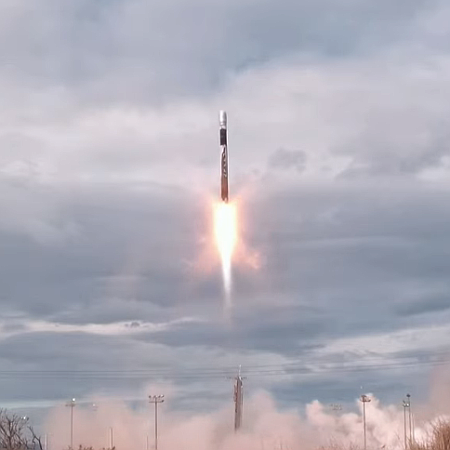
Continuing its annual rush of launches at year’s end, China today used its solid-fueled Kuaizhou-1A rocket to place four weather satellites into orbit, lifting off from its Jiuquan spaceport in the northwest of China. This was the second launch of this rocket with four weather satellites in less than three days.

No word on where the rocket’s lower stages crashed in China, or whether they landed on anyone’s home, as did the core stage of yesterday’s Long March 3B rocket.

The leaders in the 2023 launch race:

94 SpaceX
65 China
19 Russia
8 Rocket Lab
7 India

American private enterprise still leads China in successful launches 108 to 65, and the entire world combined 108 to 102. SpaceX in turn trails the rest of the world (excluding other American companies) 94 to 102.

Hat tip to Jay, as I had missed this because I had mistakenly first thought it was the Kuaizhou-1A launch from two days ago, not a second launch.

3 comments

Isolated mesa on Mars

An Isolated mesa on Mars
Click for original image.

Cool image time! The picture to the right, cropped, reduced, and sharpened to post here, was taken on August 13, 2023 by the high resolution camera on Mars Reconnaissance Orbiter (MRO).

The central butte is about 100 feet high. Not only are its flanks terraced, suggesting sedimentary layers, note the many black dots on its northern slopes. Those dots appear to be many boulders that appear to have rolled down the slopes to settle mostly near the mesa’s base.

The boxwork ridges to the west and south suggest the ground was fractured in some event to produce cracks, which were later filled with material that was erosion resistent. As the terrain was worn away by wind it left these ridges behind.

The prevailing winds in this region are believed to blow mostly to the south, which might explain the parallel ridges south of the mesa. Or not. On this I am guessing entirely.
» Read more

0 comments

Update on Ingenuity

Overview mapClick for interactive map.

The overview map above shows the travels of both the rover Perseverance and the helicopter Ingenuity on Mars through today, with the blue dot marking Perseverance’s present location and the green dot Ingenuity’s. Because of image downloads today from Perseverance — including a few more pictures taken by the helicopter during several of its recent flights — the helicopter’s engineering team has finally been able to add the flight paths for flights #68, #69, and #70 to this map, as well as provide more accurate information about what each accomplished..

Flight #68, which took place on December 15, 2023, a few days later than originally planned, as I reported on December 20, 2023 when the first preliminary data arrived. At the time it appeared the flight had ended prematurely by almost 1,500 feet. We now know the flight did end early, but by not that much. Instead of flying, as per its flightplan, to the northeast 2,716 feet for 147 seconds and then returning to its take-off point, it flew out and back 2,304 feet for 131 seconds. The engineering team has not explained why it turned around prematurely by about 200 feet.

Flight #69 on December 20, 2023 was supposed fly 2,304 feet total over 131 seconds, also going out and back, traveling to the east-northeast. It ended up flying 2,315 feet over 135 seconds on a flight path that was almost identical to flight #68. Like most previous flights, it appears it hovered over its landing spot for a few extra seconds before descending in order to make sure it would land safely.

The final numbers for flight #70 have not yet been added to the flight log, but the engineering team has apparently been able to figure out the path the helicopter took and where it landed from the images that have been downloaded in the past few days. The flight plan had called for a relatively short flight, 849 feet long, but taking almost as long as the previous two, 129 seconds, thus allowing Ingenuity to get better and more detailed scouting pictures of the terrain below it for scientists to review.

One more detail: It appears that the Perseverance science team has decided to use Ingenuity data to guide its route. Rather than follow the planned course, as indicated by the red dotted line, the rover has been following the ground scouted by Ingenuity on its 63rd flight on October 19, 2023. This has taken Perseverance deeper into the rough fractured terrain to the south, where it likely can obtain better geological data.

It also suggests that Ingenuity’s more recent flight paths are giving us a hint as to Perseverance’s future travels.

0 comments

Russia launches military satellite

Russia today successfully placed a classified military satellite into orbit, its Soyuz-2 rocket lifting off from its Plesetsk spaceport in the north of Russia.

No other information was released, including where the rocket’s strap-on boosters and core stage crashed inside Russia.

The leaders in the 2023 launch race:

94 SpaceX
64 China
19 Russia
8 Rocket Lab
7 India

American private enterprise still leads China in successful launches 108 to 64, and the entire world combined 108 to 101. SpaceX in turn trails the rest of the world (excluding other American companies) 94 to 101.

0 comments

December 26, 2023 Quick space links

Courtesy of BtB’s stringer Jay.


2 comments

Record-setting Falcon 9 1st stage booster lost after landing

The SpaceX Falcon 9 first stage booster that launched on December 23, 2023 for a record-setting nineteenth time was damaged beyond repair when, after landing on its drone ship successfully, experienced rough seas that caused it to fall over.

The picture at the link shows the crushed booster on its side on the drone ship. SpaceX noted the spectacular history of this booster in a separate tweet:

This one reusable rocket booster alone launched to orbit 2 astronauts and more than 860 satellites — totaling 260+ metric tons — in ~3.5 years.

In a sense, it actually put more mass into orbit that a Saturn 5 rocket, for significant less money though over a much longer period of time.

For SpaceX the loss of this booster is hardly a set back, because it has several other boosters with only a few less total launches in its fleet. Expect one to exceed twenty launches in the near future.

Hat tip to out stringer Jay as well as several readers.

6 comments

The violent animals on the left who support Hamas

Hamas protesters threaten blind children

I am in no mood this day to be polite or diplomatic. The ugliness exhibited in the past week by pro-Hamas demonstrators — using the violent techniques of Antifa and BLM and copying Nazi storm-trooper tactics — deserve no politeness. They are no longer acting like civilized rational human beings, but mere animals eager to kill and only held back from that goal by the last few shreds remaining of civilization’s rule of law.

Thus, at this moment they only attack innocent people in ugly ways, not intending to kill but clearly hoping to intimidate and strike fear into the hearts of everyone else. Some examples from the past three days:

The last story in this list is especially egregious. The screen capture above shows two demonstrators on stage. In the video at the link they are screaming and yelling, with the one on the right charging at the children in a threatening manner. Remember, this is a fund-raiser for blind children. Those kids cannot see, so all they know is that someone unexpected has appeared on the stage and is screaming at them, and their helpers are desperately trying to get them to safety.

This behavior illustrates perfectly the hatred and viciousness of all these pro-Hamas demonstrators. » Read more

4 comments

Galaxies galore, near and far

Galaxies galore, and near and far

Cool image for the day after Christmas! The picture to the right, reduced and sharpened to post here, was taken by the Hubble Space Telescope, and shows a cluster of galaxies that all seem near each other. However, as the caption notes,

[W]hilst NGC 1356 [the largest spiral] and LEDA 95415 [close by its left] appear to be so close that they must surely be interacting, the former is about 550 million light-years from Earth and the latter is roughly 840 million light-years away, so there is nearly a whopping 300 million light-year separation between them. That also means that LEDA 95415 is likely nowhere near as [small] as it appears to be.

On the other hand, whilst NGC 1356 and IC 1947 [farthest to the left] seem to be separated by a relative gulf in this image, IC 1947 is only about 500 million light-years from Earth. The angular distance apparent between them in this image only works out to less than four hundred thousand light-years, so they are actually much much closer neighbours in three-dimensional space than NGC 1356 and LEDA 95415!

The two galaxies farthest apart in this image are actually close enough together to interact significantly. Though this picture doesn’t have the resolution to see it, there is likely a stream of stars between the two.

Note also the numerous tiny other galaxies scatterered throughout the picture. In fact, except for three stars (the objects with the north-south-east-west spikes), every object is a galaxy holding stars too numerous to count.

1 comment

China launches two GPS-type satellites

China today successfully placed two more of its BeiDou GPS-type satellites into orbit, its Long March 3B rocket lifting off from its Xichang spaceport in the southwest of China.

This footage shows that the rocket’s core stage crashed near homes in China. No word on where the four strap-on boosters and second stage crashed. All use very toxic hypergolic fuels.

This launch continues China’s annual rush of launches at the end of the year. Since everything is owned and run by the Chinese government, one wonders if this pattern is because of the typical government mentality that requires agencies to rush to spend a lot at the end of each year so as to make sure their budgets are not cut.

The leaders in the 2023 launch race:

94 SpaceX
64 China
18 Russia
8 Rocket Lab
7 India

American private enterprise still leads China in successful launches 108 to 64, and the entire world combined 108 to 100. SpaceX in turn trails the rest of the world (excluding other American companies) 94 to 100.

2 comments

Core stage of China’s Long March 5 launched on December 15th about to hit the Earth

According to the Chinese government, the core stage of Long March 5 that China launched on December 15th will hit the Earth tomorrow, somewhere in the South China Sea.

China warned that remnants of a rocket would hit an area in the South China Sea on Tuesday, following the sixth deployment of its most powerful launch vehicle eleven days ago.

Rocket debris, which generally burns up in the atmosphere on re-entry, is expected to fall off the coast of China’s island province of Hainan between 11:00 a.m. (0300 GMT) and noon (0400 GMT), said the China Maritime Safety Administration.

I have not been able to find out any further information about this rocket body from sources like the Aerospace Corporation that normally track such things. However, that China is predicting a landing spot suggests they have upgraded the engines on the Long March 5’s core stage so that they can be restarted and used to control the stage’s descent over the ocean. If so, this is excellent news, as China has stated that it intends to ramp up launches of this rocket as well as its Long March 5B variation. Prevous launches produced the threat of impacts anywhere on Earth, with one launch in 2020 missing the New York metropolitan area by only a few minutes.

That China wants to bring this down so close to China suggests it also wants to salvage the material.

2 comments

China launches three classified satellites into orbit

China today successfully launched three classified satellites into orbit, its Long March 11 rocket lifting off from a barge off the coast of China in the South China Sea.

No information at all was released about the three satellites, other than they were “experimental.”

The leaders in the 2023 launch race:

94 SpaceX
63 China
18 Russia
8 Rocket Lab
7 India

American private enterprise still leads China in successful launches 108 to 63, and the entire world combined 108 to 99. SpaceX in turn trails the rest of the world (excluding other American companies) 94 to 99.

3 comments
1 2 3 4 5 196